Marketing attribution should tell you exactly which campaigns drive revenue—but for most marketers, it's a frustrating puzzle of missing data, conflicting reports, and guesswork. You're running campaigns across Meta, Google, TikTok, and LinkedIn, yet your ad platforms each claim credit for the same conversions. Your CRM shows different numbers than your analytics dashboard. And with iOS privacy changes and cookie deprecation, tracking gaps keep widening.
The result? Budget decisions based on incomplete data, wasted ad spend on underperforming channels, and an inability to prove marketing's true impact.
This guide walks you through fixing the most common attribution challenges step by step. You'll learn how to diagnose your specific tracking gaps, implement server-side solutions that survive privacy changes, connect your ad data to actual revenue, and build a unified view of your customer journey. Whether you're dealing with cross-device tracking issues, multi-touch attribution confusion, or data discrepancies between platforms, each step provides actionable solutions you can implement immediately.
By the end, you'll have a clear framework for accurate attribution that shows exactly which ads and channels drive leads and revenue.
Step 1: Audit Your Current Tracking Setup and Identify Gaps
Before you can fix attribution problems, you need to know exactly where your tracking breaks down. Start by mapping every touchpoint in your customer journey from the moment someone first clicks your ad to the point they become a paying customer. This means documenting every interaction: ad clicks, landing page visits, form submissions, email opens, demo requests, sales calls, and closed deals.
Next, pull conversion reports from every system you use. Export data from Meta Ads Manager, Google Ads, TikTok Ads, LinkedIn Campaign Manager, Google Analytics, and your CRM. Place these numbers side by side in a spreadsheet. You'll likely discover significant discrepancies immediately—one platform reports 150 conversions while another shows 180 for the same time period.
These gaps reveal where data gets lost. Common culprits include users who browse on mobile but convert on desktop, iOS users whose activity isn't tracked due to App Tracking Transparency restrictions, visitors using ad blockers, and offline conversions that never get connected back to the original ad click. For businesses with sales teams, the gap between marketing qualified leads and closed deals often represents the biggest blind spot. Understanding these attribution challenges in digital marketing is essential before implementing solutions.
Pay special attention to your UTM parameter usage. Pull a sample of your recent campaign URLs and check whether they follow consistent naming conventions. If your team uses "utm_source=facebook" in some campaigns and "utm_source=meta" in others, you're fragmenting your data unnecessarily. Missing UTM parameters mean conversions get attributed to "direct" traffic instead of the actual source.
Document every tracking pixel and tag on your website. Use your browser's developer tools or a tag management audit tool to see which pixels fire on key pages. You might discover that your checkout confirmation page is missing the conversion pixel entirely, or that certain pixels only load after a user accepts cookies.
Create a prioritized list of gaps based on revenue impact. A 30% data loss on your highest-performing channel deserves immediate attention. A minor discrepancy on a test channel can wait. This audit becomes your roadmap for the fixes that follow.
Success indicator: You have a clear spreadsheet showing conversion counts from each platform, identified discrepancies, documented tracking gaps, and a prioritized list of issues to address ranked by potential revenue impact.
Step 2: Implement Server-Side Tracking to Capture Lost Data
Browser-based tracking is failing, and the problem keeps getting worse. Ad blockers now block tracking pixels entirely. iOS users must explicitly opt in to tracking, and most don't. Browsers increasingly restrict third-party cookies. The combined effect means traditional pixel-based tracking often misses significant portions of your actual conversions.
Server-side tracking solves this by sending conversion data directly from your server to ad platforms, bypassing browser limitations entirely. Instead of relying on a JavaScript pixel that might get blocked, your server makes a direct API call to Meta, Google, or other platforms when a conversion happens. This approach captures conversions that browser-based tracking misses.
Start by implementing the Conversions API for Meta and the Enhanced Conversions API for Google Ads. These tools allow you to send conversion events from your server along with hashed customer information like email addresses and phone numbers. The platforms use this data to match conversions back to ad clicks, even when browser tracking fails. A comprehensive attribution marketing tracking guide can help you navigate this implementation process.
The technical implementation varies based on your website platform, but the general process involves setting up a server endpoint that receives conversion events from your website or CRM, then forwards them to ad platform APIs. If you use a tag management system, many now offer server-side container options that handle this routing automatically.
Connect your CRM events to your tracking infrastructure next. When a lead becomes a customer weeks after their initial ad click, that revenue should still get attributed to the original source. Set up webhooks or integrations that send deal closed events from your CRM back through your attribution system. This closes the loop between marketing activity and actual revenue.
Test your implementation thoroughly. Run parallel tracking where both your pixel and server-side implementation fire simultaneously. Compare the conversion counts. You should see your server-side tracking capture more conversions than the pixel alone. Check the event match quality scores in your ad platforms—higher scores indicate better data accuracy and matching.
Monitor your match rates closely. Meta and Google provide quality scores showing what percentage of your server-side events successfully matched to users. If your match rate is below 70%, you're likely missing key customer identifiers or sending poorly formatted data. Improve this by collecting email addresses earlier in the funnel and ensuring your data hashing follows platform specifications exactly.
Success indicator: Your server-side tracking captures significantly more conversions than pixel-based tracking alone, your event match quality scores exceed 70%, and you see reduced discrepancies between platform reports and actual conversions.
Step 3: Unify Cross-Platform Data Into a Single Source of Truth
Relying on individual platform dashboards creates a distorted view of reality. Each platform uses its own attribution window, its own model, and its own definitions. Meta might count a conversion if someone clicked your ad within seven days. Google might claim the same conversion because the user searched your brand name afterward. When you add up platform-reported conversions, the total often exceeds your actual number of customers.
You need a central attribution system that ingests data from all sources and applies consistent logic. This system becomes your single source of truth—the place where deduplicated, accurate conversion data lives. Instead of checking five different dashboards, you analyze performance in one unified view. Effective cross-channel marketing attribution software makes this unification possible.
Start by connecting all your ad platforms to your attribution system. This typically involves API integrations that pull ad spend, clicks, impressions, and platform-reported conversions. Modern attribution platforms can connect to Meta, Google, TikTok, LinkedIn, and dozens of other channels automatically. The goal is capturing every marketing touchpoint in one database.
Integrate your website analytics next. Connect Google Analytics or your analytics platform so you can see on-site behavior alongside ad data. This reveals the full journey: which ad someone clicked, what pages they visited, how long they spent on your site, and whether they converted. Learning how to use GA4 for marketing attribution can significantly enhance your tracking capabilities.
Your CRM integration matters most for revenue attribution. Connect your CRM so every closed deal, its value, and the customer's journey history flow into your attribution system. This allows you to track not just leads, but actual revenue back to specific ads and channels. You finally see which campaigns drive customers, not just clicks. Dedicated marketing attribution platforms for revenue tracking specialize in connecting these data points.
Establish consistent naming conventions across all campaigns immediately. Create a standardized UTM structure and enforce it across your team. Use the same source names, campaign structures, and parameter formats everywhere. This consistency allows your attribution system to properly aggregate data and prevents the fragmentation that makes analysis impossible.
Set up deduplication rules in your attribution system. When the same conversion appears in multiple platforms, your system should count it once and attribute it according to your chosen model. This eliminates the inflation problem where platform totals exceed reality.
Success indicator: You have one dashboard showing all channel performance with deduplicated conversion counts, and the total conversions match your actual customer count. Revenue attribution connects ad spend directly to closed deals.
Step 4: Choose and Apply the Right Attribution Model for Your Business
Attribution models determine how credit gets distributed across the touchpoints in a customer journey. Choose wrong, and you'll systematically undervalue channels that actually drive results. Choose right, and you'll finally understand which marketing activities deserve more budget. Understanding what a marketing attribution model is forms the foundation for making this decision.
First-touch attribution gives all credit to the initial touchpoint. This model makes sense if you're primarily focused on awareness and lead generation. It shows which channels introduce new prospects to your business. The downside? It ignores everything that happens after that first click, potentially undervaluing the nurture campaigns that actually close deals.
Last-touch attribution does the opposite, crediting only the final touchpoint before conversion. This model works well for short sales cycles where the last click truly drives the decision. But for considered purchases, it ignores all the earlier touchpoints that built awareness and consideration. Your brand search campaigns will look amazing while your prospecting campaigns appear worthless.
Linear attribution distributes credit evenly across all touchpoints. If someone clicked your Facebook ad, visited from Google search, and then clicked an email before converting, each touchpoint gets one-third credit. This model acknowledges that multiple channels contribute, but it assumes all contributions are equal—which rarely reflects reality. Exploring linear model marketing attribution software can help you implement this approach effectively.
Time-decay attribution gives more credit to touchpoints closer to conversion. The logic is that recent interactions matter more than older ones. This works well for businesses where momentum and recency drive decisions, but it can undervalue the top-of-funnel channels that started the journey.
Data-driven attribution uses machine learning to assign credit based on actual conversion patterns in your data. It analyzes thousands of customer journeys to determine which touchpoints statistically increase conversion likelihood. This approach often reveals surprising insights about which channels actually influence decisions. Learn more about how machine learning can be used in marketing attribution to leverage this advanced approach.
Match your attribution model to your sales cycle length and complexity. Short, transactional sales cycles with few touchpoints work fine with last-touch attribution. Longer B2B sales cycles with multiple stakeholders and touchpoints demand multi-touch models that reveal which channels initiate deals versus which close them.
Compare your performance across different models before committing. Run reports using first-touch, last-touch, and multi-touch models simultaneously. Notice which channels gain or lose credit under each model. This comparison reveals hidden performers—channels that assist conversions without getting last-click credit. A detailed overview of types of marketing attribution models can guide your selection process.
Pick one model and stick with it for meaningful periods. Constantly switching attribution models makes it impossible to track improvement or compare performance over time. Choose the model that best matches your business reality, then optimize against it consistently for at least a quarter before reconsidering.
Success indicator: You clearly understand which channels initiate customer journeys versus which close them, and your budget allocation reflects the true contribution of each channel rather than just last-click bias.
Step 5: Connect Attribution Data Back to Ad Platforms for Better Optimization
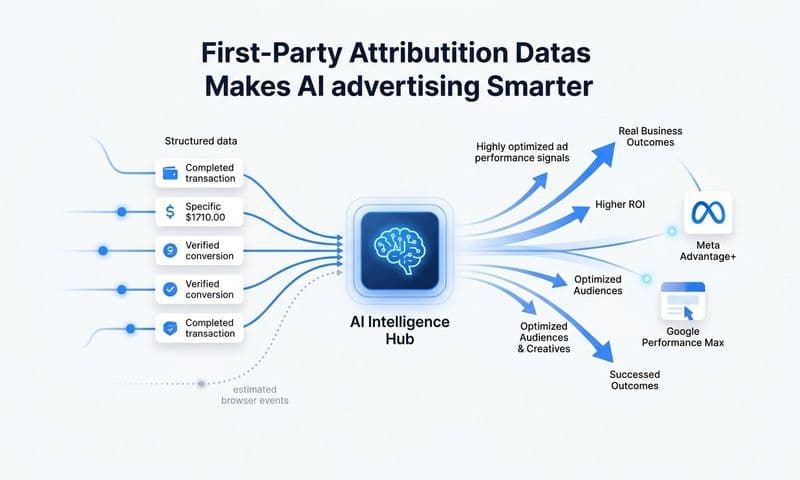
Accurate attribution isn't just about understanding past performance. It's about feeding better data back to ad platforms so their algorithms optimize more effectively. When you send complete, accurate conversion signals to Meta, Google, and other platforms, their machine learning systems can identify better audiences and improve targeting automatically.
Set up conversion sync through Conversions API for Meta and Enhanced Conversions for Google Ads. These tools allow you to send enriched conversion data back to platforms, including conversions that happened offline or that browser-based tracking missed. The platforms use this data to improve their optimization algorithms and find more customers like your converters.
Include conversion values in your event data. Don't just tell Meta that a conversion happened—tell them the deal was worth $5,000. This allows platform algorithms to optimize for revenue rather than just conversion volume. Over time, the system learns to prioritize audiences and placements that drive higher-value customers, not just more leads.
Send post-conversion events for even better optimization. When a lead becomes a customer weeks after their initial conversion, send that event back to the platform. This teaches the algorithm which initial conversions eventually turn into revenue. The platform can then optimize toward leads that are more likely to close, improving your overall conversion rate and customer quality.
Monitor your match rates and event quality scores in each platform. Meta provides an Events Manager showing what percentage of your Conversions API events successfully matched to users. Google shows similar metrics in their conversion tracking interface. Higher match rates mean better data quality and more effective optimization. If your scores are low, review your implementation—you might be missing key identifiers or formatting data incorrectly.
Track your cost per acquisition trends after implementing conversion sync. Many marketers see improved performance as platforms receive better data and optimize more effectively. The algorithms can finally see the complete picture of which audiences convert, leading to more efficient targeting and lower acquisition costs over time. Implementing performance marketing attribution strategies ensures you maximize this optimization loop.
Set up automated syncing so new conversion data flows continuously. Your attribution system should automatically send conversion events to ad platforms as they happen, not through manual exports. This real-time data flow keeps platform algorithms learning and optimizing constantly based on your latest results.
Success indicator: Your ad platforms show improved event match quality scores above 70%, you're tracking conversion values not just counts, and you observe improved ad performance metrics like lower cost per acquisition as platform optimization improves with better data.
Step 6: Validate Your Attribution Accuracy and Iterate
Attribution systems can report impressive numbers while being fundamentally wrong. The only way to know if your attribution actually reflects reality is through ongoing validation against ground truth: your actual revenue.
Run holdout tests to verify attribution accuracy. Pause spending on a channel that your attribution system says drives significant revenue. If that channel truly drives results, you should see a measurable drop in conversions. If nothing changes, your attribution model was giving false credit. This test reveals whether your attribution predicts actual causation or just correlation.
Compare attributed revenue against closed deals in your CRM monthly. Pull your attribution system's report of revenue by channel for the past month. Then pull your CRM's report of actual closed deals and their sources for the same period. These numbers should align within a reasonable variance—typically within 10-15% accounting for attribution model differences and timing delays. Generating a comprehensive marketing attribution report facilitates this comparison process.
Investigate any significant discrepancies immediately. If your attribution system reports $100,000 in revenue from Google Ads but your CRM only shows $60,000 in closed deals from that source, something is wrong. Common causes include duplicate conversion tracking, incorrect revenue values being passed, or attribution logic errors. Dig into individual customer journeys to identify where the mismatch occurs.
Set up automated monitoring alerts for tracking failures. Configure your attribution system to notify you when conversion tracking drops significantly, when data from a major channel stops flowing, or when discrepancies between systems exceed thresholds. Catching tracking breaks quickly prevents weeks of missing data that can't be recovered.
Review your attribution setup quarterly as your business evolves. New marketing channels, website changes, CRM updates, and platform algorithm changes all impact attribution accuracy. Schedule regular audits to ensure your tracking still captures everything correctly and your attribution model still matches your business reality.
Document your attribution methodology clearly for your team. Everyone should understand which model you use, why you chose it, what the numbers actually mean, and what limitations exist. This shared understanding prevents misinterpretation and ensures consistent decision-making based on attribution data.
Success indicator: Your attribution-reported revenue matches CRM actual revenue within 10-15% variance, you catch tracking failures within days through automated monitoring, and your team trusts attribution data enough to make confident budget decisions.
Putting It All Together
Fixing marketing attribution challenges isn't a one-time project—it's an ongoing practice of capturing every touchpoint, unifying your data, and continuously validating accuracy. Start with your audit to identify the biggest gaps, then prioritize server-side tracking to recover lost data from privacy restrictions. Once your data flows into a unified system, you can finally trust your attribution insights to guide budget decisions.
The transformation from broken attribution to accurate insights takes effort, but the payoff is substantial. You'll stop wasting budget on channels that look good in their own dashboards but don't actually drive revenue. You'll discover hidden performers that assist conversions without getting last-click credit. And you'll feed better data back to ad platforms, improving their optimization and lowering your acquisition costs.
Quick Implementation Checklist:
Complete tracking audit and gap analysis
Implement server-side tracking for key conversion events
Connect all ad platforms to central attribution system
Integrate CRM data for full-funnel visibility
Select and apply consistent attribution model
Set up conversion sync to feed data back to ad platforms
Establish monthly validation and monitoring routine
With accurate attribution in place, you'll know exactly which ads and channels drive revenue—and scale your campaigns with confidence. Every marketing decision becomes backed by complete data rather than guesswork. Your team can finally prove marketing's true impact and optimize toward the metrics that actually matter: customers and revenue.
Ready to elevate your marketing game with precision and confidence? Discover how Cometly's AI-driven recommendations can transform your ad strategy—Get your free demo today and start capturing every touchpoint to maximize your conversions.