You're running ads on Meta, Google, TikTok, and maybe a few other platforms. Every morning, you check the dashboards. Meta's crushing it today, but Google's ROAS just tanked. Do you shift budget? How much? By the time you've pulled the data into a spreadsheet and made your decision, the opportunity has already passed.
This is the reality for most marketers managing multi-platform campaigns. You're making budget decisions based on yesterday's data, gut feelings, and whatever platform you happened to check first. Meanwhile, your competitors with automated systems are reallocating spend every few minutes based on real-time performance signals.
Automated budget allocation isn't about replacing marketers with robots. It's about removing the manual bottlenecks that prevent you from responding to performance shifts as they happen. It's the difference between reactive budget management and proactive optimization that captures opportunities before they disappear.
The Manual Budget Problem: Why Spreadsheets Can't Keep Up
Managing ad budgets across multiple platforms manually creates a fundamental timing problem. By the time you've logged into Meta Ads Manager, pulled yesterday's performance data, switched over to Google Ads, exported those metrics, and built a comparison spreadsheet, the market conditions have already changed.
The data lag compounds the challenge. Most platforms show performance metrics with a delay—conversions attributed hours or even days after the initial click. You might pause a campaign thinking it's underperforming, only to discover later that it was actually driving valuable bottom-funnel conversions with a longer attribution window.
Then there's the sheer cognitive load. A marketer running campaigns across four platforms with five campaigns each is juggling twenty different performance streams. Which campaign gets the extra $500 today? Should you pull budget from that Google Search campaign that's been consistent but not spectacular? What about that new TikTok test that's showing promise but limited data?
These decisions require processing dozens of variables simultaneously: current ROAS, trend direction, budget pacing, conversion volume, cost per acquisition, attribution windows, and competitive factors. The human brain simply isn't wired to optimize across that many dimensions in real time.
If you're evaluating software to handle these tasks, our roundup of the best automated ad optimization platforms covers the leading tools and their capabilities.
Manual budget management also introduces emotional decision-making. You might hesitate to cut budget from a campaign you spent weeks building, even when the data clearly shows it's underperforming. Or you might overreact to a single bad day, pausing campaigns that would have recovered with a larger data sample.
The result? Budgets stay locked in suboptimal allocations for days or weeks. High-performing campaigns hit their daily caps by noon and stop spending, while underperformers continue burning budget all day. You're leaving money on the table not because of bad strategy, but because manual processes can't keep pace with real-time marketing budget allocation needs.
How Automated Budget Allocation Actually Works
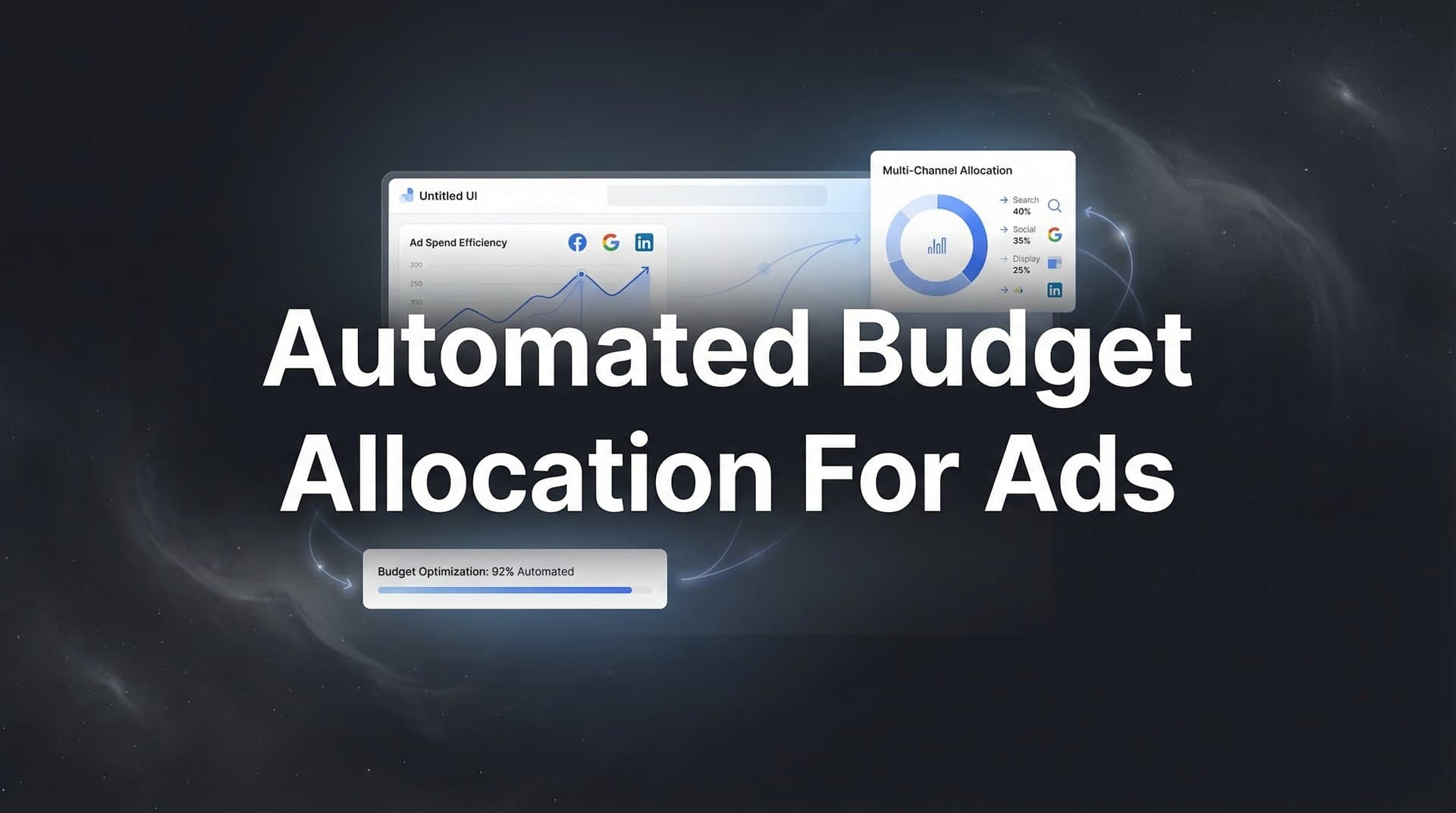
At its core, automated budget allocation is a continuous feedback loop. The system monitors performance signals across all your advertising channels, compares results against your goals, and shifts budget toward the best opportunities—all without requiring manual intervention.
Real-time performance monitoring forms the foundation. Instead of checking dashboards once or twice daily, automation systems pull fresh data every few minutes. They track conversion events, cost metrics, and engagement signals as they happen, building a constantly updating picture of what's working right now.
But raw platform data only tells part of the story. This is where attribution becomes critical. A Meta ad might show a modest ROAS based on platform reporting, but when you layer in attribution modeling for paid ads that tracks the full customer journey, you discover that ad is actually the first touchpoint for your highest-value customers who convert days later through other channels.
Accurate attribution data transforms budget allocation from a surface-level optimization into strategic revenue maximization. Systems that can see the complete customer journey—from initial ad click through CRM events to final purchase—make fundamentally different allocation decisions than systems relying only on last-click attribution.
There's a spectrum of automation sophistication. On the simpler end, rule-based systems execute predetermined logic: if a campaign's ROAS drops below 3.0 for two consecutive days, reduce its budget by 20%. These rules provide basic automation but lack adaptability to changing conditions.
AI-driven allocation represents the more advanced approach. Machine learning for ads analyzes patterns across multiple variables simultaneously—time of day performance, audience segment behavior, creative fatigue signals, competitive intensity, and conversion probability. They identify optimization opportunities that wouldn't be obvious from looking at individual metrics in isolation.
The most effective systems combine internal budget allocation with platform algorithm optimization. They don't just shift your budget between Meta and Google—they also send enriched conversion data back to each platform's algorithm. When Meta's AI receives accurate conversion signals that include CRM data and full customer journey context, it can optimize targeting and bidding more effectively than if it only sees browser-based conversion pixels.
Server-side tracking plays an increasingly important role here. As browser-based tracking becomes less reliable due to privacy changes, server-side conversion tracking provides the accurate data that automation systems need to make smart decisions. You're not optimizing based on incomplete or delayed signals—you're working with the full picture of what's actually driving revenue.
Key Benefits That Change How Teams Operate
The speed advantage of automation fundamentally changes campaign performance. When a campaign starts converting at a higher rate, automated systems can increase its budget within minutes. Manual processes might take hours or days to notice the trend and respond—by which time the opportunity window has often closed.
This speed compounds over time. A system that makes dozens of small optimizations daily, each capturing a 2-5% efficiency gain, creates substantial performance improvements that would be impossible to achieve manually. You're not just faster at making individual decisions—you're making exponentially more optimization decisions than any human team could execute.
Budget efficiency improves because allocation decisions are based on comprehensive data rather than partial visibility. Instead of a marketer checking platforms sequentially and making decisions based on whatever they happened to review first, automated systems evaluate all campaigns simultaneously against the same performance criteria.
The system naturally shifts spend toward high-performers and away from underperformers without the emotional attachment that affects human decision-making. If a campaign you launched yesterday isn't performing, the system reduces its budget immediately rather than giving it "a few more days to see what happens."
Perhaps the most valuable benefit is strategic focus. When your team isn't spending hours each day pulling reports, building comparison spreadsheets, and manually adjusting budgets, they can focus on the work that actually requires human creativity and strategic thinking.
What's the next audience segment to test? How should messaging evolve for different funnel stages? Which creative angles are resonating and deserve expanded production? These strategic questions drive breakthrough performance improvements, but they require dedicated focus that's impossible when you're buried in daily budget management tasks.
Automation also enables testing at scale. You can run more experimental campaigns because the system will automatically reduce budget on tests that don't perform while scaling winners. This creates a continuous optimization cycle where you're always learning what works and doubling down on successful approaches through improving marketing campaign performance.
What You Need Before Implementing Automation
Automated budget allocation is only as intelligent as the data feeding it. If your attribution data is incomplete or inaccurate, automation will optimize toward the wrong signals and actually decrease performance rather than improve it.
Start by ensuring you can track the complete customer journey across all touchpoints. This means connecting your ad platforms, website analytics, CRM, and conversion events into a unified view. If someone clicks a Meta ad, visits your site, leaves, clicks a Google ad three days later, and then converts, your attribution system needs to see that entire sequence through proper customer journey mapping for paid ads.
Many marketers discover attribution gaps only after implementing automation and wondering why budget is being allocated in seemingly counterintuitive ways. The system isn't broken—it's making logical decisions based on incomplete data that doesn't reflect the full customer journey.
Server-side tracking becomes essential here, particularly for e-commerce and lead generation businesses. Browser-based tracking misses conversions due to ad blockers, cookie limitations, and cross-device journeys. Server-side tracking captures conversion events directly from your backend systems, providing the accuracy that automation requires.
Clear KPIs and business goals give automation systems their optimization targets. Are you optimizing for revenue, ROAS, customer acquisition cost, lifetime value, or some combination? The algorithm needs explicit direction about what "good performance" means for your business.
Different campaigns might have different goals. Your prospecting campaigns might optimize toward cost per lead, while retargeting focuses on ROAS. Your automation system should be sophisticated enough to apply the appropriate success metrics to each campaign type rather than using a one-size-fits-all approach.
Integration requirements vary by platform, but you'll typically need API access to your ad platforms for both reading performance data and making budget adjustments. You'll also need your analytics and attribution systems connected so the automation can access the complete performance picture beyond what individual ad platforms report.
Budget availability matters too. Automation works best when there's flexibility to shift spend toward opportunities. If every campaign is locked at a fixed daily budget with no room for reallocation, automation can't do its job. You need some budget elasticity that allows the system to capitalize on high-performing campaigns when they're converting efficiently.
Common Pitfalls and How to Avoid Them
Over-automation is the most common mistake. Some marketers implement automated budget allocation and then completely step away, assuming the system will handle everything. But automation should enhance human strategy, not replace it entirely.
Maintain oversight of major strategic decisions. If your automation system wants to shift 80% of your budget into a single campaign, that deserves human review before execution. The algorithm might be seeing strong short-term performance, but you might know about upcoming creative fatigue or competitive factors that aren't yet reflected in the data.
Set appropriate guardrails from the start. Define minimum and maximum budget levels for each campaign. Establish rules about how quickly budgets can change—maybe no single campaign can increase more than 50% in a single day. These guardrails prevent runaway optimization that might make sense algorithmically but creates operational problems. Following marketing budget allocation best practices helps establish these boundaries effectively.
Attribution gaps create the most insidious problems because they're not immediately obvious. If your attribution system isn't capturing offline conversions, phone calls, or long sales cycles, your automation will systematically underinvest in top-of-funnel campaigns that drive those conversion types.
The solution is comprehensive tracking paid ads performance across every customer touchpoint. If you run campaigns that drive phone calls, make sure those calls are tracked and attributed back to the originating ad. If you have a sales team that closes deals weeks after the initial ad interaction, ensure those conversions feed back into your attribution model.
Another pitfall is optimizing too quickly with insufficient data. An automation system that makes aggressive budget changes based on a handful of conversions will chase statistical noise rather than true performance trends. Build in minimum sample size requirements before the system makes major allocation decisions.
Platform-specific limitations can also create problems. Some ad platforms have minimum daily budgets or require 24-48 hours before budget changes take full effect. Your automation system needs to understand these platform quirks rather than treating all channels identically.
AI Automation Best Practices for Paid Advertising Budget Allocation in 2025
AI-powered budget allocation has matured rapidly. The platforms available in 2025 go far beyond simple if/then rules—they use predictive models and real-time signal processing to move spend toward opportunities before human managers even notice them. But deploying AI automation effectively requires following a clear set of best practices to avoid common pitfalls.
1. Lead With Attribution Accuracy
No AI system can allocate budget intelligently if it’s working with corrupted data. Before enabling any automated reallocation, verify that your attribution modeling for paid ads captures every conversion touchpoint accurately—especially post-iOS and cross-device journeys. Server-side tracking is now table stakes: browser-based pixels routinely miss 20–30% of conversions, which causes AI models to systematically underfund top-performing channels.
2. Set Budget Floors and Ceilings Before You Launch
AI allocation systems can shift spend aggressively when they detect performance signals. Without guardrails, a single high-ROAS day can drive a campaign to consume 90% of your total budget by midday. Define a minimum daily budget (to preserve learning phase data) and a maximum daily budget (to prevent overexposure) for every campaign before turning on automation. Solid marketing budget allocation best practices recommend starting with ±30% variance limits and widening them only after validating system behavior over 30+ days.
3. Choose the Right Automation Tier for Your Spend Level
Not every advertiser needs a fully autonomous AI system. Match the sophistication of your automation to your monthly ad spend:
For a deeper dive into this space, see our autonomous AI advertising platform guide.
- Under $10K/month: Platform-native smart bidding (Google’s Target CPA, Meta’s Advantage+) combined with scheduled rule-based budget adjustments covers most needs.
- $10K–$100K/month: Third-party automation tools that integrate machine learning for ads across channels, with human review of major reallocations.
- $100K+/month: Full AI allocation platforms that ingest server-side attribution data and make intraday rebalancing decisions across channels continuously.
4. Use Real-Time Attribution Signals, Not Delayed Reports
Most ad platforms report conversions with a 24–48 hour lag. AI systems relying on end-of-day reports are effectively making yesterday’s decisions today. The competitive edge goes to advertisers whose automation pipelines consume real-time marketing budget allocation signals—server-side conversion events firing within seconds of a purchase, not platform attribution reports pulling the next morning. Wire your CRM and checkout events directly into your allocation layer for maximum responsiveness.
5. Separate Learning Phase Campaigns From Optimization Targets
AI allocation systems should not treat every campaign equally. A new campaign in its learning phase needs stable spend to collect statistically valid data; pulling its budget based on early signals defeats the purpose. Tag new campaigns explicitly and exclude them from automated reallocation for the first 14–21 days—or until they hit 50+ conversion events. Only then should the system incorporate their performance data into cross-channel allocation decisions.
6. Monitor for Signal Drift and Model Decay
Seasonality, competitive shifts, and creative fatigue can cause the performance signals that your AI model learned from to become stale. Schedule a monthly review of whether automated allocation decisions still align with your strategic priorities. If the system is consistently pushing budget toward channels that no longer reflect your highest-value customer segments, recalibrate the training data or update optimization goals to match current business objectives.
7. Keep Humans in the Strategy Loop
The biggest efficiency gains come from letting AI handle high-frequency tactical decisions while humans focus on strategy. Use your freed-up time for creative roadmapping, audience expansion testing, and evaluating new channels—the work that requires judgment and context that algorithms can’t replicate. Following improving marketing campaign performance principles means treating AI as an accelerator for human strategy, not a replacement for it.
8. Validate AI Decisions Against Business Outcomes, Not Just ROAS
AI systems optimize toward the metric you give them. If your optimization target is ROAS, the system will ruthlessly pursue ROAS—sometimes at the expense of new customer acquisition, brand building, or long-term LTV. Audit monthly whether the campaigns your AI is scaling are generating the customer quality your business needs. If automation is over-indexing on retargeting at the expense of prospecting, reset your optimization inputs to reflect the full business goal, not just the easiest-to-measure signal.
Putting It All Together: Your Path to Smarter Ad Spend
The path to effective automated budget allocation starts with data foundation, not automation tools. Before implementing any automation, ensure you have accurate multi-touch attribution that tracks the complete customer journey across all platforms and touchpoints.
Many marketers rush to implement automation and then wonder why it's not delivering results. The issue isn't the automation—it's that they're automating decisions based on incomplete or inaccurate data. Fix your attribution first, and automation becomes dramatically more effective.
Take a gradual implementation approach. Start by automating budget allocation for a subset of campaigns while maintaining manual control over others. This lets you validate that the system is making sensible decisions before expanding automation across your entire account structure.
Monitor results closely during the initial weeks. Are automated campaigns showing improved efficiency compared to manual control groups? Is the system shifting budget in ways that align with your strategic understanding of what drives results? Use this learning period to refine your optimization goals and guardrails.
The competitive advantage comes from combining AI recommendations with human strategic thinking. Let automation handle the high-frequency tactical decisions—which campaigns get more budget today, when to pause underperformers, how to respond to real-time performance fluctuations. Reserve your strategic focus for creative direction, audience development, and testing roadmaps that require human insight.
This human-AI partnership is where breakthrough performance happens. The automation ensures you're always allocating budget efficiently based on current performance, while your strategic work identifies the next opportunities that the algorithm should optimize toward.
The Future Belongs to Data-Driven Automation
Automated budget allocation represents a fundamental shift from reactive to proactive ad management. Instead of responding to yesterday's performance data, you're optimizing in real time as opportunities emerge. Instead of manual processes that create optimization bottlenecks, you're making dozens of smart allocation decisions daily.
But the foundation of effective automation is accurate attribution data. Without knowing which touchpoints actually drive revenue across the complete customer journey, automation optimizes toward incomplete signals and misallocates budget. The marketers winning with automation are those who invested in comprehensive tracking and attribution before layering on algorithmic optimization.
As advertising platforms continue evolving and privacy changes make browser-based tracking less reliable, the competitive gap will widen between marketers with accurate attribution-powered automation and those still making budget decisions based on delayed, incomplete data.
The opportunity is clear: better data enables smarter automation, which frees your team to focus on strategy and creative work that drives breakthrough performance. The question isn't whether to embrace automated budget allocation—it's how quickly you can build the attribution foundation that makes automation truly effective.
Ready to elevate your marketing game with precision and confidence? Discover how Cometly's AI-driven recommendations can transform your ad strategy—Get your free demo today and start capturing every touchpoint to maximize your conversions.