You're running Google Ads, Meta campaigns, and LinkedIn sponsored posts simultaneously. Your ad platforms are all reporting conversions. Your team is celebrating the numbers. But when you look at your CRM, the qualified leads and closed deals don't quite match what the dashboards are showing. Sound familiar?
This is the defining frustration of B2B SaaS marketing. Your budget is spread across multiple platforms, your sales cycle stretches across weeks or months, and somewhere between the first ad click and the signed contract, the data trail goes cold. You're left guessing which campaigns actually drove revenue and which ones just burned budget.
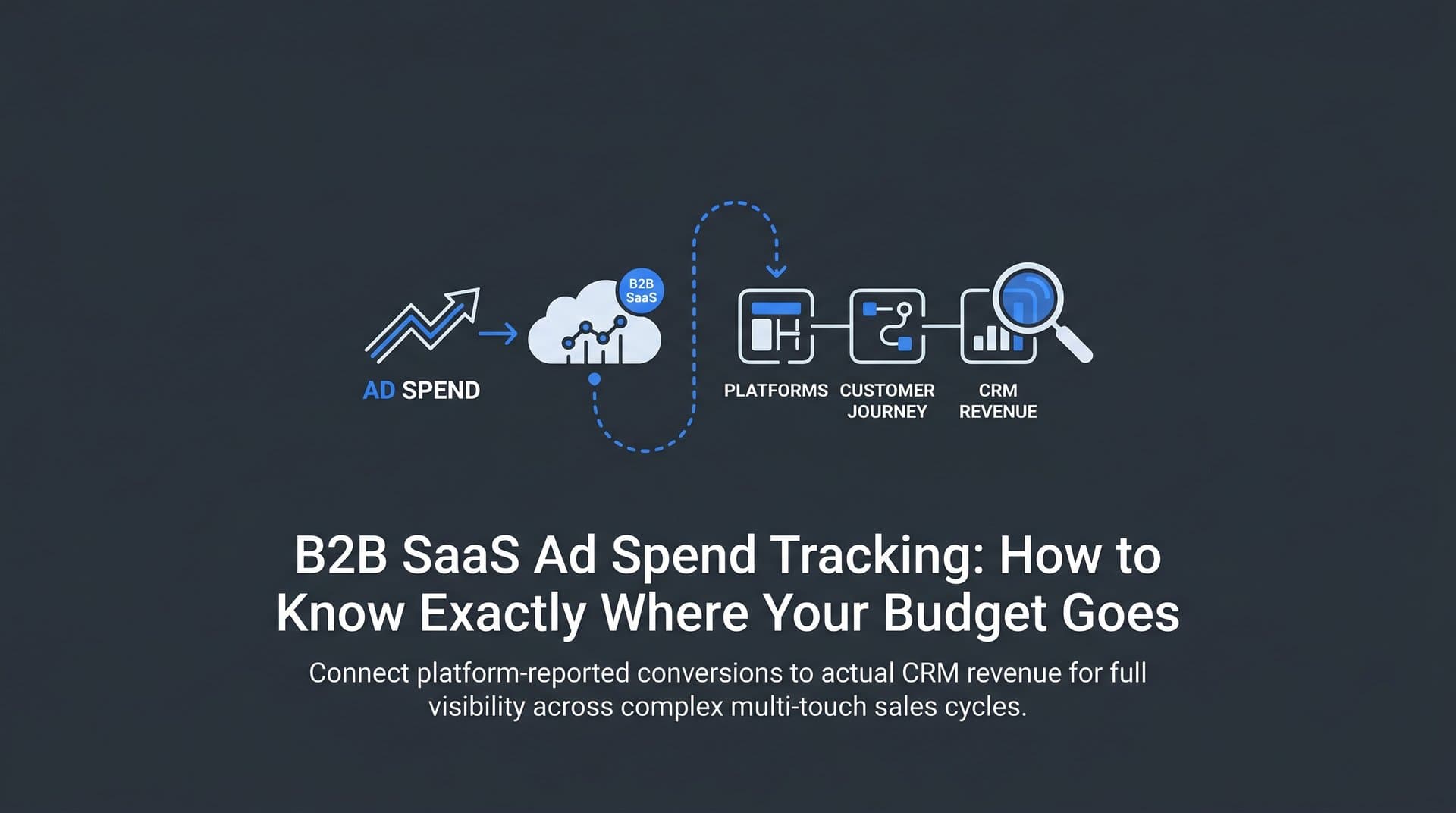
B2B SaaS ad spend tracking is the practice of monitoring, attributing, and optimizing every dollar of paid advertising across the entire customer journey, from the first impression to closed deal. Done right, it gives you a clear line of sight from your ad spend to your pipeline and revenue, even when the path is long and winding. Done poorly, or not done at all, it leaves you making expensive budget decisions based on incomplete or misleading data.
This article breaks down exactly why traditional tracking fails B2B SaaS teams, what a modern tracking framework looks like, and how to build one that connects your ad spend to real business outcomes. Let's get into it.
Why Native Ad Reporting Misleads B2B SaaS Teams
Here's the core problem: ad platforms like Google and Meta were built with e-commerce in mind. A shopper sees an ad, clicks it, and buys a product within the same session. The attribution is clean. The reporting is straightforward. But B2B SaaS buying doesn't work that way.
A typical B2B SaaS prospect might see a LinkedIn thought leadership ad in week one, click a Google search ad in week three, attend a webinar in week five, and finally convert after a sales demo in week eight. The deal involves multiple stakeholders, multiple touchpoints, and multiple platforms. Native ad reporting sees only a sliver of that journey.
Google Ads reports conversions within its own attribution window. Meta Ads Manager does the same, using its own model. LinkedIn follows suit. When you add up the conversions each platform claims, the total often exceeds your actual number of new customers by a wide margin. Each platform is taking credit for the same deal. This makes calculating your true cost per acquisition or return on ad spend nearly impossible without a layer of marketing attribution tracking sitting above all of them.
The problem compounds when you factor in privacy changes. Apple's App Tracking Transparency framework, introduced with iOS 14.5, significantly limited the ability of Meta and other platforms to track user behavior across apps and websites. The broader industry shift away from third-party cookies has had a similar effect. Client-side pixels, which rely on browser cookies to track conversions, are increasingly blocked, dropped, or degraded by browsers, ad blockers, and device settings.
What this means practically: a real conversion happens, but the pixel doesn't fire. The platform doesn't record it. Your reported conversion volume drops, your reported cost per conversion rises, and you start making budget decisions based on data that's missing a meaningful portion of your actual results.
For B2B SaaS teams running campaigns across multiple channels with long sales cycles, these blind spots don't just create reporting headaches. They lead to real misallocation of budget. Upper-funnel channels that create awareness and drive early-stage engagement get starved of investment because they don't show up in last-click reports. Lower-funnel branded search gets over-credited because it's the last touchpoint before a form fill, even though the prospect was already sold before they searched.
The result is a team that's optimizing for the wrong signals and wondering why their pipeline isn't growing despite consistent ad spend.
The Building Blocks of Accurate Ad Spend Tracking
Getting accurate B2B SaaS ad spend tracking requires building a data infrastructure that goes well beyond placing pixels and hoping for the best. There are three foundational components every team needs to get right.
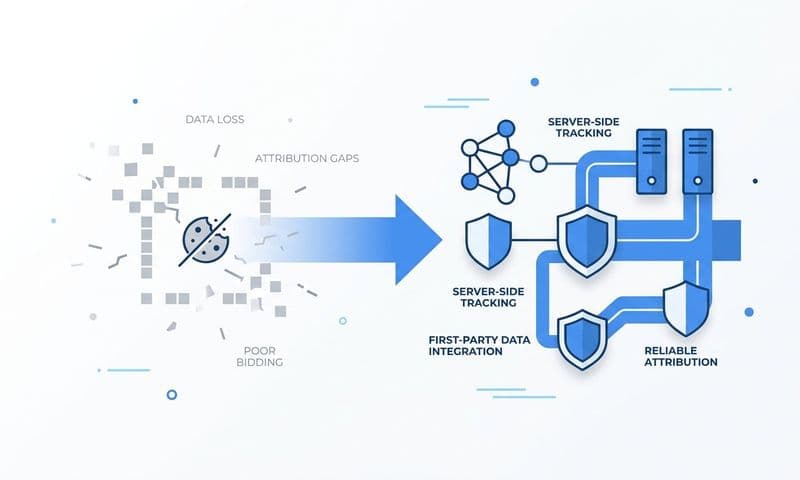
Server-Side Tracking: Instead of relying solely on browser-based pixels to capture conversion events, server-side tracking captures those events directly from your backend systems. When a prospect fills out a form, your server records the event and sends it to your analytics and ad platforms directly, bypassing ad blockers and cookie restrictions entirely. This means fewer missed conversions and a more complete picture of what your ads are actually driving. For B2B SaaS teams dealing with technically sophisticated audiences who are more likely to use ad blockers, server-side tracking isn't optional. It's the foundation.
CRM and Payment Integration: A form fill or trial signup is not a revenue event. For B2B SaaS, the conversion that matters is a qualified lead, an opportunity, or a closed deal. That data lives in your CRM, not your ad platform. Connecting your ad platforms to your CRM (and to payment processors like Stripe if you have a self-serve motion) means you can track the full funnel from ad click to actual revenue. When a deal closes in your CRM, that event gets tied back to the original ad that started the journey. This is what transforms ad spend tracking from a marketing metric into a business metric.
UTM Parameter Discipline and First-Party Data: UTM parameters are the connective tissue that links ad spend to downstream outcomes. Every campaign, ad set, and creative needs consistent, standardized UTM tagging so you can trace traffic and conversions back to their source across every platform. Without this discipline, your data becomes fragmented and unreliable the moment a prospect moves from one channel to another or returns to your site days later. Pairing UTM consistency with first-party data strategies, such as capturing email addresses early in the funnel and using them as identifiers across touchpoints, gives you a reliable trail from first ad click through to pipeline and revenue. For a deeper dive on this topic, explore UTM tracking and attribution best practices.
These three components work together. Server-side tracking ensures you capture events accurately. CRM integration ensures those events reflect real business outcomes. UTM discipline ensures every event is tied back to the right campaign and channel. Without all three, your ad spend tracking will have gaps that grow larger as privacy restrictions tighten and sales cycles lengthen.
Multi-Touch Attribution: Mapping Spend to Revenue Across Long Sales Cycles
Once you have the data infrastructure in place, the next challenge is making sense of it. Multi-touch attribution is the methodology that assigns credit for a conversion across every touchpoint in the customer journey, rather than giving all the credit to the first or last interaction.
There are several attribution models worth understanding. Linear attribution distributes credit equally across every touchpoint. Time-decay attribution gives more credit to touchpoints closer to the conversion, on the assumption that recent interactions were more influential. Position-based attribution (sometimes called U-shaped) gives the most credit to the first and last touchpoints, with the remaining credit distributed across the middle. Data-driven attribution uses machine learning to assign credit based on which touchpoints actually correlate with conversion in your specific data set.
For B2B SaaS, where a prospect might interact with a Google search ad, a retargeting display ad, and a LinkedIn sponsored post before booking a demo, the choice of attribution model has real consequences for how you allocate budget. Last-click attribution will tell you that branded search drove the deal. Multi-touch attribution will reveal that a LinkedIn campaign created the initial awareness that started the journey.
The real power comes from comparing models side by side. When you look at your pipeline through a linear lens versus a time-decay lens versus a data-driven lens, patterns emerge. Channels that consistently appear in the early stages of winning deals deserve investment even if they never get last-click credit. Channels that only appear late in journeys that would have converted anyway deserve more scrutiny.
Critically, multi-touch attribution for B2B SaaS needs to be tied to CRM outcomes, not just platform-reported conversions. Measuring attribution at the level of form fills gives you a partial picture. Measuring it at the level of qualified leads, sales opportunities, and closed-won deals gives you a picture that reflects actual business impact. This is where revenue attribution for B2B SaaS becomes genuinely strategic: you're not just counting clicks and leads, you're understanding which combination of touchpoints produces customers with the best lifetime value.
This insight allows you to make budget allocation decisions that go beyond gut instinct. Instead of asking "which platform has the lowest cost per click," you can ask "which combination of channels produces the highest pipeline contribution per dollar spent," and actually answer it with data.
Feeding Better Data Back to Ad Platform Algorithms
Here's something many B2B SaaS marketers overlook: the quality of your ad spend tracking directly affects the quality of your ad targeting, not just your reporting.
Platforms like Meta and Google use conversion data to train their bidding algorithms. When you tell Meta that a conversion happened, Meta uses that signal to find more people like the person who converted. The problem is that if you're only sending "form submitted" events, you're training the algorithm to find more form submitters. For B2B SaaS, many of those form submitters will turn out to be unqualified leads who never become customers.
This is where conversion sync changes everything. By sending downstream conversion events back to ad platforms, events like "marketing qualified lead," "sales qualified lead," or "closed deal," you train the algorithm to optimize for the outcomes that actually matter to your business. Meta and Google's AI gets smarter about who to show your ads to, because it's learning from your best customers, not just your highest-volume leads. Leveraging conversion API tracking tools makes this process seamless and reliable.
The feedback loop works like this: your server-side tracking captures a conversion event accurately. Your attribution layer ties it to the right campaign and channel. Your CRM confirms it as a qualified lead or closed deal. That verified event gets synced back to the ad platform as an offline conversion. The platform updates its model and starts delivering your ads to more people who match the profile of your actual customers.
Over time, this loop compounds. Better conversion signals lead to better targeting, which leads to higher-quality leads, which generates better conversion signals. For B2B SaaS teams dealing with high customer acquisition costs and long sales cycles, this improvement in targeting efficiency can meaningfully reduce wasted spend and improve overall ROAS without changing a single creative or bid strategy.
Building Your B2B SaaS Ad Spend Tracking Framework Step by Step
Understanding the concepts is one thing. Building the system is another. Here's a practical sequence for putting a complete tracking framework in place.
Step 1: Audit your current setup. Map every ad platform you're running, every conversion event you're tracking, and every data destination those events flow into. Identify the gaps: where does spend exist without any connection to outcomes? Where are conversion events being tracked only at the platform level without CRM verification? This audit gives you a baseline and a prioritized list of what to fix first.
Step 2: Implement server-side tracking and integrate your CRM. Move your primary conversion tracking from client-side pixels to server-side events. Connect your CRM so that downstream events like lead status changes and deal closures flow into your attribution system. If you have a self-serve or product-led motion, connect your payment processor as well. The goal is a single source of truth that captures the full funnel. Comparing top server-side tracking platforms can help you choose the right solution for your stack.
Step 3: Standardize your UTM conventions. Create a consistent naming convention for UTM parameters across every platform, campaign, and ad set. Document it. Enforce it. Inconsistent UTM tagging is one of the most common reasons ad spend tracking breaks down, because even small variations in naming create separate data silos that can't be compared or aggregated reliably.
Step 4: Configure multi-touch attribution. Set up attribution models that span your full customer journey, from first touch to closed deal. Configure your system to compare models side by side so you can see how credit shifts depending on the model you use. This comparison is where the most valuable budget insights come from.
Step 5: Set up conversion sync. Configure your system to send verified conversion events back to each ad platform, prioritizing the events that reflect real business value. Start with qualified leads if you don't yet have enough closed-deal data to send meaningful signals. As your data set grows, shift toward sending closed-deal events for maximum algorithmic impact.
Step 6: Build a unified reporting dashboard. Create a view that shows spend, pipeline, and revenue by channel, campaign, and ad creative in one place. This dashboard should be accessible to both marketing and leadership, and it should answer the questions that matter: which campaigns are generating qualified pipeline, what is the cost per closed deal by channel, and where should we shift budget next quarter.
From Tracking Data to Smarter Budget Decisions
Tracking data is only valuable if it changes how you make decisions. The goal of B2B SaaS ad spend tracking isn't a prettier dashboard. It's a more confident, more defensible budget allocation process.
With accurate attribution data in hand, the conversation shifts from cost per click to cost per qualified lead and cost per closed deal by channel. This reframing often reveals surprising truths. A LinkedIn campaign might look expensive on a cost-per-click basis but generate a fraction of the wasted leads that a cheaper display campaign produces. A branded search campaign might look efficient on last-click data but mostly capture demand that other channels created. Using revenue tracking software lets you see these dynamics clearly and act on them.
AI-powered recommendations take this further. Rather than manually reviewing dozens of campaigns across multiple platforms to find optimization opportunities, AI can surface the highest-impact actions: which ad sets to pause because they're generating clicks but no pipeline, which campaigns to scale because they're driving closed deals at an efficient cost, and which audiences to expand based on the profile of your best-converting customers. This kind of AI-driven analysis replaces gut instinct with evidence, and it's particularly valuable for B2B SaaS teams managing complex multi-platform campaigns with limited bandwidth.
Building a cadence for data-driven budget reviews is equally important. Set a weekly rhythm for reviewing campaign-level performance against pipeline contribution, and a monthly rhythm for reviewing channel-level allocation against revenue outcomes. Understanding SaaS marketing spend benchmarks gives you external context for evaluating whether your cost per closed deal is competitive. The goal isn't to make large, reactive budget shifts based on short-term fluctuations. It's to make small, incremental adjustments informed by accumulating evidence about what's working across the full sales cycle.
Over time, this cadence builds institutional knowledge. Your team develops a clear understanding of which channels perform at which stages, how long it takes for spend to show up as pipeline, and what a healthy cost per closed deal looks like by segment and campaign type. That knowledge is a competitive advantage that compounds with every budget cycle.
Putting It All Together
B2B SaaS ad spend tracking is not about knowing how much you spent. It's about knowing exactly what that spend produced: which campaigns drove qualified pipeline, which channels influenced the deals that closed, and where the next dollar of budget will generate the most revenue.
The combination of server-side tracking, multi-touch attribution, CRM integration, and conversion sync creates a system that gets more accurate over time. As you send better conversion signals back to ad platforms, your targeting improves. As your attribution data accumulates, your budget decisions get sharper. As your team builds the habit of reviewing attribution data on a regular cadence, the gap between ad spend and revenue outcomes narrows.
The marketers who win in B2B SaaS aren't necessarily the ones with the biggest budgets. They're the ones who know exactly what their budget is doing and can prove it with data that connects to real business outcomes.
If you're ready to build that level of clarity into your ad spend tracking, Get your free demo of Cometly today. Cometly unifies your ad spend data across every platform and touchpoint, connecting every click to pipeline and revenue so you can scale your campaigns with confidence.