If you've ever tried to answer the question "which marketing efforts actually drive revenue?" in a B2B SaaS environment, you already know the frustration. Your buyers don't convert after clicking one ad. They read a blog post, attend a webinar, download a whitepaper, sit through a demo, loop in three colleagues, disappear for six weeks, and then finally sign a contract. By the time they close, they've touched your brand dozens of times across multiple channels and devices.
Traditional attribution models were never designed for this kind of complexity. They were built for the simple, single-session consumer purchase: someone clicks an ad, buys a product, done. In B2B SaaS, that model breaks down almost immediately. And when your attribution data is wrong, every decision downstream is wrong too: which campaigns to scale, where to cut budget, how to report ROI to leadership.
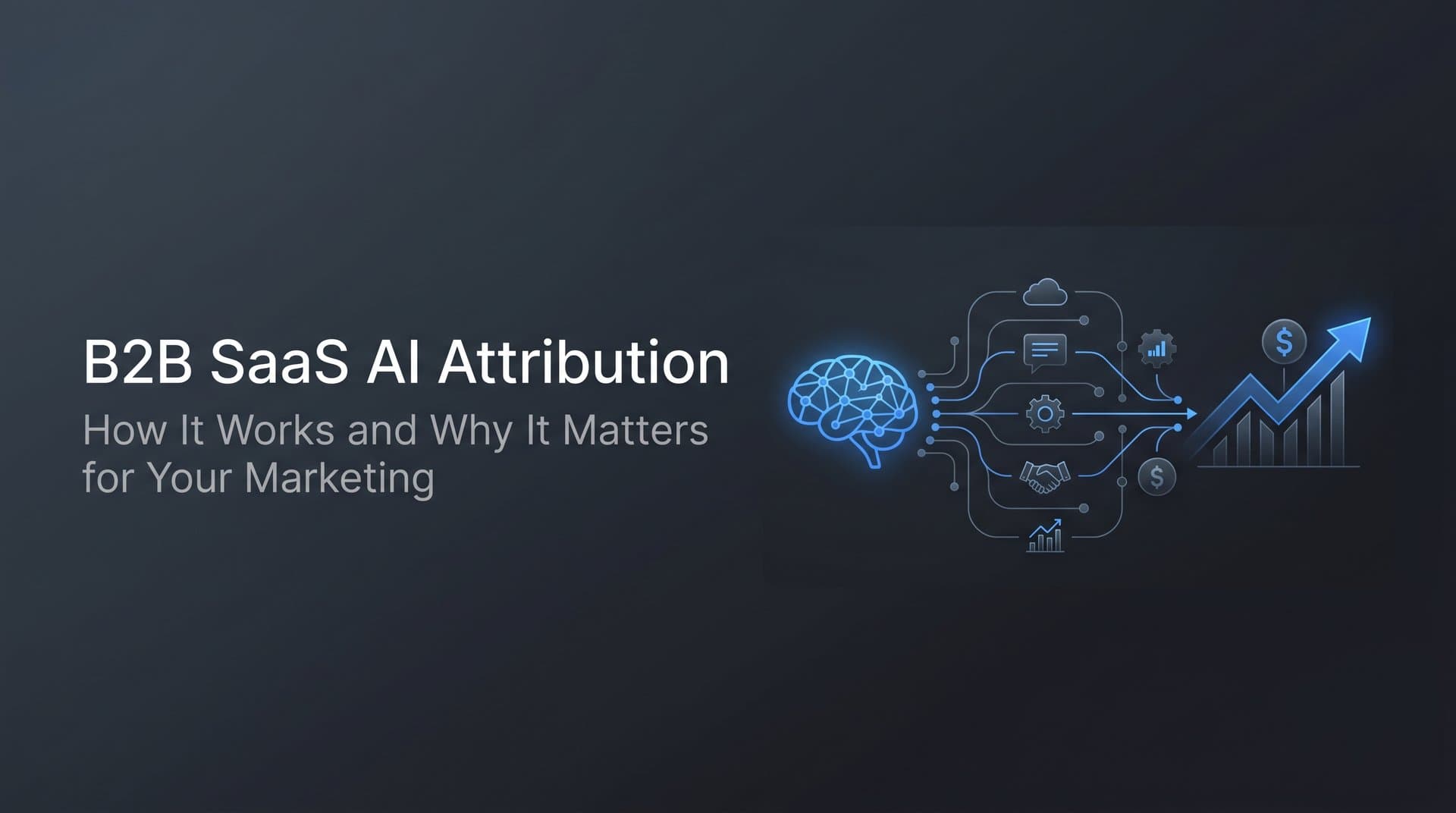
That's where AI-powered attribution comes in. By applying machine learning to massive amounts of cross-channel data, AI attribution can map the full customer journey, assign credit based on actual influence rather than arbitrary rules, and surface insights that would be invisible to any human analyst. This article walks you through exactly how it works, why it matters for B2B SaaS specifically, and how to put it to work in your marketing operation.
Why Traditional Attribution Fails B2B SaaS Marketers
The B2B SaaS buying journey is unlike almost any other purchase. A single deal might involve a champion user, a technical evaluator, a finance stakeholder, and a C-suite decision-maker, each consuming different content at different stages. The journey can span weeks or months, crossing paid ads, organic search, LinkedIn posts, webinars, sales calls, and product trials. No single touchpoint tells the whole story.
Yet most legacy attribution models try to tell that story with a single data point. Last-click attribution gives all the credit to whatever channel the buyer clicked right before converting, typically a branded search or a direct visit. First-click attribution goes the other direction and credits the very first touchpoint, ignoring everything that happened in between. Linear models spread credit evenly, which sounds fair but is statistically meaningless. None of these approaches reflect how B2B buyers actually make decisions, which is why understanding single source versus multi-touch attribution is so important.
The problem has gotten significantly worse as privacy restrictions have tightened. Apple's App Tracking Transparency framework, the ongoing deprecation of third-party cookies, and cross-device fragmentation have all degraded the quality of client-side tracking data that legacy attribution depends on. When browser-based pixels can't fire reliably, you end up with attribution gaps that make already-flawed models even less accurate. A touchpoint that genuinely influenced a deal simply doesn't get recorded.
The downstream consequences are serious. When attribution data is misleading, marketing teams routinely misallocate budget, scaling campaigns that look good on surface metrics like clicks and impressions but don't actually contribute to pipeline. They cut channels that appear underperforming but are actually doing critical mid-funnel work. And when it's time to report to leadership, they can't credibly connect marketing spend to revenue, which makes it nearly impossible to justify budget increases or strategic investments. These are well-documented SaaS marketing attribution challenges that affect teams of every size.
In short: bad attribution doesn't just make your reports look bad. It actively steers your strategy in the wrong direction, and in a competitive SaaS market, that compounds quickly.
How AI Attribution Thinks Differently Than Rule-Based Models
The fundamental problem with rule-based attribution models is that they apply fixed formulas to dynamic, complex human behavior. Someone decided that "last touch gets all the credit" or "credit decays linearly over time," and those rules get applied uniformly to every single conversion path, regardless of what actually happened. The model doesn't learn. It doesn't adapt. It just executes its formula.
AI attribution works from the opposite direction. Instead of starting with a rule, it starts with data. Machine learning algorithms analyze patterns across thousands of real customer journeys, looking at which touchpoints consistently appear in paths that end in conversion versus paths that don't. Over time, the model learns which channels, content types, and ad formats actually influence buying decisions, and it dynamically assigns credit based on those observed patterns rather than predetermined logic. This is a fundamentally different approach from the attribution model approach mainly used in marketing today.
This opens up a category of insight that rule-based models simply cannot surface. For example, an AI attribution model might discover that a specific product comparison guide consistently appears in the conversion paths of high-value accounts, even though it rarely generates direct clicks that show up in last-touch reports. Or it might reveal that a LinkedIn retargeting campaign doesn't drive many first conversions but dramatically accelerates pipeline velocity for deals that are already in progress. These are non-obvious patterns that require analyzing hundreds of variables simultaneously, exactly the kind of work machine learning is built for.
The accuracy of AI attribution depends heavily on the quality and completeness of the underlying data. This is where server-side tracking becomes critical. Rather than relying on browser-based pixels that can be blocked, dropped, or distorted by privacy restrictions, server-side tracking sends conversion data directly from your server to ad platforms and attribution tools. The result is more complete, more accurate data that gives the AI model a true picture of what's happening across the customer journey.
First-party data collection is equally important. When you own the data flowing into your attribution system, rather than depending on third-party cookies and inferred identities, your models are working from a foundation that privacy changes can't erode. AI attribution built on first-party, server-side data is both more accurate today and more resilient to future privacy shifts.
The Core Components That Make It Work
Understanding AI attribution conceptually is one thing. Understanding what actually has to be in place for it to function is another. There are three foundational components that any effective B2B SaaS AI attribution system needs.
Cross-platform data unification: AI attribution can only be as good as the data it has access to. That means connecting every channel where your buyers interact with your brand: paid ads on Google, Meta, LinkedIn, and TikTok; your CRM system where deals and pipeline stages live; your website analytics; offline events like webinars and sales calls; and any other touchpoints that influence the buying decision. Without a unified data layer that captures all of this, the AI is working with an incomplete picture, and the insights it surfaces will reflect those gaps. Effective SaaS marketing attribution tracking starts with getting this data foundation right.
Multi-touch attribution modeling: Once the data is unified, the AI processes it to build a holistic view of each account's journey. Rather than applying a fixed rule, the model weights each touchpoint by its actual observed contribution to conversion, based on patterns learned from all the journeys in your dataset. This produces a credit distribution that reflects reality: the LinkedIn ad that introduced the brand, the webinar that built trust, the demo that converted the champion, and the case study that closed the CFO all receive credit proportional to their actual influence. The best multi-touch attribution tools make this process seamless.
Conversion syncing and feedback loops: The final component is often overlooked, but it may be the most practically valuable. Once your AI attribution system has identified which touchpoints and conversion events actually drive revenue, that enriched data gets sent back to the ad platforms themselves. Meta, Google, and LinkedIn all use conversion signals to optimize their targeting and bidding algorithms. When you feed them accurate, revenue-connected conversion data instead of raw lead counts, their algorithms can find more buyers who look like your best customers. This creates a compounding feedback loop: better attribution data leads to better ad platform optimization, which leads to better results, which generates more data to improve the model further.
Putting AI Attribution to Work: Real Applications for B2B SaaS Teams
The practical value of AI attribution shows up in three specific areas where B2B SaaS marketing teams consistently struggle.
Smarter budget allocation: When you know which channels and campaigns genuinely contribute to pipeline and closed revenue, not just clicks and impressions, you can move budget with confidence. AI attribution gives you the data to shift spend away from campaigns that generate traffic but don't convert, and toward the ones that consistently appear in high-value conversion paths. This is particularly powerful in B2B SaaS, where cost-per-acquisition can be high and budget decisions have significant downstream consequences. A strong SaaS marketing attribution strategy makes these budget conversations far more productive.
Scaling campaigns with evidence: One of the most common mistakes in B2B SaaS marketing is scaling a campaign based on surface metrics, only to find that the incremental spend doesn't produce incremental revenue. AI attribution solves this by showing you which ads and content types consistently appear across multiple successful conversion paths. When you see that pattern clearly, scaling becomes a data-supported decision rather than a gut call. You're not just hoping it works. You have evidence that it does.
Bridging the marketing-sales gap: In most B2B organizations, marketing and sales operate with different data and different definitions of success. Marketing measures leads and MQLs; sales measures pipeline and closed deals. Proper revenue attribution for B2B SaaS companies creates a shared language by mapping which marketing touchpoints warm up prospects before they ever talk to a salesperson. When sales teams can see that a prospect attended a webinar, downloaded a comparison guide, and engaged with a retargeting ad before requesting a demo, they have context that makes their conversations more effective. And when marketing can show which of their efforts actually correlate with deals closing, the relationship between the two teams shifts from adversarial to collaborative.
How to Choose and Implement an AI Attribution Platform
Not all attribution tools are created equal, and the gap between a solid AI attribution platform and a basic analytics dashboard is significant. Here's what to evaluate when you're choosing a solution for your B2B SaaS business.
Real-time data processing: B2B SaaS campaigns move fast. You need attribution insights that reflect current performance, not data that's days old. Look for platforms that process and surface data in real time so you can make timely optimization decisions.
Integration depth: The platform needs to connect to all the places your customer journey data lives: your ad accounts on Google, Meta, LinkedIn, and any other platforms you use; your CRM; your website; and ideally your product analytics. Shallow integrations that only pull surface-level data will limit the quality of the AI's output. Reviewing the best marketing attribution tools for B2B SaaS companies can help you compare integration capabilities across platforms.
Server-side tracking capabilities: Given the state of browser-based tracking, any serious attribution platform needs to support server-side data collection. This ensures your models have complete, accurate data regardless of what's happening with cookies or privacy restrictions.
Model comparison: The ability to view your data through multiple attribution lenses simultaneously, comparing first-touch, last-touch, linear, and AI-driven models side by side, is invaluable for understanding how different models tell different stories about the same data. Exploring top attribution modeling platforms will give you a sense of which solutions offer the most robust comparison features.
On the implementation side, the fundamentals are straightforward but need to be done completely. Connect all your ad accounts. Install tracking on your website using server-side methods where possible. Integrate your CRM so deal data flows into the attribution system. Define and configure the conversion events that matter to your business, not just form fills, but pipeline stages, demos booked, and closed revenue.
A few common pitfalls are worth avoiding. First, don't expect meaningful AI insights immediately. Machine learning models need sufficient data to identify reliable patterns, and that takes time. Be patient in the early weeks and focus on ensuring your data collection is complete and accurate. Second, don't treat attribution as a one-time setup. The most valuable use of an AI attribution platform is as an ongoing optimization engine that informs your decisions every week. Third, don't leave out any significant touchpoints. If your webinars, events, or sales call data aren't flowing into the system, the model is working with an incomplete picture, and its recommendations will reflect that.
Moving Forward With Clarity
B2B SaaS marketing is too complex and too expensive to run on guesswork. When sales cycles stretch across months, buying committees involve multiple stakeholders, and your budget is spread across half a dozen channels, the cost of bad attribution isn't just inaccurate reports. It's misallocated spend, missed opportunities to scale what's working, and an inability to prove that marketing is driving real business results.
AI attribution changes that equation. It gives marketing teams the clarity to see which efforts actually drive revenue, the confidence to scale campaigns that have evidence behind them, and the data to demonstrate ROI in terms that leadership and sales teams can both understand and trust.
Cometly is built specifically for this challenge. It connects your ad platforms, CRM, and website to track the entire customer journey in real time, delivers AI-powered recommendations that surface what's actually working, and feeds enriched conversion data back to Meta, Google, and other platforms to improve their targeting algorithms. Whether you're trying to optimize an existing attribution setup or building one from scratch, Cometly gives you the complete picture your marketing decisions deserve.
Ready to elevate your marketing game with precision and confidence? Discover how Cometly's AI-driven recommendations can transform your ad strategy. Get your free demo today and start capturing every touchpoint to maximize your conversions.