If you run marketing for a B2B SaaS company, you already know the feeling. A campaign wraps up, you pull the numbers from your ad dashboards, and everything looks great on paper. But when you sit down with sales leadership and compare those results to what actually closed in the CRM, the stories do not match. Deals that marketing claims credit for never showed up in the pipeline. Channels that look expensive in the dashboard are the ones sales says drove the best conversations. And nobody can quite explain the gap.
This is the attribution problem in B2B SaaS, and it is not a minor reporting inconvenience. When you cannot accurately trace which marketing efforts drive revenue, every decision downstream becomes a guess. Budget allocations, channel investments, headcount justifications, and scaling strategies are all built on a foundation that may be fundamentally flawed.
Attribution accuracy matters because it is the connective tissue between marketing activity and business outcomes. Get it right, and you can scale with confidence, defend your budget with data, and have productive conversations with leadership about what is working. Get it wrong, and you are essentially flying blind while spending real money. This guide breaks down why B2B SaaS attribution is so difficult to get right, what happens when it breaks down, and the practical steps you can take to build a more accurate, revenue-connected attribution system.
What Makes B2B SaaS Attribution So Uniquely Challenging
B2B SaaS is not like e-commerce. A consumer buying a pair of shoes might click an ad, land on a product page, and convert within minutes. The entire journey is compact and trackable within a single session. B2B SaaS deals rarely work that way, and the structural differences are exactly what make attribution so difficult.
Start with the sales cycle length. Many B2B SaaS products have cycles that run anywhere from 30 days on the short end to 90 days, six months, or longer for enterprise deals. That means a prospect might first encounter your brand through a LinkedIn ad in January, read a case study in February, attend a webinar in March, and finally book a demo in April before closing in June. The marketing touchpoints are spread across months, and connecting that initial LinkedIn impression to the closed deal requires data persistence and system integration that most teams simply do not have in place.
Then there is the buying committee problem. Enterprise and mid-market B2B purchases almost never involve a single decision-maker. A typical deal might include an end user who champions the product, a manager who evaluates the technical fit, a finance stakeholder who reviews pricing, and a legal or procurement contact who handles the contract. Each of these individuals may interact with your marketing in completely different ways, on different devices, and through different channels. Traditional single-user tracking models are built around one person, one journey. They cannot capture the distributed, multi-stakeholder reality of how B2B buying decisions actually get made. Understanding these SaaS marketing attribution challenges is the first step toward solving them.
This creates fragmented journey data. You might track the champion's behavior through your website and email, but miss the CFO who read your pricing page three times from a work laptop with ad blockers enabled. Or the IT lead who watched a YouTube ad but never clicked through. These invisible touchpoints still influence the deal, but they leave no trace in your tracking system.
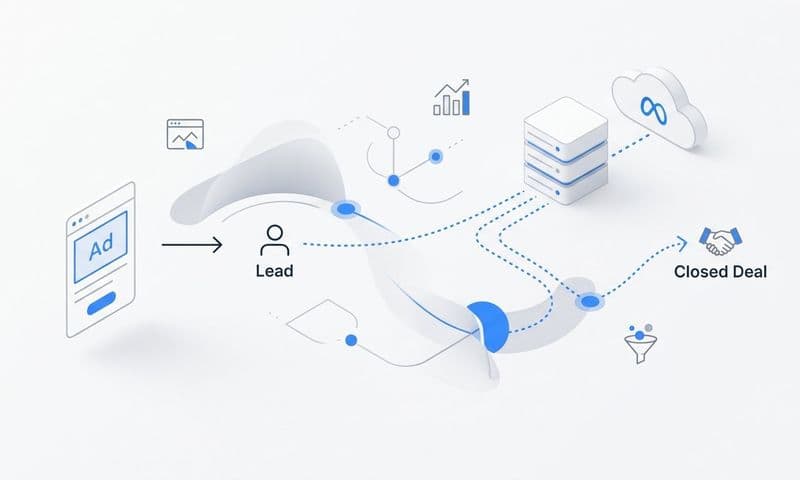
Finally, there is the gap between marketing-qualified actions and actual revenue. When a prospect fills out a demo request form, your marketing platform records a conversion. But that form fill is miles away from a closed deal. For B2B SaaS teams, the events that matter most to the business happen weeks or months after the initial marketing conversion, and they live in the CRM rather than the ad platform. Bridging that gap, connecting the ad click in January to the closed-won deal in June, is the central challenge of B2B SaaS attribution accuracy.
The Hidden Cost of Inaccurate Attribution Data
When attribution is off, the consequences are not abstract. They show up in your budget, your ad performance, and the trust between your marketing and sales teams.
The most direct cost is budget misallocation. If your attribution model gives credit to the wrong channels, you will naturally invest more in those channels while pulling back from the ones that are actually driving pipeline. This is especially common with last-click attribution, which tends to over-credit bottom-funnel channels like branded search or direct traffic while ignoring the awareness and nurture touchpoints that actually started the conversation. Over time, you end up starving the channels that generate demand while doubling down on the channels that simply capture it.
The second cost is less obvious but arguably more damaging: broken ad platform optimization. Platforms like Meta and Google do not just report on your campaigns. They use your conversion data to actively train their targeting and bidding algorithms. When you send these platforms incomplete or inaccurate conversion signals, you are giving their machine learning systems bad inputs. The result is that the algorithms optimize toward the wrong outcomes, targeting users who look like form-fillers rather than users who look like actual buyers. This degrades campaign performance over time in ways that are difficult to diagnose because the dashboards still show conversions, just not the ones that matter.
The third cost is organizational. When marketing reports one set of numbers and the CRM tells a different story, it creates friction between marketing and sales teams. Marketing claims credit for deals that sales does not recognize. Sales questions whether marketing is actually contributing to pipeline. If you have ever wondered why attribution data doesn't match, this disconnect is often at the root of the problem.
Inaccurate attribution does not just create bad reports. It creates bad decisions at every level of the organization, from which campaigns to scale to how to structure the marketing team to whether to hire more demand generation or content resources. Every downstream choice is only as good as the data it is built on.
Why Platform-Reported Metrics Often Miss the Full Picture
Most B2B SaaS marketers are familiar with the experience of pulling data from multiple ad platforms and watching the numbers refuse to add up. Meta says it drove 40 conversions. Google says it drove 35. LinkedIn claims another 20. But your CRM shows only 50 new leads total. The platforms are not lying exactly, but they are telling incomplete and incompatible versions of the truth.
Each ad platform uses its own attribution window and model. Meta might attribute a conversion to any user who clicked an ad within seven days or viewed an ad within one day of converting. Google might use a data-driven model that distributes credit across multiple clicks. LinkedIn uses its own logic entirely. When you look at these dashboards in isolation, you get overlapping credit claims that inflate your apparent ROAS and make it impossible to do an apples-to-apples comparison across channels.
Privacy changes have made this worse. iOS restrictions, the gradual deprecation of third-party cookies, and browser-level tracking prevention have significantly reduced the volume of data that client-side pixels can capture. When a user's browser blocks a tracking pixel or their device limits data sharing, the ad platform simply does not see that conversion. From the platform's perspective, it never happened. This means platform-reported metrics are increasingly undercounting actual conversions, which distorts the picture further and can cause teams to incorrectly conclude that a channel is underperforming. Comparing UTM tracking vs attribution software can help you understand the limitations of each approach.
But the deepest limitation of platform attribution is structural. Ad platforms are built to track to a lead event: a form fill, a sign-up, a demo request. That is where their visibility ends. They do not have access to what happens after the lead enters your CRM. They cannot see whether that lead became a sales-qualified opportunity, moved through pipeline stages, or eventually closed as revenue. For B2B SaaS teams, this is a massive blind spot. A campaign that generates a high volume of leads might look excellent in the platform dashboard while actually producing low-quality prospects who never convert to paying customers.
This is why relying on platform-reported metrics as your primary source of attribution truth is a structural mistake in B2B SaaS. The platforms are measuring what they can see, but they cannot see the outcomes that actually matter to your business.
Building Blocks of Accurate B2B SaaS Attribution
Improving attribution accuracy in B2B SaaS is not about finding one magic solution. It requires building a layered system where each component addresses a different gap in your data. Here are the foundational pieces.
Server-Side Tracking: Traditional tracking relies on client-side pixels, small pieces of JavaScript that run in the user's browser and fire events back to ad platforms and analytics tools. The problem is that these pixels are increasingly blocked by ad blockers, browser privacy settings, and iOS restrictions. Server-side tracking moves the conversion tracking logic to your server rather than the user's browser. When a conversion event occurs, your server sends the data directly to the platform's API, bypassing the browser entirely. This approach captures conversion data that client-side pixels miss, improving the completeness and accuracy of your tracking without depending on the user's browser to cooperate. For a deeper dive into implementation, explore SaaS marketing attribution tracking best practices.
CRM Integration: Server-side tracking solves the data capture problem, but it does not solve the data depth problem. Ad platforms still only see lead-level events unless you connect them to your CRM. Integrating your attribution platform with your CRM allows you to push downstream events back into your attribution model: when a lead becomes a sales-qualified opportunity, when an opportunity moves to a proposal stage, when a deal closes. This transforms attribution from a lead-counting exercise into a revenue attribution analysis. Instead of asking "which channels drive form fills," you can ask "which channels drive closed revenue," which is the question that actually matters.
Multi-Touch Attribution Models: Single-touch models like first-click or last-click attribution assign all credit for a conversion to one touchpoint. In B2B SaaS, where the average deal involves many interactions across many channels over many weeks, this is almost always wrong. Multi-touch attribution models distribute credit across the full buyer journey. A linear model gives equal credit to every touchpoint. A time-decay model gives more credit to touchpoints closer to the conversion. A position-based model gives heavier credit to the first and last touchpoints while distributing the remainder across the middle. A data-driven model uses machine learning to assign credit based on which touchpoints statistically correlate with conversion. Each model has tradeoffs, but any of them will give you a more accurate picture than single-touch attribution for long B2B cycles.
The key is that multi-touch attribution only works if you are actually capturing all the touchpoints. If your tracking has gaps, your multi-touch model will distribute credit across an incomplete set of interactions, which produces its own distortions. This is why server-side tracking and CRM integration are prerequisites, not optional add-ons.
How Conversion Syncing Improves Ad Platform Performance
Here is where attribution accuracy stops being just a reporting improvement and starts being a performance lever. When you build an accurate attribution system, you gain something valuable: verified, enriched conversion data that you can feed back to your ad platforms. This process, often called conversion syncing, is one of the highest-impact things a B2B SaaS marketing team can do to improve campaign performance.
Ad platforms like Meta and Google are optimization machines. They are constantly adjusting targeting, bidding, and audience selection based on the conversion signals you send them. The quality of those signals directly determines the quality of the optimization. If you are sending platform-tracked lead events as your primary conversion signal, you are telling the algorithm to find more people who fill out forms. That sounds reasonable, but in B2B SaaS, form fills are a noisy proxy for actual buyers. Many leads never convert to revenue. Understanding SaaS customer acquisition tracking helps you identify which signals matter most at each funnel stage.
When you sync deeper funnel events back to the platform, such as sales-qualified leads, opportunities created, or closed-won deals, you give the algorithm a much more accurate picture of what a valuable conversion looks like. The platform can then identify the characteristics of users who actually become customers and optimize targeting toward that profile. This shift can meaningfully improve the quality of leads your campaigns generate, even if the volume looks similar on the surface.
The practical workflow looks like this: your attribution platform captures conversion events from your website and CRM, enriches them with the data needed for matching (email addresses, phone numbers, and other identifiers), and sends them back to Meta, Google, or other platforms through their conversion APIs. This creates a feedback loop where better data leads to better targeting, which generates better leads, which produces more accurate conversion data, which further improves targeting. Each iteration of the loop compounds the performance gains.
This is also why the completeness of your tracking setup matters so much for ad performance, not just for reporting. Every conversion event you fail to capture is a signal the algorithm never receives. Every gap in your tracking is a gap in the platform's ability to optimize on your behalf.
Putting Accurate Attribution Into Practice
Understanding the principles of accurate attribution is one thing. Actually implementing them requires a structured approach, especially if your current setup has accumulated gaps and workarounds over time.
Start with an audit of your existing tracking. Map the journey from ad click to closed deal and identify every point where data can drop off. Common gaps include: ad clicks that are not connected to website sessions due to UTM stripping, form fills that are captured in the ad platform but not passed to the CRM, CRM records that lack marketing source data, and pipeline events that never get synced back to attribution. Prioritizing these gaps by their impact on revenue visibility will help you focus your efforts where they matter most. Following proven SaaS marketing attribution best practices can accelerate this process significantly.
Once you understand where your data breaks down, the next step is consolidating your attribution into a single platform rather than trying to stitch together reports from multiple dashboards. Spreadsheet-based attribution, where you manually export data from Meta, Google, LinkedIn, and your CRM and try to reconcile them, is fragile, time-consuming, and prone to error. A centralized attribution platform that connects your ad channels, website, and CRM into a unified data model gives you a single source of truth that everyone in the organization can reference. Reviewing the best marketing attribution tools for B2B SaaS can help you evaluate which solution fits your needs.
Finally, treat attribution as an ongoing discipline rather than a one-time setup. Buyer behavior changes. Channels evolve. New campaigns introduce new touchpoints. Privacy regulations continue to shift the landscape of what data you can collect and how. Regularly validating your attribution data against actual revenue, checking that the deals your attribution model credits to specific channels actually show up in your CRM as closed-won, is the only way to catch drift before it compounds into major misalignment.
Teams that do this well do not just have better reports. They have better conversations, better budget decisions, and better campaigns because every layer of their marketing operation is built on data they can actually trust.
The Bottom Line on B2B SaaS Attribution
Attribution accuracy in B2B SaaS is not a problem you solve once and move on from. It is an ongoing discipline that sits at the foundation of every meaningful marketing decision your team makes. When your attribution is accurate, you know which channels drive revenue, you can defend your budget with confidence, you can scale what works, and you can give ad platform algorithms the signals they need to optimize toward real buyers rather than surface-level engagement.
The key levers are clear: server-side tracking to capture what client-side pixels miss, CRM integration to connect marketing touchpoints to actual revenue outcomes, multi-touch attribution models to distribute credit fairly across long and complex buyer journeys, and conversion syncing to feed better data back to the platforms that power your campaigns.
None of these are simple to implement in isolation, and they are even harder to manage when spread across disconnected tools. That is exactly the problem Cometly is built to solve. Cometly connects your ad platforms, website, and CRM into a single attribution system that tracks every touchpoint from first ad click to closed deal, syncs enriched conversion data back to Meta, Google, and other channels, and gives your team AI-powered recommendations to identify what is working and scale it with confidence.
If your current attribution setup leaves you guessing about which channels actually drive revenue, now is the time to change that. Get your free demo and see how Cometly helps B2B SaaS teams build the attribution accuracy their growth strategies depend on.