You're running Google Ads, LinkedIn Sponsored Content, Meta campaigns, and a nurture email sequence simultaneously. A prospect signs a contract after a three-month evaluation. Your Google Ads dashboard says Google closed the deal. LinkedIn says LinkedIn did. Meta has its own claim. Your CRM shows a closed-won opportunity but no clear trail back to where this buyer first encountered your brand.
This is the daily reality for B2B SaaS marketers. Unlike e-commerce, where a customer might see an ad and purchase within minutes, B2B SaaS deals unfold over weeks or months, involve multiple stakeholders, and touch dozens of channels before anyone signs on the dotted line. Single-platform reporting was never designed for this kind of complexity, and it shows.
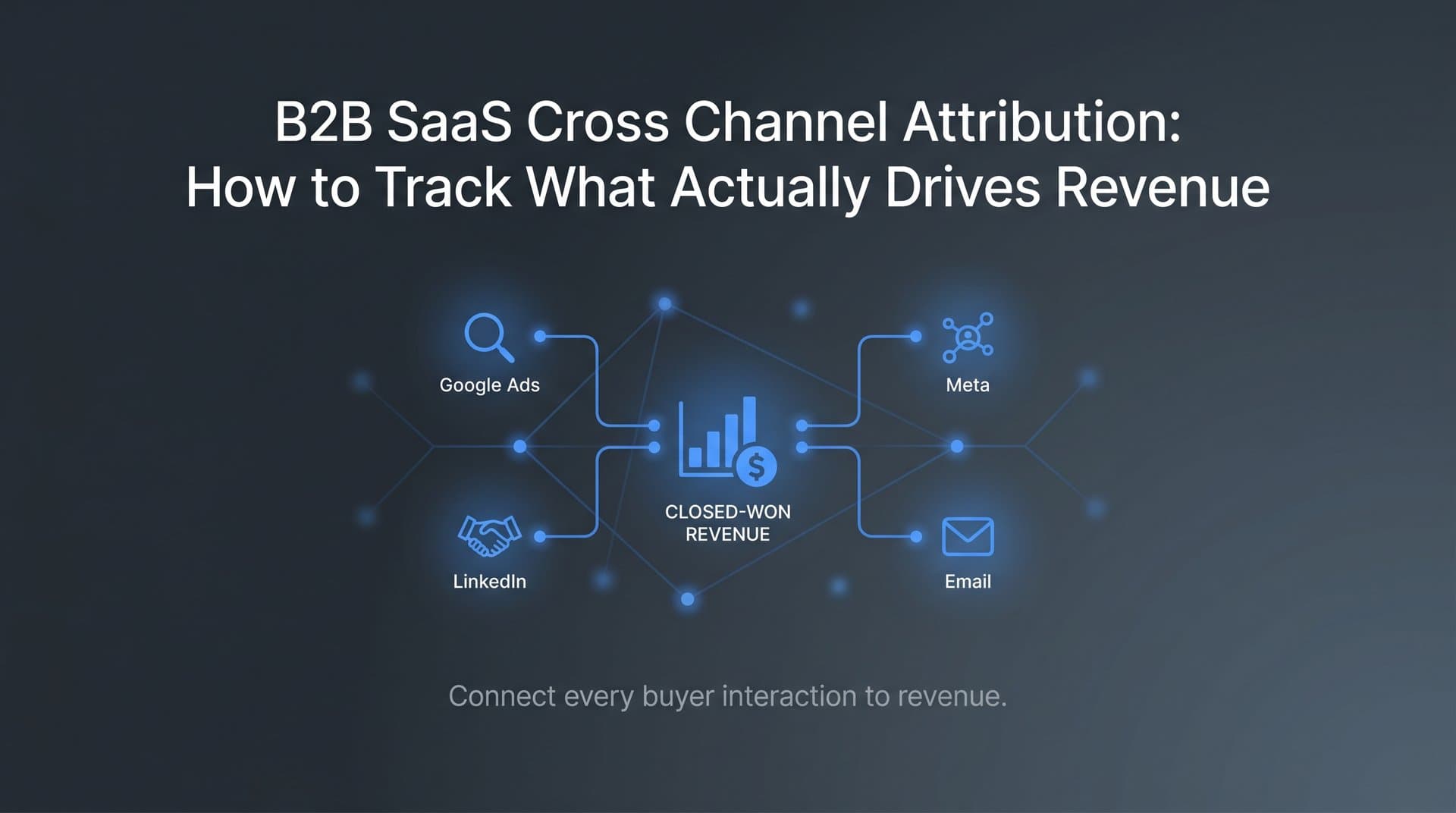
B2B SaaS cross channel attribution is the practice of tracking and assigning credit to every marketing touchpoint across all channels that contributed to a conversion or closed deal, from the first LinkedIn impression to the Google search that brought a decision-maker back to your pricing page six weeks later. Done right, it replaces the guesswork with a clear, connected view of how your marketing actually drives revenue. This article breaks down why it matters, how the models work, what the data foundation looks like, and how to implement it in a way that genuinely informs your budget decisions.
Why B2B SaaS Buyer Journeys Break Single-Channel Reporting
Think about what a typical B2B SaaS buying journey actually looks like. A VP of Marketing sees a LinkedIn ad and clicks through to read a blog post. A week later, they search Google for a comparison between your product and a competitor. They download a whitepaper from a retargeting ad on Meta. Two months later, they forward a case study to three colleagues, one of whom books a demo through a branded search. The deal closes after four calls with your sales team.
How many channels contributed to that deal? All of them. But here is the problem: each ad platform only sees its own slice of that journey. Google knows about the branded search and the demo booking. LinkedIn knows about the initial click. Meta knows about the retargeting engagement. None of them can see the others, and none of them are incentivized to share credit.
The result is what many B2B SaaS marketers know as the attribution overlap problem. When you add up the conversions each platform claims, the total often far exceeds the actual number of deals closed. Every platform is telling you it deserves full credit, and there is no independent system to arbitrate. Understanding why attribution data doesn't match across platforms is the first step toward solving this.
This creates real budget risk. Without cross channel visibility, marketers often end up cutting spend on awareness channels like LinkedIn or display because they appear to generate few direct conversions. But those channels may be doing the essential work of introducing prospects to your brand and warming them up for the high-intent Google searches that close deals. Cut them, and you starve the top of your funnel without immediately seeing the downstream consequences.
Long B2B sales cycles compound this problem. A deal that takes three months to close will accumulate touchpoints across multiple campaign cycles, budget periods, and even team changes. Single-channel reporting was built for short, linear journeys. B2B SaaS journeys are anything but linear, and the ability to track customer journey across channels needs to reflect that reality.
Attribution Models That Actually Fit B2B Sales Cycles
Not all attribution models are created equal, and the one you choose shapes how you interpret your marketing performance. For B2B SaaS teams, understanding the tradeoffs between models is essential before you can use attribution data confidently.
First-Touch Attribution: All credit goes to the channel that generated the very first interaction. This is useful for understanding what drives awareness and brings new prospects into your funnel. The downside is that it ignores everything that happened between that first touch and the closed deal, which in B2B SaaS is often where most of the heavy lifting occurs.
Last-Touch Attribution: All credit goes to the final touchpoint before conversion. This is the default for many ad platforms and CRMs, and it consistently overstates the value of bottom-funnel channels while ignoring the upstream work that made the deal possible.
Linear Attribution: Credit is distributed equally across every touchpoint in the journey. This is more honest than single-touch models, but it treats a brand awareness impression the same as a product demo booking, which rarely reflects actual influence on the buying decision.
Time-Decay Attribution: Touchpoints closer to the conversion receive more credit than earlier ones. This makes sense for short sales cycles but can undervalue awareness channels in long B2B deals where early education plays a critical role.
Position-Based (U-Shaped) Attribution: The first and last touchpoints each receive a larger share of credit, with the remaining credit distributed across middle touchpoints. This model is particularly popular in B2B SaaS because it acknowledges both the channel that introduced the prospect and the channel that closed the deal, while still recognizing the nurture touches in between.
Data-Driven Attribution: Machine learning analyzes your actual conversion paths to assign credit based on the statistical contribution of each touchpoint. This is the most accurate model when you have sufficient data volume, but it requires a mature attribution setup and meaningful conversion history to produce reliable outputs.
Here is where it gets interesting: the real value often comes not from picking one model and committing to it, but from running multiple models in parallel and comparing the results. For a deeper dive into how these approaches differ, explore the difference between single source and multi-touch attribution models. When you look at first-touch data alongside position-based data, you might discover that LinkedIn consistently introduces prospects who eventually convert through Google search. That insight tells you something neither model reveals on its own, and it directly informs how you allocate budget across both channels.
The Data Foundation: Connecting Platforms, CRM, and Revenue
Attribution models are only as good as the data feeding them. Before you can assign credit accurately across channels, you need a technical foundation that captures every touchpoint without gaps. For B2B SaaS teams, this means solving three interconnected data challenges.
The first is tracking accuracy. Browser-based tracking has become increasingly unreliable due to privacy changes, including Apple's App Tracking Transparency and the gradual deprecation of third-party cookies. When a prospect clicks a LinkedIn ad on their iPhone and lands on your website, a pixel-based setup may fail to capture that event entirely. Server-side tracking addresses this by moving the tracking logic from the browser to your server, capturing events more reliably regardless of browser restrictions or ad blockers. This is not optional for B2B SaaS teams running multi-channel campaigns; it is the foundation that everything else depends on.
The second challenge is CRM integration. In B2B SaaS, the conversion that matters most is not a form fill or a demo booking. It is a closed-won deal, and that event lives in your CRM, often weeks or months after the last marketing touchpoint. Without connecting your attribution platform to your CRM, you are measuring marketing performance against lead generation metrics rather than actual revenue. Effective revenue attribution for B2B SaaS companies allows you to tie every upstream marketing touch to pipeline stages and closed deals, giving you a true picture of which channels drive revenue rather than just traffic.
The third piece is conversion syncing. Once you have accurate conversion data, feeding it back to ad platforms like Meta and Google creates a positive feedback loop. These platforms use conversion signals to train their bidding algorithms and refine audience targeting. When you send enriched, conversion-ready events that reflect actual pipeline and revenue rather than just clicks or form fills, you improve the quality of the machine learning that powers your campaigns. Over time, this tends to result in better targeting and more efficient spend, because the algorithm is optimizing toward the outcomes that actually matter to your business.
Common data pitfalls to watch for include broken or inconsistent UTM parameters that make it impossible to trace traffic back to specific campaigns, disconnected tools that create data silos between your ad platforms and CRM, and over-reliance on cookie-based tracking that misses a growing share of real user behavior. Understanding the tradeoffs of UTM tracking vs attribution software helps you build a unified data pipeline that connects your ad platforms, website, and CRM into a single attribution system.
Turning Attribution Data Into Budget Decisions That Scale
Attribution data is only valuable if it changes how you spend money. The goal of cross channel attribution is not to produce interesting reports; it is to give you the confidence to move budget toward what works and away from what does not.
The most direct application is accurate cost-per-acquisition analysis at the channel, campaign, and ad level. When you have unified attribution data connected to your CRM, you can calculate the true cost to acquire a customer through each channel, not just the cost per click or cost per lead that individual platforms report. The ability to track marketing ROI across channels often produces surprising results. A channel that looks expensive on a cost-per-click basis might turn out to be your most efficient source of high-value customers when you trace deals all the way to closed-won revenue.
AI-powered recommendations take this further by surfacing patterns across all channels simultaneously that would be difficult to spot manually. Rather than reviewing each platform's dashboard in isolation, an AI layer can identify which campaigns are consistently contributing to high-value deals, which are generating volume but poor-quality pipeline, and where budget reallocation would have the greatest impact. This removes a significant amount of guesswork from optimization decisions, especially when you are managing campaigns across four or five channels at once.
There is also the concept of incrementality to consider. Attribution data can help you distinguish between channels that are genuinely driving net-new revenue and channels that are simply capturing conversions that would have happened anyway. For example, branded search campaigns often show strong last-touch attribution numbers, but many of those conversions might have occurred through direct traffic if the paid search campaign did not exist. Understanding incrementality helps you avoid over-investing in channels that look good on paper but are not actually adding to your revenue.
The practical output of good attribution is a clearer investment thesis for each channel: this channel builds awareness among new audiences, this one nurtures mid-funnel prospects, and this one captures high-intent buyers at the moment of decision. A well-defined SaaS marketing attribution strategy that reflects this reality tends to outperform budgets built on platform-reported data alone.
How to Implement Cross Channel Attribution Step by Step
Implementation does not have to be overwhelming. Breaking it into three clear phases makes the process manageable and ensures you build on a solid foundation before adding complexity.
Step 1: Audit your current tracking setup. Before connecting anything new, map out what you currently have. Walk through each paid channel and identify exactly how conversions are being tracked. Check whether UTM parameters are consistent across all campaigns and whether they are passing through to your CRM. Look for gaps between the ad click and the CRM entry, which is where most attribution data is lost in B2B SaaS setups. Document what is working, what is broken, and what is missing entirely. This audit gives you a clear picture of your current data quality and tells you exactly where to focus your implementation effort.
Step 2: Build the unified data infrastructure. Implement server-side tracking to capture touchpoints reliably across all channels. Connect your ad platforms (Google, Meta, LinkedIn, and any others you run) to a single attribution platform. Integrate your CRM so that pipeline stages and closed-won events feed back into your attribution data. For guidance on tracking conversions across multiple ad platforms, set up conversion syncing to push enriched event data back to your ad platforms. The goal at this stage is to ensure that every touchpoint from the first ad impression to the signed contract is captured in one place, with no gaps in the data chain.
Step 3: Run models in parallel, analyze, and iterate. Once your data infrastructure is in place, activate multiple attribution models simultaneously and let them run for a meaningful period before drawing conclusions. Compare the outputs across models to identify discrepancies and insights. Look for channels that consistently appear in first-touch data but rarely in last-touch data; these are likely your awareness drivers. Look for channels that appear heavily in last-touch but rarely in first-touch; these are your demand-capture channels. Use these insights to make iterative budget shifts rather than dramatic reallocations. As your data matures and you accumulate more conversion history, revisit your model selection and consider moving toward data-driven attribution for the most accurate view of channel contribution.
Mistakes That Quietly Undermine Your Attribution Strategy
Even teams that invest in attribution infrastructure often undercut their own results by falling into predictable traps. Knowing what these are upfront saves a significant amount of time and budget.
The most common mistake is treating platform-reported data as the source of truth. Google, Meta, and LinkedIn each report conversions based on their own tracking logic, and each has a structural incentive to claim as much credit as possible. Using these numbers to make budget decisions without an independent, unified attribution system is like letting each department write its own performance review. Reviewing the most common SaaS marketing attribution challenges can help you build a third-party view that stitches together the full journey without bias toward any single channel.
Another mistake is treating attribution as a one-time setup rather than an ongoing practice. B2B SaaS marketing mixes evolve constantly. You add new channels, launch new campaign types, shift messaging, and enter new markets. Each of these changes can affect how your attribution data should be interpreted and which models are most appropriate. Many teams configure their attribution system at launch and then never revisit it, which means they are making decisions based on models that no longer reflect how their funnel actually works.
Finally, many B2B SaaS teams undercount the role of offline and non-click touchpoints. Sales calls, webinars, in-person events, and direct outreach from SDRs all influence buying decisions, but they rarely appear in digital attribution data unless you deliberately integrate your CRM and sales activity into your attribution system. Ignoring these touchpoints creates a distorted picture that overvalues digital channels and undervalues the relationship-building work that often closes complex B2B deals.
Your Path to Attribution That Actually Drives Decisions
B2B SaaS cross channel attribution is not a reporting upgrade. It is a strategic capability that changes how your team makes decisions, how you justify budget to leadership, and how confidently you can scale the campaigns that genuinely drive revenue.
The teams that get this right share a few things in common. They have a unified data foundation that connects every touchpoint from ad click to closed deal. They run multiple attribution models and compare them rather than committing blindly to one. They use attribution data to inform iterative budget shifts rather than dramatic, reactive reallocations. And they treat attribution as an ongoing practice that evolves alongside their marketing mix.
The place to start is always the audit. Map your current tracking gaps, identify where data is being lost between your ad platforms and your CRM, and build from there. You do not need a perfect setup on day one; you need a direction and a foundation that improves over time.
Cometly is built for exactly this challenge. It connects your ad platforms, CRM, and website into a single attribution system, captures every touchpoint through server-side tracking, syncs enriched conversion data back to Meta and Google to improve their algorithms, and delivers AI-powered recommendations that surface which campaigns are driving real revenue across every channel. It gives B2B SaaS marketing teams the clear, accurate, unified view they need to invest with confidence and scale what works.
If you are ready to move beyond platform-reported data and start making budget decisions backed by the full picture of your buyer journey, Get your free demo and see how Cometly can transform the way your team tracks, analyzes, and optimizes across every channel.