B2B SaaS marketing teams often run campaigns across dozens of channels simultaneously. Paid search, LinkedIn ads, webinars, content marketing, email nurture sequences, review sites, and direct sales outreach all compete for budget and attention. But when leadership asks which efforts actually drive pipeline and closed revenue, most teams struggle to give a confident answer.
The problem is not a lack of data. It is a lack of connected data. A prospect might click a Google ad on Monday, read three blog posts over the next two weeks, attend a demo webinar, and then convert a month later after a personalized email follow-up. Without proper attribution, you are left crediting the email and ignoring everything that came before it.
B2B SaaS buying cycles make this especially challenging. They are long, often stretching 30 to 90 days or more. They involve multiple stakeholders from different departments. And they cross devices, channels, and both marketing and sales touchpoints in ways that no single platform dashboard can capture on its own.
This guide walks you through a practical, seven-step process for building a marketing attribution system that fits the real complexity of B2B SaaS. You will learn how to define revenue-focused goals, map your buyer journey, choose the right attribution model, set up cross-platform tracking, connect your CRM data, analyze results through a revenue lens, and continuously optimize based on what is actually working.
Whether you are a growth marketer at an early-stage startup or part of a scaling SaaS marketing team, these steps will help you move from vanity metrics to revenue-based decision making. Let's get into it.
Step 1: Define Your Attribution Goals and Key Revenue Events
Before you configure a single tracking pixel or connect a single data source, you need to be clear about what you are trying to learn. Attribution without a defined purpose produces dashboards full of data that nobody acts on.
Start by identifying the specific business questions your attribution system needs to answer. The most common ones in B2B SaaS include: Which channels are driving qualified pipeline? Which campaigns produce the highest lifetime value customers? Where should we increase spend, and where should we cut it? These questions sound simple, but answering them requires connecting marketing data all the way to revenue outcomes. To understand the full scope of questions marketing attribution can answer, it helps to think beyond simple channel reporting.
Next, map out the key conversion events that matter in your specific funnel. In B2B SaaS, these typically include:
Free trial signups or product-led growth activations: The moment a prospect enters your product experience and becomes a known contact in your system.
Demo requests: A high-intent action that signals a prospect is actively evaluating your solution.
MQL to SQL handoff: The point where marketing-qualified leads are accepted by the sales team as sales-qualified opportunities.
Closed-won deals: The revenue event that ultimately justifies every dollar spent on marketing.
Expansion revenue: Upsells, cross-sells, and renewals that often trace back to specific onboarding or nurture campaigns.
Aligning your marketing and sales teams on these definitions before you build anything is critical. If marketing counts a form fill as a conversion but sales considers only accepted SQLs to be meaningful, your attribution data will reflect two different realities. Get everyone in the same room and agree on what counts.
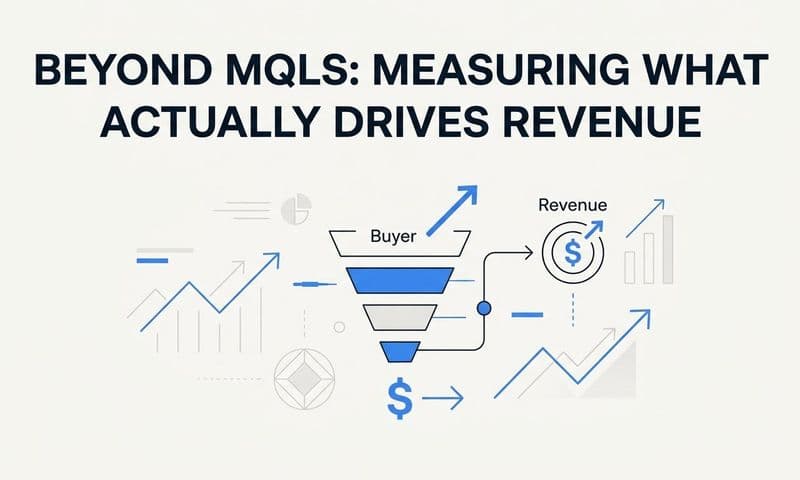
Finally, set clear success metrics that connect back to revenue. Cost per acquisition, customer acquisition cost by channel, pipeline velocity, and revenue per channel are far more useful than cost per click or click-through rate. The goal is to build an attribution system that tells you which investments produce the best downstream outcomes, not just which ones generate the most activity at the top of the funnel.
The most common pitfall at this stage is defining goals around lead volume rather than revenue quality. Teams that optimize for MQL volume often end up with a full pipeline of low-intent prospects that sales cannot close. Define your goals around what happens after the lead is created, and your attribution system will guide smarter decisions from day one.
Step 2: Map the Full B2B Buyer Journey Across Channels
You cannot attribute what you cannot see. Before setting up any tracking, you need a clear picture of every touchpoint a prospect can encounter on their way to becoming a customer. This exercise often reveals gaps that teams did not realize existed.
Start by documenting every channel where your brand shows up. This typically includes paid ads on Google, Meta, and LinkedIn; organic search through blog content and SEO; gated content downloads; webinars and virtual events; email nurture sequences; direct sales outreach including cold email and LinkedIn messages; and third-party review sites like G2 or Capterra.
Recognize that in B2B SaaS, the journey is rarely linear and rarely involves just one person. A single deal might involve a champion who discovered you through a Google search, a technical evaluator who downloaded your security documentation, and a CFO who only engaged with a pricing page and a case study. All of these touchpoints influenced the purchase, but they happened across different people and different channels. Effective tracking for B2B marketing campaigns requires capturing all of these interactions systematically.
This is where account-level thinking becomes essential. Rather than tracking individual contacts in isolation, effective B2B attribution groups touches by company or account. That way, you can see the full picture of how a buying committee engaged with your marketing before a deal closed.
Next, identify the gaps where tracking typically breaks down. Cross-device sessions, where a prospect sees a LinkedIn ad on mobile but converts on desktop, are notoriously difficult to stitch together without server-side tracking. Dark social, meaning content shared in Slack channels, private communities, or direct messages, is nearly impossible to track directly but can be inferred. Offline conversations at events or during sales calls also influence decisions without leaving a digital footprint.
Create a visual journey map that organizes your channels by funnel stage: awareness, consideration, and decision. Note which channels are most active at each stage and which are most likely to be the first or last touch before a conversion. This map becomes the blueprint for your tracking setup in the steps that follow.
The reason this step matters so much is practical. If you skip the journey mapping and go straight to configuring tools, you will almost certainly miss tracking something important. Discovering that gap six months later, after you have already made budget decisions based on incomplete data, is far more costly than spending a few hours mapping the journey upfront.
Step 3: Choose the Right Attribution Model for Your Sales Cycle
Attribution models are the rules that determine how credit for a conversion is distributed across the touchpoints that preceded it. Choosing the wrong model for your sales cycle leads to systematically over-investing in some channels and starving others.
Here is a quick breakdown of the core models you will encounter:
First-touch attribution: Gives 100% of the credit to the very first interaction a prospect had with your brand. Useful for understanding what drives awareness, but ignores everything that happened after the first click.
Last-touch attribution: Gives 100% of the credit to the final touchpoint before conversion. This is the default in many platforms and is deeply misleading for B2B SaaS because it almost always over-credits the bottom of the funnel while ignoring the content and campaigns that built intent.
Linear attribution: Distributes credit equally across all touchpoints. Simple and fair in theory, but it treats a brand awareness blog post and a high-intent demo request email as equally important, which is rarely accurate.
Time-decay attribution: Gives more credit to touchpoints that occurred closer to the conversion. This can make sense for shorter sales cycles but tends to undervalue early-stage awareness efforts in long B2B cycles.
U-shaped (position-based) attribution: Assigns a larger share of credit to the first touch and the lead creation event, with the remaining credit distributed across the middle touchpoints. This model works well for teams that care about both what drives awareness and what converts prospects into leads.
W-shaped attribution: Extends the U-shaped model by also giving significant credit to the touchpoint that converts a lead into an opportunity. This is particularly well-suited to B2B SaaS funnels where the MQL-to-SQL transition is a meaningful milestone.
Data-driven or AI-powered attribution: Uses machine learning to analyze your actual conversion paths and distribute credit based on which touchpoints statistically correlate with successful outcomes. This is the most accurate model available, but it requires a meaningful volume of conversion data to work reliably.
For most B2B SaaS teams, the practical recommendation is to start with a W-shaped or U-shaped model. These give you a more balanced view of the funnel than single-touch models without requiring the data volume that algorithmic attribution needs to be reliable. For a deeper comparison of each approach, explore this guide on types of marketing attribution models.
As your data volume grows, graduating to a data-driven model becomes worthwhile. AI-powered attribution adapts to your actual conversion patterns rather than applying a rigid rule, which means it gets smarter over time as it processes more deals.
One useful practice regardless of which model you choose: compare results across multiple models side by side. Channels that look strong in last-touch but weak in first-touch are likely benefiting from work that other channels did earlier. Channels that appear consistently strong across all models are genuinely high-performing and deserve confidence in your investment.
Step 4: Set Up Cross-Platform Tracking and Server-Side Data Collection
With your goals defined, journey mapped, and attribution model selected, it is time to build the technical foundation that makes attribution possible. This step is where many teams either get it right or introduce data quality problems that undermine everything downstream.
Start with UTM parameters. Every link you share across paid and organic channels should carry a consistent UTM structure that identifies the source, medium, campaign, and content. The key word here is consistent. If one person uses "linkedin" and another uses "LinkedIn" and another uses "li-ads," your attribution system will treat these as three different sources. Create a naming convention document and enforce it across your team and any agencies you work with.
Next, address the tracking gaps that client-side pixels cannot solve on their own. Ad blockers prevent a significant portion of browser-side tracking scripts from firing. iOS privacy restrictions have reduced the reliability of cookie-based tracking for a meaningful segment of your audience. Third-party cookie deprecation continues to erode the accuracy of cross-site tracking. Server-side tracking resolves these issues by processing conversion events on your server before sending them to your attribution tool and ad platforms, rather than relying entirely on the user's browser to do it. For a detailed walkthrough of how to implement this, see our guide on SaaS marketing attribution tracking.
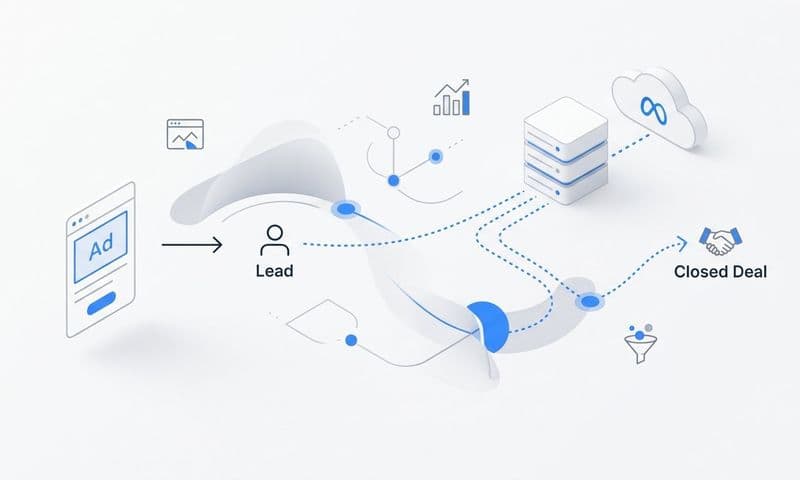
Connect your ad platforms to a centralized attribution tool. When Google Ads, Meta, and LinkedIn each report conversions in their own dashboards, you will almost always see double and triple counting. A prospect who saw a LinkedIn ad and then clicked a Google retargeting ad before converting will appear as a conversion in both platforms. A centralized attribution tool deduplicates these events and gives you a single, accurate view of what happened.
Integrate your payment and CRM tools as well. Connecting Stripe for revenue data and HubSpot or Salesforce for CRM data allows your attribution system to link marketing touches to actual subscription revenue, not just form fills. This is what makes it possible to calculate true return on ad spend by channel rather than cost per lead.
Use conversion sync to feed accurate, enriched conversion data back to your ad platforms. When Google and Meta receive better quality conversion signals, their optimization algorithms improve. Instead of optimizing toward any click or form submission, they learn to target the users who are most likely to become paying customers. This creates a compounding benefit: better data in means better targeting and lower cost per acquisition over time.
Before you scale any spend, run test conversions through each channel and confirm they appear correctly in your attribution system. Catching a misconfigured UTM or a broken server-side event before you have spent significant budget on a campaign is far less painful than discovering the problem during a quarterly review.
Step 5: Connect CRM and Revenue Data to Close the Attribution Loop
This is the step that separates teams with real attribution from teams with fancy dashboards that still cannot answer the question that matters most: which marketing investments actually drive revenue?
Most attribution setups capture top-of-funnel activity reasonably well. They can tell you which channels drive form fills and demo requests. But without connecting CRM and revenue data, you have no way to know whether those leads turned into opportunities, whether those opportunities closed, or what the average deal value was for customers acquired from each channel. Understanding revenue attribution for B2B SaaS companies is what bridges this critical gap.
Link your marketing touchpoints to CRM stages systematically. Your attribution tool should be able to follow a contact from their first marketing interaction through lead creation, MQL status, SQL acceptance, opportunity creation, and closed-won. When this chain is intact, you can calculate pipeline generated per channel and revenue per channel, not just leads per channel.
Enable your attribution tool to pull deal values and close dates from your CRM. This allows you to calculate true return on ad spend at the campaign level. A campaign that generated 200 leads at a low cost per lead might look excellent on the surface, but if those leads converted at a fraction of the rate of a smaller, more targeted campaign that generated 40 higher-quality leads, the second campaign is actually the better investment.
Account-level attribution deserves special attention in B2B SaaS. Because buying decisions involve multiple stakeholders, you need to group all the touchpoints associated with a single company together rather than treating each contact in isolation. When you look at a closed deal, you want to see every marketing interaction that any member of that buying committee had with your brand, weighted by the attribution model you have chosen.
Before you connect your CRM, address data hygiene. Missing lead source fields, inconsistent naming conventions in campaign fields, and duplicate contact records will all corrupt your attribution data. Run a data audit before you integrate systems. Clean up the most critical fields: lead source, campaign name, and deal stage. The quality of your attribution output is directly proportional to the quality of your CRM data.
The success indicator for this step is clear: you should be able to open any closed deal in your system and trace it back through every marketing and sales touchpoint that influenced it. If you can do that, your attribution loop is closed.
Step 6: Analyze Attribution Data and Reallocate Budget by Revenue Impact
With your tracking in place and your CRM connected, you now have the data to make smarter budget decisions. The goal of this step is to shift from reporting on activity to driving action based on revenue impact.
Build a channel-level view that shows attributed pipeline and revenue alongside cost. This view should answer the question: for every dollar spent on this channel, how much pipeline and closed revenue did it generate? Channels that look expensive on a cost-per-click basis might be highly efficient on a cost-per-acquired-customer basis. Channels that generate a high volume of leads at low cost might be producing low-quality pipeline that sales cannot close.
Look specifically for high-efficiency channels: those with low customer acquisition cost, strong close rates, and high customer lifetime value relative to acquisition cost. These are the channels that deserve increased investment before you optimize anything else. Building unified dashboards for marketing and sales attribution makes it far easier to spot these patterns at a glance.
Pay close attention to assisted conversions. In B2B SaaS, content marketing and brand campaigns rarely get last-touch credit, but they consistently appear in the early stages of winning deals. If you are evaluating channels only on a last-touch basis, you will systematically undervalue these efforts and over-invest in bottom-of-funnel channels that benefit from the intent those earlier touchpoints built.
Use AI-powered recommendations to surface optimization opportunities you might miss in manual analysis. Modern attribution platforms can identify patterns across thousands of conversion paths and flag campaigns that are underperforming relative to their spend, audiences that are saturating, or budget that could be reallocated to higher-potential campaigns across your ad platforms.
Run cohort analysis to compare customers acquired from different channels over time. Some channels might produce customers who churn quickly, while others produce customers with strong retention and expansion revenue. The channel with the highest initial conversion volume is not always the one that produces the best long-term business outcomes. Leveraging SaaS marketing analytics helps you surface these deeper insights across your entire funnel.
Create a regular attribution review cadence. A monthly or bi-weekly meeting where marketing and sales jointly review attributed pipeline and revenue data, then make concrete budget and campaign decisions based on what they see, is one of the highest-leverage habits a B2B SaaS marketing team can build.
Step 7: Iterate, Test, and Scale What Works
Attribution is not a one-time project. It is an ongoing practice that needs to evolve as your channels change, your buyer behavior shifts, and your data volume grows.
Revisit your attribution model at least quarterly. If you launched a new channel, changed your go-to-market motion, or shifted your ICP, your existing model may no longer reflect how buying decisions actually happen. The model that served you well at one stage of growth may need to be recalibrated at the next. Reviewing established SaaS marketing attribution best practices during these reviews helps ensure your framework stays current.
Run incrementality tests to validate what your attribution model is telling you. Pausing a channel for a defined period in a controlled way, or scaling it significantly while holding others constant, lets you observe whether the change produces the outcome your model predicted. Incrementality testing is one of the most reliable ways to confirm that your attribution data reflects reality rather than correlation.
As your conversion data volume grows, move toward data-driven or AI-powered attribution. These models learn from your actual conversion patterns and distribute credit in ways that rigid rule-based models cannot. They also adapt automatically as buyer behavior changes, which means they stay accurate without requiring manual reconfiguration.
Feed better conversion data back to your ad platforms continuously. Every time a deal closes, that signal should flow back to Google, Meta, and LinkedIn so their algorithms can learn what a high-value customer looks like. Over time, this creates a flywheel: better data produces better targeting, which produces higher-quality leads, which produces better data.
Document your attribution framework so that new team members and executive stakeholders understand how credit is assigned and how decisions are made. Attribution that lives only in one person's head is fragile. A written framework ensures that the logic is transparent, auditable, and transferable. If you are evaluating platforms to support this process, our comparison of the best marketing attribution tools for B2B SaaS is a useful starting point.
The clearest success indicator for this step is behavioral: your team makes budget decisions based on attributed revenue data rather than gut instinct or platform-reported metrics. When that shift happens, you have built something genuinely valuable.
Putting It All Together
Building a marketing attribution system for B2B SaaS is not a weekend project. But by following these seven steps in sequence, you create a foundation where every marketing dollar can be traced to its impact on pipeline and revenue.
Start by defining clear, revenue-focused goals and aligning your team on what counts as a meaningful conversion. Map your buyer journey before you touch a single tool. Choose a multi-touch attribution model that fits your sales cycle, and graduate to data-driven attribution as your data matures. Implement server-side tracking to capture what client-side pixels miss. Connect your CRM to close the loop between marketing touches and closed revenue. Analyze results through a revenue lens and reallocate budget based on what is actually working. Then keep iterating as your business scales.
The marketers who win in B2B SaaS are the ones who can confidently answer the question: which campaigns are actually driving revenue? With the right attribution setup, you will have that answer every time someone asks.
Cometly helps B2B SaaS teams capture every touchpoint across the full customer journey, connect marketing data to CRM revenue, and get AI-powered recommendations to optimize spend across every channel. From server-side tracking and multi-touch attribution to conversion sync and real-time analytics, Cometly gives you the complete picture your team needs to make smarter budget decisions.
If you are ready to move beyond guesswork and start making data-driven decisions with confidence, Get your free demo today and start capturing every touchpoint to maximize your conversions.