You're sitting in a meeting with leadership, and someone asks the question every marketer dreads: "Which of our marketing channels are actually working?" You glance at your dashboard—Meta says one thing, Google claims another, and your CRM tells a completely different story. You want to give a confident, data-backed answer, but instead you're left piecing together conflicting reports and making educated guesses about where your budget should really go.
This is the reality for most marketing teams. You're running campaigns across multiple platforms, spending thousands or even millions on ads, yet you can't definitively say which efforts drive actual revenue. You're making critical budget decisions based on incomplete data, gut feelings, and platform-reported metrics that each claim full credit for the same conversion.
Marketing attribution changes everything. It's not just another analytics tool that tracks clicks and impressions. It's the strategic framework that connects every touchpoint in your customer's journey to actual business outcomes. Attribution transforms vague questions like "is this working?" into specific, actionable insights like "this Meta campaign generated 47 qualified leads that converted to $180,000 in closed revenue, while this Google campaign spent twice as much and drove half the results."
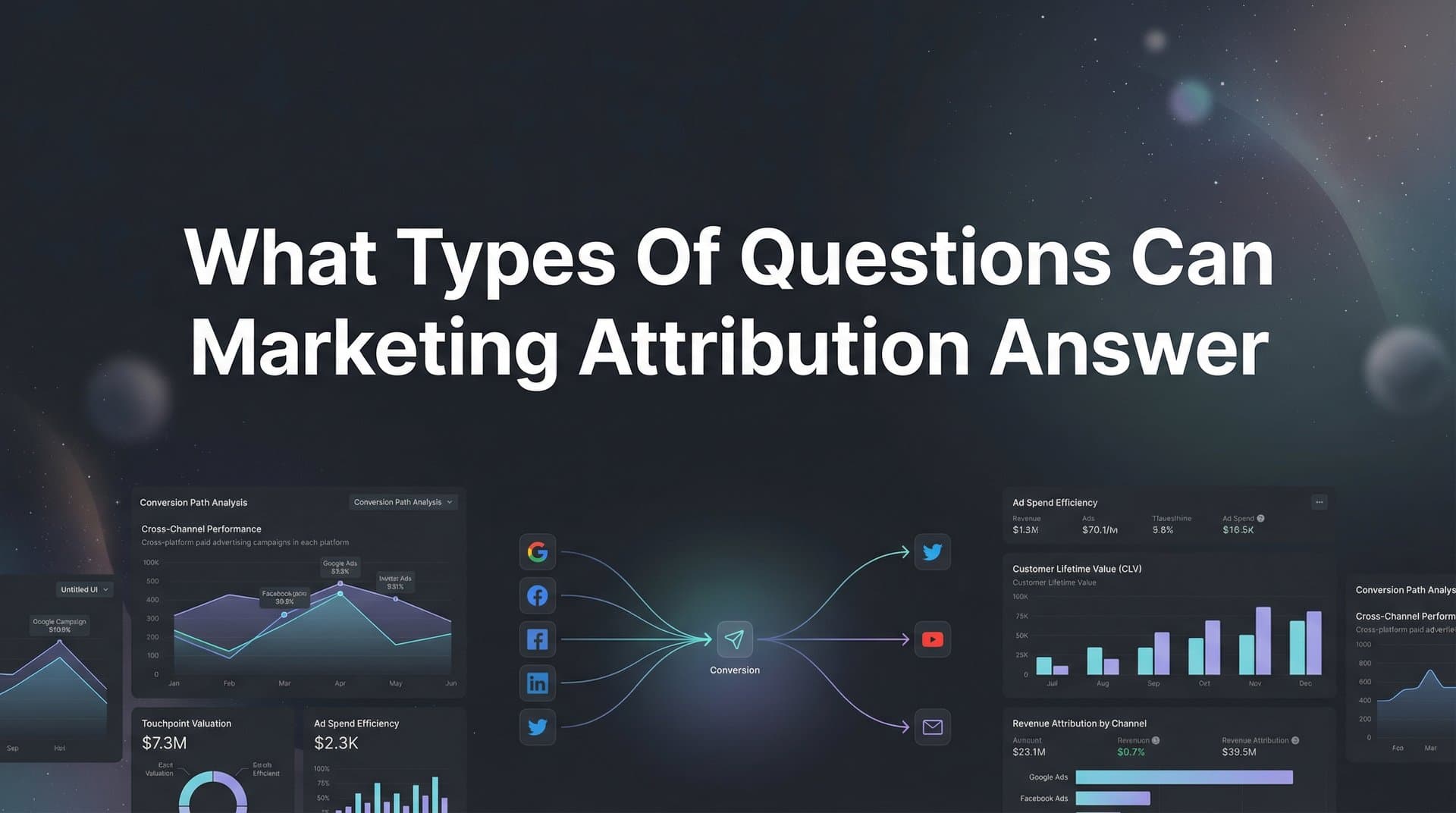
The power of attribution isn't in the data collection itself. It's in the questions it can answer—the strategic questions that determine whether you scale confidently or waste budget on underperforming channels. This guide breaks down the specific questions marketing attribution addresses across budget optimization, channel performance, customer journey understanding, revenue tracking, and growth planning. By the end, you'll understand exactly how attribution turns marketing from a cost center into a measurable growth engine.
Budget Allocation: Where Should Your Money Actually Go?
The most expensive mistake in marketing isn't running a bad campaign. It's continuing to fund channels that don't deliver while starving the ones that actually drive results. Without attribution, you're flying blind—increasing spend on platforms because they "feel" like they're working or because a competitor told you they're crushing it there.
Marketing attribution answers the fundamental budget question: which channels deserve more investment, and which are quietly draining resources? It reveals the truth behind platform-reported metrics. When Meta's dashboard shows 200 conversions and Google claims 150 for the same time period, attribution shows you which platform actually influenced the customer's decision versus which one happened to be the last click before conversion.
This matters because ad platforms are designed to make themselves look good. They use attribution windows that maximize their reported conversions. They count view-through conversions that may have had zero influence on the purchase decision. Attribution gives you an independent view of reality—one that tracks the customer journey across all platforms and assigns credit based on actual influence, not just proximity to the conversion. Understanding what attribution means in marketing is the first step toward breaking free from platform bias.
The question of diminishing returns becomes crystal clear with proper attribution. You might discover that your first $10,000 on LinkedIn generates a 4x return, but scaling to $30,000 drops you to 1.5x because you've exhausted your highest-intent audiences. Attribution shows you exactly when performance starts declining, allowing you to cap spend before you cross into unprofitable territory.
Budget reallocation decisions shift from guesswork to strategy. Instead of wondering whether you should move $5,000 from Google to Meta, attribution shows you the projected impact. You can see that Google drives 60% of your top-of-funnel awareness but Meta closes deals more efficiently. The answer isn't to eliminate Google—it's to optimize the ratio between discovery and conversion channels based on how they work together in your customer journey.
Many marketing teams find that their budget distribution looks nothing like their actual performance distribution. You might be spending 40% of your budget on a channel that drives 15% of revenue, while a channel receiving 10% of spend generates 35% of results. Attribution surfaces these misalignments immediately, giving you a clear roadmap for rebalancing investment toward what actually works.
Channel Performance: Which Campaigns Actually Convert?
Platform dashboards love to celebrate clicks, impressions, and engagement. Your Meta campaign got 10,000 clicks and a 2% CTR—sounds great, right? But attribution asks the question that actually matters: how many of those clicks turned into paying customers, and how much revenue did they generate?
This is where the gap between vanity metrics and business outcomes becomes painfully obvious. A campaign might generate impressive traffic and low cost-per-click, but if those visitors never convert or convert at significantly lower rates than other channels, you're optimizing for the wrong metric. Attribution connects ad performance to actual conversions, showing you which campaigns drive revenue versus which ones just drive clicks. Implementing channel attribution for revenue tracking reveals these critical performance gaps.
The comparison between channels becomes meaningful when you measure contribution, not just activity. Attribution reveals that your LinkedIn ads generate fewer clicks but higher-quality leads that close at 3x the rate of other channels. Your display ads create massive awareness but rarely drive direct conversions—they're influencers, not closers. Your search campaigns capture high-intent buyers ready to purchase. Each channel plays a different role, and attribution shows you exactly what that role is.
Identifying underperforming campaigns early saves massive amounts of wasted spend. Without attribution, you might run a campaign for weeks before realizing it's not delivering results. By then, you've burned through thousands in budget. Attribution provides real-time visibility into which campaigns are trending toward your target CPA and which are drifting off course. The right digital marketing attribution software can pause, pivot, or optimize before small problems become expensive mistakes.
The creative and messaging questions become answerable too. Which ad variations actually drive conversions versus which ones just get clicks? Attribution shows you that your benefit-focused ads convert better than feature-focused ones, or that video outperforms static images for your audience. You're not guessing based on engagement rates—you're seeing which creative elements influence actual purchase decisions.
Campaign performance also reveals timing and seasonality patterns. Attribution might show that your campaigns perform significantly better on certain days of the week or times of month. You discover that customers who engage with your ads on weekends convert at higher rates, or that the last week of the quarter drives disproportionate revenue. These insights allow you to concentrate spend during high-performance windows and reduce waste during low-conversion periods.
Customer Journey Mapping: How Do Buyers Actually Find You?
The single-touch conversion is mostly a myth. In reality, customers interact with your brand multiple times across different channels before they're ready to buy. They might see your LinkedIn ad, visit your website from organic search, read a blog post, click a retargeting ad, and then finally convert through a Google search. Attribution answers the critical question: what does this journey actually look like for your customers?
Understanding touchpoint quantity changes how you plan campaigns. If your typical customer needs seven interactions before converting, launching a campaign and expecting immediate results is unrealistic. Attribution shows you the average number of touchpoints required for conversion in your specific business, allowing you to set appropriate expectations and build campaigns designed for the actual journey length, not an imagined one.
But not all touchpoints carry equal weight. Some interactions genuinely influence the purchase decision, while others are just background noise. Attribution helps you distinguish between influential touchpoints and incidental ones. You might discover that customers who engage with your educational content convert at much higher rates, while those who only see display ads rarely progress. This insight shifts your content strategy toward what actually moves prospects through the funnel. Mastering multi-touch attribution in marketing is essential for understanding these complex buyer journeys.
The path from first click to closed deal reveals surprising patterns. Many businesses assume their customer journey is linear—awareness, consideration, decision. Attribution shows the reality is messier. Customers might start in the middle of your funnel, jump back to awareness content, skip to a demo request, then circle back to comparison content before finally converting. Understanding these non-linear paths helps you build campaigns that support how people actually buy, not how you wish they would buy.
Multi-channel attribution specifically answers which combinations of channels work together most effectively. You might find that customers who discover you through LinkedIn and then engage with Google search convert at 2x the rate of those who only use one channel. Or that organic social followed by paid search creates your highest-value customers. These insights reveal which channel combinations to intentionally orchestrate, rather than treating each platform as an isolated effort.
Revenue Connection: What's Your True Marketing ROI?
The ultimate question for any marketing team is simple: are we making more money than we're spending? But answering it requires connecting marketing activity to actual revenue, not just leads or form fills. Attribution bridges the gap between ad platforms and your CRM, showing you exactly which marketing efforts drive closed deals and how much revenue each channel generates.
This connection transforms how you calculate ROI. Instead of measuring cost-per-lead and hoping those leads eventually convert, you measure cost-per-customer and revenue-per-channel. You can definitively say "we spent $50,000 on this campaign and it generated $200,000 in closed revenue" rather than "we spent $50,000 and got 500 leads and we think some of them probably bought something." Leveraging marketing revenue attribution software makes this level of clarity possible.
The CRM integration is where attribution becomes truly powerful. When you connect marketing touchpoints to closed-won deals in your CRM, you see the complete picture. That LinkedIn ad didn't just generate a form fill—it started a relationship that led to a $50,000 annual contract. That webinar didn't just create engagement—it influenced three deals worth $180,000 combined. Attribution makes marketing's contribution to revenue undeniable.
Proving marketing value to leadership becomes straightforward when you have revenue data. Instead of defending your budget with traffic metrics and engagement rates, you walk into meetings with clear statements: "Marketing drove $2.4 million in pipeline this quarter, with an average ROI of 4.2x across all channels." You can show which campaigns directly contributed to the company's revenue goals and which investments are paying off.
The revenue lens also reveals customer lifetime value patterns by acquisition channel. Attribution might show that customers acquired through content marketing have 40% higher lifetime value than those from paid ads, even though the initial acquisition cost is similar. Or that customers who engage with multiple touchpoints before converting stay longer and spend more. These insights shift your strategy toward channels that don't just drive volume, but drive valuable, long-term customers.
Scaling Decisions: What's Ready for More Budget?
Every marketer wants to scale winning campaigns, but the critical question is: which campaigns can handle more budget without breaking? Just because a campaign performs well at $5,000 per month doesn't mean it will maintain that performance at $20,000. Attribution helps you identify which efforts are genuinely scalable and which will hit diminishing returns if you push harder.
The patterns in your attribution data reveal scalability signals. Campaigns with consistent performance across increasing spend levels, stable conversion rates as volume grows, and deep audience pools are prime candidates for scaling. Campaigns showing declining efficiency as spend increases, narrowing audience reach, or rising cost-per-acquisition are warning signs that you're approaching the ceiling. Understanding which attribution model is best for optimizing ad campaigns helps you identify these patterns accurately.
Attribution also answers the combination question: which mix of audience, creative, and platform creates repeatable success? You might discover that your highest-performing campaigns share common elements—they target mid-market companies, use case study creative, and run on LinkedIn. That's a formula you can replicate and scale with confidence. Without attribution, you might chalk up success to luck rather than recognizing the winning pattern you can deploy again.
Predicting performance before committing large budgets becomes possible when you have historical attribution data. You can look at how similar campaigns performed, identify the early indicators that predicted success or failure, and make informed projections about new initiatives. If campaigns targeting a specific industry consistently deliver 3x ROI, you can confidently invest in expanding that segment. If another segment has never broken even despite multiple attempts, you can avoid wasting budget there.
The scaling question extends beyond individual campaigns to entire channel strategies. Attribution shows you whether you've maxed out a platform's potential or if there's room for growth. You might be spending $30,000 monthly on Google Ads and wondering if you should double it. Attribution reveals whether your current spend is capturing most of your available search volume or if you're only scratching the surface. That data determines whether scaling makes sense or if you should diversify into new channels instead.
From Data to Decisions: Making Attribution Actionable
Having attribution data is one thing. Knowing what to do with it is another. The real value of marketing attribution emerges when you move from collecting information to making confident decisions based on insights. This shift requires both the right data and the right interpretation.
Modern attribution platforms have evolved beyond simple reporting. They provide AI-powered recommendations that translate data into specific actions. Instead of just showing you that Campaign A outperforms Campaign B, advanced systems suggest exactly how much budget to shift, which audiences to prioritize, and which creative elements to test next. This guidance transforms attribution from a measurement tool into a strategic advisor. Exploring how machine learning is used in marketing attribution reveals the technology powering these intelligent recommendations.
The feedback loop between attribution insights and ad platform optimization represents a significant advancement in marketing effectiveness. When you feed enriched conversion data back to platforms like Meta and Google, their algorithms learn what actual conversions look like, not just pixel fires. This conversion sync approach helps ad platforms optimize for real business outcomes—closed deals, high-value customers, revenue—rather than surface-level actions. The platforms get smarter about who to target, and your campaigns become more efficient over time.
Acting on attribution insights requires organizational buy-in. The data might reveal uncomfortable truths—that a channel leadership loves isn't performing, or that a new platform everyone was skeptical about is your top revenue driver. The most successful marketing teams use attribution data to align stakeholders around objective performance metrics rather than opinions or assumptions. When everyone agrees to follow the data, decision-making becomes faster and more effective. Understanding the purpose of attribution in digital marketing helps build this organizational alignment.
The continuous improvement cycle powered by attribution creates compounding returns. Each campaign you run generates data that makes the next campaign smarter. You learn which audiences respond best, which messages resonate, which channels work together effectively. Over time, your marketing becomes increasingly efficient as you eliminate what doesn't work and double down on what does. Attribution is the engine that powers this evolution from guesswork to precision.
Turning Questions Into Growth
Marketing attribution fundamentally transforms how you approach growth. It replaces uncertainty with clarity, gut feelings with data, and reactive adjustments with proactive strategy. The questions attribution answers—about budget allocation, channel performance, customer journeys, revenue impact, and scaling potential—are the same questions that determine whether your marketing drives real business growth or just generates activity.
The most successful marketing teams don't just use attribution to answer questions. They use it to ask better ones. Instead of "is this working?", they ask "how can we make this work better?" Instead of "should we try this channel?", they ask "what would success look like in this channel based on our attribution data?" The shift from reactive measurement to proactive optimization is what separates marketing teams that struggle from those that consistently drive growth.
The future of marketing belongs to teams that can connect every dollar spent to business outcomes. As privacy changes continue to limit traditional tracking methods and customer journeys become increasingly complex across devices and platforms, accurate attribution becomes more valuable, not less. Staying current with the latest trends in marketing attribution technology ensures your measurement capabilities evolve alongside these challenges.
Your marketing should be a measurable growth engine, not a cost center with unclear returns. The right attribution solution provides the visibility, insights, and AI-powered recommendations you need to make every campaign decision with confidence. When you can answer the strategic questions that drive budget allocation, channel optimization, and scaling decisions, you transform marketing from an expense into your most predictable revenue driver.
Ready to elevate your marketing game with precision and confidence? Discover how Cometly's AI-driven recommendations can transform your ad strategy—Get your free demo today and start capturing every touchpoint to maximize your conversions.