Ask any B2B SaaS marketing leader where their pipeline comes from, and you'll likely get a confident answer. Ask them to prove it with data, and the room gets quiet. This is the core frustration of B2B SaaS marketing: long sales cycles, multiple decision-makers, and a buyer journey so complex that connecting marketing activities to actual revenue feels nearly impossible.
In e-commerce, attribution is relatively straightforward. Someone clicks an ad, buys a product, and the platform reports a conversion. Clean, simple, done. B2B SaaS is an entirely different world. A single deal might involve 15 or more touchpoints spread across three to six months, with different stakeholders engaging at different stages through different channels. The CMO reads your blog. The VP of Sales watches your webinar. The end user searches for reviews on G2. None of that shows up cleanly in your ad platform dashboard.
This is where B2B SaaS pipeline attribution becomes essential. Pipeline attribution is the practice of mapping marketing activities not just to leads or MQLs, but to the actual qualified sales opportunities and closed revenue those activities generate. It shifts the conversation from "how many leads did we get?" to "which marketing investments are building our pipeline and driving growth?"
As budgets tighten and CFOs demand proof of marketing ROI, the ability to connect spend to pipeline is no longer a nice-to-have. It is a strategic requirement. This article breaks down how pipeline attribution works, which models make sense for B2B SaaS, how to build the technical foundation, and how to turn attribution data into decisions that actually move the business forward.
Why Traditional Lead Tracking Falls Short for B2B SaaS
Most marketing teams start with lead tracking because it is the easiest thing to measure. Someone fills out a form, they become a lead, and the marketing team gets credit. It feels like progress. The problem is that leads are not revenue, and in B2B SaaS, the gap between a lead and a closed deal can be enormous.
B2B SaaS deals rarely involve a single decision-maker. You might be selling to a team of five, with a champion driving internal adoption, a finance lead evaluating cost, and a technical stakeholder assessing integration requirements. Each of these people may engage with your marketing in completely different ways at completely different times. A single-touch attribution model that credits the first or last interaction completely ignores this reality. Understanding the difference between single-source and multi-touch attribution is critical for navigating these complex journeys.
Consider what happens when you rely on last-touch attribution in this environment. A prospect spends four months engaging with your content, attending your webinar, and comparing you against competitors. Then they click a branded search ad right before requesting a demo. Last-touch attribution gives all the credit to that branded search ad. Your content team, your webinar, and your top-of-funnel campaigns look like they generated nothing, when in reality they did most of the heavy lifting.
Tracking MQLs creates a similar distortion. Marketing teams optimized for MQL volume can easily hit their targets while generating pipeline that never converts. If your MQL definition does not correlate with actual pipeline creation and closed revenue, you are measuring the wrong thing and making budget decisions based on misleading signals.
The gap between ad platform reporting and CRM data makes this worse. Your ad platforms report conversions based on their own attribution windows and logic. Your CRM tracks deals based on sales activity. These two systems rarely speak the same language, and the disconnect means marketing is often operating on incomplete information. You might see strong conversion numbers in Google Ads while your CRM shows that those conversions never became qualified opportunities. Understanding why attribution data doesn't match across platforms is the first step toward solving this problem.
This is not a minor reporting inconvenience. When budgets are allocated based on inaccurate attribution data, high-performing channels get underfunded and underperforming ones continue to consume resources. The result is a marketing strategy built on a flawed foundation, optimizing for metrics that do not reflect business outcomes.
The Anatomy of B2B SaaS Pipeline Attribution
Pipeline attribution at its core is about connecting the dots between marketing activity and business results. More specifically, it is the process of mapping every marketing touchpoint across the full buyer journey to the creation of qualified sales opportunities and, ultimately, closed revenue.
This definition matters because it sets the right goal. You are not trying to prove that marketing generated clicks or impressions. You are trying to demonstrate that specific marketing investments created pipeline that sales could work and close. That is the language finance and leadership understand, and it is the conversation that a strong SaaS marketing attribution strategy equips you to have.
There are three core components that make pipeline attribution work.
Touchpoint Tracking: Every interaction a prospect has with your brand needs to be captured. This includes paid ad clicks, organic search visits, content consumption, email opens and clicks, webinar registrations and attendance, social media engagement, and direct website visits. The more complete your touchpoint data, the more accurate your attribution will be.
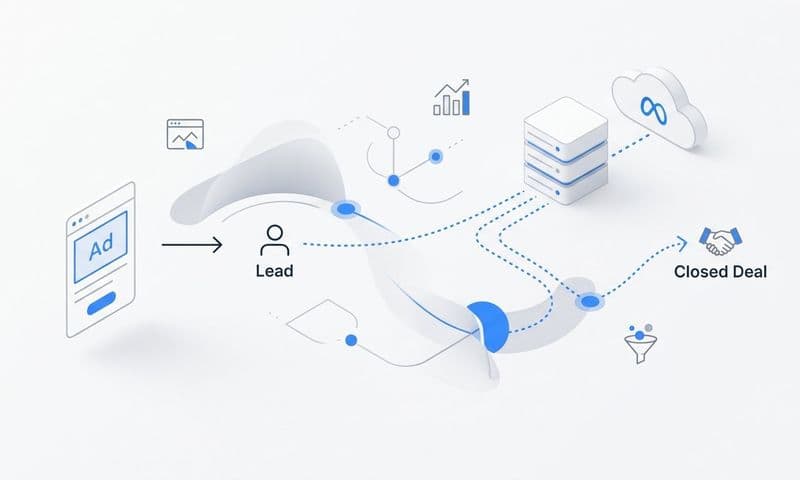
CRM Integration: Touchpoint data alone is not enough. You need to connect those touchpoints to pipeline stage data in your CRM. When a prospect becomes a qualified opportunity, you need to know which marketing touches preceded that moment. When a deal closes, you need to trace it back through the entire journey. CRM integration is the bridge between marketing activity and business outcomes.
Attribution Modeling: Once you have touchpoints and pipeline data connected, attribution models distribute credit across the journey. Different models answer different questions, and choosing the right one (or comparing several) gives you the insight to make better decisions.
To make this concrete, consider a realistic B2B SaaS buyer journey. A VP of Operations at a mid-market company sees a LinkedIn ad promoting a guide on operational efficiency. She downloads the guide and is added to a nurture sequence. Three weeks later, she reads a blog post on your site after a Google search. Two months after that, she registers for a webinar on workflow automation. A colleague mentions your product in a Slack community. She returns to your site directly, watches a product demo video, and then requests a live demo. The deal enters the pipeline.
In this scenario, which touchpoint gets credit? The LinkedIn ad that created initial awareness? The blog post that educated her? The webinar that deepened engagement? The word-of-mouth mention that reinforced credibility? The demo request that converted her? The honest answer is that all of them contributed. Pipeline attribution is the discipline of acknowledging that reality and distributing credit in a way that reflects the actual buyer journey, so you can invest more in what works across the entire funnel.
Attribution Models That Actually Work for Pipeline Tracking
Choosing an attribution model is not about finding the one "correct" answer. It is about choosing the lens that helps you answer the specific question you are asking. In B2B SaaS, different models reveal different truths about your pipeline, and the smartest teams use multiple models in combination.
Here is how the most common models apply specifically to B2B SaaS pipeline creation.
First-Touch Attribution: Gives 100% of the credit to the first interaction a prospect had with your brand. This model is useful for understanding which channels are best at creating awareness and bringing new prospects into your funnel. If you want to know which campaigns are most effective at generating net-new pipeline candidates, first-touch gives you a clear signal. Its weakness is that it ignores everything that happened after that initial interaction, which in a long B2B sales cycle, is most of the journey.
Last-Touch Attribution: Gives all credit to the final touchpoint before a prospect became pipeline or converted. This is useful for understanding which channels are most effective at closing the loop and driving conversion actions like demo requests or trial signups. The problem in B2B SaaS is that last-touch systematically undervalues top-of-funnel and mid-funnel activity, creating a bias toward bottom-of-funnel channels like branded search.
Linear Attribution: Distributes credit equally across every touchpoint in the journey. This model is democratic and avoids the extremes of first and last-touch, but it treats every interaction as equally important, which is rarely true. A quick blog visit and a 45-minute webinar attendance both get the same credit, which can obscure which touchpoints are actually driving pipeline engagement. Exploring the most commonly used attribution model approaches can help you understand the tradeoffs involved.
Time-Decay Attribution: Gives more credit to touchpoints closer to the conversion event, with credit decreasing as you move further back in time. This model reflects the intuition that recent interactions are more influential, which can be true in shorter sales cycles. For long B2B SaaS cycles, it risks undervaluing the early awareness touchpoints that put your brand on the prospect's radar in the first place.
Position-Based (U-Shaped) Attribution: Assigns the most credit to the first and last touchpoints, with remaining credit distributed across the middle. This model acknowledges that both the moment of initial awareness and the moment of conversion are particularly significant, making it a popular choice for B2B SaaS teams who want to value both acquisition and conversion without completely ignoring the middle of the journey.
Here is the key insight: no single model captures the full picture for B2B SaaS. The real value comes from comparing models side by side. When you look at the same set of pipeline opportunities through multiple attribution lenses, patterns emerge. A channel that looks mediocre in last-touch might look exceptional in first-touch, revealing that it is a powerful awareness driver that deserves investment even though it rarely gets direct conversion credit. Comparing models helps you make budget decisions with much greater confidence than relying on any single view.
Multi-touch attribution is not just recommended for B2B SaaS, it is essential. The buyer journey is too complex and too long for single-touch models to provide an accurate picture. The best multi-touch attribution tools help you capture the full journey so your budget allocation reflects reality.
Building Your Pipeline Attribution Stack
Understanding attribution models is the strategic layer. Building the technical foundation is what makes it actually work. Without the right infrastructure, your attribution data will be incomplete, inaccurate, or both.
The three pillars of a solid pipeline attribution stack are server-side tracking, CRM integration, and conversion syncing.
Server-Side Tracking: Traditional pixel-based tracking has become increasingly unreliable. Apple's App Tracking Transparency framework, the deprecation of third-party cookies in major browsers, and the widespread adoption of ad blockers all degrade the accuracy of client-side tracking. When pixels fire in the browser, a significant portion of events are never captured, creating gaps in your attribution data that skew every model you run.
Server-side tracking solves this by moving data collection from the browser to your server. Instead of relying on a pixel to fire in the user's browser, events are captured server-side and sent directly to your analytics and ad platforms. This approach is far more reliable because it is not subject to browser restrictions, privacy settings, or ad blockers. The result is more complete data, which means more accurate attribution and better decisions. Implementing robust SaaS marketing attribution tracking is the foundation everything else depends on.
CRM Integration: Your CRM is where pipeline lives. Without connecting your marketing touchpoint data to your CRM's pipeline stages and deal records, you cannot perform true pipeline attribution. You need a system that can match marketing touches to CRM contacts and accounts, and then track those contacts as they progress through pipeline stages. When a deal closes, that revenue should be traceable back through every marketing interaction that contributed to it.
This integration is what allows you to answer the questions that matter most: which campaigns generated the most pipeline? Which channels produce the highest average deal size? Which content drives prospects to become qualified opportunities faster?
Conversion Syncing: Once you have rich conversion data, feeding it back to ad platforms like Meta and Google is a significant opportunity. Ad platform algorithms are designed to optimize for conversions, but by default, they optimize for whatever conversion event you give them. If you feed them form fills, they optimize for form fills, which may or may not correlate with pipeline quality.
When you sync enriched, pipeline-stage conversion data back to ad platforms, their algorithms can optimize for the outcomes that actually matter to your business. This leads to better targeting, lower cost per qualified opportunity, and ad spend that is working harder for you. Dedicated revenue attribution tracking tools make this feedback loop possible at scale.
From Data to Decisions: Acting on Pipeline Attribution Insights
Pipeline attribution data is only valuable if it changes how you make decisions. The goal is not to build a beautiful attribution dashboard that nobody acts on. It is to create a feedback loop where attribution insights directly inform budget allocation, campaign strategy, and channel investment.
The most immediate application is identifying which channels and campaigns generate not just leads, but revenue-stage opportunities. When you can see that a specific content campaign consistently produces prospects who become qualified pipeline, you have a compelling case to invest more. When you can see that a high-volume lead generation campaign produces almost no pipeline, you have an equally compelling case to cut or restructure it. Tracking the right essential metrics every SaaS company should care about ensures you are measuring what actually matters.
This kind of analysis often reveals hidden gems. Channels or campaigns that look underwhelming on surface-level metrics like click-through rate or cost per lead sometimes show up as strong pipeline contributors when you trace deals back through the full journey. Without pipeline attribution, these high-performers stay hidden and underfunded.
The reverse is also true. Campaigns that look impressive on vanity metrics often fail to generate qualified pipeline when you trace deals back. These are the budget drains that attribution data exposes. They are generating activity, but not business results, and that distinction is worth real money.
AI-powered recommendations accelerate this process significantly. Instead of manually analyzing attribution data across dozens of campaigns and channels, AI can surface the patterns and optimization opportunities that matter most. Which campaigns should get more budget? Which ad sets are underperforming relative to their pipeline contribution? Where is there untapped opportunity? Getting these answers quickly means faster decisions and a tighter feedback loop between data and action.
The practical cadence for most teams is to review pipeline attribution data weekly for tactical adjustments and monthly for strategic budget reallocation. The key is building the habit of connecting marketing decisions to pipeline outcomes rather than to surface-level platform metrics.
Common Pipeline Attribution Pitfalls and How to Avoid Them
Even teams with solid attribution infrastructure run into predictable mistakes. Knowing what to watch for saves time and prevents costly misinterpretations of your data.
Tracking Only Online Touchpoints: B2B SaaS deals frequently involve interactions that never show up in your digital tracking. Sales calls, in-person events, partner referrals, community mentions, and word-of-mouth conversations all influence pipeline creation, but they are invisible to most attribution systems. This is sometimes called the "dark funnel," and it is a real limitation that every attribution platform faces.
The honest approach is to acknowledge this gap rather than pretend it does not exist. You can partially address it by adding offline event tracking, using UTM parameters for event-driven traffic, and capturing referral source data in your CRM. Comparing UTM tracking versus attribution software helps you understand the strengths and limitations of each approach. You will not achieve perfect visibility, but you can reduce the blind spots meaningfully.
Waiting for Perfect Data Before Acting: Attribution data is never perfect. Privacy changes, tracking limitations, and the inherent complexity of multi-stakeholder B2B journeys mean there will always be gaps. Teams that wait for perfect data before making decisions end up in analysis paralysis, spending months refining their tracking setup while competitors are already acting on imperfect but actionable insights.
A solid multi-touch attribution model with good server-side tracking and CRM integration gives you far more signal than single-touch models or no attribution at all. Start there, make decisions based on what you can see, and iterate as your data quality improves over time. Reviewing SaaS marketing attribution best practices can help you avoid common missteps along the way.
Misalignment Between Marketing and Sales: Attribution only works when marketing and sales agree on what they are measuring. If marketing counts a prospect as pipeline-sourced but sales considers the deal to have come from a direct referral, you will have attribution data that nobody trusts. This erodes confidence in the entire system.
Invest time upfront in aligning on definitions: what counts as a marketing-sourced opportunity versus a marketing-influenced one, how pipeline stages map to marketing funnel stages, and how credit is assigned when both marketing and sales played a role. These conversations are sometimes uncomfortable, but they are essential for building attribution data that both teams believe in and act on.
Putting It All Together
B2B SaaS pipeline attribution is not just a reporting upgrade. It is a strategic capability that changes how marketing teams allocate budgets, prove value, and contribute to growth. When you can trace pipeline and revenue back to specific marketing investments, you move from defending your spend to confidently scaling what works.
The goal is not perfect attribution. The goal is better attribution: a system that gives you enough signal to make smarter decisions than you could make without it. Start with multi-touch models, build the technical foundation with server-side tracking and CRM integration, feed enriched data back to your ad platforms, and create a decision-making rhythm around the insights you generate.
Teams that do this well stop arguing about whether marketing is contributing to the business. They show it, in pipeline numbers and revenue outcomes that finance and leadership can see clearly.
Cometly is built to solve exactly these challenges. With multi-touch attribution, server-side tracking, CRM integration, conversion syncing to Meta and Google, and AI-powered optimization recommendations, Cometly gives B2B SaaS marketing teams the complete attribution stack they need to connect every touchpoint to pipeline and revenue. If you are ready to move beyond lead metrics and start proving the real impact of your marketing, Get your free demo today and see how Cometly can transform the way you track, analyze, and optimize your campaigns.