You've invested real budget into paid campaigns across Meta, Google, and LinkedIn. Your ads are running, leads are coming in, and your team is working hard to close deals. But when you pull up your attribution dashboard, something feels off. The numbers don't add up. Conversions look lower than expected, your cost per acquisition seems inflated, and you can't quite pinpoint which campaigns are actually driving pipeline.
This isn't a campaign strategy problem. It's a tracking problem. And for B2B SaaS marketers, it's gotten significantly worse since Apple introduced its App Tracking Transparency framework in 2021.
The ripple effects of iOS privacy changes have touched every digital advertiser, but B2B SaaS companies face a uniquely difficult version of this challenge. Longer sales cycles, multi-stakeholder buying journeys, and cross-device research patterns mean that the gaps created by iOS restrictions don't just cause minor reporting discrepancies. They cause complete attribution breakdowns. The gap between what your ad platforms report and what's actually driving revenue can be substantial, and decisions made on that incomplete data cost real money.
This article breaks down exactly how iOS limitations affect B2B SaaS tracking, why the impact is disproportionately severe for this business model, and what practical steps you can take to reclaim visibility into your full customer journey.
How Apple's Privacy Changes Disrupted Digital Ad Tracking
When Apple launched iOS 14.5 in April 2021, it introduced the App Tracking Transparency framework, which fundamentally changed how advertisers could track user behavior on Apple devices. Before ATT, advertisers could access a device-level identifier called the IDFA (Identifier for Advertisers), which allowed ad platforms to link ad exposures to downstream actions across apps and websites. ATT required apps to explicitly ask users for permission to access this identifier.
The result was predictable: the vast majority of users decline the tracking prompt when asked. With IDFA access stripped from most iOS traffic, ad platforms lost a critical signal for matching ad clicks to conversions. What had been a relatively clean, deterministic tracking method became fragmented and unreliable almost overnight.
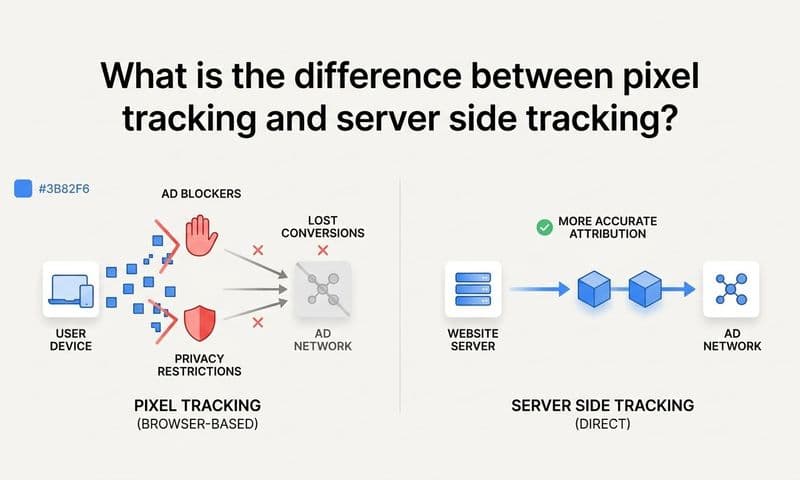
The cascading effects hit quickly. Browser-based tracking pixels, which rely on cookies and device identifiers to connect ad clicks to site behavior, became far less effective for iOS users. Ad platforms like Meta and Google found themselves with incomplete conversion data, which forced them to supplement real signals with modeled and estimated conversions. Understanding tracking pixel limitations is essential for any marketer navigating this landscape.
Safari's Intelligent Tracking Prevention (ITP) compounds the issue further, and it predates ATT by several years. ITP aggressively limits cookie lifespans to protect user privacy. Third-party cookies are blocked entirely in Safari. Some first-party cookies set via JavaScript are capped at as little as 24 hours, and others expire within seven days. For any marketing funnel where the time between first click and conversion exceeds a week, Safari's ITP alone can sever the tracking thread entirely.
Together, ATT and ITP create a double layer of signal loss. ATT eliminates device-level cross-app tracking for the majority of iOS users, while ITP limits cookie-based tracking even for users who visit your website directly. The result is that a significant and growing portion of your traffic leaves virtually no trackable footprint that browser-based pixels can follow.
Ad platforms have adapted by leaning more heavily on probabilistic matching, modeled conversions, and first-party signals. But these methods introduce uncertainty. When the data feeding your optimization decisions is partly estimated rather than observed, the reliability of your entire measurement framework comes into question.
Why B2B SaaS Funnels Are Hit Harder Than Most
E-commerce businesses deal with iOS limitations too, but their funnels are relatively short. A user sees an ad, clicks, browses, and often converts within the same session or within a few days. Even with degraded tracking, there's a reasonable chance the conversion gets attributed correctly because the window between click and purchase is narrow.
B2B SaaS doesn't work that way. Sales cycles in this space routinely span 30 to 90 days or longer, depending on deal size and organizational complexity. A prospect might click a LinkedIn ad on their phone during their commute, research your product on their work laptop later that week, attend a webinar from a tablet two weeks later, and finally request a demo from their desktop after a team discussion. That's four touchpoints across four devices over several weeks, and iOS restrictions make it nearly impossible to stitch that journey together using client-side tracking alone.
The multi-stakeholder nature of B2B buying amplifies this problem. Enterprise and mid-market SaaS deals often involve multiple decision-makers, each conducting their own independent research. Effective tracking for B2B marketing campaigns must account for these fragmented journeys across stakeholders and devices.
The high-value nature of B2B SaaS conversions makes this especially painful. Your most important conversion events, such as demo requests, free trial signups, and contract closes, happen far downstream from the initial ad click. When tracking breaks at the top of the funnel because a cookie expired or an iOS user opted out of tracking, you lose visibility into the entire chain that led to that revenue. You can't credit the right campaign, you can't identify which channels are actually driving pipeline, and you can't confidently allocate budget toward what's working.
This is fundamentally different from losing attribution on a $50 e-commerce purchase. In B2B SaaS, a single untracked conversion might represent thousands or tens of thousands of dollars in annual recurring revenue. At scale, the cumulative blind spots in your attribution data can translate into significant misallocation of marketing budget and missed opportunities to double down on high-performing channels.
The longer the sales cycle and the more complex the buying committee, the more severe the iOS tracking problem becomes. B2B SaaS sits at the extreme end of that spectrum.
The Hidden Cost: How Bad Data Poisons Ad Platform Algorithms
Here's where the problem gets even more serious. It's not just that your reporting is inaccurate. It's that inaccurate reporting actively degrades your campaign performance by corrupting the machine learning models that power modern ad platforms.
Meta, Google, and other platforms rely on conversion signals to train their algorithms. When you run a campaign and users convert, those conversion events tell the algorithm what a valuable user looks like, which enables it to find more users with similar characteristics. This feedback loop is the engine behind smart bidding strategies and audience optimization. It only works when the conversion data flowing back to the platform is accurate and complete.
When iOS restrictions block conversion signals from reaching these platforms, the algorithm is working with a fraction of the picture. It sees fewer conversions than actually occurred, which leads it to conclude that certain audiences, creatives, or placements are underperforming. Many marketers don't realize the importance of tracking conversions after the iOS update to prevent this exact scenario.
The feedback loop becomes self-defeating. Fewer accurate conversions reported means worse algorithm performance. Worse algorithm performance means higher costs and less efficient targeting. Higher costs mean you get fewer clicks and conversions for the same budget, which further starves the algorithm of the signal it needs to improve. Many B2B SaaS marketers find themselves in this cycle without realizing the root cause is a data quality problem, not a creative or strategy problem.
The CPA and ROAS figures you see in platform dashboards can be misleading in another way too. Because iOS users who opt out of tracking are largely invisible to pixel-based attribution, the conversions that do get tracked skew heavily toward non-iOS users and users on browsers that are less restrictive than Safari. This creates a biased sample. Your reported performance metrics reflect a subset of your actual customer base, and that subset may behave differently from your iOS and Safari users in ways that distort your optimization decisions.
The practical implication is that you may be systematically underfunding campaigns that perform well among iOS users, simply because those conversions aren't making it back to the platform. Fixing your tracking infrastructure isn't just about better reporting. It's about feeding your ad platforms the data they need to actually optimize effectively on your behalf.
Server-Side Tracking: The Foundation for Accurate B2B Attribution
The core problem with browser-based pixel tracking is that it depends on the browser and device to cooperate. When iOS restricts IDFA access and Safari limits cookie lifespans, client-side tracking loses its ability to connect the dots. Server-side tracking takes a fundamentally different approach by removing the browser from the equation entirely.
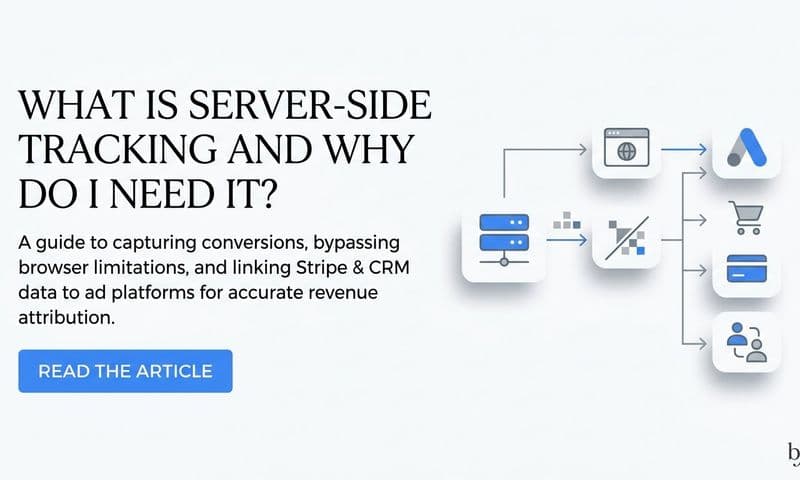
With server-side tracking, conversion events are captured and sent from your own server directly to ad platforms, rather than relying on a JavaScript pixel firing in the user's browser. Understanding why server-side tracking is more accurate helps explain why this approach has become essential for modern attribution.
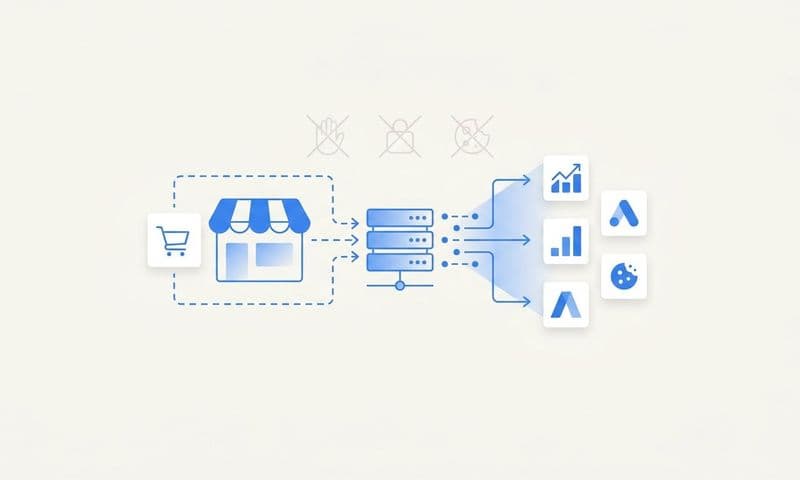
For B2B SaaS specifically, server-side tracking opens up a critical capability: the ability to track conversion events that happen outside the browser entirely. Think about what a complete B2B funnel actually looks like. A prospect clicks an ad and visits your website. That's a browser event. They fill out a demo request form. That's another browser event. But then they attend the demo, get handed to a sales rep, move through a CRM pipeline, and eventually sign a contract. Those downstream events live in your CRM, not in any browser session. Server-side infrastructure can capture CRM events like "demo completed," "opportunity created," or "deal closed" and pass them back to your ad platforms as conversion signals.
This is where Meta's Conversions API (CAPI) and Google's Enhanced Conversions come in. These are server-side solutions built specifically to supplement or replace pixel-based tracking. You can explore the leading conversion API tracking tools to find the right fit for your stack. CAPI allows you to send conversion events directly from your server to Meta, using hashed first-party data like email addresses to match events to users even when the IDFA is unavailable. Google's Enhanced Conversions works similarly, using hashed customer data to improve conversion matching accuracy.
The key word is "enriched." Server-side tracking is most powerful when the data you're sending is enriched with first-party identifiers collected through your own systems, such as email addresses from form fills, CRM contact IDs, or other user-level data your business already holds. This enriched data dramatically improves the match rate between your conversion events and actual users in the ad platform, which in turn improves the quality of the signal feeding the algorithm.
Implementing server-side tracking properly requires infrastructure investment and technical setup, but the payoff is a tracking foundation that remains reliable regardless of what browsers or operating systems do next. As privacy restrictions continue to tighten, server-side infrastructure is not optional for B2B SaaS marketers who want accurate data.
Multi-Touch Attribution: Connecting the Full B2B Journey
Even with server-side tracking in place, you still face the challenge of making sense of a complex, multi-touchpoint B2B journey. A prospect might interact with your brand a dozen times before converting, across paid search, social ads, organic content, email, and direct visits. Understanding which of those touchpoints actually drove the decision is where multi-touch attribution becomes essential.
Multi-touch attribution models distribute conversion credit across every touchpoint in the customer journey rather than assigning all credit to a single interaction. This is fundamentally better suited to B2B SaaS than last-touch attribution, which credits only the final interaction before conversion and systematically undervalues the awareness and consideration channels that initiated and nurtured the journey. Implementing proper SaaS marketing attribution tracking is what separates data-driven teams from those flying blind.
The real power emerges when you combine server-side data with CRM integration. When your attribution platform can ingest both ad platform data and CRM events, it can reconstruct journeys that iOS restrictions would otherwise fragment or erase. A prospect who clicked a Meta ad on their iPhone three months ago, then converted through a Google search on their laptop last week, can be connected into a single coherent journey using first-party identifiers like email addresses that persist across devices and sessions.
Different attribution models tell different stories, and comparing them is genuinely valuable. First-touch attribution highlights which channels are best at generating initial awareness. Last-touch attribution shows what's closing deals. Linear attribution spreads credit evenly and gives you a balanced view of the full journey. Time-decay models weight recent touchpoints more heavily, which can be useful for understanding what accelerates deals in the final stages. No single model is universally correct, but having the ability to compare them gives you insight that any single model would obscure.
For B2B SaaS marketers trying to understand pipeline contribution by channel, building a robust revenue attribution framework connected to CRM data is the closest thing to a ground truth available. It lets you move beyond platform-reported metrics, which are inherently biased by tracking gaps, and build a picture of revenue attribution grounded in your own first-party data.
A Practical Playbook for Reclaiming Your Tracking Accuracy
Understanding the problem is one thing. Fixing it requires a structured approach. Here's how to systematically address B2B SaaS tracking gaps created by iOS limitations.
Start with a tracking audit: Before implementing solutions, quantify the gap you're dealing with. Pull your platform-reported conversions from Meta, Google, and other channels over the past 90 days. Then pull the actual conversion data from your CRM for the same period. Compare them. The discrepancy between what your ad platforms claim to have driven and what your CRM actually shows is your tracking gap. This exercise often reveals that the problem is larger than marketers expect, and it creates a baseline for measuring improvement after you implement fixes.
Implement server-side tracking and conversion sync: Once you know the size of your gap, the next step is building the infrastructure to close it. Set up server-side event tracking to capture conversion events from your website and CRM and send them to your ad platforms via CAPI and Enhanced Conversions. Reviewing the top server-side tracking platforms can help you evaluate your options. Use enriched first-party data, particularly hashed email addresses collected at form fill, to maximize match rates. Then sync these enriched conversion events back to Meta, Google, and other platforms so their algorithms receive accurate, complete signals. This directly improves targeting quality and campaign optimization, which means better results for the same budget.
Adopt a unified attribution platform: Platform-native attribution dashboards only show you what happened inside their own ecosystem. To understand the full B2B journey, you need a tool that connects your ad platforms, your website, and your CRM in one place. Exploring the best marketing attribution tools for B2B SaaS is a smart starting point for finding the right solution. When your attribution platform is pulling from server-side data and CRM events rather than relying solely on browser pixels, the picture it shows you is far more reliable.
Cometly is built specifically for this challenge. It captures every touchpoint from ad click through CRM events, connects ad performance to actual revenue, and feeds enriched conversion data back to ad platforms so their algorithms can optimize effectively. The AI-powered analytics layer surfaces which campaigns and channels are genuinely driving pipeline, not just clicks, so you can scale with confidence rather than guesswork.
The playbook isn't complicated, but it does require deliberate action. Audit your gaps, fix your infrastructure, and adopt tools that give you a complete view of the journey. The marketers who do this will have a meaningful data advantage over those who continue relying on incomplete platform reporting.
The Bottom Line for B2B SaaS Marketers
iOS limitations are not a temporary inconvenience. Apple's privacy-first direction has reshaped the tracking landscape permanently, and the broader industry trend toward user privacy means restrictions are more likely to tighten than loosen in the years ahead. For B2B SaaS marketers, adapting to this reality isn't optional. It's a competitive necessity.
The companies that continue relying on browser-based pixels and platform-reported metrics will increasingly make budget decisions based on incomplete, biased data. The companies that move to server-side tracking, enrich their conversion signals, and adopt multi-touch attribution connected to CRM data will have a clearer picture of what's actually driving revenue and the confidence to act on it.
Cometly helps B2B SaaS teams do exactly this. By capturing every touchpoint across the full customer journey, connecting ad performance to real revenue outcomes, and feeding better data back to ad platform algorithms, Cometly restores the visibility that iOS restrictions have taken away. You get accurate attribution, smarter optimization, and the clarity to scale what's working.
If your current attribution data feels incomplete or your platform metrics don't match your CRM reality, it's time to close that gap. Get your free demo today and start capturing every touchpoint to maximize your conversions.