

You just closed a high-value deal. Your CRM shows the conversion, your team is celebrating, and then you open your ad dashboards. Meta claims full credit. Google Ads says it drove the sale. LinkedIn reports it as a conversion too. TikTok shows an assist. When you add up what each platform reports, you've somehow generated 340% of your actual revenue.
Sound familiar?
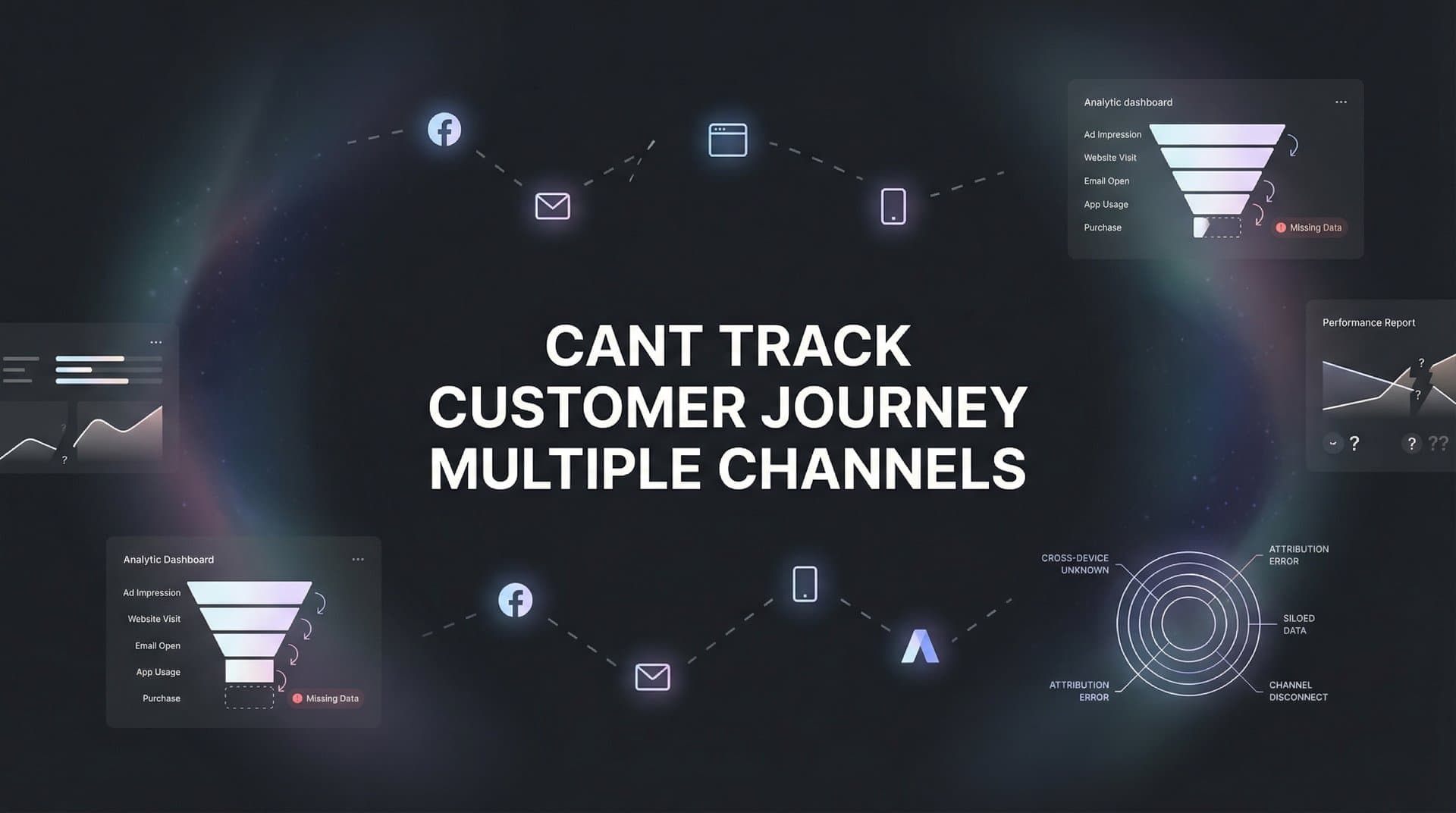
This isn't a tracking glitch. It's the reality of running campaigns across multiple channels in 2026. Every platform operates in its own universe, each one eager to claim credit for conversions it may have barely influenced. Meanwhile, you're left trying to piece together a customer journey that spans five different ad accounts, three devices, and a dozen touchpoints, with no clear picture of what actually worked.
The frustration goes beyond messy dashboards. When you can't track the customer journey across multiple channels, you can't optimize with confidence. Budget decisions become guesswork. High-performing channels get underfunded while underperformers drain your spend. You're flying blind with six-figure ad budgets on the line.
Here's the good news: multi-channel tracking challenges are solvable. The infrastructure exists to connect every touchpoint from first click to final conversion. But first, you need to understand why traditional tracking methods fall apart and what modern solutions actually work in today's privacy-first landscape.
The Data Fragmentation Problem Behind Broken Customer Journeys
The core issue isn't that tracking technology doesn't exist. It's that every advertising platform built its own tracking ecosystem with zero intention of playing nicely with competitors.
Meta has its pixel. Google has its tag. LinkedIn, TikTok, Twitter, Pinterest—each one requires its own tracking code. These pixels were designed to capture data for their respective platforms, not to communicate with each other. When a customer clicks a LinkedIn ad, browses your site, then converts three days later after clicking a Google ad, each platform sees only its own piece of the puzzle.
This creates what marketers call "data silos." Your Meta dashboard shows conversions that happened after someone clicked a Meta ad. Your Google Ads account shows conversions that happened after someone clicked a Google ad. But neither system knows about the other's involvement. Neither can tell you that the same person interacted with both channels before converting. Understanding customer journey tracking gaps is essential for diagnosing where your data breaks down.
The fragmentation gets worse when you factor in cross-device behavior. Your customer might discover your brand on their phone during a morning commute, research on their tablet over lunch, and finally convert on their desktop at work. Traditional cookie-based tracking treats these as three separate users because cookies don't transfer between devices.
Think about your own behavior. You probably start researching products on your phone, continue on your laptop, maybe check reviews on your tablet. That's one customer journey spanning three devices. But to most tracking systems, that looks like three different people who all mysteriously abandoned their carts.
The identity gap this creates is massive. When tracking can't connect the dots across devices, you lose visibility into how your channels work together. That LinkedIn ad that introduced someone to your brand? It gets zero credit because the conversion happened on a different device after a Google search. This is why customer journey tracking across devices has become a critical capability for modern marketers.
Then there's the attribution window problem. Meta might use a 7-day click and 1-day view window. Google Ads defaults to 30 days. Your CRM tracks everything back to the original source indefinitely. When the same conversion falls within multiple attribution windows, every platform claims it. The math stops making sense, and you're left with conversion counts that exceed your actual sales.
This isn't a technical bug you can patch. It's a fundamental architecture problem. Each platform was built to optimize its own performance, not to give you an accurate view of how channels interact. The data fragmentation is a feature, not a flaw, because it makes each platform look more effective than it actually is.
How Privacy Changes Shattered Traditional Tracking Methods
Just when marketers had learned to navigate the chaos of multiple tracking pixels, privacy regulations and platform policies fundamentally changed the game.
Apple's iOS App Tracking Transparency framework, introduced in 2021 and now the standard across all iOS devices, requires apps to ask permission before tracking users across other apps and websites. Most users decline. This single change eliminated the ability to track a massive portion of mobile traffic using traditional methods.
The impact extends far beyond iOS devices. When someone opts out of tracking, your Meta pixel can't see what they do after leaving Facebook. Your Google tag loses visibility into cross-site behavior. The customer journey that used to be trackable becomes a series of disconnected events with massive gaps in between. Many advertisers now find they can't track conversions after cookie changes disrupted their existing infrastructure.
Browser manufacturers followed Apple's lead. Safari blocks third-party cookies by default. Firefox does the same. Chrome has repeatedly delayed its cookie deprecation timeline, but the writing is on the wall. The third-party cookie, which powered digital advertising tracking for two decades, is effectively dead.
Here's what that means in practice: when someone clicks your ad and lands on your site, browser-based tracking pixels have limited ability to follow them across the web. If they leave your site and return later through a different channel, traditional pixels often can't connect those visits to the same person. The customer journey fragments further.
Consent requirements add another layer of complexity. GDPR in Europe, CCPA in California, and similar regulations worldwide require explicit user consent before collecting certain types of data. Cookie consent banners are now ubiquitous. Many users decline, creating immediate gaps in your data collection.
The compounding effect is brutal. Someone opts out of app tracking on their iPhone, declines cookies on your website, and uses Safari with default privacy settings. Your tracking infrastructure sees almost nothing. That person might interact with five of your ads across three platforms before converting, and you'll have visibility into maybe one of those touchpoints.
Traditional client-side tracking, which relies on JavaScript pixels loading in the user's browser, has become increasingly unreliable. Ad blockers strip out tracking scripts. Privacy-focused browsers limit pixel functionality. Even users who don't actively block tracking benefit from default browser protections that restrict data collection. These customer journey tracking challenges require fundamentally new approaches.
This isn't a temporary challenge that will resolve itself. Privacy protections are expanding, not contracting. Regulations are getting stricter. Users are becoming more aware of tracking and more likely to opt out. Any attribution solution built on client-side pixels and third-party cookies is fundamentally incompatible with the direction the industry is moving.
Why Platform-Reported Data Tells Conflicting Stories
Open your ad dashboards right now. Add up the conversions each platform reports. Now compare that total to your actual sales or leads in your CRM.
The numbers don't match, do they?
This isn't a data sync error. It's the inevitable result of each platform using different attribution models, lookback windows, and counting methodologies. Every platform is optimized to make its own ads look as effective as possible.
Meta might attribute a conversion to an ad someone viewed seven days ago, even if they never clicked it. Google Ads gives credit to the last ad clicked within a 30-day window. LinkedIn uses its own attribution logic. When the same conversion falls within multiple platforms' attribution windows, each one claims it. You end up with three platforms reporting the same sale as their own success. Learning how to track conversions across multiple ad platforms requires moving beyond these conflicting reports.
The attribution model differences are even more problematic. Some platforms use last-click attribution, giving all credit to the final touchpoint before conversion. Others use data-driven models that distribute credit across multiple interactions. A few still rely on view-through attribution, counting conversions that happen after someone merely saw an ad without clicking.
These methodological differences make cross-platform comparison nearly impossible. When Meta says it drove 100 conversions and Google says it drove 85, you can't simply conclude that Meta performed better. They might be counting different things entirely. Some of those conversions probably overlap. The true number could be 120 total conversions with both platforms contributing to many of them.
There's also an inherent conflict of interest in platform-reported data. Meta's business model depends on convincing you that Meta ads work. Google makes money when you believe Google Ads drive results. Each platform has a financial incentive to attribute as many conversions as possible to its own ads, even when the attribution is questionable. Understanding customer journey attribution helps you see through these biased reports.
This creates a trust problem. You can't rely on self-reported metrics from the platforms you're paying. It's like asking a salesperson if their product is worth buying. The answer is always yes, whether it's true or not.
Without a unified source of truth, you're left making budget decisions based on conflicting data. Should you increase spend on Meta because it reports strong conversion numbers? Or is Google actually driving those results and Meta is just taking credit? When platforms disagree about which channels work, optimization becomes guesswork.
The over-counting problem has real financial consequences. If your platforms collectively report 200 conversions but you only closed 150 deals, you're calculating your cost per acquisition based on inflated numbers. Your campaigns look more efficient than they actually are. You might be overspending on channels that contribute less than their reported metrics suggest.
The solution isn't to trust one platform over another. It's to implement tracking infrastructure that sits outside the platforms, capturing data independently and attributing conversions based on your own logic rather than each platform's self-serving methodology.
Server-Side Tracking: The Foundation for Accurate Multi-Channel Data
While privacy changes demolished traditional tracking methods, they also forced the industry to develop better solutions. Server-side tracking emerged as the answer to browser restrictions, privacy regulations, and data fragmentation.
Here's the fundamental difference: client-side tracking relies on JavaScript pixels that load in the user's browser. Server-side tracking captures events at the server level, before data ever reaches the user's device. This architectural shift solves multiple problems simultaneously.
When tracking happens server-side, browser restrictions become irrelevant. Ad blockers can't strip out tracking code that never loads in the browser. Cookie limitations don't matter because you're not relying on third-party cookies. Privacy-focused browser settings can't block tracking that occurs on your own server infrastructure.
The data quality improvements are immediate. Client-side pixels miss events when JavaScript fails to load, when users navigate away quickly, or when browser extensions interfere. Server-side tracking captures every event reliably because it operates independently of the user's browser environment. This is why proper ecommerce tracking setup for multiple channels now prioritizes server-side implementation.
First-party data collection is the other critical advantage. When you track events server-side using your own domain and infrastructure, you're collecting first-party data. This type of data collection is both privacy-compliant and highly reliable. Users who decline third-party tracking often still allow first-party data collection because it's necessary for the website to function.
Server-side tracking also enables better identity resolution. When someone visits your site from multiple devices, server-side systems can use authenticated data like email addresses or user IDs to connect those sessions. Traditional cookie-based tracking can't bridge the device gap, but server-side infrastructure can tie together a customer's phone, tablet, and desktop activity into a single coherent journey.
The technical implementation involves setting up server-side tracking infrastructure that receives events from your website, CRM, and other data sources. Instead of each ad platform's pixel firing independently in the user's browser, your server collects the data first, then selectively shares it with ad platforms through their server-side APIs.
This centralized data collection creates a unified event stream. When someone clicks a LinkedIn ad, visits your site, fills out a form, and later converts after a Google search, your server-side tracking captures all of it in sequence. You can see the complete journey because all events flow through the same infrastructure. Solving multi-device customer tracking challenges becomes possible with this approach.
Server-side tracking also improves data accuracy for the ad platforms themselves. When you send conversion data back to Meta, Google, or other platforms through server-side APIs, you're providing cleaner, more reliable signals than browser-based pixels can deliver. This helps platform algorithms optimize more effectively because they're working with better data.
The privacy compliance aspect is equally important. Server-side tracking gives you complete control over what data gets collected and shared. You can implement proper consent management, anonymize sensitive information, and ensure compliance with GDPR, CCPA, and other regulations. Browser-based pixels often collect data indiscriminately, creating compliance risks.
Building a Unified View of Every Customer Touchpoint
Server-side tracking solves the data collection problem, but accurate multi-channel attribution requires connecting that data into a coherent view of each customer's journey. This is where unified attribution platforms transform disconnected events into actionable insights.
The goal is simple: connect every touchpoint from first ad click to final CRM conversion in a single system. When someone interacts with your LinkedIn ad on Monday, clicks a Google ad on Wednesday, visits your site directly on Friday, and converts on Saturday, you need to see all four events as one journey, not four isolated data points. A dedicated customer journey tracking platform makes this unified view possible.
This requires integrating your ad platforms, website analytics, CRM, and any other systems that capture customer interactions. A unified attribution platform sits at the center, ingesting data from all sources and stitching together the complete customer journey using identity resolution and event sequencing.
Multi-touch attribution models are essential for understanding how channels work together. Last-click attribution, which most platforms use by default, gives all credit to the final touchpoint before conversion. This systematically undervalues top-of-funnel channels that introduce customers to your brand. Someone might discover you through a LinkedIn ad, research through organic search, and convert after clicking a retargeting ad. Last-click gives all credit to retargeting while ignoring LinkedIn's crucial role.
Linear attribution distributes credit equally across all touchpoints. Time-decay attribution gives more weight to recent interactions. Position-based attribution emphasizes the first and last touchpoints while distributing remaining credit to middle interactions. Data-driven attribution uses machine learning to assign credit based on how each touchpoint statistically influences conversion probability. Learning how to analyze customer journeys effectively requires understanding when to apply each model.
The right attribution model depends on your business and sales cycle. B2B companies with long sales cycles often benefit from position-based or data-driven models that recognize early touchpoints. E-commerce businesses with shorter journeys might prefer time-decay models that emphasize recent interactions. The key is having the flexibility to analyze your data through multiple lenses rather than being locked into one platform's methodology.
Unified tracking also enables you to feed enriched conversion data back to ad platforms. This concept, often called "conversion sync" or "enhanced conversions," dramatically improves platform algorithm performance. When you send Meta or Google accurate, server-side conversion data that includes additional context like revenue, customer lifetime value, or lead quality, their algorithms can optimize more effectively.
Think about how this changes campaign optimization. Instead of Meta's algorithm working with incomplete browser-based conversion data, it receives reliable server-side signals about which ads drive high-value customers. The algorithm can then find more people similar to your best converters rather than optimizing based on partial data.
The unified view also reveals channel interactions that would otherwise stay hidden. You might discover that LinkedIn ads rarely drive direct conversions but consistently introduce people who later convert through paid search. Or that email marketing touchpoints significantly increase conversion rates for people who previously clicked display ads. These insights only emerge when you can see the complete journey across all channels.
Real-time data access is another critical capability. When your attribution platform processes events as they happen, you can make budget adjustments immediately based on current performance rather than waiting for delayed reports. If a campaign starts driving high-value conversions, you can scale spend the same day. If a channel's performance drops, you can investigate and adjust before wasting significant budget.
Putting Accurate Attribution Into Action
Understanding multi-channel attribution theory is one thing. Actually implementing it requires a systematic approach that starts with auditing your current setup and progressively building better tracking infrastructure.
Begin by mapping out every system that currently captures customer data. List your ad platforms, website analytics tools, CRM, email marketing platform, and any other touchpoints. For each system, document what data it collects, how it tracks conversions, and where gaps exist. This audit reveals exactly where your tracking breaks down and what needs to be connected. Understanding what customer journey touchpoints matter most helps prioritize your integration efforts.
Prioritize based on spend and impact. If you're running six-figure monthly budgets on Meta and Google Ads, those channels should be your first priority for accurate tracking. Connect your highest-spend platforms to unified attribution infrastructure before worrying about smaller channels. The goal is to get visibility into where most of your budget goes, then expand from there.
Implement server-side tracking as your foundation. This might require technical resources or working with a platform that provides server-side infrastructure. The investment pays off immediately through better data quality and privacy compliance. Once server-side tracking is operational, you can progressively connect additional data sources.
Connect your CRM next. The connection between ad platforms and CRM is where the most valuable insights emerge. When you can track from ad click through to closed deal, you see which channels drive revenue, not just which ones drive clicks or form fills. This revenue-focused view transforms how you evaluate channel performance. Knowing how to measure ROI from multiple marketing channels becomes straightforward once this connection is established.
Start using the data to reallocate spend. When you have accurate attribution showing which channels actually drive results, budget decisions become straightforward. If LinkedIn consistently contributes to high-value customer journeys but Google Ads shows weak performance, shift budget accordingly. The key is making changes based on your unified attribution data, not platform-reported metrics.
Test different attribution models to understand how channel credit shifts. Run reports using last-click, linear, time-decay, and position-based attribution. The differences reveal which channels get under-credited by last-click models and which might be over-valued. This multi-model analysis provides a more complete picture than any single attribution approach.
Use enriched conversion data to improve platform algorithms. When you feed accurate, server-side conversion data back to ad platforms, their optimization improves noticeably. Campaigns find better audiences, cost per acquisition often decreases, and overall performance strengthens because algorithms work with reliable signals instead of incomplete browser data.
Making Confident Budget Decisions With Complete Data
Multi-channel tracking challenges aren't going away, but they're completely solvable with the right infrastructure. The days of relying on platform-reported metrics and guessing which channels actually work are over. Unified attribution platforms that combine server-side tracking, multi-touch attribution, and conversion sync provide the complete visibility modern marketers need.
The real value isn't just seeing prettier dashboards or having more data. It's making confident budget decisions based on accurate attribution. When you know which channels drive revenue, which work together to influence conversions, and which underperform despite claiming credit, you can optimize with precision instead of guesswork.
Privacy changes and browser restrictions forced the industry to evolve beyond fragile client-side tracking. The solutions that emerged—server-side infrastructure, first-party data collection, unified attribution platforms—are more robust, more accurate, and more privacy-compliant than what they replaced. Marketers who adopt these modern approaches gain a decisive advantage over competitors still relying on outdated tracking methods.
Your customer journey spans multiple channels, devices, and touchpoints. Your tracking infrastructure should capture all of it. When you connect every interaction from first click to final conversion, you unlock the insights needed to scale campaigns profitably and allocate budget where it actually drives results.
Ready to elevate your marketing game with precision and confidence? Discover how Cometly's AI-driven recommendations can transform your ad strategy—Get your free demo today and start capturing every touchpoint to maximize your conversions.


