
Running campaigns across Meta, Google, TikTok, and LinkedIn means dealing with fragmented data scattered across multiple dashboards. Each platform tells its own story, often claiming credit for the same conversions. This makes it nearly impossible to understand which channels actually drive revenue and where to allocate your budget.
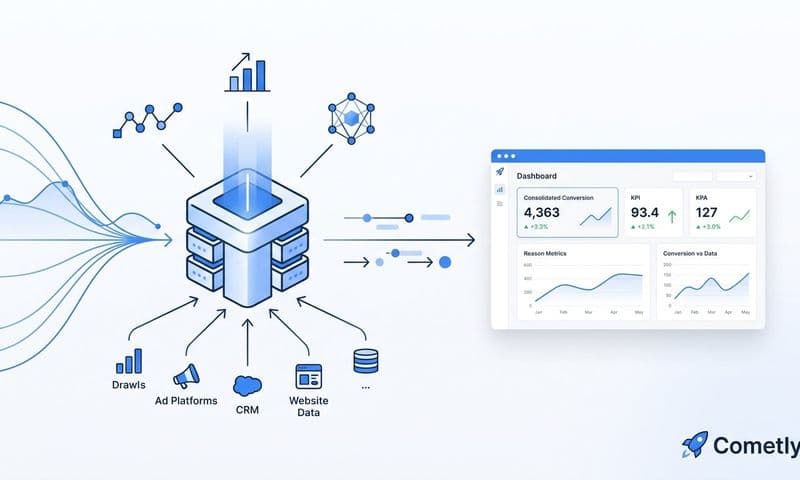
Consolidating your marketing analytics solves this by bringing all your data into a single source of truth. Instead of jumping between tabs and manually reconciling numbers, you get a unified view of performance across every touchpoint.
This guide walks you through the exact steps to consolidate your marketing analytics, from auditing your current data sources to building automated reporting workflows. By the end, you will have a clear roadmap for creating a centralized analytics system that shows exactly which ads and channels generate leads and revenue.
Step 1: Audit Your Current Data Sources and Identify Gaps
Before you can consolidate anything, you need to know exactly what you're working with. Start by listing every platform that generates marketing data for your business. This includes obvious sources like Meta Ads, Google Ads, TikTok Ads, and LinkedIn Campaign Manager, but also your CRM, website analytics, email marketing tools, and any other platforms where customer interactions happen.
Document what metrics each platform tracks and where data overlaps or conflicts. You'll quickly notice that Meta might report 50 conversions while Google claims 45 for the same time period, and your CRM shows only 38 actual sales. These discrepancies happen because each platform uses different attribution windows, tracking methods, and conversion definitions.
Identify blind spots where customer journey data gets lost between platforms. The gap between an ad click and a CRM entry is where most attribution breaks down. Someone might click your Meta ad on mobile, research on desktop, and convert three days later after reading an email. Without proper tracking across these touchpoints, you're flying blind. Understanding marketing analytics data gaps is essential for building a complete picture.
Create a data source inventory spreadsheet that includes platform names, what data they track, access credentials, API documentation links, and who owns each data source in your organization. This becomes your reference document throughout the consolidation process.
Pay special attention to conversion tracking implementations. Check whether you're using pixel-based tracking, server-side tracking, or a combination. Note which platforms have direct CRM integrations and which rely on manual data exports. These details determine how complex your consolidation project will be.
Look for data quality issues in your audit. Are conversion values being tracked correctly? Do lead forms capture all the information you need to match them with CRM records? Is your website analytics properly excluding internal traffic? Fixing these foundational issues now prevents garbage data from polluting your consolidated system.
Step 2: Define Your Core Metrics and Attribution Model
Select five to eight key performance indicators that matter most for your business goals. Resist the temptation to track everything. Focus on metrics that directly connect to revenue and business outcomes. For most marketing teams, this includes cost per acquisition, customer acquisition cost, return on ad spend, conversion rate, and customer lifetime value.
The metrics you choose should tell a complete story from awareness through revenue. You might track impressions and click-through rates at the top of the funnel, lead quality scores in the middle, and revenue per channel at the bottom. Each metric should have a clear owner who's responsible for improving it.
Choose an attribution model that reflects your actual customer journey complexity. If your sales cycle is short and simple, last-click attribution might work. But if customers interact with multiple touchpoints before converting, you need multi-touch attribution that gives appropriate credit to each interaction. Many teams struggle with common attribution challenges in marketing analytics when making this decision.
Many marketing teams find that position-based or time-decay models provide the most actionable insights. Position-based gives more credit to the first and last touchpoints while still acknowledging middle interactions. Time-decay gives more weight to recent touchpoints, which makes sense when recency matters for your conversions.
Establish consistent definitions for conversions, leads, and revenue across all sources. Your definition of a qualified lead must be identical whether it comes from Meta, Google, or LinkedIn. Revenue attribution rules need to be standardized so a sale doesn't get counted differently depending on which platform claims it.
Document your metric hierarchy from awareness metrics down to revenue impact. This creates a framework for understanding how top-of-funnel activities eventually drive bottom-line results. When you see changes in awareness metrics, you can predict their downstream impact on conversions and revenue.
Get buy-in from stakeholders on these definitions before you start consolidating data. If your sales team defines a qualified lead differently than your marketing team, your consolidated analytics will create more confusion than clarity. Alignment on metrics and attribution is non-negotiable.
Step 3: Connect Your Ad Platforms and Data Sources
Set up server-side tracking to capture data that browser-based tracking misses. Browser-based pixels face increasing limitations from iOS privacy changes and cookie restrictions. Server-side tracking sends conversion data directly from your server to ad platforms, bypassing browser limitations and providing more accurate attribution.
Start by implementing a server-side tracking solution that can capture events from your website and send them to multiple ad platforms simultaneously. This ensures consistent data collection regardless of browser settings or ad blockers. The setup requires technical implementation, but the data accuracy improvement is substantial.
Integrate your ad platforms with your CRM to connect ad clicks to actual revenue. This is where marketing attribution analytics becomes truly valuable. When someone clicks your ad, fills out a form, and eventually becomes a customer, you need to track that entire journey and attribute the revenue back to the original ad click.
Most modern CRMs offer native integrations with major ad platforms, but you'll likely need a marketing attribution platform to handle the complex data matching and attribution logic. Look for solutions that can handle multiple touchpoints, different attribution models, and real-time data syncing.
Configure website tracking to capture every touchpoint in the customer journey. This means tracking not just conversions, but also page views, time on site, content interactions, and any other signals that indicate purchase intent. The richer your behavioral data, the better your attribution accuracy.
Verify data is flowing correctly by comparing source platform numbers with your consolidated data. Pick a specific conversion event and check that the count matches across your ad platform, your tracking solution, and your CRM. Small discrepancies are normal due to timing differences, but large gaps indicate a tracking problem that needs fixing.
Test your tracking setup with real conversions before relying on it for budget decisions. Run a small test campaign, track conversions manually, and verify they appear correctly in your consolidated system. This quality check prevents you from making decisions based on inaccurate data.
Document your tracking implementation thoroughly. Future team members need to understand how data flows from ad click through conversion to revenue attribution. Clear documentation prevents tracking from breaking when someone makes changes without understanding the full system.
Step 4: Build Your Unified Analytics Dashboard
Structure your dashboard around business questions rather than platform-specific metrics. Instead of separate sections for Meta performance and Google performance, organize around questions like "Which channels drive the most qualified leads?" and "What's our actual cost per customer by source?"
This question-based approach forces you to think about what decisions you need to make rather than just displaying available data. Each dashboard section should answer a specific question that helps you allocate budget or optimize campaigns more effectively. Explore data visualization tools for marketing analytics to find the right solution for your needs.
Create cross-channel comparison views to see performance side by side. Build tables or charts that show cost per acquisition, conversion rate, and return on ad spend for Meta, Google, TikTok, and LinkedIn in a single view. This makes it immediately obvious which channels perform best and where you should shift budget.
Add customer journey visualization to track how touchpoints work together. A journey map showing common paths from first touch to conversion reveals which channel combinations drive the best results. You might discover that LinkedIn ads work best for initial awareness while Google search captures high-intent conversions.
Include real-time data feeds so decisions are based on current performance. Stale data leads to outdated decisions. Your dashboard should refresh automatically, showing performance from the last hour or day depending on your campaign velocity. This enables you to catch problems quickly and capitalize on winning campaigns.
Design different dashboard views for different roles. Executives need high-level metrics like total revenue by channel and overall ROAS. Channel managers need detailed performance data for their specific platforms. Analysts need granular data with the ability to drill down into segments and cohorts.
Keep your main dashboard clean and focused. Resist the urge to cram every possible metric onto one screen. Your primary view should show only the most critical metrics, with the ability to drill down into details when needed. A cluttered dashboard is just as useless as having no dashboard at all.
Set up custom alerts within your dashboard for significant changes. If cost per acquisition suddenly spikes or conversion rate drops below a threshold, you need to know immediately. Automated alerts mean you can focus on strategy rather than constantly monitoring dashboards for problems.
Step 5: Set Up Conversion Sync to Improve Platform Optimization
Send enriched conversion data back to ad platforms for better algorithm training. When you feed platforms accurate information about which conversions actually led to revenue, their machine learning systems can optimize toward valuable customers instead of just any conversion. This creates a powerful feedback loop that improves targeting over time.
Conversion sync means sending data from your CRM back to Meta, Google, and other ad platforms. Instead of relying on pixel-based conversion tracking that might miss conversions or attribute them incorrectly, you're feeding platforms the ground truth about what happened after the ad click.
Configure event mapping so platforms receive accurate revenue and lead quality signals. Don't just send a generic "conversion" event. Send detailed information like conversion value, lead quality score, and whether the lead eventually became a customer. This granular data helps platforms optimize for outcomes that actually matter to your business.
Set up your conversion sync to include offline conversions that happen outside the standard attribution window. If your sales cycle is 30 days but the ad platform's attribution window is only 7 days, you're missing most of your actual conversions. Syncing offline conversions ensures platforms see the full impact of their campaigns. A robust marketing data analytics platform can automate this entire process.
Test that synced data appears correctly in each ad platform's conversion tracking. After setting up conversion sync, verify that the events show up in Meta Events Manager, Google Ads conversion tracking, and other platform interfaces. Check that conversion values match what your CRM shows and that the timing aligns with when conversions actually occurred.
Monitor how improved data quality affects campaign performance over time. After implementing conversion sync, track whether your cost per acquisition decreases and whether the quality of leads improves. Better data should lead to better optimization, but this takes time as platform algorithms learn from the new signals.
Update your conversion sync configuration as your business evolves. When you add new conversion events or change how you define lead quality, make sure those updates flow through to your ad platforms. Stale conversion data is almost as bad as no data.
Step 6: Create Automated Reporting Workflows
Build scheduled reports that pull consolidated data automatically. Manual reporting is time-consuming and error-prone. Set up reports that generate daily, weekly, or monthly depending on what each stakeholder needs. These reports should pull directly from your consolidated data source, ensuring consistency across all reporting.
Your automated reports should include trend analysis that shows whether performance is improving or declining. A single week's numbers don't tell you much without context. Include week-over-week and month-over-month comparisons so readers can quickly see if things are moving in the right direction. Learn more about marketing analytics and reporting best practices to maximize your insights.
Set up alerts for significant performance changes that require immediate attention. If cost per acquisition increases by more than 20% in a single day, or if a major campaign stops delivering conversions, you need to know right away. Automated alerts catch these issues faster than scheduled reports.
Create role-specific report views for executives, channel managers, and analysts. Executives need summary metrics and high-level trends. Channel managers need detailed performance data for their specific platforms with actionable insights. Analysts need raw data access for deep-dive analysis. One report template doesn't serve all these needs.
Establish a weekly review cadence to act on consolidated insights. Reports are worthless if nobody reads them or acts on what they show. Schedule a standing meeting where your team reviews performance, identifies opportunities, and makes budget allocation decisions based on your consolidated data.
Include commentary in automated reports that highlights key changes and recommended actions. Numbers alone don't tell the full story. Add context about why performance changed, what external factors might be affecting results, and what actions you're taking in response. Leveraging AI marketing analytics can help surface these insights automatically.
Make your reports accessible to everyone who needs them. Use a shared dashboard or automated email distribution to ensure stakeholders get the information they need without having to request it. The easier you make it to access consolidated data, the more likely people are to use it for decisions.
Making Consolidated Analytics Work for Your Business
Consolidating your marketing analytics transforms how you make budget decisions and optimize campaigns. With unified data, you can finally see which channels drive real revenue instead of relying on each platform's inflated self-reporting. The difference between fragmented dashboards and consolidated analytics is the difference between guessing and knowing.
Use this checklist to verify your consolidation is complete: all data sources connected and flowing correctly, core metrics defined with stakeholder buy-in, unified dashboard built and accessible to your team, conversion sync active and sending enriched data to ad platforms, and automated reporting running on schedule. If you can check all these boxes, you have a functioning consolidated analytics system.
The next step is to review your consolidated data weekly and shift budget toward the channels and campaigns that your unified view shows are actually performing. This is where consolidated analytics pays off. You'll spot opportunities and problems faster, make confident budget decisions backed by complete data, and stop wasting money on channels that look good in their own dashboards but don't drive real results.
Start by auditing your current data sources this week, and you will be making better-informed marketing decisions within 30 days. The initial setup requires effort, but the ongoing benefits compound over time. Every budget decision becomes more accurate. Every optimization is based on complete customer journey data rather than partial platform reporting.
Ready to elevate your marketing game with precision and confidence? Discover how Cometly's AI-driven recommendations can transform your ad strategy. Get your free demo today and start capturing every touchpoint to maximize your conversions.