You've invested months into building a content library. Blog posts optimized for search, videos that explain your product, case studies that showcase real results, newsletters that keep your audience engaged. The content is good. You know it's good. But when leadership asks which pieces are actually driving revenue, you hesitate. The data doesn't give you a clean answer.
This is the central frustration of content marketing measurement. Unlike a paid search ad where someone clicks and converts in the same session, content marketing operates across a much longer arc. A prospect might discover your brand through a blog post in January, download a whitepaper in March, read three comparison pages in April, and finally convert in May after watching a product demo. Which of those touchpoints deserves credit? All of them? Just the last one?
Content marketing attribution methods are the frameworks and tools that help you answer those questions. They assign credit to the content interactions that influence conversions, giving you a structured way to understand what's actually moving buyers through your pipeline. Get this right, and you'll know exactly where to invest your content budget. Get it wrong, and you'll keep cutting the content that quietly fuels your best deals while doubling down on tactics that look good on the surface but don't connect to revenue.
This guide breaks down the most important attribution methods available to content marketers today, explains when to use each one, and shows you how to turn attribution data into smarter content decisions.
The Measurement Gap Content Marketers Face
Content marketing is inherently a multi-channel, multi-session activity. A single buyer might encounter your content through organic search, a LinkedIn post, a forwarded email, a retargeting ad, and a direct visit before they ever fill out a form or make a purchase. Each of those interactions happens in a different context, often on different devices, sometimes weeks apart.
This creates a fundamental measurement challenge. Traditional analytics tools are built around sessions and single-channel views. They can tell you how many people read a blog post in a given month, but they struggle to tell you how many of those readers eventually became customers and how much revenue they represented.
The problem has intensified in recent years. Privacy restrictions from Apple's App Tracking Transparency and the ongoing evolution of browser-based tracking limitations have created significant gaps in the data that marketers used to rely on. When a user switches from their phone to their laptop, or when they clear cookies between sessions, the connection between their early content interactions and their eventual conversion can break entirely. Browser-based tracking simply wasn't built for the complexity of today's buyer journeys.
Server-side tracking has emerged as a more reliable alternative, capturing content interactions at the data layer rather than depending on browser cookies. But even with better tracking infrastructure, many teams default to last-click reporting because it's the simplest option available in most analytics platforms. Understanding what an attribution model in digital marketing actually does is the first step toward moving beyond these defaults.
Last-click attribution is particularly damaging for content marketers. It systematically undervalues every piece of content that plays a nurturing or awareness role. The blog post that first introduced a prospect to your brand gets zero credit. The case study that convinced them to take your product seriously gets zero credit. The only content that looks valuable is whatever happened to be the last thing someone clicked before converting. This creates a distorted picture of content performance that leads to poor investment decisions.
Understanding why these gaps exist is the first step toward choosing attribution methods that actually reflect how content marketing works.
Single-Touch Models: Simple but Limited
Before diving into more complex approaches, it's worth understanding the two single-touch models that most teams start with. They're imperfect, but they each offer a specific lens that has genuine value when used in the right context.
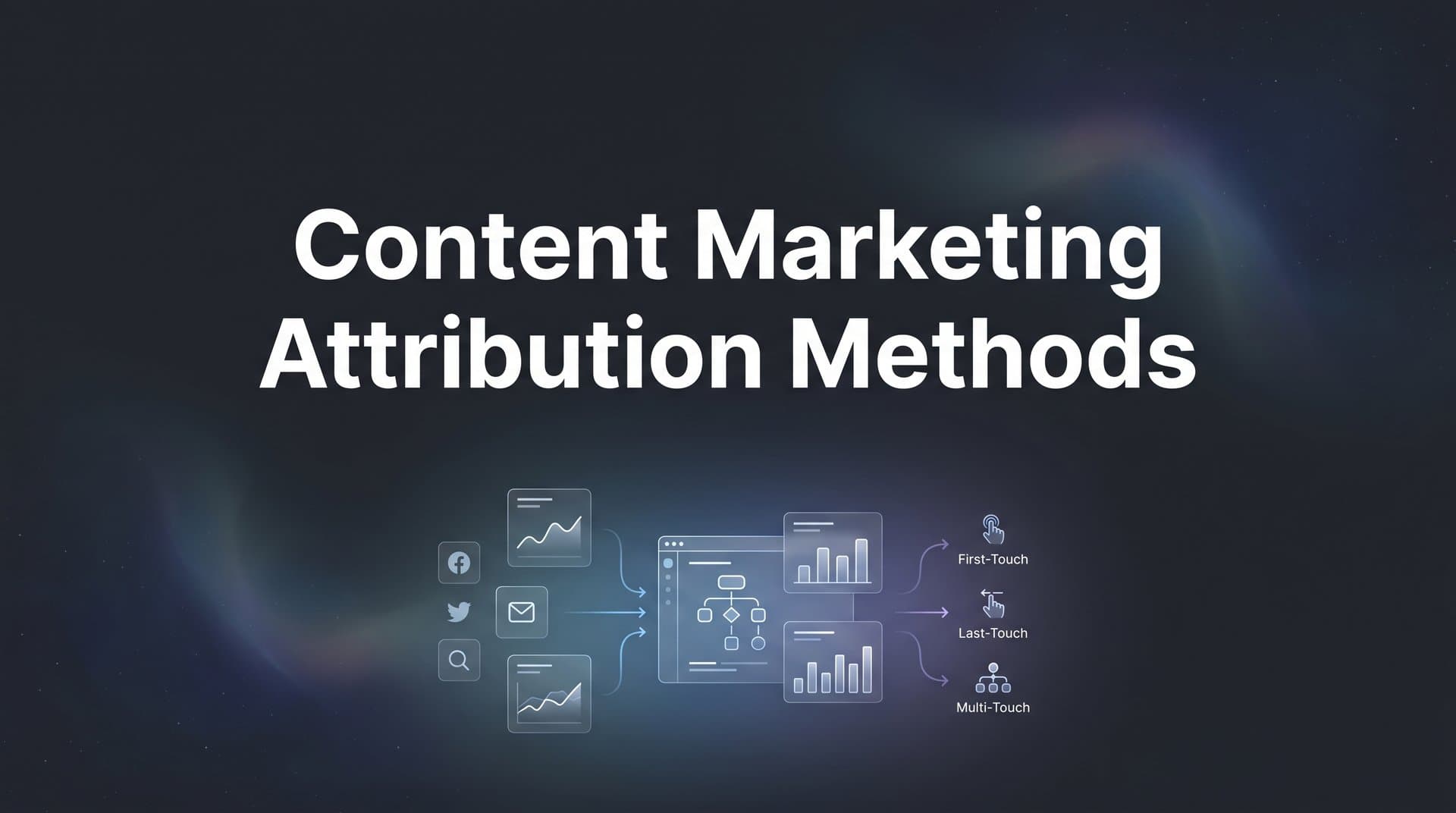
First-Touch Attribution gives 100% of the conversion credit to the very first interaction a prospect had with your brand. If someone discovered you through a blog post about industry trends, that blog post gets full credit for any eventual conversion, regardless of what happened in between.
This model is genuinely useful for understanding discovery. It tells you which content channels and topics are best at bringing new audiences into your funnel. If you're trying to evaluate the effectiveness of your SEO strategy or your top-of-funnel content investments, first-touch attribution gives you a clean signal. It answers the question: what content is responsible for introducing prospects to our brand? For a deeper look at the full range of models available, explore this guide on types of marketing attribution models.
Last-Touch Attribution works in the opposite direction, giving 100% of the credit to the final interaction before conversion. This model is useful for understanding what content helps close deals. If a specific comparison page or a detailed product walkthrough consistently appears as the last touchpoint before purchase, that's valuable information about what content performs best at the bottom of the funnel.
Last-touch is also the default model in many analytics platforms, which is part of why it's so widely used. It's easy to implement and produces clear, actionable-looking data.
Here's the problem with both models: they ignore everything in the middle. And for content marketing, the middle is often where the real work happens. Think about a B2B buyer evaluating a software purchase. They might spend weeks reading your blog, watching your webinars, and studying your documentation before they're ready to request a demo. First-touch and last-touch attribution will each credit one piece of content for that conversion while completely ignoring all the content that built trust and educated the prospect along the way.
Using single-touch models in isolation creates a false narrative about content performance. The best use of these models is as complementary perspectives, not standalone measurements. Running first-touch and last-touch side by side at least gives you a view of what's driving awareness versus what's closing deals, even if it leaves the middle of the funnel unexplained.
Multi-Touch Attribution: Giving Credit Across the Full Journey
Multi-touch attribution models distribute conversion credit across multiple touchpoints in the buyer journey, rather than assigning all credit to a single interaction. This approach is far better suited to content marketing because it acknowledges the reality that multiple content pieces typically contribute to a single conversion.
There are several distinct multi-touch models, each with its own logic for how credit gets distributed.
Linear Attribution divides credit equally among all touchpoints in the conversion path. If a prospect touched five pieces of content before converting, each one receives 20% of the credit. This model is simple to understand and ensures that every content interaction is recognized. The downside is that it treats all touchpoints as equally important, which may not reflect how your funnel actually works.
Time-Decay Attribution gives more credit to touchpoints that occurred closer to the conversion event. The logic is that interactions nearer to the conversion decision had more direct influence on it. This model tends to favor bottom-of-funnel content and can undervalue early-stage content that planted the initial seed of interest.
Position-Based (U-Shaped) Attribution takes a more nuanced approach by weighting the first and last touchpoints more heavily, typically assigning around 40% credit to each, and distributing the remaining 20% across all the interactions in between. This model recognizes that the moment of first discovery and the moment of final decision are both significant, while still acknowledging the nurturing content in the middle. Teams looking for a dedicated platform to implement these models should consider a multi-touch marketing attribution platform built for this purpose.
W-Shaped Attribution adds a third key milestone to the position-based model: the moment a lead is created. This model is particularly relevant for B2B content marketers because it recognizes that lead creation (such as a form fill or a demo request) is a meaningful conversion event in its own right, not just a step on the way to closed revenue. The W-shaped model distributes heavier credit to first touch, lead creation, and opportunity creation, with the remaining credit spread across other interactions.
What makes multi-touch attribution so valuable for content teams is the visibility it creates into the full buyer journey. You can see how a blog post that introduces a prospect connects to a case study that builds their confidence, which connects to a comparison page that helps them make their final decision. Each piece of content gets credit proportional to its role in that journey.
Implementing multi-touch attribution requires a solid data foundation. You need unified tracking across all the channels where your content lives, integration between your website analytics and your CRM, and the ability to stitch together touchpoints from different sessions and devices into a single customer journey. A strong marketing attribution CRM integration is essential for connecting content interactions to actual revenue data. Without this infrastructure, multi-touch models operate on incomplete data and produce unreliable results.
Algorithmic Attribution: Letting the Data Decide
Rule-based attribution models, whether first-touch, last-touch, or any of the multi-touch variants, all share a common limitation: they apply predetermined logic to your data rather than learning from it. A U-shaped model always gives 40% credit to the first and last touch, regardless of whether that distribution actually reflects how conversions happen in your specific funnel.
Data-driven or algorithmic attribution takes a fundamentally different approach. Instead of applying fixed rules, it uses machine learning to analyze your actual conversion paths and assign credit based on the patterns it finds in your data. The model learns which touchpoints, sequences, and combinations of content interactions correlate most strongly with conversions, then assigns credit accordingly. Understanding the distinction between attribution modeling vs marketing mix modeling can help you determine which analytical approach best fits your needs.
The practical implications of this are significant. An algorithmic model might discover that prospects who read a specific topic cluster of blog posts are far more likely to convert than those who don't, even if those posts don't appear right before the conversion event. It might reveal that a particular content format, such as detailed comparison guides, consistently appears in the conversion paths of your highest-value customers. These are insights that rule-based models can't surface because they're not looking for patterns, they're just applying formulas.
Algorithmic attribution also adapts over time. As your content strategy evolves and your audience behavior changes, the model updates its credit assignments based on new data. This makes it more accurate than static rule-based approaches, which can become outdated as your funnel changes.
The trade-off is complexity and prerequisites. To run effective algorithmic attribution, you need sufficient conversion volume for the model to find statistically meaningful patterns. You also need clean, comprehensive data collection across all your content channels. This is where server-side tracking becomes especially important: if your data has significant gaps due to cookie limitations or cross-device tracking failures, the model will learn from incomplete information and produce unreliable outputs.
You also need a platform capable of processing and visualizing the results in a way your team can act on. Raw algorithmic output isn't useful without clear dashboards that translate the model's findings into content decisions. For teams with the right data infrastructure and conversion volume, marketing attribution modeling software that supports algorithmic approaches is the most accurate and insightful option available.
Matching Your Attribution Approach to Your Strategy
There's no single attribution method that works for every content marketing team. The right approach depends on where your team is in its measurement maturity, the quality of your data infrastructure, and the nature of your sales cycle.
If your team is just starting to think seriously about content attribution, the most practical first step is to run first-touch and last-touch models side by side. This immediately gives you a more complete picture than relying on either one alone. You'll start to see the gap between what content is driving discovery and what content is driving conversion, which often reveals surprising disconnects between where you're investing and where you're getting results. Learning how to build a marketing attribution model with real examples can accelerate this process significantly.
As your data infrastructure matures and you establish unified tracking across channels, moving to a multi-touch model becomes both feasible and valuable. The position-based or W-shaped models tend to be good starting points for B2B content teams because they acknowledge the importance of early discovery content without completely ignoring closing content.
Your sales cycle length should heavily influence this decision. If you're in e-commerce or another business with short, single-session conversion paths, simpler models may be sufficient. But if you're in B2B with sales cycles that span weeks or months and involve multiple stakeholders consuming multiple pieces of content, multi-touch and algorithmic attribution are not optional luxuries. The right B2B marketing attribution tools are essential for understanding what's actually driving pipeline.
One of the most effective practices for mature content teams is to compare multiple attribution models simultaneously rather than picking one as the definitive source of truth. Different models highlight different aspects of content performance. Viewing your content library through the lens of first-touch, linear, and position-based attribution at the same time gives you a much richer understanding than any single model can provide.
Think of attribution models the way you think about financial statements: a balance sheet, income statement, and cash flow statement each tell you something different about the health of a business. You wouldn't rely on just one. The same logic applies to attribution models and content performance.
From Attribution Data to Smarter Content Investments
Attribution data is only valuable if it changes what you do. The goal isn't to produce more accurate reports; it's to make better content decisions. Here's how attribution insights should feed directly into your content strategy.
Identify your highest-impact content: Attribution data reveals which topics, formats, and distribution channels contribute most to pipeline and revenue. When you can see that a specific series of educational blog posts consistently appears in the conversion paths of your best customers, that's a clear signal to invest more in that topic area and format. A well-structured marketing attribution report makes these patterns visible across your entire content library.
Reallocate resources based on funnel contribution: Many content teams discover through attribution analysis that they're over-investing in content that looks good on traffic metrics but rarely appears in conversion paths. Attribution data gives you the evidence to shift resources toward content that actually moves buyers forward, even if that content gets less raw traffic.
Close the feedback loop with ad platforms: One of the most powerful applications of attribution data is sending enriched conversion signals back to the ad platforms and distribution channels you use to promote your content. When Meta or Google receives accurate data about which content interactions led to real revenue, their algorithms can better identify and target audiences who are likely to engage with your content and convert. Understanding how to leverage analytics for marketing strategy ensures this feedback loop drives compounding improvement in your content distribution efficiency over time.
Use real-time dashboards to act quickly: Attribution isn't just a quarterly analysis exercise. Real-time attribution dashboards allow teams to spot underperforming content quickly, identify which pieces are contributing to a current campaign, and reallocate budget mid-flight based on what the data shows. The faster you can act on attribution insights, the less budget you waste on content that isn't contributing to your goals.
Building an Attribution Practice That Grows With You
Content marketing attribution is not a one-time configuration. It's an evolving practice that should grow more sophisticated as your content strategy expands and your data infrastructure matures. The teams that get the most value from attribution are the ones that treat it as an ongoing discipline, not a setup task they complete once and forget.
Start by auditing your current measurement gaps. Where are you losing visibility into content interactions? Where does your tracking break down across devices or channels? Answering these questions gives you a clear roadmap for improving your data foundation before investing in more complex attribution models.
From there, progressively adopt more sophisticated methods as your infrastructure supports them. Move from single-touch to multi-touch as you build unified tracking. Move from rule-based multi-touch to algorithmic attribution as your conversion volume and data quality increase. Each step forward gives you a more accurate picture of what your content is actually doing for your business.
Cometly is built for exactly this kind of progressive attribution practice. It connects every content touchpoint to revenue through multi-touch attribution, server-side tracking that captures interactions even in a privacy-first environment, and AI-powered recommendations that surface which content is driving your best results. With Cometly's real-time analytics dashboard, your team can see the full customer journey from first content interaction to closed revenue, compare attribution models side by side, and feed enriched conversion data back to ad platforms to improve targeting and distribution.
You've already invested in creating great content. Now it's time to know exactly what it's worth. Get your free demo and start connecting every content touchpoint to the revenue it generates.