

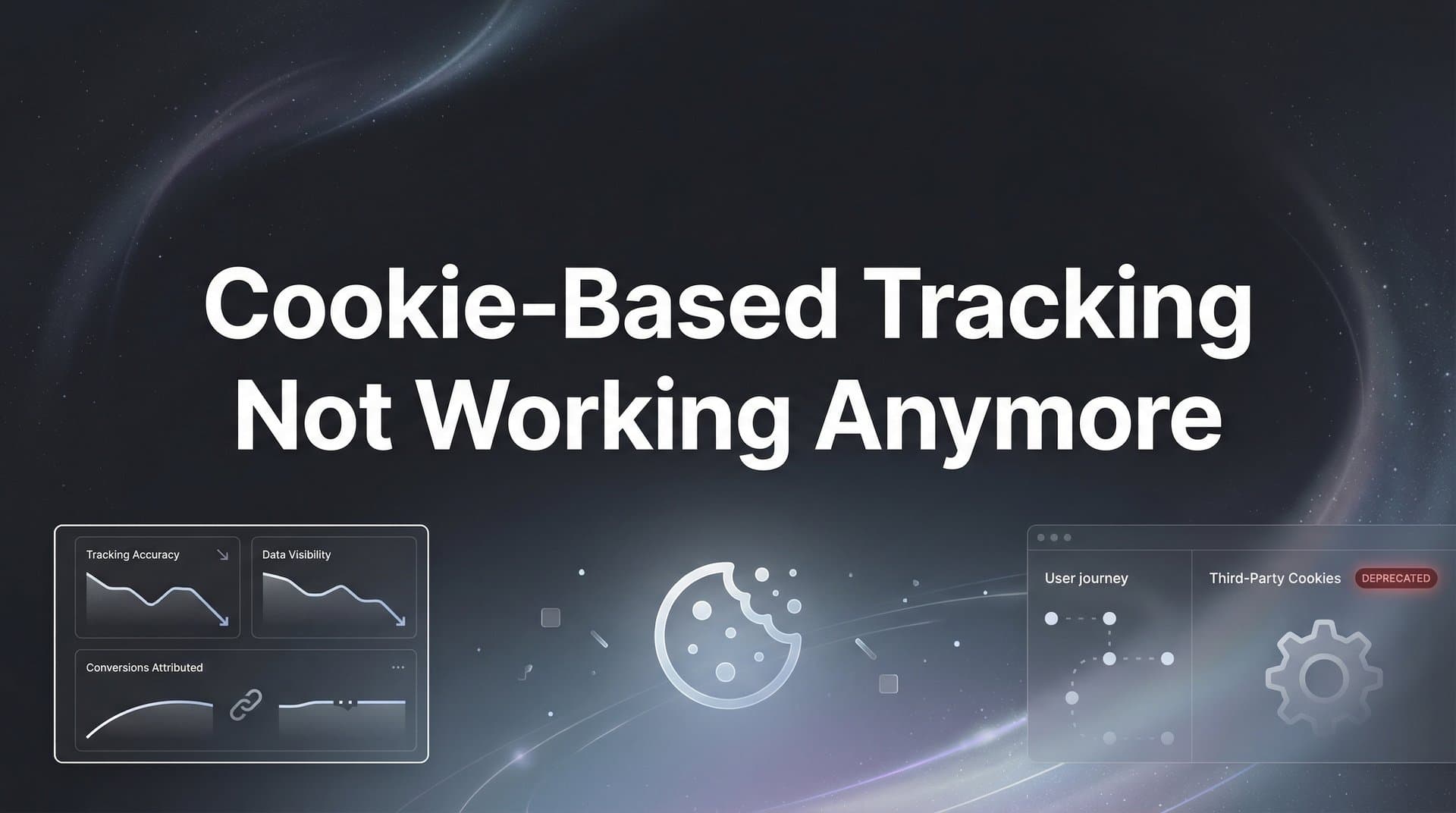
You check your ad dashboard and see 47 conversions. You check your CRM and count 31 actual sales. The numbers don't match, and this isn't the first time. Your retargeting audiences that once had 50,000 users now barely hit 12,000. Your attribution reports show most conversions happening within hours of the first click, even though you know your average sales cycle takes two weeks.
This isn't a platform glitch or a tracking pixel that needs reinstalling. What you're experiencing is the systematic collapse of cookie-based tracking, the technology that's powered digital marketing attribution for the past two decades.
The internet has fundamentally changed how it handles user data, and the tracking methods that once gave marketers clear visibility into campaign performance are breaking down in real time. Browser updates, privacy regulations, and shifting user behavior have created a perfect storm that's making traditional cookie tracking increasingly unreliable. For marketers running paid campaigns across multiple platforms, this means flying blind just when accurate data matters most.
The Perfect Storm Killing Third-Party Cookies
Three major forces are simultaneously dismantling the cookie-based tracking infrastructure that marketers have relied on for years. Understanding each component helps explain why your data has become so fragmented.
Browser manufacturers have taken the most aggressive stance. Safari's Intelligent Tracking Prevention, first introduced in 2017 and continuously strengthened since, now limits first-party cookies to just seven days of lifespan and blocks third-party cookies entirely. Firefox's Enhanced Tracking Protection follows a similar path, blocking known trackers and cross-site cookies by default for all users.
Google Chrome, despite multiple delays in its timeline, continues developing its Privacy Sandbox initiative as a replacement for third-party cookies. While Chrome hasn't fully deprecated cookies yet, the direction is clear. When the world's most popular browser (with over 60% market share according to StatCounter data from 2025) restricts cookie functionality, the impact on marketing data becomes unavoidable.
The practical effect? Attribution windows that marketers set for 30 or 90 days now break after mere days or hours. A user who clicks your ad on Monday and converts on Friday might appear as an entirely new visitor in your tracking system. For B2B companies with multi-week sales cycles or e-commerce brands with considered purchases, this creates massive blind spots in understanding what actually drives conversions. Many marketers are now losing tracking data from cookies at an alarming rate.
Regulatory frameworks add another layer of complexity. GDPR in Europe and CCPA in California require explicit user consent before setting non-essential cookies. Many users simply decline these consent requests or close the banner without responding. Research from various compliance platforms shows consent rates typically ranging from 40% to 60%, meaning nearly half your traffic operates outside your tracking capabilities from the moment they arrive.
User behavior compounds these technical restrictions. Ad blocker adoption continues growing, with privacy-focused browsers like Brave and DuckDuckGo gaining market share among privacy-conscious users. Incognito mode usage has increased as users become more aware of tracking practices. Each of these behaviors creates additional gaps in your tracking data.
The combined impact of browser restrictions, regulatory requirements, and user choices means that cookie-based tracking now captures only a fraction of actual user journeys. What was once a reliable foundation for marketing attribution has become a porous system that misses more data than it captures.
How Cookie Decay Breaks Your Marketing Data
The breakdown of cookie tracking doesn't just create minor data gaps. It fundamentally distorts how you understand campaign performance and makes critical business decisions based on incomplete information.
Attribution becomes nearly impossible for longer sales cycles. Imagine running a B2B SaaS campaign where prospects typically research for two weeks before requesting a demo. With cookies expiring after seven days or less, your attribution system loses the connection between the initial ad click and the eventual conversion. The demo request appears as direct traffic or organic search in your reports, even though a paid ad actually initiated the journey. This is a common symptom when attribution tracking not working properly.
This attribution gap means you can't accurately calculate return on ad spend. You're measuring costs against only the conversions that happen within the shortened cookie window, missing all the valuable conversions that occur later. Your ROAS calculations become artificially deflated, potentially leading you to pause campaigns that are actually profitable when viewed across the complete customer journey.
Retargeting audiences fragment in ways that inflate costs and reduce effectiveness. When a user visits your site, gets cookied, then returns three days later after their cookie has expired, they appear as a completely new visitor. They won't be included in your retargeting audience despite having shown clear purchase intent. Meanwhile, your audience size shrinks as cookies expire faster than you can replenish them with new visitors.
Smaller retargeting audiences mean higher CPMs as you compete for a limited pool of users. The users you do reach see ads less frequently because your audience pool is artificially constrained. Your retargeting campaigns that once drove 4x ROAS now struggle to break even, not because your creative or offer changed, but because the underlying tracking infrastructure can no longer maintain accurate audience segments.
Platform algorithms suffer when they receive incomplete conversion data. Meta's algorithm, Google's Smart Bidding, and other machine learning systems optimize based on the conversion signals they receive. When cookies fail to track conversions properly, these platforms see fewer conversion events than actually occurred. The algorithms interpret this as poor campaign performance and adjust bidding and delivery accordingly.
The result? Your campaigns deliver to the wrong audiences, bid inefficiently, and miss opportunities to scale. You might be generating strong results that the ad platforms simply can't see, leading their algorithms to make poor optimization decisions. This creates a vicious cycle where incomplete data leads to worse performance, which generates even less reliable data for future optimization.
Server-Side Tracking: The Foundation of Modern Attribution
Server-side tracking represents a fundamental shift in how marketing data flows from user actions to your analytics and ad platforms. Instead of relying on browser-based cookies and pixels, server-side tracking processes data at the infrastructure level, bypassing browser restrictions entirely.
Here's how it works in practice. When a user clicks your ad and lands on your website, their browser still communicates with your server as it always has. But instead of setting third-party cookies or firing pixels that browsers might block, your server captures the interaction data directly. When that user takes an action like filling out a form or making a purchase, your server records the event and sends it to your ad platforms and analytics tools through direct server-to-server connections.
This approach sidesteps the entire cookie deprecation problem because no third-party cookies are involved. The data collection happens on your own domain and infrastructure, making it first-party data that isn't subject to browser blocking or privacy restrictions in the same way third-party cookies are. Safari's ITP and Firefox's tracking protection don't interfere with server-side data transmission because they target client-side tracking mechanisms. Understanding the difference between server-side tracking vs pixel tracking is essential for modern marketers.
The technical implementation requires connecting several systems. Your website or app needs to send event data to your server rather than directly to ad platforms. Your server needs the capability to process this data and forward it to multiple destinations like Meta's Conversion API, Google Ads API, and your analytics platform. This typically involves implementing a tracking infrastructure that can handle real-time data flows and maintain connections with various advertising platforms.
For marketers, the practical benefit is complete visibility into user journeys regardless of browser settings or cookie restrictions. When a user converts two weeks after their initial ad click, your server-side tracking maintains the connection between that conversion and the original traffic source. Attribution windows work as intended because the tracking doesn't depend on cookies persisting in the user's browser.
Server-side tracking also enables you to enrich conversion data before sending it to ad platforms. You can include additional context like customer lifetime value, product categories, or CRM status that helps ad platforms optimize more effectively. A conversion isn't just a form submission anymore, it's a qualified lead with specific characteristics that inform better targeting decisions.
Implementation does require more technical setup than simply installing a tracking pixel. You need server infrastructure capable of handling the data processing, proper configuration of conversion APIs for each ad platform, and integration between your website, server, and marketing tools. Many businesses use specialized attribution platforms that provide this infrastructure as a service, handling the technical complexity while giving marketers the data visibility they need.
First-Party Data Strategies That Actually Work
Building attribution on first-party data means creating direct connections between user interactions on your owned properties and actual business outcomes in your CRM or sales system. This approach survives privacy changes because you're collecting data with user consent on your own domain and using it to understand your own business performance.
CRM-connected attribution creates the most complete picture of campaign effectiveness. Instead of stopping at website conversions, you track the entire journey from ad click through to closed deals and revenue generated. When someone clicks your LinkedIn ad, fills out a demo request form, books a call, and eventually becomes a customer, your attribution system connects all these events back to that original ad interaction. Implementing first-party data tracking solutions is critical for maintaining this visibility.
This level of visibility transforms how you evaluate campaign performance. You're no longer optimizing for form submissions or trial signups in isolation. You can see which campaigns, ad sets, and individual ads drive not just conversions but qualified opportunities and actual revenue. A campaign that generates fewer leads but higher-quality prospects becomes clearly more valuable than one that drives volume with poor conversion-to-customer rates.
Conversion APIs and event syncing represent the technical mechanism for feeding this enriched data back to ad platforms. Meta's Conversion API, Google's Enhanced Conversions, and similar tools from other platforms allow you to send conversion events directly from your server with additional customer information. You're not just telling Meta that a conversion happened, you're providing context about the value of that conversion and characteristics of the customer.
This enriched data dramatically improves how ad platforms optimize your campaigns. Meta's algorithm can identify patterns in which ads drive high-value customers versus low-value ones. Google's Smart Bidding can adjust bids based on the actual value of different conversion types rather than treating all conversions equally. The platforms' machine learning systems work better when they receive complete, accurate data about what happens after the click.
Multi-touch attribution models become essential when you're working with first-party data across the full customer journey. Last-click attribution misses the reality that most customers interact with multiple touchpoints before converting. Someone might discover you through a Facebook ad, research via organic search, return through an email campaign, and finally convert after clicking a retargeting ad. Exploring different attribution tracking methods helps you find the right approach for your business.
With complete first-party data, you can analyze how different touchpoints contribute to conversions. Linear attribution gives equal credit to each interaction. Time-decay models give more weight to recent touchpoints. Position-based models emphasize the first and last interactions. The right model depends on your business, but having the complete data to analyze different attribution approaches gives you much clearer insight into what's actually driving results.
Evaluating Your Current Tracking Setup
Several warning signs indicate that cookie decay is already impacting your marketing data. Recognizing these symptoms helps you understand the urgency of transitioning to more reliable tracking methods.
The most obvious signal is persistent mismatches between platform-reported conversions and actual business outcomes. Your ad dashboard shows 60 conversions this month, but your sales team closed 45 deals and your CRM shows 50 qualified leads. These discrepancies aren't minor rounding errors, they represent fundamental gaps in tracking accuracy that make it impossible to calculate true return on ad spend. Understanding why your conversions are not tracking is the first step toward fixing these issues.
Shrinking retargeting audiences despite steady or growing traffic volumes indicate that cookies are expiring faster than you can build audience segments. If your website traffic has remained consistent but your retargeting pool has dropped by 40% or more over the past year, cookie restrictions are preventing you from maintaining audience continuity. Users are visiting your site but not being properly added to retargeting segments because their cookies expire before they can be leveraged.
Attribution reports that show unrealistic conversion patterns reveal tracking problems. If 80% of your conversions appear to happen within 24 hours of the first click, but you know your actual sales cycle takes weeks, your attribution system is only capturing the shortest paths to conversion. All the longer, more complex journeys are being lost to cookie expiration and appearing as direct traffic or other sources.
Declining ROAS despite consistent spend and creative quality suggests that incomplete tracking data is causing ad platforms to optimize poorly. When platforms can't see all the conversions your campaigns generate, they make suboptimal decisions about bidding and audience targeting. Your actual performance might be stable, but the platforms' view of performance has degraded due to data loss.
To audit your current setup, start by comparing platform data against your CRM or sales system for a specific time period. Export conversion data from your ad platforms and match it against actual customer acquisitions in your CRM. Calculate the percentage of customers that can be attributed to known marketing sources versus those appearing as direct or unknown. If more than 30% of your customers can't be connected to a marketing source, you have significant attribution gaps.
Check your cookie consent rates by reviewing your consent management platform data or website analytics. What percentage of visitors accept tracking cookies? How does your conversion tracking perform for users who decline cookies versus those who accept? This analysis reveals how much of your audience operates outside your tracking visibility.
Review your attribution window accuracy by analyzing the time between first click and conversion for your tracked conversions. If your attribution reports show most conversions happening within days but your sales team knows the actual cycle takes weeks, the shortened cookie lifespans are cutting off your tracking prematurely.
Prioritize your transition based on business impact. If you're running high-budget campaigns with unclear ROI, fixing attribution should be your immediate priority. If your retargeting campaigns are your most profitable channel and audiences are shrinking, focus there first. If platform optimization has degraded, implementing conversion APIs to feed better data back to ad platforms delivers quick wins.
Building a Future-Proof Attribution Stack
A modern attribution infrastructure centers on first-party data collection, server-side tracking, and direct integrations between your website, CRM, and ad platforms. This architecture survives privacy changes because it operates on data you collect directly from user interactions on your owned properties.
The core components work together to create complete visibility. Server-side tracking captures user interactions without relying on browser cookies. First-party data collection happens on your domain with proper user consent. CRM integration connects marketing touchpoints to actual business outcomes like deals closed and revenue generated. Conversion sync capabilities send enriched event data back to ad platforms to improve their optimization. A proper attribution tracking setup ensures all these components work together seamlessly.
This infrastructure enables you to track the complete customer journey from initial ad click through multiple touchpoints to final conversion and beyond. When someone clicks your Facebook ad, visits your website, leaves without converting, returns a week later through Google search, requests a demo, and eventually becomes a customer, your attribution system maintains the connection across all these interactions.
Feeding better data to ad platforms improves their machine learning and targeting capabilities significantly. When you send conversion events through Meta's Conversion API with additional context about customer value, product interest, and qualification status, Meta's algorithm learns which audiences and creative approaches drive your most valuable customers. The platform can then optimize delivery toward similar high-value prospects rather than simply maximizing conversion volume.
Google's Enhanced Conversions work similarly, allowing you to send hashed customer information along with conversion events. This helps Google match conversions to ad clicks even when cookies have expired, improving attribution accuracy and giving Smart Bidding better data for optimization decisions. The algorithm can bid more aggressively for clicks likely to drive valuable conversions and reduce spend on lower-value traffic.
AI-powered optimization becomes possible when you have complete journey data across all touchpoints. Modern attribution platforms use machine learning to identify patterns in which combinations of ads, channels, and touchpoints drive the best outcomes. Instead of manually analyzing campaign data, AI can surface insights like which ad creative performs best for different audience segments or which channel sequence produces the highest conversion rates. Leveraging conversion tracking analytics helps you make sense of this data.
These AI recommendations help you scale with confidence. When the system identifies that a specific campaign consistently drives high-value customers, you can increase budget knowing the performance will likely continue. When certain ad combinations show strong synergy in the data, you can replicate that approach across other campaigns. You're making decisions based on comprehensive data analysis rather than incomplete platform reports or intuition.
The investment in building this infrastructure pays dividends in improved campaign performance, clearer ROI visibility, and better optimization decisions. You're no longer guessing which campaigns work or flying blind due to tracking limitations. Every marketing dollar can be traced to actual business outcomes, and every optimization decision is grounded in complete data about what drives results.
Moving Forward With Confidence
Cookie-based tracking isn't coming back. Browser manufacturers continue strengthening privacy protections, regulatory frameworks are expanding rather than contracting, and user expectations around data privacy are only increasing. Waiting for the situation to reverse or hoping for workarounds means accepting continued data loss and increasingly unreliable campaign optimization.
The solution isn't about fighting these changes or finding clever hacks to restore cookie functionality. It's about building a fundamentally better approach to marketing attribution that centers on first-party data, server-side tracking, and direct connections between your marketing activities and actual business outcomes.
This transition represents an opportunity to gain competitive advantage. Marketers who adapt early will have accurate data and effective optimization while competitors struggle with incomplete tracking and degraded platform performance. The businesses that build robust first-party data strategies and modern attribution infrastructure will make better decisions, achieve higher returns on ad spend, and scale more confidently.
The technology and tools to implement these solutions exist today. Server-side tracking, conversion APIs, and CRM-connected attribution are proven approaches that major brands and sophisticated marketing teams have already adopted. The question isn't whether this transition is possible, but how quickly you can implement it to stop losing valuable data and start capturing the complete picture of your marketing performance.
Start by auditing your current tracking setup to understand where the biggest gaps exist. Compare platform data against CRM data to quantify attribution loss. Review your retargeting audience sizes and conversion window accuracy. These diagnostics reveal which problems to prioritize and where you'll see the biggest impact from improvements.
Ready to elevate your marketing game with precision and confidence? Discover how Cometly's AI-driven recommendations can transform your ad strategy. Get your free demo today and start capturing every touchpoint to maximize your conversions.



