

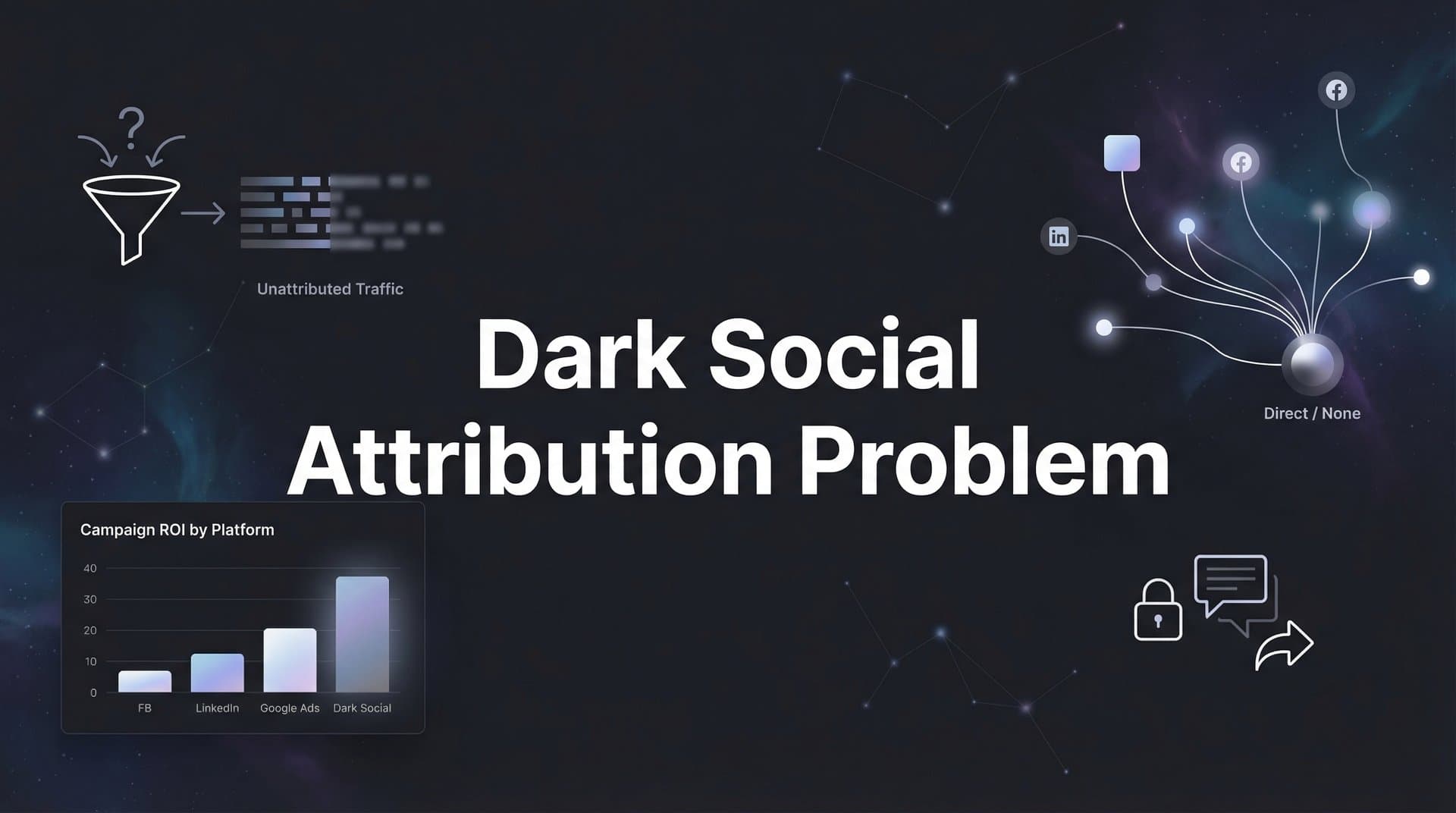
Your marketing dashboard shows a sudden surge in direct traffic. The team celebrates—people are typing your URL directly into their browsers! Proof that brand awareness is working, right? But here's what actually happened: a respected industry leader shared your case study in a private LinkedIn DM thread with five potential customers. Your content got forwarded through three different Slack workspaces. A podcast host mentioned your brand in their show notes, and listeners copied the link into WhatsApp groups. None of this shows up in your analytics. Instead, it all appears as "direct traffic"—a black box that tells you nothing about what's really driving results.
This is the dark social attribution problem, and it's costing you more than you realize.
Dark social represents the hidden iceberg beneath your analytics surface—the shares, recommendations, and conversations happening in private channels that traditional tracking can't see. While you're analyzing public social metrics and optimizing campaigns based on visible data, your most influential traffic sources are operating in complete darkness. Marketing teams make budget decisions, cut underperforming channels, and double down on "winners" based on incomplete information. The channels that actually drive your best customers might be the ones you're about to defund.
The Hidden Channels Reshaping Modern Marketing
Dark social isn't a single platform or channel—it's an entire ecosystem of private communication that exists outside traditional analytics visibility. When someone shares your content through WhatsApp, Messenger, Slack, Discord, or any private messaging app, that share leaves no digital fingerprint your analytics can follow. The same applies to email forwards, SMS messages, and content shared within native mobile app browsers.
The technical reality is surprisingly simple: these channels strip referrer data. When a user clicks a link in a private message, their browser doesn't pass along information about where they came from. Your analytics platform sees a visitor arriving with no referrer header, so it categorizes them as "direct traffic"—the same bucket that includes people who genuinely typed your URL from memory or clicked a bookmark.
Think about how you actually share content worth reading. You don't post everything publicly on Twitter or LinkedIn. The truly valuable insights? Those get sent directly to specific colleagues who need them. That industry report your competitor published? You forwarded it to your team lead via Slack. That brilliant article about attribution modeling? You texted the link to your marketing director friend. These private shares carry more weight precisely because they're personal recommendations from trusted sources.
The contrast with trackable social is stark. When someone shares your content on Twitter or LinkedIn with a properly formatted link, you can see exactly where that traffic came from. Add UTM parameters, and you can track which specific post, campaign, or influencer drove each visit. But the moment that same content moves into a private channel—copied into a DM, forwarded in an email thread, shared in a team chat—it becomes invisible. Understanding dark social traffic attribution is essential for any marketer trying to capture this hidden influence.
Native mobile app browsers compound the problem. Many apps use in-app browsers that don't pass referrer information when users click external links. Someone discovers your content in their Reddit app, taps the link, reads your article in Reddit's internal browser, then navigates to your homepage. Your analytics? Direct traffic. The reality? A social discovery journey that's completely hidden from view.
Why Your Attribution Models Can't See the Whole Picture
Traditional attribution models operate on a simple premise: track every touchpoint in the customer journey, then assign credit based on a predetermined logic. Last-click gives all credit to the final touchpoint. First-click credits the initial discovery. Multi-touch models distribute credit across multiple interactions. But here's the fundamental problem: all these models only work with touchpoints they can actually see.
When dark social enters the equation, attribution models don't just become less accurate—they become systematically biased toward channels that happen to be trackable. A prospect's actual journey might look like this: they see your content shared in a private Slack channel by a colleague they trust. Intrigued, they research your brand on their own time. They visit your website directly (appears as "direct traffic"), read several articles, then search your brand name on Google and convert. Your attribution model credits organic search with the conversion. The private recommendation that actually initiated the entire journey? Completely invisible. This represents a core attribution problem in marketing that affects nearly every business.
The compounding effect creates even bigger distortions over time. Imagine you're running a thought leadership campaign that generates substantial dark social sharing. Industry professionals forward your content to colleagues, teams discuss your insights in private channels, and your brand becomes the go-to reference in private conversations. Meanwhile, your analytics show modest performance—some direct traffic, some brand searches, but nothing that justifies the content investment. Based on incomplete data, you might cut the program entirely, eliminating the very activity that was building your most valuable pipeline.
This leads to a dangerous budget misallocation risk. Channels that appear to underperform in your analytics might actually be driving significant dark social activity downstream. That LinkedIn thought leadership content that shows modest direct engagement? It could be getting forwarded through private channels to decision-makers who later convert through "direct" or "organic search" channels. That podcast sponsorship that doesn't show impressive referral traffic? Listeners might be sharing your brand in private conversations that eventually drive conversions attributed elsewhere.
Even sophisticated multi-touch attribution models struggle here because they can only redistribute credit among known touchpoints. If the most influential touchpoint is invisible, the model can't account for it at all. You're not just missing data points—you're making strategic decisions based on a fundamentally incomplete picture of what drives customer behavior.
The risk extends beyond individual campaigns. When you optimize your entire marketing strategy based on attribution models that can't see dark social, you systematically undervalue channels that generate private sharing and overvalue channels that happen to be easily trackable. Over time, this creates a strategic drift away from the activities that actually build trust and generate qualified leads.
Practical Approaches to Measure the Unmeasurable
You can't track every private share, but you can build systems that capture more of the customer journey before data disappears into the dark social void. Server-side tracking represents a fundamental shift in how you collect data—processing events on your servers rather than relying solely on browser-based tracking that's vulnerable to blockers, privacy settings, and stripped referrers.
When a visitor lands on your site from a dark social source, client-side tracking might miss critical context because the browser never received referrer information. Server-side tracking captures the event at a different point in the data flow, before certain types of information loss occur. You're still working with incomplete data—the original share in a private channel remains invisible—but you can maintain better data integrity for the touchpoints you do capture.
Server-side tracking also helps you maintain consistent tracking as privacy regulations tighten and browser restrictions increase. By processing data on your infrastructure rather than depending entirely on third-party cookies and client-side scripts, you build a more resilient measurement foundation that continues functioning even as the tracking landscape evolves. Learning how to fix attribution discrepancies in data becomes critical as you implement these systems.
CRM integration offers another powerful approach: connecting your marketing touchpoints with sales conversations and customer data to build a more complete journey picture. When a lead enters your CRM, they bring context that analytics alone can't provide. Sales conversations reveal how prospects actually discovered your brand, which content influenced their decision, and what recommendations drove them to reach out.
This is where the real story emerges. A prospect might appear in your analytics as a direct visitor who converted after two website sessions. But when your sales team talks to them, they learn the prospect first heard about your brand in a private Slack channel, then received an email forward of your case study, then finally visited your site directly after discussing your solution with their team. None of that context exists in your analytics—but it's all captured in your CRM notes.
By systematically connecting CRM data back to your analytics, you start seeing patterns. That spike in direct traffic? It coincides with a wave of sales conversations where prospects mention hearing about you from colleagues. That content piece with modest analytics performance? Sales teams report it's being forwarded constantly in private channels. This qualitative intelligence helps you interpret quantitative data more accurately.
Self-reported attribution provides another critical data source. Adding "How did you hear about us?" fields to your forms and correlating responses with behavioral data reveals discrepancies between what your analytics reports and what actually influenced decisions. Many companies discover that a significant percentage of customers cite sources that barely register in their attribution models—colleague recommendations, private messages, offline conversations.
The key is making self-reported attribution actionable rather than just interesting. Structure your questions to capture specific channels and sources. Instead of an open text field, provide options that align with how you track other channels: "Colleague recommendation," "Private message or email forward," "Podcast or video mention," "Industry community or Slack group." This lets you quantify dark social's impact even when you can't track individual touchpoints.
Creating Content That Thrives in Private Channels
Once you understand that your most valuable shares happen in private, your content strategy needs to adapt. Content optimized for public social engagement—designed for likes, comments, and retweets—often differs from content people actually forward to colleagues or share in private professional channels.
Shareability in private contexts means creating content that makes the sharer look good. When someone forwards your article in a Slack channel or emails it to their team, they're implicitly endorsing it. They're saying "this is worth your time" to people whose opinion matters to them. That's a higher bar than public social sharing, where the social cost of sharing something mediocre is minimal.
Focus on practical, immediately actionable content rather than purely promotional material. The industry report that breaks down complex topics into clear frameworks? That gets forwarded to entire teams. The case study that shows exactly how another company solved a common problem? That gets shared in private channels where people discuss similar challenges. The tactical guide that saves someone hours of work? That gets bookmarked and referenced repeatedly.
Mobile-friendly formatting becomes critical because much dark social sharing happens on mobile devices. Your content needs to render perfectly in messaging app previews, load quickly on mobile connections, and be easily scannable on small screens. If someone shares your link in a WhatsApp group and the preview looks broken or the page takes ten seconds to load, the share dies there.
Compelling preview text and meta descriptions matter more for dark social than for search engines. When your link appears in a message thread, the preview is your only chance to convince someone to click. Generic descriptions like "Learn more about our solutions" waste this opportunity. Specific, benefit-focused previews like "How three marketing teams reduced CAC by 40% with better attribution data" give the recipient a clear reason to engage.
Implementing trackable share buttons helps capture some dark social activity. While you can't track what happens after someone copies a link into a private channel, you can at least identify which content pieces generate the most copy actions. Add "Copy Link" buttons with event tracking to understand what content resonates enough that people want to share it privately. Proper social media measurement should account for these private sharing behaviors.
Creating unique links for different content pieces and distribution channels gives you better signal even when referrer data disappears. If you share slightly different URLs in different contexts—one version in your newsletter, another in your LinkedIn posts, another in your email signature—you can identify patterns in your "direct traffic" that suggest dark social origins. When you see traffic spikes to the newsletter version of a link, you know that content is being forwarded through private channels.
AI-powered analytics can identify patterns in direct traffic that suggest dark social origins. Sudden spikes in direct visits to specific content pages, especially when they correlate with email sends or social posts, often indicate private sharing activity. Visitors who arrive as "direct traffic" but immediately navigate to specific deep-linked content rather than your homepage? Likely following a shared link. Geographic clustering of direct traffic that matches your target account locations? Probably internal sharing within those organizations.
Building a Complete View of Your Customer Journey
The goal isn't perfect attribution—that's impossible in a world where privacy protections are increasing and communication is moving to private channels. The goal is building a comprehensive enough picture that you can make confident strategic decisions despite incomplete data.
Enriched conversion data becomes your bridge across attribution gaps. When you can't track every touchpoint, focus on making the touchpoints you do capture as valuable as possible. Feed your ad platforms detailed conversion data that helps their algorithms optimize even when the attribution path is murky. If you know a lead came from a specific target account, works in a relevant role, and engaged with particular content themes, that context helps ad platforms find similar prospects—regardless of whether you can trace the exact path that led them to you.
This is where platforms like Cometly create value beyond traditional analytics. By capturing comprehensive conversion events and syncing enriched data back to ad platforms, you help their AI optimize toward outcomes rather than just trackable clicks. The ad platform might not know that a conversion started with a dark social share, but if you're consistently feeding it high-quality conversion data with rich context, its algorithms can find more prospects who fit similar patterns.
First-party data plays an increasingly critical role in building this complete picture. When you own the relationship with your customers and can connect their interactions across multiple touchpoints—website visits, email engagement, product usage, support conversations, renewal behavior—you create a dataset that's far more valuable than what any third-party tracker can provide. This first-party data helps you identify which marketing activities correlate with valuable customer outcomes, even when you can't trace direct attribution paths. Addressing customer journey attribution problems requires this holistic approach to data collection.
The key is connecting data sources that traditionally operate in silos. Your marketing automation platform knows about email engagement. Your CRM knows about sales conversations. Your product analytics know about user behavior. Your support system knows about customer satisfaction. When you unify these data sources, patterns emerge that single-channel attribution models miss entirely. You might discover that customers who engage with certain content themes in private channels (evidenced by sales conversation notes) have higher lifetime value, even if your marketing attribution can't credit those touchpoints directly.
Balancing privacy concerns with measurement needs requires thoughtful approaches. Customers increasingly expect their privacy to be respected, and regulations like GDPR and CCPA enforce these expectations legally. The solution isn't trying to track everything—it's building measurement systems that respect privacy while still providing actionable insights. Understanding the limitations of Google Analytics attribution helps you recognize where supplementary tools become necessary.
This means being transparent about what you track and why. It means using aggregated, anonymized data for strategic decisions rather than trying to track individual journeys across every possible touchpoint. It means recognizing that some level of measurement uncertainty is the acceptable cost of respecting user privacy and building trust with your audience.
Adapting to the Reality of Hidden Influence
Dark social isn't a problem to solve—it's a reality to adapt to. The most trusted recommendations have always happened in private conversations, long before digital marketing existed. What's changed is that these private recommendations now happen at scale through digital channels, creating a massive attribution blind spot for marketers who rely solely on trackable data.
The marketers who thrive in this environment are those who accept measurement uncertainty while building systems to minimize it. They invest in server-side tracking to capture more data before it's lost. They integrate CRM insights to understand the qualitative context behind quantitative metrics. They implement self-reported attribution to validate their analytics assumptions. And they create content worth sharing privately—content that makes people look good when they forward it to colleagues.
Your attribution models will never be perfect. Direct traffic will always contain an unknowable mix of genuine direct visits, dark social shares, and other unmeasurable sources. But you can build a comprehensive enough picture to make confident decisions. Focus on the touchpoints you can measure, enrich them with as much context as possible, and use qualitative data to interpret patterns in your quantitative metrics.
The alternative—making decisions based solely on easily trackable channels—leads to systematic underinvestment in the activities that actually build trust and generate qualified leads. When you understand that your best traffic sources might be invisible, you start making smarter strategic choices. You value thought leadership content that generates private sharing even when it doesn't show impressive public engagement metrics. You invest in customer experience that turns customers into advocates who recommend you in private conversations. You build measurement systems that acknowledge their own limitations while still providing actionable insights.
Marketers who embrace comprehensive attribution—combining server-side tracking, CRM integration, self-reported data, and enriched conversion events—will outpace competitors who rely on incomplete analytics. They'll understand which activities truly drive customer acquisition, even when the attribution path isn't perfectly visible. They'll allocate budgets based on a more complete picture of what works, rather than just what's easily measurable.
Ready to elevate your marketing game with precision and confidence? Discover how Cometly's AI-driven recommendations can transform your ad strategy—Get your free demo today and start capturing every touchpoint to maximize your conversions.


