You check your analytics dashboard and see a spike in conversions. Great news—except when you try to figure out where those customers came from, half of them are labeled "direct traffic." No campaign source. No referrer. Just... direct.
But here's the thing: nobody typed your 15-character product URL from memory.
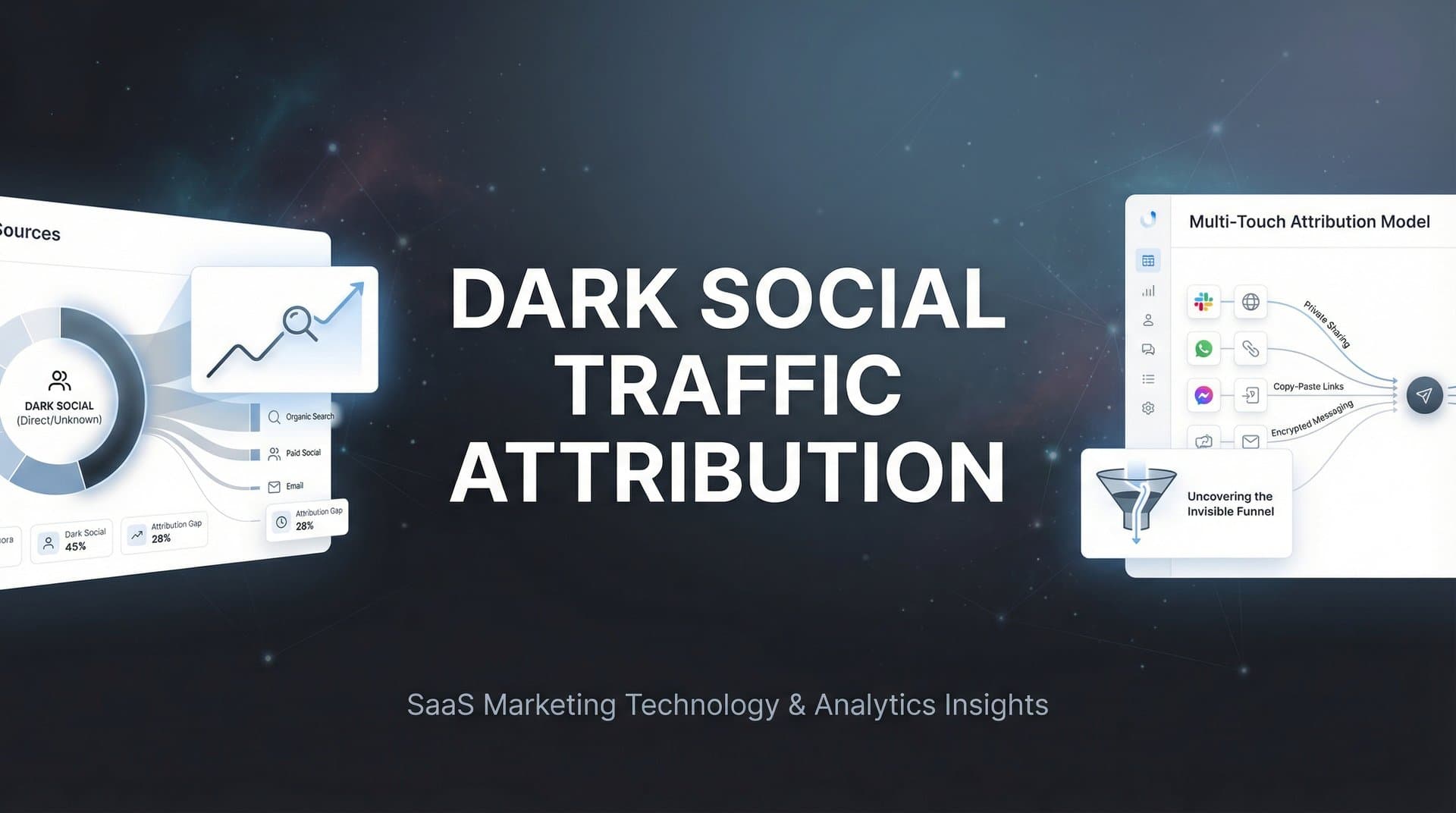
What you're looking at is dark social—the invisible web of private shares, messaging apps, and email forwards that drive real traffic but leave zero attribution trail. It's the colleague who Slacks your article to their team. The customer who forwards your newsletter to a friend. The WhatsApp group where someone drops your product link with a glowing recommendation.
For marketers trying to understand what's actually working, dark social creates a massive blind spot. You're making budget decisions based on incomplete data, potentially defunding the channels that are quietly driving your best conversions. This article breaks down what dark social traffic really is, why it matters for your attribution strategy, and most importantly—how to measure and account for it in your marketing decisions.
The Hidden Traffic Problem: Why Your Analytics Are Lying to You
Dark social traffic refers to any sharing that happens through private, untrackable channels—places where traditional analytics tools can't see the referrer information that tells you where a visitor came from. When someone shares your content via WhatsApp, copies a link from Slack, forwards an email, or sends a direct message on LinkedIn, that traffic shows up in your analytics as "direct" even though it's clearly not.
The term was coined by Alexis Madrigal in The Atlantic back in 2012, but the problem has only grown more significant as private messaging becomes the dominant way people share content online. Think about your own behavior: when you find an interesting article, do you publicly tweet it, or do you text it to a colleague who'd find it useful?
Here's how the technical breakdown works. When someone clicks a link from a public source like a social media feed or a website, their browser sends referrer data—essentially saying "I came from this other page." Analytics tools capture this and attribute the visit accordingly. But messaging apps, email clients, and secure browsing features often strip this referrer data for privacy reasons. The result? Your analytics platform sees a visitor with no referrer and categorizes them as "direct traffic."
This creates a cascading attribution problem. Your Facebook ads might be generating incredible content that people share privately with their networks. Your email newsletters might be forwarded to decision-makers who eventually convert. Your blog posts might be circulating in industry Slack channels. But none of this shows up in your attribution reports. Understanding common attribution challenges in marketing analytics helps you recognize these blind spots.
The business impact is real and measurable. You're potentially undervaluing your best-performing content because you can't see the private sharing it generates. You might be cutting budget from channels that are actually driving awareness and consideration, just because the final touchpoint looks like "direct" traffic. And you're missing critical insights about how your customers actually discover and evaluate your product.
The challenge becomes even more complex when you consider that different types of businesses experience dark social differently. E-commerce brands might see dark social from product recommendations shared in family group chats. B2B companies often see it in professional Slack communities and forwarded email chains. SaaS products get shared in private channels where teams evaluate tools together.
What makes dark social particularly tricky is that it often represents your highest-intent traffic. When someone takes the time to personally recommend your content or product to a specific person, that's a qualified referral. But your analytics can't distinguish between that warm introduction and someone who genuinely typed your URL from memory.
Common Sources of Dark Social Traffic in B2B and E-commerce
Understanding where dark social traffic actually comes from helps you identify it in your analytics and build strategies to measure it. The sources vary significantly depending on your industry and audience, but certain patterns emerge consistently.
Private Messaging Platforms: This is the biggest category. WhatsApp, iMessage, Facebook Messenger, Slack, Microsoft Teams, Discord—anywhere people have private conversations is a potential dark social source. In B2B contexts, Slack channels and Teams groups are particularly significant. Someone discovers your case study, drops the link in their company's marketing channel, and suddenly you have five new visitors from that organization—all showing up as direct traffic.
The mobile messaging ecosystem creates additional complexity. When someone shares a link through their phone's native share sheet, it might go through SMS, WhatsApp, Signal, or any number of apps—all of which strip referrer data. Cross-app sharing on mobile devices is essentially invisible to traditional analytics.
Email-Based Sharing: Email forwards are a classic dark social source. Your newsletter subscriber reads something valuable and forwards it to colleagues. Those colleagues click through, but because the link came from an email client rather than a trackable campaign, it appears as direct traffic. Personal email recommendations work the same way—someone copies your URL from their browser and pastes it into an email to a friend.
Email client behavior adds another layer. Some email clients, particularly mobile ones, open links in in-app browsers that don't pass referrer information correctly. Even if you're using UTM parameters in your newsletter, forwarded emails often lose that tracking data when recipients click through.
Mobile App Behaviors: Mobile apps handle links in ways that consistently break attribution. In-app browsers—like when someone clicks a link in LinkedIn's mobile app or Twitter's app—often don't pass referrer data the way a standard mobile browser would. Native sharing features that let users copy links or share to other apps strip tracking parameters. Implementing proper mobile app attribution tracking becomes essential for capturing these touchpoints.
The handoff between apps creates additional dark social traffic. Someone sees your post in one app, shares it to another app, and by the time the recipient clicks through, the attribution chain is completely broken. This is particularly common in social media apps that want to keep users within their ecosystem.
Secure Browsing and Privacy Features: Modern browsers and privacy tools increasingly strip referrer data by default. HTTPS-to-HTTP transitions, privacy-focused browsers, and browser extensions designed to block tracking all contribute to dark social by removing the referrer information your analytics relies on. This means even some public sharing can end up looking like dark social in your reports. The rise of cookieless attribution tracking addresses some of these privacy-driven challenges.
Practical Methods to Identify and Measure Dark Social
You can't eliminate dark social, but you can get much better at identifying and measuring it. The key is combining multiple tracking approaches to capture data that traditional analytics miss.
UTM Parameter Strategies: The most direct approach is making your shared content inherently trackable. Use shortened, branded links with embedded UTM parameters for any content you expect to be shared. Tools like Bitly or custom URL shorteners let you create trackable links that maintain attribution even when shared through private channels.
The strategy works like this: instead of sharing your raw blog URL, create a shortened version with UTM parameters that identify the source as "social-share" or "email-forward." When someone copies and shares that shortened link, the tracking parameters stay attached. You can create different shortened URLs for different distribution channels—one for your newsletter, one for social posts, one for your blog's share buttons.
Make these trackable links the default. Put them in your email signatures, use them in your social media profiles, and include them in any content you distribute. The goal is to make the trackable version easier to share than the raw URL.
Direct Traffic Analysis: Not all direct traffic is actually direct. You can identify dark social by analyzing which pages receive direct traffic that doesn't make logical sense. If you're seeing direct traffic to a blog post with a URL like "/blog/complete-guide-to-marketing-attribution-models-for-b2b-saas-companies," nobody typed that manually. That's dark social.
Look for these patterns in your analytics: direct traffic to deep pages rather than your homepage, direct traffic with high engagement rates, direct traffic that converts at rates similar to your best referral sources, and direct traffic spikes that correlate with content launches or campaigns. These are all indicators that you're looking at dark social rather than genuine direct visits.
Create segments in your analytics to separate likely dark social from true direct traffic. Filter for direct visits that land on URLs longer than a certain character count, or direct traffic to pages that require navigation through multiple levels of your site. This gives you a more accurate picture of how much dark social you're actually receiving. Learning to fix attribution discrepancies in data helps you clean up these misclassified visits.
Server-Side Tracking Approaches: Browser-based analytics miss data that server-side tracking can capture. When you implement server-side tracking, you're collecting data at the server level before browser privacy features, ad blockers, or app behaviors can strip it away. This doesn't solve the dark social problem entirely, but it captures more touchpoints along the customer journey.
Server-side tracking is particularly valuable for capturing events that happen outside the browser—like when someone clicks a link in a mobile app or when tracking scripts are blocked. By enriching your data collection infrastructure, you create more complete customer journey maps even when individual touchpoints remain hidden.
Platforms like Cometly use server-side tracking to capture the full scope of customer interactions across channels, helping you see patterns that browser-based analytics miss. This approach connects ad clicks, CRM events, and website behavior into a unified view—making it easier to identify where dark social fits into your attribution model.
Qualitative Data Collection: Sometimes the best way to measure dark social is to simply ask. Post-purchase surveys with questions like "How did you first hear about us?" can reveal dark social sources that analytics never captured. Include options like "Recommendation from a colleague," "Shared in a private message," or "Forwarded email" to specifically identify dark social. Implementing post-purchase attribution tracking solutions makes this data collection systematic.
Make these surveys a standard part of your conversion process. The data won't be perfect, but it provides directional insights about how much dark social influences your conversions. You can cross-reference survey responses with your analytics data to estimate what percentage of your "direct" traffic is actually dark social.
Building an Attribution Model That Accounts for Dark Social
Once you understand the scope of dark social in your traffic, the next challenge is incorporating it into your attribution model. Ignoring dark social means your attribution reports are fundamentally incomplete—but you also can't attribute conversions to sources you can't definitively track.
The solution is building attribution frameworks that acknowledge dark social's existence and estimate its influence rather than pretending it doesn't exist or lumping it all into "direct" traffic.
Multi-Touch Attribution Frameworks: Single-touch attribution models—whether first-touch or last-touch—are particularly bad at handling dark social because they ignore the middle of the customer journey where dark social often plays a role. Understanding the difference between single source attribution and multi-touch attribution models is essential for handling dark social effectively.
Here's how this works in practice: a customer might first discover you through a Facebook ad, then receive a forwarded email from a colleague (dark social), then return directly to convert. A last-touch model would credit "direct" traffic. A multi-touch model would credit both the Facebook ad and the direct visit, acknowledging that multiple touchpoints contributed. While you still don't see the email forward, you're at least recognizing that the customer journey involved more than just the visible touchpoints.
Time-decay attribution models are particularly useful for dark social scenarios because they give more credit to touchpoints closer to conversion while still acknowledging earlier interactions. This helps account for dark social that often happens in the consideration phase, even when you can't track it explicitly. Exploring multi-touch attribution models for data gives you frameworks specifically designed for these complex journeys.
Connecting CRM Data With Website Analytics: Your CRM contains information that your website analytics can't see. By connecting these systems, you can trace customer journeys even when individual touchpoints are hidden by dark social. Someone might enter your CRM through a form fill attributed to "direct" traffic, but their CRM record might show they were referred by a specific customer or came from a particular industry event.
This connection helps you identify patterns. If you see clusters of conversions from the same company showing up as direct traffic, that's likely dark social—someone shared your content internally and multiple colleagues checked it out. If you see conversions from specific geographic regions or industries spiking as direct traffic after you publish relevant content, that content is probably being shared through private channels. Implementing customer attribution tracking bridges these data gaps.
The goal is to enrich your attribution data with context that helps you infer dark social influence even when you can't track it directly. This requires breaking down data silos between your analytics platform, CRM, and marketing tools.
Using AI-Powered Analysis: AI excels at identifying patterns in complex, incomplete data—exactly the challenge dark social creates. AI-powered attribution platforms can analyze correlations between content distribution, engagement patterns, and conversions to estimate dark social's contribution even without direct tracking.
For example, AI might identify that blog posts on specific topics consistently generate conversion spikes that appear as direct traffic 3-5 days after publication. That pattern suggests dark social sharing. Or it might notice that certain customer segments show unusually high "direct" traffic rates, indicating those audiences prefer private sharing channels.
These AI-driven insights help you make smarter decisions about where dark social is likely influencing conversions, even when your attribution data is incomplete. Platforms like Cometly use AI to analyze the full customer journey and identify high-performing content and campaigns across channels—including patterns that suggest dark social influence.
Turning Dark Social Insights Into Marketing Decisions
Understanding dark social is only valuable if you use those insights to make better marketing decisions. Here's how to translate dark social awareness into actionable strategy changes.
Reallocate Budget Based on More Accurate Channel Performance: Once you've identified how much of your "direct" traffic is actually dark social, you can make smarter budget decisions. If your content marketing is generating significant dark social sharing, that's evidence of value even if the attribution is messy. Don't defund channels just because the attribution is invisible—look for indirect signals of their effectiveness. Understanding channel attribution in digital marketing revenue tracking helps you see the full picture.
Similarly, if you discover that certain campaigns or content types consistently generate dark social sharing, double down on them. The lack of clean attribution doesn't mean they're not working; it means you need to evaluate them using different metrics. Look at engagement rates, time on page, conversion rates from "direct" traffic to specific pages, and qualitative feedback.
Create Content Designed for Private Sharing: Once you recognize dark social's importance, you can create content specifically optimized for it. This means making sharing easy with pre-populated messages, creating content that's immediately useful to specific audiences, and building in tracking mechanisms that survive the sharing process.
Use shortened, trackable URLs in the content itself. Include unique discount codes or campaign identifiers that help you trace conversions back to specific pieces of content even when the referrer data is lost. Create resources that are valuable enough to forward to colleagues—templates, calculators, research reports—and build tracking into those assets.
Design your content with the understanding that it might be shared in a Slack channel or forwarded in an email. Make it self-contained and immediately valuable without requiring context from where it was originally posted.
Set Up Feedback Loops: The most reliable way to understand dark social's impact is to ask your customers directly. Implement post-purchase surveys that specifically ask about private sharing and word-of-mouth discovery. Add "How did you hear about us?" fields to your forms with options that capture dark social sources.
Make these qualitative data points a regular part of your attribution analysis. Even rough directional data—like knowing that 30% of customers mention colleague recommendations or forwarded content—helps you calibrate how much weight to give to dark social in your decision-making.
Create feedback loops with your sales team too. They often hear directly from prospects about how they discovered your company, and that information rarely makes it back to marketing analytics. Regular check-ins with sales can reveal dark social patterns that your analytics can't see.
Bringing Dark Social Into Focus
Dark social isn't a problem to solve—it's a reality to account for. The private sharing that happens in messaging apps, email forwards, and secure channels represents real, often high-intent traffic. Ignoring it because it's hard to track means making marketing decisions based on incomplete data.
The strategies we've covered give you practical ways to identify and measure dark social: using trackable shortened links, analyzing direct traffic patterns for dark social signals, implementing server-side tracking to capture more touchpoints, and building attribution models that acknowledge dark social's influence even when individual instances remain hidden.
Start by auditing your current "direct" traffic. Look for the patterns that suggest dark social—deep page URLs receiving direct visits, conversion rates that don't match typical direct traffic, spikes that correlate with content launches. That analysis will give you a baseline understanding of how much dark social affects your attribution.
Then layer in better tracking infrastructure. Make trackable links your default for shared content. Connect your CRM data with your analytics to see customer journeys more completely. And supplement your quantitative data with qualitative insights from surveys and sales conversations.
The goal isn't perfect attribution—that's impossible in a world of private messaging and privacy-focused browsing. The goal is building an attribution framework that's honest about what you can and can't see, and making smarter decisions based on that more complete picture.
Ready to elevate your marketing game with precision and confidence? Discover how Cometly's AI-driven recommendations can transform your ad strategy—Get your free demo today and start capturing every touchpoint to maximize your conversions.