
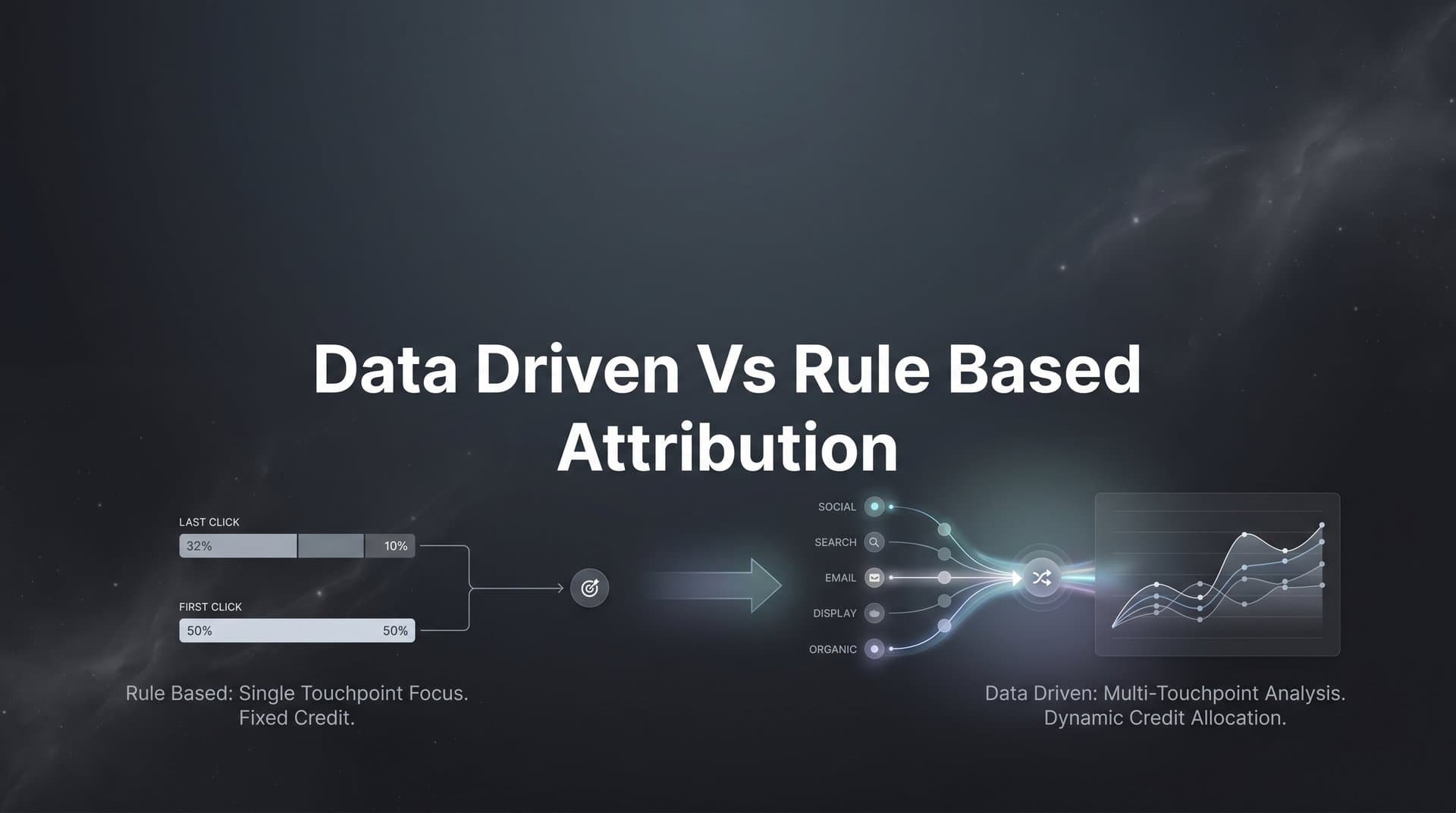
Marketing attribution determines how you allocate budget across channels, but choosing the wrong model can lead to wasted spend and missed opportunities. Rule-based attribution uses predetermined formulas to assign credit, while data-driven attribution uses machine learning to analyze actual conversion patterns. The challenge is knowing which approach fits your business context, data maturity, and marketing goals.
This guide provides actionable strategies to help you evaluate both approaches, implement the right model for your situation, and optimize your attribution setup for accurate revenue insights.
1. Audit Your Data Foundation Before Choosing a Model
The Challenge It Solves
Data-driven attribution sounds powerful, but it requires a solid foundation to work effectively. Without sufficient conversion volume and clean tracking, algorithmic models produce unreliable insights that can mislead your budget decisions. Many marketers jump to sophisticated attribution before their data infrastructure is ready, leading to false confidence in flawed recommendations.
The Strategy Explained
Before selecting an attribution model, evaluate three critical data elements: tracking completeness, data quality, and conversion volume. Tracking completeness means capturing every touchpoint across all channels where customers interact with your brand. Data quality requires accurate event tracking without duplicates, missing parameters, or broken connections between platforms. Conversion volume determines whether you have enough data points for machine learning algorithms to identify meaningful patterns.
Most platforms require minimum conversion thresholds before data-driven models become reliable. If you're generating fewer than 300-400 conversions per month, data-driven attribution may not have enough signal to distinguish between random variation and actual performance patterns.
Implementation Steps
1. Review your current tracking setup across all marketing channels and identify gaps where customer interactions aren't being captured or connected to your analytics platform.
2. Calculate your monthly conversion volume for each significant conversion event and compare it against platform-specific minimums for data-driven attribution.
3. Test data accuracy by comparing conversion counts across your analytics platform, CRM, and ad platforms to identify discrepancies that need resolution before implementing sophisticated attribution.
Pro Tips
Server-side tracking significantly improves data accuracy compared to client-side tracking alone, especially given browser privacy restrictions and iOS tracking limitations. If your conversion counts vary widely between platforms, address tracking infrastructure before worrying about attribution models.
2. Map Your Customer Journey Complexity
The Challenge It Solves
Attribution models should match the reality of how customers actually find and buy from you. Simple customer journeys with one or two touchpoints don't need complex attribution, while multi-channel journeys spanning weeks or months require more sophisticated approaches. Mismatched attribution complexity either oversimplifies important patterns or adds unnecessary confusion to straightforward conversion paths.
The Strategy Explained
Analyze your typical customer journey to understand touchpoint patterns and decision timelines. Look at how many interactions happen before conversion, which channels customers use, and how long the consideration period lasts. If most customers convert after a single ad click, last-touch attribution captures reality accurately. If customers research across multiple channels over several weeks, you need attribution that recognizes the cumulative influence of various touchpoints.
Journey complexity also varies by product type and price point. Lower-cost products with shorter consideration periods often have simpler journeys, while high-ticket items or B2B solutions typically involve multi-touch attribution models across awareness, consideration, and decision stages.
Implementation Steps
1. Pull conversion path reports from your analytics platform to see the average number of touchpoints and channels involved in your typical customer journey.
2. Calculate the average time from first interaction to conversion to understand whether your sales cycle is measured in hours, days, or weeks.
3. Segment journey patterns by product type, customer segment, or price point to identify whether different offerings require different attribution approaches.
Pro Tips
If your average customer journey involves three or fewer touchpoints, rule-based models like position-based attribution often provide sufficient insight without algorithmic complexity. Reserve data-driven models for journeys with five or more meaningful interactions across multiple channels.
3. Align Attribution Model to Business Objectives
The Challenge It Solves
Different business goals require different attribution perspectives. Optimizing for brand awareness demands different credit distribution than optimizing for immediate conversions or customer lifetime value. Using an attribution model that doesn't align with your actual business objectives leads to budget decisions that optimize for the wrong outcomes.
The Strategy Explained
Match your attribution approach to what you're actually trying to achieve. If your primary goal is generating awareness and top-of-funnel engagement, first-touch attribution highlights which channels introduce new prospects to your brand. If you're focused on closing deals and immediate revenue, last-touch attribution shows which channels directly drive conversions. For balanced growth across the entire funnel, linear or position-based attribution models distribute credit more evenly.
Business objectives also determine which conversion events matter most. Lead generation businesses might optimize for form submissions, while e-commerce companies focus on completed purchases. B2B companies with long sales cycles need attribution that connects marketing touchpoints to eventual closed deals, not just initial leads.
Implementation Steps
1. Define your primary business objective for the next quarter and identify which conversion events directly support that goal.
2. Map each attribution model type to your objective: first-touch for awareness, last-touch for direct response, linear for balanced growth, position-based for emphasis on introduction and conversion, and data-driven for complex optimization.
3. Select the model that best aligns with how you want to allocate budget across your marketing funnel stages.
Pro Tips
Your attribution model choice should evolve with your business stage. Early-stage companies often prioritize awareness and lead volume, making first-touch or linear models appropriate. As you mature and focus on efficiency, data-driven models that optimize for actual revenue become more valuable.
4. Test Rule-Based Models as Your Baseline
The Challenge It Solves
Jumping directly to data-driven attribution without establishing benchmarks makes it impossible to validate whether algorithmic recommendations actually improve performance. You need reference points to assess whether sophisticated models provide meaningful advantages over simpler approaches. Without baselines, you can't distinguish between model-driven improvements and natural performance variation.
The Strategy Explained
Start with rule-based attribution models to establish performance baselines before adding algorithmic complexity. Implement last-touch attribution to understand which channels directly drive conversions, then compare it against first-touch to see which channels introduce new customers. Run position-based or linear models to understand how credit distribution changes when you acknowledge multiple touchpoints.
These baseline comparisons reveal whether your conversion patterns are straightforward or complex. If all rule-based models produce similar channel rankings and budget recommendations, your customer journey is probably simple enough that data-driven attribution won't add much value. If different models produce dramatically different insights, you likely have complex journeys where data-driven approaches can identify patterns that predetermined formulas miss.
Implementation Steps
1. Implement last-touch attribution first and document your current channel performance rankings and conversion costs.
2. Run first-touch attribution for the same period and compare how channel rankings change when you credit initial touchpoints instead of final ones.
3. Test position-based or linear attribution to see how distributing credit across multiple touchpoints affects your understanding of channel contribution.
Pro Tips
Document specific decisions you would make based on each rule-based model's insights. If last-touch suggests cutting spend on social while first-touch shows social drives initial discovery, you've identified a complexity that attribution data analysis can help resolve.
5. Implement Hybrid Attribution for Transitional Periods
The Challenge It Solves
Switching attribution models creates uncertainty about whether performance changes reflect actual marketing improvements or just measurement differences. Teams lose confidence when channel rankings shift dramatically after model changes, making it difficult to commit to new budget allocations. Running only one attribution approach at a time means you can't validate insights or build trust in new methodologies.
The Strategy Explained
Run both rule-based and data-driven attribution simultaneously during transition periods to compare results and build confidence in algorithmic insights. This hybrid approach lets you validate data-driven recommendations against established baselines while gradually shifting decision-making toward more sophisticated models. You can test budget changes suggested by data-driven attribution while maintaining rule-based benchmarks to ensure performance doesn't deteriorate.
Hybrid attribution also helps identify where data-driven models provide the most value. If algorithmic insights match your rule-based models for some channels but reveal new patterns for others, you know exactly where sophisticated attribution adds meaningful perspective versus where simpler models suffice.
Implementation Steps
1. Configure your analytics platform to display both rule-based and data-driven attribution side by side for the same conversion events and time periods.
2. Compare channel rankings and credit distribution between models to identify where they agree and where they diverge significantly.
3. Test small budget adjustments based on data-driven recommendations while monitoring performance through both attribution lenses to validate improvements.
Pro Tips
Focus on channels where rule-based and data-driven models disagree most. These discrepancies often reveal where predetermined formulas miss important patterns that machine learning identifies. Use agreement between models as validation that insights are robust regardless of methodology.
6. Connect Attribution to Actual Revenue Outcomes
The Challenge It Solves
Attribution models can accurately track conversions while completely missing whether those conversions generate actual revenue. Optimizing for leads or sign-ups without connecting them to closed deals and customer value means your attribution guides you toward volume metrics that don't necessarily improve business outcomes. This disconnect becomes especially problematic for businesses with long sales cycles or significant variation in customer value.
The Strategy Explained
Validate attribution accuracy by integrating CRM data and tracking complete customer journeys from initial touchpoint through closed deals and revenue generation. This connection reveals which channels attract high-value customers versus those that generate low-quality leads. It also shows whether your attribution model correctly identifies the touchpoints that influence purchase decisions versus those that simply correlate with conversions.
Revenue-connected attribution transforms marketing measurement from counting conversions to understanding profit contribution. You can calculate true customer acquisition costs, identify which campaigns generate positive ROI, and optimize ROAS with attribution data instead of initial conversion volume.
Implementation Steps
1. Connect your marketing attribution platform to your CRM system so conversion events can be matched with eventual revenue outcomes and deal closure data.
2. Track the complete customer journey from first marketing touchpoint through CRM stages to closed-won revenue, ensuring all systems share consistent customer identifiers.
3. Compare channel performance based on initial conversions versus actual revenue contribution to identify discrepancies where attribution credit doesn't align with business value.
Pro Tips
Feeding enriched conversion data back to ad platforms improves their optimization algorithms. When platforms understand which conversions generate revenue, they can automatically optimize toward high-value customers instead of just conversion volume. This creates a virtuous cycle where better attribution drives better targeting.
7. Build Feedback Loops for Continuous Model Improvement
The Challenge It Solves
Attribution models become outdated as customer behavior changes, new marketing channels emerge, and business priorities evolve. Setting up attribution once and never revisiting it means your insights gradually drift from reality. Without regular audits and updates, you make budget decisions based on increasingly stale assumptions about how customers actually convert.
The Strategy Explained
Establish regular processes to audit attribution accuracy and update models based on actual performance outcomes. Review conversion path reports monthly to identify whether journey patterns are changing. Compare attributed channel performance against actual revenue results to catch discrepancies early. Test new attribution approaches when you launch significant campaigns or enter new markets where customer behavior might differ from historical patterns.
Continuous improvement also means feeding conversion insights back to advertising platforms. When your attribution reveals which campaigns drive valuable customers, sync that data back to Meta, Google, and other platforms so their algorithms can optimize toward similar audiences. This feedback loop improves both your attribution accuracy and your campaign performance.
Implementation Steps
1. Schedule monthly attribution reviews where you compare model recommendations against actual business outcomes and identify any significant discrepancies that require investigation.
2. Set up automated conversion sync to feed enriched event data back to your advertising platforms, including revenue values and customer quality signals.
3. Document attribution changes over time to understand how customer journey patterns evolve and whether your model still matches current behavior.
Pro Tips
Attribution accuracy improves when you capture every touchpoint across all channels. Implementing first-party data tracking helps maintain data quality as browser restrictions tighten, ensuring your attribution models have complete information about customer journeys regardless of privacy changes.
Putting It All Together
Choosing between data-driven and rule-based attribution is not a permanent decision but an evolving strategy that should match your data maturity and business needs. Start by auditing your data foundation to ensure you have the tracking completeness and conversion volume necessary for sophisticated attribution. Map your customer journey complexity to understand whether you need algorithmic models or if simpler approaches capture your reality accurately.
Align your attribution model to actual business objectives, whether you're optimizing for awareness, leads, or revenue. Test rule-based models first to establish baselines, then implement hybrid approaches that run both methodologies simultaneously during transitions. Connect attribution to revenue outcomes by integrating CRM data so you optimize for business value instead of just conversion volume.
Build feedback loops that continuously improve model accuracy and feed conversion insights back to ad platforms for better optimization. The goal is accurate attribution that connects marketing activity to revenue, enabling confident budget decisions that scale your campaigns effectively.
Ready to elevate your marketing game with precision and confidence? Discover how Cometly's AI-driven recommendations can transform your ad strategy. Get your free demo today and start capturing every touchpoint to maximize your conversions.