

You're staring at a $5,000 conversion in your dashboard. The customer clicked a Facebook ad three weeks ago, read two blog posts, opened three emails, and finally converted after clicking a Google search ad. Which channel gets credit? Which budget do you increase?
This is the daily reality for marketers managing multi-channel campaigns. Your customers don't convert in a straight line. They discover your brand through one channel, research through another, and convert through a third. Single-touch attribution models force you to choose: credit the channel that introduced them, or credit the one that closed them.
Position based attribution offers a different approach. Instead of picking sides, it acknowledges that both awareness and conversion matter. It's built on a simple premise: the touchpoint that introduces a customer and the touchpoint that converts them both deserve significant credit, while the middle interactions that kept them engaged deserve recognition too.
This guide breaks down exactly how position based attribution works, when it makes strategic sense for your business, and how to implement it in your marketing stack. If you're running campaigns across multiple channels and struggling to justify budgets for both awareness and conversion efforts, this model might be exactly what you need.
The 40-20-40 Split: Understanding Position Based Attribution
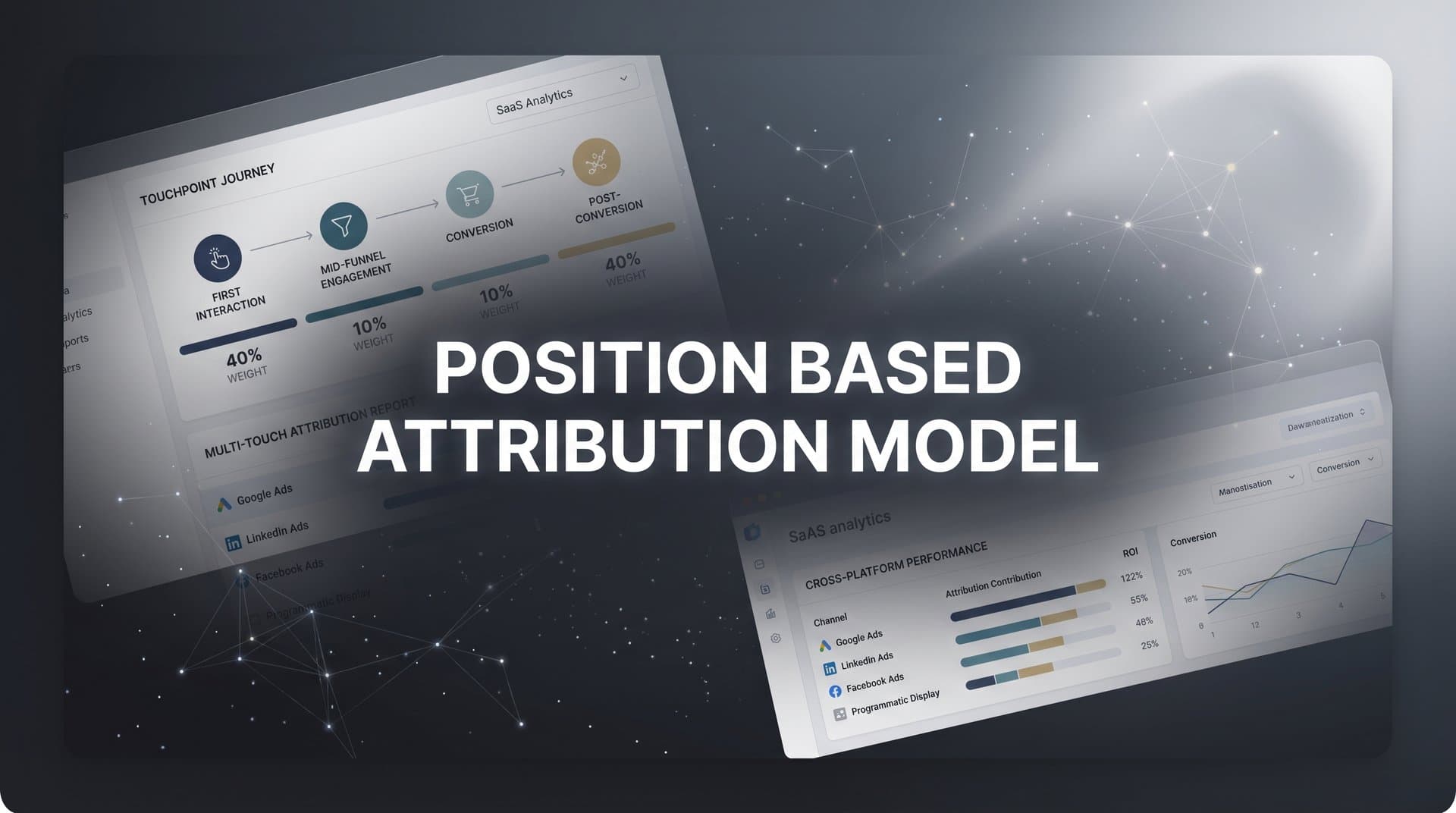
Position based attribution is a multi-touch attribution model that distributes conversion credit across the customer journey using a specific weighting formula: 40% to the first touchpoint, 40% to the last touchpoint, and the remaining 20% split evenly among all middle interactions.
Think of it like a U-shape, which is why you'll often hear it called U-shaped attribution. The credit curve dips in the middle and rises at both ends. This structure reflects a specific marketing philosophy: the channel that introduces a customer to your brand and the channel that drives them to convert are both critical, but everything in between still matters.
Here's how it works in practice. Let's say a customer takes this journey before purchasing your product:
1. Clicks a Facebook ad (first touch)
2. Reads a blog post from organic search
3. Opens a marketing email
4. Clicks a retargeting ad on Instagram
5. Searches your brand name on Google and converts (last touch)
With position based attribution, here's how the credit breaks down: Facebook gets 40% because it introduced the customer to your brand. Google search gets 40% because it drove the final conversion. The three middle touchpoints (blog post, email, Instagram ad) split the remaining 20%, giving each one 6.67% credit.
This distribution tells a story about your marketing funnel. It says that awareness channels and conversion channels both deserve substantial recognition, while nurture channels play a supporting role. If that Facebook ad costs $50 and generates 100 conversions using position based attribution, you can confidently attribute $2,000 in conversion value to your awareness efforts, even if those customers didn't convert immediately.
The model becomes particularly revealing when you compare channel performance. You might discover that TikTok excels at first-touch attribution (introducing new customers) but rarely appears as the last touch. Meanwhile, Google search consistently shows up at the end of journeys but rarely introduces new customers. Both channels are valuable, but they serve completely different roles in your funnel.
Position based attribution gives you the language and data to justify both investments. Your CFO wants to cut the TikTok budget because it doesn't show direct conversions? You can now demonstrate that it's responsible for 40% of the credit on conversions that happen weeks later through other channels.
Position Based vs. Other Attribution Models: Key Differences
Understanding position based attribution requires context. Let's compare it to the other models marketers use to make sense of their data.
First-touch attribution gives 100% credit to the initial interaction. If someone clicks your Facebook ad, browses your site for three months through various channels, and finally converts, Facebook gets all the credit. This model is simple and great for measuring awareness campaign effectiveness, but it completely ignores the channels that actually drove the conversion. You'll overvalue top-of-funnel channels and underinvest in conversion optimization.
Last-touch attribution does the opposite: 100% credit to the final touchpoint before conversion. Google search ads often dominate in last-touch models because people search for brands right before buying. The problem? You're crediting the channel that harvested demand while ignoring all the channels that created that demand in the first place. Your awareness campaigns look worthless even though they're essential.
Linear attribution tries to solve this by giving equal credit to every touchpoint. If a customer has five interactions before converting, each gets 20%. This seems fair, but it treats all touchpoints as equally important. The Facebook ad that introduced your brand gets the same credit as the email they ignored. The Google search that drove them to purchase gets the same weight as a blog post they skimmed. Linear attribution avoids bias, but it also avoids strategic insight.
Time-decay attribution weights touchpoints based on recency. Interactions closer to the conversion get more credit than earlier ones. This makes intuitive sense (recent touchpoints are fresh in the customer's mind), but it undervalues the awareness channels that started the relationship. If you optimize purely for time-decay attribution, you'll shift budget away from top-of-funnel campaigns and wonder why your pipeline eventually dries up.
Data-driven attribution uses machine learning to analyze thousands of customer journeys and determine which touchpoints actually influence conversions. It's sophisticated and potentially the most accurate, but it requires massive data volumes to work effectively. Most businesses don't have enough conversion data for reliable algorithmic attribution, and the model can feel like a black box when you're trying to explain budget decisions to stakeholders.
Position based attribution sits in a strategic middle ground. It's more nuanced than single-touch models, more opinionated than linear attribution, and more transparent than algorithmic approaches. It makes a clear statement about marketing philosophy: awareness and conversion both matter significantly, and we'll give them equal weight while still acknowledging the supporting role of middle touchpoints.
When Position Based Attribution Makes Strategic Sense
Position based attribution isn't the right fit for every business. It shines in specific scenarios where its assumptions align with how customers actually buy.
The ideal candidate is a business with a considered purchase cycle. If customers typically discover your brand, research for days or weeks, and then convert, position based attribution reflects that reality. B2B software companies, high-ticket e-commerce brands, and professional services firms often fit this profile. Your customers aren't impulse buying. They're taking a journey, and both the beginning and end of that journey deserve recognition.
You also need multiple active marketing channels. If you're only running Google search ads, attribution modeling doesn't matter because every touchpoint is Google. Position based attribution becomes valuable when you're investing in awareness channels (social media, display ads, content marketing) and conversion channels (search ads, retargeting, email) simultaneously. The model helps you prove that both investments are working together.
Marketing teams with separate awareness and conversion budgets benefit enormously. Picture a team where one person manages brand campaigns on Meta and TikTok, while another manages Google search and shopping ads. With last-touch attribution, the search marketer looks like a hero while the social marketer struggles to prove ROI. Position based attribution levels the playing field by showing how awareness efforts contribute to conversions that happen through other channels.
The model also makes sense when you're scaling from single-channel to multi-channel marketing. You've been running Google search ads successfully, and now you want to invest in awareness channels to grow your audience. Choosing the right attribution model will help you measure whether those new channels are actually introducing customers who later convert, even if they don't drive immediate sales.
But there are warning signs this model might not fit. If your purchase cycle is extremely short (customers see an ad and buy within minutes), position based attribution adds unnecessary complexity. Single-touch or linear models will tell you everything you need to know. Similarly, if your middle touchpoints are genuinely critical to conversion (like a product demo or consultation call), giving them only 20% of the credit undervalues their impact. You might need a custom weighting model or data-driven attribution instead.
Ask yourself: do we invest significantly in both awareness and conversion campaigns? Do customers take multi-day or multi-week journeys before buying? Do we need to justify budgets for channels that don't show up in last-click reports? If you answered yes to these questions, position based attribution probably makes strategic sense for your business.
Implementing Position Based Attribution in Your Marketing Stack
Understanding position based attribution conceptually is one thing. Actually implementing it requires technical infrastructure that most marketing teams underestimate.
The foundation is comprehensive journey tracking. You need to capture every touchpoint a customer has with your brand across all channels. That means tracking pixels on your website, integration with every ad platform you use (Meta, Google, TikTok, LinkedIn, etc.), and connections to your email marketing platform. Each interaction needs to be logged with a timestamp and associated with a unique customer identifier.
This is harder than it sounds. A customer might click your Facebook ad on their phone, research on their laptop later that day, and convert on their tablet the next week. Without cross-device tracking, these look like three different people. Your attribution model will fragment the journey and assign credit incorrectly. Modern attribution platforms use probabilistic matching and deterministic identifiers to stitch these interactions together, but it requires sophisticated tracking infrastructure.
CRM integration is the next critical piece. If you're a B2B company, the conversion might not happen on your website at all. A prospect might fill out a form, have three sales calls, and close a $50,000 deal two months later. That deal needs to be connected back to the original marketing touchpoints. Your attribution platform must integrate with your CRM to capture offline conversions and associate them with the digital journey that preceded them.
Server-side tracking has become increasingly important as browser-based tracking faces limitations. iOS privacy changes, cookie restrictions, and ad blockers mean that client-side pixels miss significant portions of your traffic. Server-side tracking sends event data directly from your server to ad platforms and attribution tools, bypassing browser limitations and improving data accuracy. If your attribution data feels incomplete, missing server-side tracking is often the culprit.
Data accuracy is non-negotiable for attribution modeling. If your tracking misses 30% of touchpoints, your attribution insights will be fundamentally flawed. You'll undervalue channels with tracking issues and overvalue channels where tracking works better. This creates a vicious cycle where you shift budget toward channels that simply have better tracking, not channels that actually perform better.
Modern attribution platforms like Cometly automate the heavy lifting. They connect to your ad accounts, install tracking across your website, integrate with your CRM, and automatically calculate attribution credit using position based (or other) models. You get a unified dashboard showing how each channel performs at different stages of the funnel, with credit distribution happening in real time as conversions occur.
The implementation process typically looks like this: connect your ad platforms through API integrations, install tracking pixels or server-side tracking on your website, integrate your CRM to capture closed deals, configure your attribution model settings (40-20-40 for position based), and start collecting data. You'll need at least a few weeks of data before attribution insights become reliable, and several months before you have enough volume to make major budget decisions with confidence.
Turning Attribution Insights Into Budget Decisions
Attribution data is only valuable if you actually use it to make better decisions. Here's how to translate position based attribution insights into concrete budget allocation strategies.
Start by identifying channel roles. Look at your attribution reports and note which channels consistently show up as first-touch interactions. These are your awareness channels. They're introducing new customers to your brand. Then identify which channels dominate last-touch attribution. These are your conversion channels. They're closing deals. Some channels might excel at both, while others play a specialized role.
Let's say your position based attribution report shows that TikTok ads generate 35% of first-touch credit but only 8% of last-touch credit. Meanwhile, Google search generates 10% of first-touch credit but 42% of last-touch credit. This tells you exactly what each channel does well. TikTok is an awareness machine. Google search is a conversion driver. You need both, but they serve different purposes.
Use this insight to set channel-specific goals and budgets. Your TikTok campaigns should be measured on their ability to introduce new customers (first-touch attribution), not on immediate ROAS. Your Google search campaigns should be measured on their ability to convert existing demand (last-touch attribution), not on building brand awareness. Stop expecting every channel to do everything.
Budget allocation becomes more strategic when you understand these roles. If you're seeing strong first-touch attribution from social channels but weak last-touch attribution, you might need to invest more in retargeting and email nurture to convert the awareness you're generating. If you're seeing strong last-touch attribution but declining first-touch volume, you need to invest more in top-of-funnel channels to keep your pipeline full.
Attribution data also improves ad platform optimization. When you send accurate conversion data back to Meta, Google, and other platforms through conversion APIs, their algorithms learn which audiences and creative approaches actually drive results. Position based attribution helps you identify which conversions to feed back to each platform. Credit the awareness platforms for first-touch conversions and conversion platforms for last-touch conversions, giving each algorithm the signal it needs to optimize effectively.
Watch for trends over time. If a channel's first-touch attribution is declining, it might mean your creative is getting stale or your audience is saturated. If last-touch attribution is dropping, your conversion funnel might have issues or competitors are getting more aggressive. Understanding marketing channel attribution becomes a diagnostic tool for identifying problems before they crater your performance.
The key is making attribution insights actionable. Don't just look at pretty dashboards. Ask: which channels need more budget based on their role? Which channels are underperforming and need creative refresh or audience adjustments? Where are the gaps in my funnel that attribution data reveals? Position based attribution gives you the data to answer these questions with confidence.
Making Position Based Attribution Work for You
Position based attribution delivers the most value when you're running multi-channel campaigns with distinct awareness and conversion strategies. It's built for marketers who understand that customer journeys have beginnings, middles, and ends, and that different channels excel at different stages.
The 40-20-40 credit distribution isn't arbitrary. It reflects a marketing philosophy: the channel that introduces a customer matters just as much as the channel that converts them. If your business operates this way, with significant investment in both top-of-funnel brand building and bottom-of-funnel conversion optimization, position based attribution will give you the insights you need to optimize both.
Take a moment to evaluate your current attribution approach. Are you using last-touch attribution and struggling to justify awareness campaign budgets? Are you using first-touch attribution and wondering why your conversion rates are declining? Are you using linear attribution and treating all touchpoints as equally important even though you know they're not?
Position based attribution might be the balanced approach you need. It's not perfect for every business, but for companies with considered purchase cycles, multiple marketing channels, and the technical infrastructure to track complete customer journeys, it provides clarity that single-touch models simply can't deliver.
Your Next Steps: From Attribution to Action
Position based attribution solves a fundamental challenge in modern marketing: how do you fairly credit channels that serve different roles in the customer journey? By giving equal weight to awareness and conversion touchpoints while acknowledging the supporting role of middle interactions, it provides a balanced view of channel performance.
But attribution modeling is only as good as the data behind it. Incomplete tracking, missed touchpoints, and fragmented customer journeys produce flawed insights that lead to bad budget decisions. The difference between useful attribution and misleading attribution is comprehensive journey tracking across every channel and device.
If you're ready to move beyond guessing which channels drive results, you need infrastructure that captures every touchpoint, stitches together cross-device journeys, and automatically calculates attribution credit in real time. That's where the right attribution platform becomes essential.
Ready to elevate your marketing game with precision and confidence? Discover how Cometly's AI-driven recommendations can transform your ad strategy. Get your free demo today and start capturing every touchpoint to maximize your conversions.



