You're running ads across Meta, Google, TikTok, and maybe a few other platforms. Your dashboards show thousands of clicks, hundreds of conversions, and decent ROAS numbers. But when your CFO asks which campaigns actually drove revenue last quarter, you freeze. The data's there—somewhere—but connecting the dots between that Instagram ad click and the $50,000 deal that closed three weeks later? That's where things get fuzzy.
Here's the uncomfortable truth: most marketers are drowning in data while starving for insights. You have more metrics than ever before, yet answering basic questions like "should I increase my Google budget or my Meta budget?" feels like educated guesswork. The problem isn't that you need more data. You need the right data, properly connected, and translated into decisions you can actually act on.
This guide breaks down what marketing data actually matters, why your current setup is probably failing you, and how to build a data foundation that drives confident, revenue-focused decisions. Let's cut through the noise.
The Four Types of Marketing Data That Actually Drive Decisions
Not all marketing data deserves equal attention. Understanding which types of data matter—and how they work together—is the first step toward making smarter decisions.
First-Party Data: Your Most Valuable Asset
This is data you own directly: website behavior, CRM records, purchase history, email engagement, customer support interactions. First-party data is gold because it's accurate, comprehensive, and entirely yours. When someone fills out a form on your site, downloads a resource, or completes a purchase, that's first-party data flowing into your systems.
The power of first-party data lies in its completeness. You're not relying on a platform's interpretation of what happened—you know exactly what happened because it happened on your property. This data becomes your single source of truth for understanding customer behavior and measuring actual business outcomes.
Platform Data: Useful But Siloed
Every ad platform gives you metrics: impressions, clicks, cost per click, platform-reported conversions. Meta Ads Manager shows you ROAS. Google Ads reports conversion rates. TikTok tells you about video views and engagement.
Platform data is useful for understanding performance within that specific channel. The problem? Each platform lives in its own silo. Meta doesn't know about your Google campaigns. Google doesn't see your TikTok spend. And when platforms report conversions, they're often claiming credit for the same sale, creating an attribution mess that makes budget decisions nearly impossible.
Attribution Data: The Connective Tissue
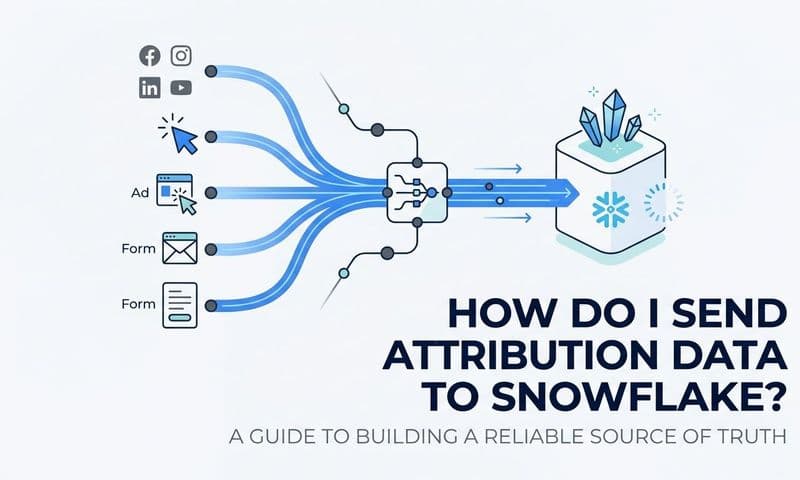
This is where things get interesting. Attribution data connects the dots across your entire customer journey. It's the layer that says "this person clicked a Meta ad on Monday, searched your brand on Google Tuesday, clicked an email link Wednesday, then purchased Thursday."
Without attribution data, you're looking at disconnected snapshots. With it, you see the full movie of how customers actually find and buy from you. This is what lets you understand which channels work together, which touchpoints matter most, and where your budget should actually go. Understanding multi-touch attribution models is essential for connecting these data points effectively.
Intent and Behavioral Signals: Reading Between the Lines
Beyond explicit actions, behavioral patterns tell you where prospects are in their buying journey. Someone who visits your pricing page three times in a week is sending a different signal than someone who bounced after reading one blog post.
These signals include time on site, pages per session, content consumption patterns, feature comparison behavior, and engagement frequency. When you learn to read these patterns, you can identify high-intent prospects before they convert and adjust your marketing to meet people where they are in their decision process.
Why Most Marketing Data Fails You (And What's Actually Going Wrong)
If you've noticed your conversion tracking getting less reliable over the past few years, you're not imagining things. Several seismic shifts have fundamentally broken how marketing data flows.
iOS Privacy Changes Created Massive Blind Spots
When Apple rolled out App Tracking Transparency with iOS 14.5, they required apps to ask permission before tracking users across other apps and websites. The result? Industry observers widely report that opt-in rates are low, meaning most iOS users are now invisible to traditional pixel-based tracking.
For marketers, this means a huge chunk of your audience—often your highest-value mobile users—simply disappears from your conversion data. That Facebook pixel that used to track every purchase? It now misses a significant portion of iOS conversions entirely. Your reported ROAS looks worse not because your ads got worse, but because you're blind to many of the conversions they're actually driving.
Platform Attribution Inflates Everything
Here's a scenario that happens constantly: someone clicks your Meta ad, later searches your brand on Google and clicks that ad, then converts. Meta claims the conversion. Google claims the conversion. Your total reported conversions across platforms add up to 150% of your actual sales.
Each platform uses last-click attribution by default, meaning whoever got the final click before conversion takes full credit. But customers rarely convert after touching just one channel. They research, compare, get distracted, come back through different channels. When every platform claims full credit for the same sale, your data becomes fiction. Learning how to fix attribution discrepancies is critical for accurate reporting.
This isn't just an accounting problem. When you're trying to decide where to allocate budget, inflated platform numbers lead you to over-invest in channels that look good on paper to campaigns that actually drive profitable growth. The difference in ROI can be dramatic.
Disconnected Data Sources Kill Context
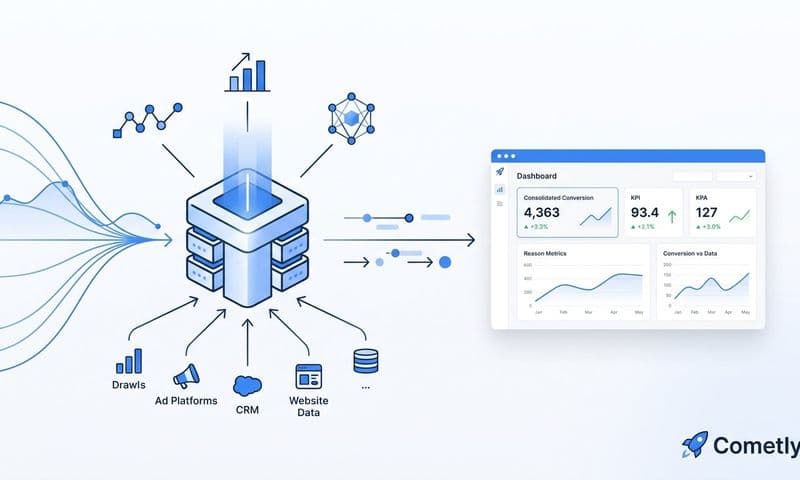
Your ad data lives in Meta Ads Manager. Your CRM data lives in Salesforce or HubSpot. Your website analytics live in Google Analytics. Your email metrics live in whatever ESP you use. Each system tells you something useful, but none of them talk to each other.
The result? You're making decisions on incomplete pictures. You might see that a Google campaign drove 50 conversions, but without connecting that to your CRM, you have no idea if those conversions were $100 customers or $10,000 customers. You're optimizing for volume when you should be optimizing for value.
Building a Connected Data Foundation: From Clicks to Revenue
Fixing your marketing data isn't about collecting more metrics. It's about building infrastructure that captures complete, accurate data and connects it across your entire customer journey.
Server-Side Tracking Recovers Lost Conversions
Browser-based pixels are dying. Ad blockers remove them. Privacy settings block them. iOS restrictions limit them. Server-side tracking bypasses all of this by sending conversion data directly from your server to ad platforms.
When someone converts on your website, your server immediately sends that conversion event to Meta's Conversions API or Google's Enhanced Conversions. This happens server-to-server, completely independent of browser pixels, cookies, or user privacy settings. The result is dramatically more complete and accurate conversion data.
Server-side tracking doesn't just recover lost conversions—it sends richer data. You can include customer lifetime value, purchase categories, subscription tiers, and other business context that browser pixels can't access. This gives ad platform algorithms better information to optimize targeting and bidding.
Connecting Ad Platforms to Your CRM Creates Truth
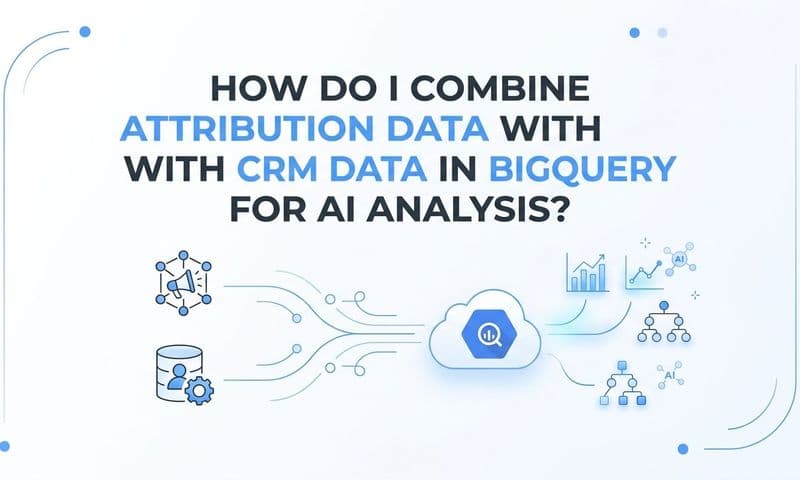
The magic happens when you connect your ad platform data to your CRM data. Suddenly, you're not just tracking clicks and conversions—you're tracking clicks to opportunities to closed deals to actual revenue. This is where marketing attribution platforms with revenue tracking become invaluable.
This connection lets you answer questions that were previously impossible: Which campaign drove the most qualified leads? Which ad creative generated the highest-value customers? What's the true customer acquisition cost when you factor in lifetime value? How long is the actual sales cycle from first ad click to closed deal?
When your CRM becomes part of your marketing data infrastructure, you stop optimizing for conversions and start optimizing for revenue. That's the shift from marketing metrics to business metrics.
Real-Time Data Syncing Enables Confident Optimization
Weekly reports are too slow. By the time you realize a campaign is underperforming, you've already wasted thousands of dollars. Real-time data syncing means you're always working with current information.
When conversions flow immediately from your website to your analytics platform to your ad platforms, you can make optimization decisions based on what's happening today, not what happened last week. You can spot trends as they emerge, pause underperformers before they burn budget, and scale winners while they're hot.
Real-time data also means your ad platform algorithms get immediate feedback, letting them optimize faster and more accurately. The faster platforms learn what's working, the better they get at finding more of the right people.
From Raw Numbers to Revenue Insights: Analyzing Marketing Data Effectively
Having good data is only half the battle. The other half is analyzing it in ways that reveal actual insights instead of just more numbers.
Multi-Touch Attribution Reveals the Full Story
Last-click attribution gives all credit to the final touchpoint before conversion. First-click attribution gives all credit to the first touchpoint. Both are wrong because they ignore everything in between.
Multi-touch attribution models distribute credit across all the touchpoints in a customer's journey. Linear attribution spreads credit equally. Time-decay gives more credit to recent touchpoints. Position-based (U-shaped) emphasizes first and last touches while acknowledging the middle. Understanding the comparison of attribution models helps you choose the right approach for your business.
The power of multi-touch attribution is seeing which channels work together. You might discover that paid social is great at initial awareness, organic search drives consideration, and paid search closes the deal. Without multi-touch attribution, you'd only see that paid search "converts best" and miss the fact that it only works because other channels set it up.
Cohort Analysis Shows Performance Over Time
Looking at aggregate metrics hides important patterns. Cohort analysis groups customers by when they converted or which campaign they came from, then tracks how those groups perform over time.
You might find that customers from Campaign A have higher immediate conversion rates, but customers from Campaign B have much better retention and lifetime value. Aggregate data would tell you Campaign A is the winner. Cohort analysis reveals that Campaign B is actually more valuable.
This approach also helps you understand seasonality, identify quality shifts in traffic sources, and spot problems before they become disasters. If you notice that cohorts from the past two weeks have significantly worse engagement than previous cohorts, you can investigate and fix issues quickly.
Comparing Attribution Models Side-by-Side
Don't pick one attribution model and treat it as truth. Compare multiple models side-by-side to understand the full picture. When last-click, first-click, and multi-touch models tell different stories, the differences themselves are insights.
If a channel looks great in last-click attribution but terrible in first-click, it's probably good at closing but not at generating new interest. If a channel performs well in every model, it's genuinely strong across the entire funnel. These patterns help you understand not just which channels work, but how they work and where they fit in your strategy. A solid data driven attribution approach makes this comparison process systematic and actionable.
Turning Data Into Action: Making Confident Budget Decisions
Analysis without action is just expensive entertainment. The point of better marketing data is making better decisions—specifically, knowing where to invest your budget for maximum return.
Identify Your True Top Performers Across All Channels
When you have unified data connecting ad clicks to actual revenue, you can finally see which campaigns, ad sets, and even individual ads are driving real business results. Not platform-reported conversions. Not click-through rates. Actual revenue.
This often reveals surprising truths. That campaign with the highest reported ROAS might actually be driving low-value customers who churn quickly. That "underperforming" campaign might be attracting your best long-term customers. Without unified data connecting marketing activity to business outcomes, you're flying blind. Implementing data analytics for digital marketing properly reveals these hidden performance patterns.
Use this insight to reallocate budget from campaigns that look good on paper to campaigns that actually drive profitable growth. The difference in ROI can be dramatic.
Feed Accurate Conversion Data Back to Ad Platforms
Ad platform algorithms are powerful, but they're only as good as the data you feed them. When you send incomplete or inaccurate conversion data, platforms optimize for the wrong things.
By sending accurate, enriched conversion data back to platforms—including conversion values, customer types, and other business context—you help their algorithms find more of your best customers. This creates a virtuous cycle: better data leads to better targeting, which leads to better customers, which generates better data.
This is especially important for Meta and Google, which use conversion data to train their optimization algorithms. The more accurate and detailed your conversion events, the better these platforms get at predicting who will convert and how much they're worth. Discover how ad tracking tools can help you scale ads by leveraging this data feedback loop.
AI-Powered Analysis Surfaces Hidden Patterns
Human analysts are great at asking questions and testing hypotheses. AI is great at finding patterns in complex, multi-dimensional data that humans would never spot.
AI-powered analysis can identify which combinations of channels, audiences, and creatives work best together. It can spot early warning signs of campaign fatigue before performance drops. It can surface opportunities for budget reallocation that would take humans days of manual analysis to find.
The key is using AI to augment human decision-making, not replace it. AI surfaces insights and recommendations. Marketers apply business context, strategic thinking, and creative judgment to turn those insights into action.
Your Marketing Data Action Plan: Where to Start
Building a proper marketing data foundation doesn't happen overnight, but you can start making progress immediately with a structured approach.
Audit Your Current Data Sources and Identify Gaps
Start by mapping out your complete customer journey and identifying where you have data and where you have blind spots. Can you track a customer from first ad impression through every touchpoint to final purchase and beyond? Where do people fall off your radar?
Common gaps include offline conversions that never get connected back to online marketing, mobile app events that aren't synced with web behavior, and CRM data that lives separately from marketing data. List every gap you find—these are your opportunities for improvement. Understanding the need for marketing data helps you prioritize which gaps to address first.
Prioritize Your Highest-Spend Channels First
You can't fix everything at once. Start with your biggest budget channels because that's where improved data accuracy will have the most immediate impact. If you're spending $50,000 per month on Meta ads and $5,000 on TikTok, fix Meta first.
Implement server-side tracking for your top channels. Connect them to your CRM. Set up proper attribution tracking. Once you have one channel working properly, you'll have a template for adding others.
Build a Data-Driven Decision Culture
Technology is only part of the solution. You also need to establish clear metrics, regular review cadences, and a culture where decisions are based on data rather than opinions or gut feelings. Understanding the distinction between being data driven vs data informed helps shape the right organizational mindset.
Define what success looks like for each channel and campaign. Set up weekly or biweekly review processes where you look at performance data and make optimization decisions. Create dashboards that make key metrics visible to everyone who needs them. Make data accessibility and transparency part of how your team operates.
Moving Forward: From Data Chaos to Marketing Confidence
Effective marketing data isn't about collecting everything—it's about connecting the right data points to see the complete customer journey from first impression to final purchase and beyond. The marketers who win in 2026 and beyond aren't the ones with the most data. They're the ones with the clearest picture of what's actually working.
When you invest in proper data infrastructure—server-side tracking, unified attribution, connected CRM data, real-time syncing—you gain a significant competitive advantage. You stop guessing which campaigns drive revenue and start knowing. You stop reacting to incomplete platform reports and start making proactive decisions based on complete business data.
The gap between marketers with good data and marketers with bad data is widening. Privacy changes, platform limitations, and increasing complexity mean that default tracking setups no longer work. The marketers who adapt by building connected data foundations will outperform competitors who are still flying blind.
Ready to elevate your marketing game with precision and confidence? Discover how Cometly's AI-driven recommendations can transform your ad strategy—Get your free demo today and start capturing every touchpoint to maximize your conversions.