
You've just spent $50,000 on a multi-channel campaign across Google, Meta, LinkedIn, and email. Revenue is up. Conversions are flowing. But when you sit down to analyze which channels actually drove those sales, you hit a wall. Google Analytics credits last-click search. Meta claims credit for the same conversions through its pixel. Your email platform shows assisted conversions. And your CRM? It's telling a completely different story.
This isn't just frustrating. It's expensive.
When you can't connect ad spend to actual revenue with confidence, you're flying blind. You might cut a profitable channel because it doesn't show up in last-click reports. Or you might pour budget into flashy top-of-funnel campaigns that never actually close deals. The modern customer journey doesn't follow a straight line from ad click to purchase. It zigzags across devices, platforms, and sessions over days or weeks. Understanding digital marketing attribution methods is what separates marketers who scale profitably from those who burn budget chasing vanity metrics.
This guide breaks down the major attribution approaches, explains when each model makes sense for your business, and shows you how to implement them effectively so you can make smarter budget decisions with confidence.
Why Attribution Matters More Than Ever in Multi-Channel Marketing
The customer journey has fundamentally changed. A decade ago, someone might see a Google ad, click through, and buy within the same session. Clean. Simple. Easy to track.
Today? That same customer sees your Instagram ad on mobile during their morning commute. They research your solution on their laptop at work. They read comparison articles. They watch a demo video. They sign up for your email list. Three days later, they click an email link, browse your pricing page, then close the tab. A week passes. They see a retargeting ad on Facebook, click through on their tablet, and finally convert.
Which touchpoint deserves credit for that sale?
This complexity isn't theoretical. Most B2B buyers interact with a brand across multiple channels before making a purchase decision. E-commerce customers often research products across several sessions and devices. Without proper attribution, you're trying to optimize campaigns with incomplete information. Understanding multi-channel attribution in digital marketing has become essential for accurate performance measurement.
The tracking landscape has gotten messier, not cleaner. iOS privacy changes introduced with App Tracking Transparency have made traditional pixel-based tracking significantly less reliable. Users can now opt out of cross-app tracking, creating blind spots in your data. Third-party cookies are being phased out across major browsers. The signals you relied on to connect touchpoints are disappearing.
Here's what happens when attribution breaks down: You see that your Facebook campaigns generate clicks but Google Analytics shows most conversions coming from direct traffic or organic search. In reality, those "direct" conversions often started with a paid ad interaction that didn't get tracked properly. You respond by cutting Facebook budget. Revenue drops. You scramble to figure out why.
Or consider the opposite scenario. Your top-of-funnel awareness campaigns on LinkedIn generate tons of impressions and clicks. Your boss loves the engagement metrics. But when you track those users through to closed revenue, you discover they rarely convert. Meanwhile, your boring retargeting campaigns with lower engagement are quietly driving most of your actual sales. Without attribution that connects clicks to revenue, you'd never know.
The stakes are real. Marketers who can accurately attribute revenue to specific channels and campaigns can confidently shift budget toward what works. They can test new channels with clear success metrics. They can prove ROI to executives who want to see results, not just activity. Those who can't? They're stuck defending budget based on surface-level metrics that don't tell the full story.
Single-Touch Attribution: First-Click vs. Last-Click Models
Single-touch attribution takes the simplest possible approach: give all the credit to one touchpoint and ignore everything else. It's clean, easy to implement, and often completely misleading. But understanding these models matters because many platforms still default to them.
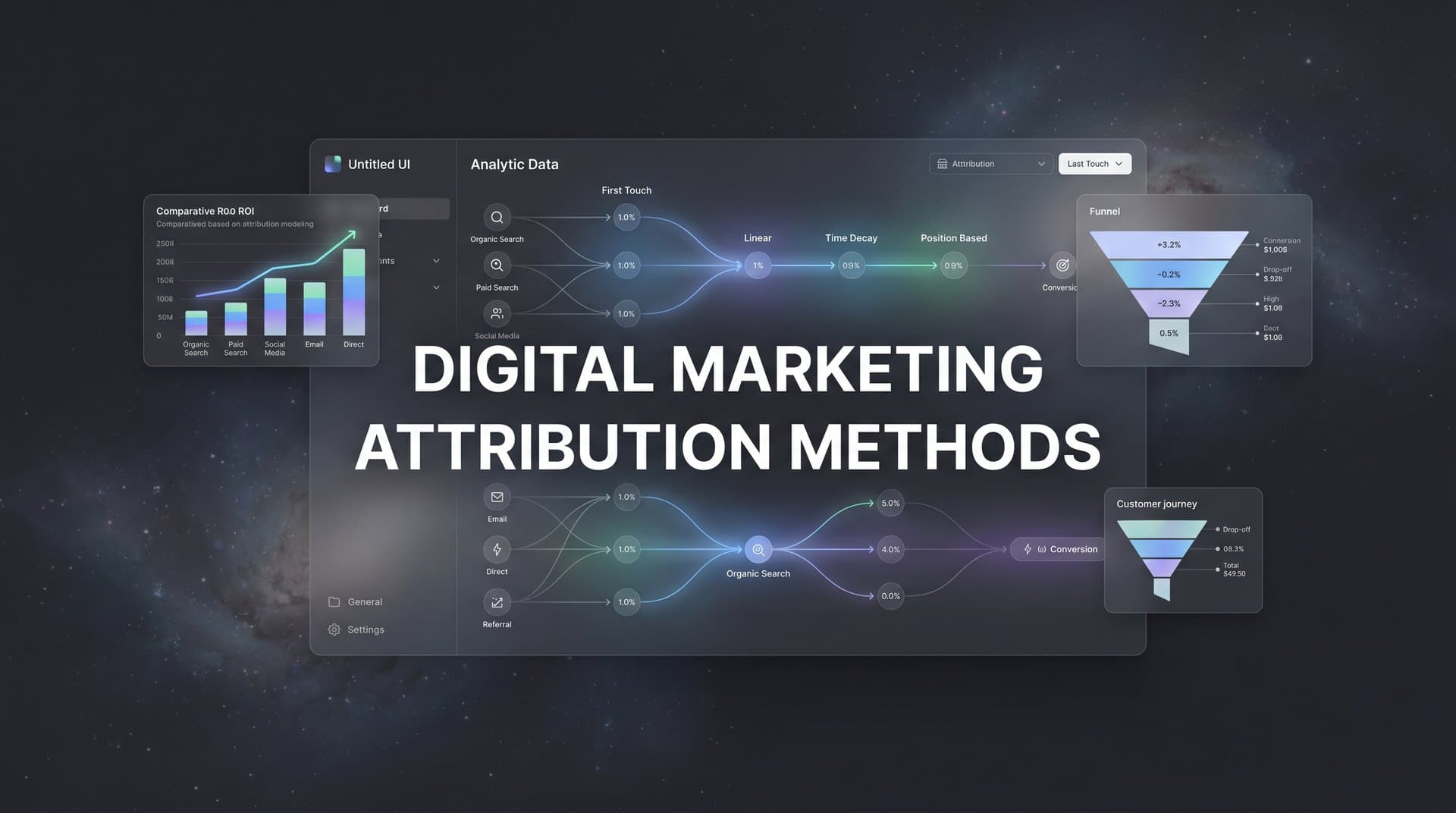
First-click attribution credits the initial interaction that introduced a customer to your brand. If someone discovered you through a LinkedIn ad, then later clicked a Google ad, then finally converted through an email, first-click gives 100% of the credit to LinkedIn. The logic? Without that initial touchpoint, the customer would never have entered your funnel.
This model makes sense in specific situations. If you're focused on top-of-funnel awareness and want to understand which channels are best at introducing new prospects to your brand, first-click shows you where people enter your ecosystem. For businesses with very short sales cycles where the first touch often leads directly to conversion, first-click can provide useful insights.
But here's the blind spot: first-click completely ignores everything that happened after that initial interaction. It assumes the first touchpoint did all the heavy lifting, even when nurture emails, retargeting campaigns, and sales outreach were essential to closing the deal. If you optimize purely for first-click attribution, you'll invest heavily in awareness channels while potentially undervaluing the campaigns that actually convert interested prospects into customers.
Last-click attribution takes the opposite approach. It gives full credit to the final interaction before conversion. If that same customer's last action before purchasing was clicking a Google search ad, Google gets 100% of the credit regardless of the LinkedIn ad and email that came before.
Last-click remains the default in many analytics platforms because it's straightforward. The conversion happened right after this action, so this action must have caused it. For businesses with impulse purchases or very short consideration periods, last-click can be reasonably accurate. If customers typically convert in the same session they discover you, the last click and the first click are often the same thing.
The problem emerges with longer, more complex buyer journeys. Last-click systematically undervalues top-of-funnel and mid-funnel touchpoints. Your awareness campaigns that introduce prospects to your brand show zero ROI under last-click attribution because they're rarely the final interaction. Your nurture emails that keep prospects engaged through a long consideration period get ignored. All the credit flows to bottom-funnel channels like branded search and retargeting. Learning about the types of attribution models in digital marketing helps you understand these limitations.
Think about how this plays out in real marketing decisions. Under last-click attribution, you might see that branded search converts at a 10% rate while cold prospecting campaigns convert at 1%. You respond by shifting budget toward branded search. But here's the twist: those branded searches only happen because your prospecting campaigns made people aware of your brand in the first place. By cutting prospecting, you're sawing off the branch you're sitting on.
Both single-touch models share a fundamental flaw: they treat complex, multi-step journeys as if they were simple, one-touch conversions. They force you to choose between understanding how customers discover you or how they convert, when the reality is you need to understand both.
Multi-Touch Attribution Models That Capture the Full Journey
Multi-touch attribution acknowledges a simple truth: most conversions involve multiple touchpoints, and understanding how they work together matters more than crediting just one. These models distribute credit across the customer journey rather than forcing you to pick a single winner.
Linear attribution takes the most democratic approach. If a customer interacted with five touchpoints before converting—a Facebook ad, a blog post, an email, a webinar, and a retargeting ad—each touchpoint receives 20% of the credit. Every interaction matters equally.
The appeal of linear attribution is its simplicity and fairness. You're not making assumptions about which touchpoints matter more. You're acknowledging that the entire journey contributed to the conversion. For businesses with moderate sales cycles where multiple touches genuinely influence the decision, linear attribution provides a more complete picture than single-touch models.
But equal credit isn't always accurate credit. Linear attribution assumes your first touchpoint (maybe a random social media impression) influenced the purchase decision just as much as the product demo the prospect attended right before buying. In reality, some interactions clearly carry more weight than others. A prospect who attends a live demo is showing much higher intent than someone who briefly visited your homepage three weeks ago.
Time-decay attribution addresses this by weighting recent interactions more heavily than earlier ones. The logic is intuitive: touchpoints closer to the conversion had more influence on the final decision. If a customer's journey spanned 30 days, an interaction that happened yesterday gets more credit than one from three weeks ago. Mastering attribution modeling in digital marketing requires understanding when each approach works best.
This model works well for businesses where recency matters. If you're selling a solution where the final decision often comes down to recent interactions—a compelling case study, a competitive comparison, a limited-time offer—time-decay reflects that reality. It acknowledges the full journey while recognizing that not all touches carry equal weight.
The challenge with time-decay is determining the right decay rate. Should yesterday's interaction be worth twice as much as last week's? Five times as much? Different decay curves produce dramatically different results. And time-decay can still undervalue crucial early touchpoints. The awareness campaign that introduced a prospect to your category might have been the most important interaction, even if it happened weeks before conversion.
Position-based attribution, sometimes called U-shaped attribution, tries to have it both ways. It gives the most credit to the first and last touchpoints (typically 40% each) while distributing the remaining 20% among all the middle interactions. The reasoning: the first touch introduced the customer to your brand, the last touch converted them, and everything in between kept them engaged.
Position-based models acknowledge that different touchpoints serve different purposes. Your top-of-funnel content creates awareness. Your bottom-funnel retargeting drives conversions. Your mid-funnel nurture keeps prospects warm. By emphasizing the endpoints while still crediting the middle, position-based attribution provides a more nuanced view than single-touch models without assuming all touches matter equally.
This approach works particularly well for businesses with clear awareness and conversion phases. If you can identify distinct stages in your customer journey—discovery, consideration, decision—position-based attribution maps nicely to that reality. It helps you understand both which channels introduce valuable prospects and which channels close deals.
But position-based attribution still relies on assumptions. Why should first and last touches always get 40% each? What if your mid-funnel content is actually the most influential part of the journey? What if customers who engage with your educational resources convert at much higher rates than those who don't? Position-based models can't tell you that because they've predetermined where the credit goes.
All rule-based multi-touch models share this limitation: they apply the same credit distribution to every conversion path, regardless of what actually influenced each specific customer. They're better than single-touch models because they acknowledge journey complexity. But they're still making educated guesses rather than analyzing actual conversion patterns.
Data-Driven and Algorithmic Attribution Approaches
Data-driven attribution takes a fundamentally different approach: instead of applying predetermined rules about how credit should be distributed, it uses machine learning to analyze your actual conversion data and assign credit based on what statistically influences outcomes.
Here's how it works in practice. The algorithm examines thousands of conversion paths—customers who converted and customers who didn't. It looks for patterns. Maybe it discovers that customers who watch a product demo are three times more likely to convert than those who don't, even when controlling for other factors. That demo gets more credit. Maybe it finds that email interactions in the middle of the journey don't significantly impact conversion rates. Those get less credit.
The power of data-driven attribution is that it's based on your actual data, not industry assumptions. If a particular touchpoint genuinely drives conversions in your business, the model will recognize that. If another touchpoint looks important but doesn't actually correlate with higher conversion rates, the model won't overvalue it. Exploring data science for marketing attribution reveals how these algorithms work under the hood.
This approach requires significant data volume to work effectively. Machine learning models need enough conversion paths to identify statistically meaningful patterns. If you're only generating a few dozen conversions per month, you don't have enough data for algorithmic attribution to produce reliable insights. The models work best when you have hundreds or thousands of conversions across multiple channels and touchpoints.
You also need comprehensive tracking across all touchpoints. Data-driven attribution can only analyze the interactions it knows about. If your tracking has gaps—maybe you're not capturing email engagement or you're missing offline conversions—the model will work with incomplete information and produce skewed results.
Platform-native data-driven attribution has become more accessible. Google Analytics 4 offers data-driven attribution as its default model for accounts with sufficient conversion volume. Google Ads provides data-driven attribution for campaigns meeting minimum thresholds. These built-in options make algorithmic attribution available without requiring custom implementation.
But platform-native attribution has limitations. Google's data-driven model only sees interactions that happen within the Google ecosystem. It can analyze how your Google Ads, organic search, and website behavior influence conversions. But it can't see your Meta campaigns, your LinkedIn ads, or your email marketing unless you're sending that data to Google Analytics. You get data-driven attribution, but only for a partial view of the customer journey.
Independent attribution solutions address this by connecting data from all your marketing channels—paid ads across platforms, email, CRM, website behavior, even offline touchpoints. They build a complete picture of the customer journey and then apply machine learning across that full dataset. This cross-platform approach reveals insights that platform-specific attribution misses. The best digital marketing attribution tools offer this comprehensive cross-channel visibility.
The trade-off is complexity. Independent attribution platforms require more setup. You need to connect all your data sources, implement proper tracking, and ensure data quality across systems. But the payoff is attribution that actually reflects your multi-channel reality rather than just what one platform can see.
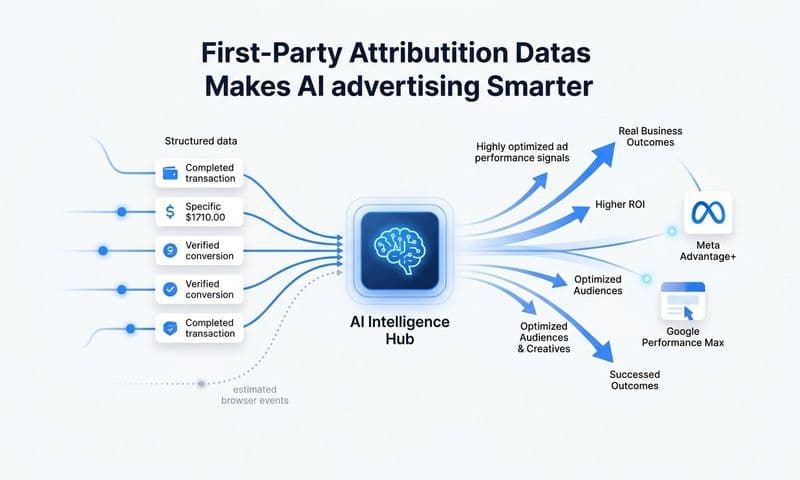
Data-driven attribution also enables something powerful beyond just reporting: you can feed those insights back to your ad platforms. When you identify which touchpoints genuinely drive conversions, you can send that enriched conversion data to Meta, Google, and other platforms. Their algorithms learn from better data, improve targeting, and optimize toward the interactions that actually lead to revenue rather than just last-click conversions.
Choosing the Right Attribution Method for Your Business
There's no universal "best" attribution model. The right approach depends on your specific business context, and choosing poorly means making decisions based on misleading data.
Start with your sales cycle length. If you're selling low-consideration products where customers typically convert in a single session, last-click attribution might actually be reasonably accurate. The customer sees an ad, visits your site, and buys. There aren't multiple touchpoints to credit because the journey is genuinely that simple. Adding complexity through multi-touch models doesn't help if the underlying reality is straightforward.
But as your sales cycle extends, single-touch models become increasingly problematic. If your typical customer takes two weeks to convert and interacts with your brand six times across three channels, last-click attribution is giving you a distorted view. You need multi-touch attribution to understand how those interactions work together. For B2B companies with sales cycles measured in months, multi-touch attribution isn't optional—it's essential. Understanding attribution for B2B marketing campaigns becomes critical for these longer sales cycles.
Consider your customer journey complexity. How many touchpoints does your average customer experience? If you're running campaigns across multiple platforms, publishing content, sending emails, and nurturing leads, you have a complex journey that requires sophisticated attribution. If you're primarily running one or two channels with straightforward conversion paths, simpler models work fine.
Your marketing channel mix matters enormously. If you're heavily invested in top-of-funnel awareness campaigns alongside bottom-funnel conversion campaigns, you need an attribution model that values both. Last-click will systematically undervalue your awareness efforts. First-click will undervalue your conversion campaigns. Multi-touch models that acknowledge the full journey become necessary.
Think about what you're trying to optimize. If your primary goal is understanding which channels introduce new prospects to your brand, first-click or position-based attribution provides useful insights. If you're focused on understanding which final interactions convert prospects into customers, last-click or time-decay might be more relevant. If you need to optimize the entire funnel from awareness through conversion, you need multi-touch or data-driven attribution.
Watch for signs that your current attribution approach is misleading you. If you're seeing dramatic discrepancies between what different platforms report, that's a red flag. If channels that "perform poorly" in your attribution reports seem to correlate with overall revenue increases, your attribution is missing something. If you cut budget from a channel and revenue drops unexpectedly, your model wasn't capturing that channel's true contribution. These are common attribution challenges in digital marketing that many teams face.
Data volume is a practical constraint. Data-driven attribution requires substantial conversion volume to produce reliable insights. If you're generating fewer than a few hundred conversions per month, rule-based multi-touch models might be more appropriate than algorithmic approaches that don't have enough data to learn from.
Your team's analytical sophistication matters too. More complex attribution models require more expertise to implement, interpret, and act on. If your team is comfortable with advanced analytics and has the resources to properly set up cross-platform tracking, data-driven attribution can deliver significant value. If you're working with limited resources and basic analytics capabilities, starting with simpler multi-touch models like position-based attribution might be more practical.
The best approach is often to use multiple attribution models in parallel. Compare what last-click, first-click, and multi-touch models tell you. Look for patterns and discrepancies. Channels that perform well across multiple attribution models are genuinely valuable. Channels that only look good under one specific model might be getting artificial credit based on that model's assumptions.
Putting Attribution Into Practice: Implementation Essentials
Understanding attribution models conceptually is one thing. Implementing them accurately is another. The foundation of reliable attribution is comprehensive, accurate tracking across all your marketing touchpoints.
Server-side tracking has become essential for accurate cross-platform attribution. Traditional browser-based pixels are increasingly unreliable. Ad blockers strip them out. Privacy settings disable them. iOS restrictions limit their effectiveness. When your tracking relies on browser pixels, you're working with incomplete data and your attribution reflects those gaps.
Server-side tracking sends conversion events directly from your server to ad platforms and analytics tools. Because the data flows server-to-server rather than through browsers, it bypasses the privacy restrictions and blocking that affect pixel-based tracking. You capture conversions that browser-based tracking misses, giving you a more complete view of campaign performance.
This isn't just about measurement accuracy. When you send more complete conversion data to platforms like Meta and Google, their algorithms have better information to optimize against. They can identify patterns in who converts and improve targeting accordingly. Server-side tracking enables better attribution and better campaign performance simultaneously. The right software for tracking marketing attribution makes this implementation much smoother.
Connecting your ad platforms, CRM, and website is crucial for complete journey visibility. Your ad platforms know about clicks and impressions. Your website analytics knows about session behavior. Your CRM knows about leads, opportunities, and closed revenue. Attribution requires connecting these data sources so you can track the full journey from initial ad interaction through to actual revenue.
This integration reveals insights that isolated data can't. You might discover that prospects who engage with specific content convert at higher rates. You might find that certain ad campaigns generate leads that close faster and at higher values. You might identify that some channels produce high click volume but low lead quality. These insights only emerge when you connect touchpoints to outcomes. Proper channel attribution in digital marketing revenue tracking requires this end-to-end visibility.
Data quality determines attribution accuracy. If your tracking has gaps, your attribution will be wrong. Make sure you're capturing all relevant touchpoints—paid ads across platforms, organic channels, email, content engagement, and any offline interactions. Implement UTM parameters consistently so you can identify traffic sources accurately. Connect your CRM so you can track leads through to closed revenue, not just website conversions.
Using attribution insights to optimize goes beyond reporting. The real value comes from feeding better data back to your ad platforms. When you identify which conversion events genuinely predict revenue, you can send those signals to Meta, Google, and other platforms. Their algorithms optimize toward those valuable conversions rather than just any conversion.
This creates a powerful feedback loop. Better attribution identifies which interactions drive revenue. You send that enriched conversion data to ad platforms. Their algorithms improve targeting and optimization. Campaign performance increases. You generate more conversions and more data. Attribution insights become even more accurate. The cycle compounds.
Start with what you can implement now rather than waiting for the perfect setup. If comprehensive cross-platform attribution feels overwhelming, begin by improving tracking within your primary channels. Implement server-side tracking for your biggest ad platforms. Connect your CRM to your analytics. Use position-based or time-decay attribution to get a more complete view than last-click provides. Build from there.
Test and validate your attribution setup. Compare attributed conversions to actual revenue. Check whether the channels your attribution model identifies as valuable actually correlate with business outcomes. Look for discrepancies between what platforms report and what your attribution shows. These gaps reveal either tracking problems or interesting insights about how different channels contribute.
Moving Forward With Confidence
The best attribution method for your business depends on your sales cycle, channel mix, and customer journey complexity. There's no one-size-fits-all solution. A B2B company with a six-month sales cycle needs different attribution than an e-commerce store with impulse purchases. A brand running awareness campaigns across five platforms needs different attribution than a performance marketer focused on direct response.
What matters is choosing an approach that reflects your reality rather than forcing your business into a model that doesn't fit. Single-touch models work for simple journeys but mislead you on complex ones. Multi-touch models acknowledge journey complexity but rely on assumptions. Data-driven models learn from your actual data but require volume and comprehensive tracking.
The goal of attribution isn't just better reporting. It's making smarter decisions about where to invest your budget. It's understanding which campaigns actually drive revenue so you can scale what works and cut what doesn't. It's feeding better data back to ad platforms so their algorithms optimize toward real business outcomes rather than vanity metrics.
Accurate attribution transforms how you approach marketing. Instead of defending budget based on surface-level metrics, you can prove ROI with confidence. Instead of guessing which channels matter, you know. Instead of treating ad platforms as black boxes, you can feed them the signals they need to improve performance. The marketers who master attribution aren't just measuring better—they're scaling more profitably.
Ready to elevate your marketing game with precision and confidence? Discover how Cometly's AI-driven recommendations can transform your ad strategy—Get your free demo today and start capturing every touchpoint to maximize your conversions.