You're staring at three different dashboards. Google Analytics says you had 47 conversions this week. Meta Ads claims 62. Google Ads reports 51. Same time period. Same website. Same campaigns. Yet somehow, you've got three completely different versions of reality.
Which one is telling the truth?
If you've ever felt that gut-punch of confusion when trying to figure out which marketing channels actually drive revenue, you're not alone. Attribution challenges aren't just frustrating technical headaches—they're the invisible force draining your marketing budget and crippling your ability to scale with confidence.
When you can't trust your data, every budget decision becomes a gamble. Should you increase spend on that Facebook campaign? Is your Google Ads investment actually paying off? Without accurate attribution, you're flying blind, making million-dollar decisions based on incomplete, conflicting information.
Here's what we're going to tackle: the most common attribution obstacles that keep marketers up at night, and more importantly, the practical solutions that actually work. Because once you solve attribution, everything else—scaling, optimization, ROI—gets dramatically easier.
The Data Fragmentation Problem: When Your Platforms Don't Talk to Each Other
Picture your marketing stack as a group of people describing the same elephant while blindfolded. Google Ads touches the trunk and declares it's a snake. Meta feels the leg and insists it's a tree. Your CRM grabs the tail and swears it's a rope.
Each platform is technically correct about what it's measuring—but none of them see the full picture.
This is data fragmentation in action. Your ad platforms, analytics tools, and CRM systems operate in their own isolated universes. Google Ads tracks clicks and conversions within its ecosystem. Meta has its pixel measuring website activity. Your CRM knows about deals closed but has no idea which ad someone clicked three weeks ago. Meanwhile, your analytics platform is trying to piece it all together with yet another tracking methodology.
The result? A fragmented view of the customer journey that makes accurate attribution nearly impossible.
Why platforms disagree on conversion counts: Each system uses different attribution windows, tracking methods, and conversion definitions. Google Ads might count a conversion if someone clicked your ad within 30 days. Meta could be using a 7-day click, 1-day view window. Your analytics platform tracks based on last-click only. They're all measuring the same events through completely different lenses.
Here's where it gets expensive: when platforms don't communicate, they double-count conversions. Someone clicks a Facebook ad, then a Google ad, then converts. Both platforms take full credit. Your reporting shows 2 conversions. Reality? You got 1. Now multiply this across hundreds of conversions per month, and you're making budget decisions based on inflated numbers.
The hidden cost runs deeper than just inaccurate reporting. Without a unified view, you can't identify which touchpoints actually contribute to conversions versus which ones just happen to be present in the journey. That awareness campaign on LinkedIn might be crucial for warming up prospects, but if you're only looking at last-click attribution in Google Analytics, LinkedIn gets zero credit and you cut the budget.
Meanwhile, you're probably over-investing in bottom-funnel channels that get the final click but wouldn't convert anyone without the earlier touchpoints doing the heavy lifting. Understanding channel attribution in digital marketing is essential for solving this problem.
The fragmentation problem isn't just about messy data—it's about making wrong decisions with confidence. You're optimizing campaigns based on incomplete information, scaling the wrong channels, and cutting budget from the ones that actually drive awareness and consideration.
Think of it this way: if you're trying to optimize a recipe but you can only taste one ingredient at a time, you'll never understand what makes the whole dish work. That's marketing without unified attribution data.
Privacy Changes and Tracking Limitations: Navigating the Post-Cookie Landscape
Remember when tracking was simple? A pixel fired, a cookie dropped, and you could follow users across the internet like breadcrumbs through the forest.
Those days are over.
Apple's iOS 14.5 update in April 2021 fundamentally changed the attribution game. App Tracking Transparency gave users the power to opt out of tracking, and most did. Suddenly, Meta, TikTok, and other platforms lost visibility into a massive portion of their conversion data. If you're running Meta Ads and targeting iPhone users, you're likely seeing only 60-70% of your actual conversions in the platform.
The underreporting is real, and it's costing you money. When Meta's algorithm doesn't see conversions, it can't optimize effectively. Your campaigns appear to perform worse than they actually do, leading you to cut budget on campaigns that are secretly profitable.
Browser restrictions compound the problem: Safari and Firefox already block third-party cookies by default. Chrome announced plans to phase them out (though the timeline keeps shifting). This means traditional pixel-based tracking—the foundation of digital advertising for the past decade—is becoming less reliable by the day.
Here's what happens in practice: Someone sees your ad on their iPhone, clicks through to your website in Safari, browses for a few minutes, then leaves. Two days later, they return directly (typing your URL or clicking a bookmark) and make a purchase. With iOS restrictions and cookie blocking in play, there's a good chance that conversion never gets connected back to the original ad click.
Your ad platform thinks the campaign failed. Your analytics shows a direct conversion with no attribution to paid media. You're left wondering if your ads work at all. This is the core digital marketing attribution problem that plagues modern marketers.
The shift away from client-side tracking (pixels and cookies that run in the browser) has exposed a critical weakness in how most marketers measure performance. When users can block tracking, clear cookies, or switch devices, browser-based measurement falls apart. You're trying to track a journey that spans multiple sessions, devices, and privacy settings with tools designed for a simpler era.
This isn't just a technical inconvenience—it's a fundamental challenge to how marketing attribution works. The old playbook assumed you could track everything. The new reality requires a completely different approach.
Many marketers are still running campaigns optimized for a world that no longer exists, wondering why their attribution data looks increasingly unreliable. The platforms themselves are adapting with modeled conversions and statistical estimates, but that means you're making budget decisions based on educated guesses rather than actual data.
The privacy-first future is here, and client-side tracking alone can't cut it anymore. The question isn't whether to adapt—it's how quickly you can implement solutions that work in this new landscape before your competitors do.
The Cross-Device and Cross-Channel Blindspot
Your customer's journey to conversion looks something like this: They see your Instagram ad on their phone during their morning commute. That evening, they Google your product on their laptop. A week later, they click a retargeting ad on their tablet. Finally, they visit your website directly on their desktop at work and make a purchase.
Four devices. Multiple touchpoints. One conversion.
Now here's the problem: most attribution systems can't connect those dots. Each device looks like a different person. Each session appears isolated. The Instagram ad, the Google search, the retargeting click, and the final conversion all exist in separate data silos with no clear thread linking them together.
This is the cross-device blindspot, and it's one of the most persistent attribution challenges in modern marketing. When someone switches from their phone to their laptop, traditional cookie-based tracking loses the trail. The conversion gets attributed to "direct traffic" or the last touchpoint, while all the earlier interactions that built awareness and consideration disappear from your reporting.
The cross-channel challenge is equally problematic. Modern buyers don't live in neat, single-channel funnels. They discover you on TikTok, research you on Google, read reviews on third-party sites, visit your website multiple times, maybe even talk to sales before converting. Implementing multi-channel attribution in digital marketing is essential for capturing this complex reality.
Let's say someone discovers your product through a LinkedIn ad, clicks through and browses your site, then leaves. Three days later, they see a Facebook retargeting ad and click again. A week later, they Google your brand name directly and convert. With last-click attribution, Google gets 100% of the credit. LinkedIn and Facebook, which actually introduced the prospect and kept them engaged, get nothing.
This creates a dangerous feedback loop. You look at your reporting, see Google driving conversions, and increase budget there. Meanwhile, you cut spend on LinkedIn because it's not showing conversions. But here's the reality: without LinkedIn creating that initial awareness, those Google searches would never happen. You're optimizing based on incomplete data and accidentally killing the channels that feed your conversion funnel.
The longer your sales cycle, the worse this problem gets. For B2B companies or high-consideration purchases, the journey from first touch to conversion can span weeks or months. Someone might interact with your brand a dozen times across multiple channels before they're ready to buy. If you can't connect those touchpoints, you're making decisions in the dark. B2B marketers face unique obstacles that require specialized approaches to common attribution challenges in B2B marketing.
Anonymous browsing sessions add another layer of complexity. Most website visitors don't identify themselves immediately. They browse anonymously, maybe visit several times, then finally fill out a form or make a purchase. Connecting those anonymous sessions to the eventual conversion—and then back to the original marketing touchpoint—requires sophisticated tracking that most basic analytics setups simply can't handle.
Choosing the Right Attribution Model for Your Business
Here's a truth that might sting a bit: there's no perfect attribution model. Every model is a simplification of reality, highlighting certain aspects of the customer journey while obscuring others.
The key isn't finding the "right" model—it's understanding what each model reveals and choosing the one that aligns with your business goals and sales cycle.
First-Touch Attribution: Gives 100% credit to the first interaction a customer has with your brand. This model is valuable for understanding what's driving awareness and filling the top of your funnel. If you're focused on customer acquisition and want to know which channels introduce new prospects, first-touch shows you that story. The downside? It completely ignores everything that happens after that initial interaction, which can be misleading for complex sales cycles.
Last-Touch Attribution: The opposite approach—100% credit goes to the final touchpoint before conversion. This is the default in most analytics platforms because it's simple and shows which channels are present at the moment of decision. It's useful for understanding what closes deals, but it dramatically undervalues awareness and consideration channels. Your brand awareness campaign might be doing the heavy lifting, but last-touch gives all the glory to the final click.
Linear Attribution: Spreads credit evenly across all touchpoints in the journey. If someone had five interactions before converting, each gets 20% credit. This model acknowledges that multiple channels contribute to conversions, which is more realistic than single-touch models. However, it assumes every touchpoint is equally valuable, which often isn't true. The ad that introduced your brand probably deserves different weight than the fifth retargeting impression.
Time-Decay Attribution: Gives more credit to touchpoints closer to the conversion, with a gradual decline for earlier interactions. This model reflects the reality that recent touchpoints often have more influence on the final decision. It's particularly useful for businesses with shorter sales cycles where momentum matters. The limitation? It can undervalue crucial early-stage touchpoints that create awareness in longer sales cycles.
Data-Driven Attribution: Uses machine learning to analyze your actual conversion paths and assign credit based on statistical significance. This model looks at what converting users did versus what non-converting users did and weights touchpoints accordingly. It's the most sophisticated approach, but it requires substantial conversion volume to work effectively and can feel like a black box since the algorithm determines credit allocation. For a deeper dive into these approaches, explore attribution modeling in digital marketing.
So which model should you use? The answer depends on your business context.
If you're running a high-volume e-commerce business with short sales cycles, last-touch or time-decay might work fine. Your customers often convert quickly, so the final touchpoint is genuinely influential. If you're in B2B with long sales cycles and multiple stakeholders, you need multi-touch attribution that acknowledges the complex journey. First-touch becomes valuable when you're focused on filling your pipeline with new leads.
Here's the real insight: don't pick one model and call it done. Compare multiple attribution models side-by-side to understand different perspectives on your marketing performance. When you see how credit shifts between first-touch, last-touch, and data-driven models, you gain a more complete understanding of what's actually working.
The goal isn't perfect attribution—it's actionable attribution that helps you make smarter budget decisions and scale with confidence.
Building an Attribution System That Actually Works
Let's talk about solutions. Because understanding attribution challenges is one thing—fixing them is what actually moves the needle for your business.
The foundation of modern attribution is server-side tracking. Instead of relying solely on pixels and cookies that run in browsers (and get blocked by privacy settings), server-side tracking sends conversion data directly from your server to ad platforms via APIs. Meta's Conversions API, Google's Enhanced Conversions, TikTok Events API—these tools bypass browser limitations entirely.
Think of it this way: client-side tracking is like trying to follow someone through a crowded mall while they keep ducking into stores and disappearing. Server-side tracking is like having a direct line to their phone—you know exactly where they are regardless of the crowd.
When you implement server-side tracking, you capture conversions that browser-based pixels miss. That iOS user who opted out of tracking? Your server still knows they converted. The person who cleared their cookies? Your server maintains the connection. The result is dramatically more accurate conversion data, which means your ad platforms can optimize effectively again. The right software for tracking marketing attribution makes this implementation significantly easier.
But server-side tracking alone isn't enough. You need to connect the dots across your entire marketing ecosystem. This means integrating your ad platforms, website analytics, and CRM into a unified system that tracks the complete customer journey.
Here's what that looks like in practice: Someone clicks your Meta ad. Your tracking system captures that click and creates a unique identifier for this visitor. They browse your website, and every action gets logged with that same identifier. They leave without converting. Two days later, they click a Google ad. Your system recognizes this is the same person and adds this touchpoint to their journey. They convert. Your attribution platform now has the complete path: Meta ad → website visit → Google ad → conversion.
This unified tracking enables multi-touch attribution that actually reflects reality. You can see which channels work together to drive conversions, not just which one happened to get the last click. Leveraging data analytics for digital marketing helps you extract actionable insights from this unified data.
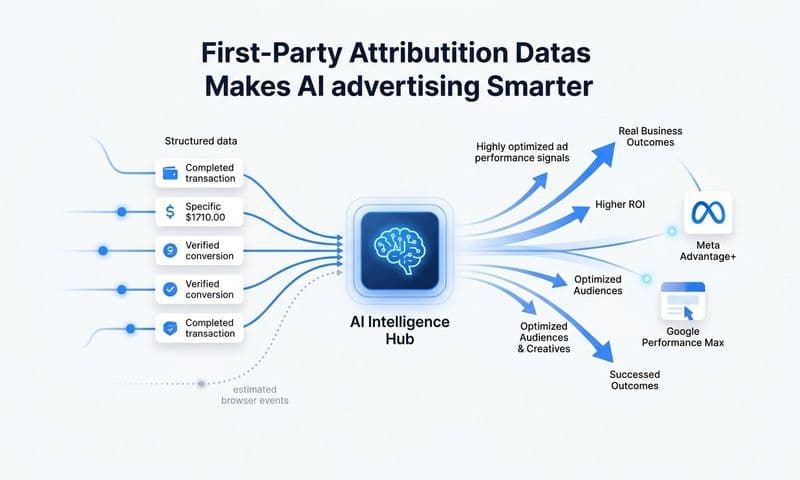
Now here's where it gets powerful: feeding enriched conversion data back to your ad platforms. When you send complete, accurate conversion data to Meta, Google, and other platforms via their APIs, you're not just improving your reporting—you're improving their optimization algorithms.
Ad platforms use conversion data to train their algorithms. The more complete and accurate your conversion data, the better they can identify high-intent audiences and optimize delivery. If Meta only sees 60% of your conversions due to iOS limitations, its algorithm is learning from incomplete data. When you feed it the full picture via Conversions API, including conversions it couldn't track client-side, the algorithm gets smarter. Your campaigns perform better. Your cost per conversion drops.
This creates a virtuous cycle: better tracking leads to better data, which leads to better optimization, which leads to better results.
The technical implementation requires connecting multiple systems—your website tracking, CRM, and ad platform APIs—but the payoff is worth it. You move from fragmented, unreliable attribution to a unified system that captures every touchpoint and connects them to actual revenue. Staying current with the latest trends in marketing attribution technology ensures your system remains competitive.
This isn't just about better reporting dashboards. It's about having the confidence to scale winning campaigns because you know they actually work. It's about cutting underperforming channels based on real data, not guesswork. It's about feeding your ad platforms the data they need to find more customers like your best ones.
Putting It All Together: From Attribution Chaos to Clarity
Let's recap what we've covered, because each of these challenges connects to create the attribution mess most marketers face daily.
Data fragmentation means your platforms don't communicate, leading to conflicting conversion counts and double-counting. Privacy changes and tracking limitations have made browser-based measurement unreliable, creating blind spots in your data. Cross-device and cross-channel journeys are nearly impossible to track with traditional tools, causing you to undervalue crucial touchpoints. And choosing the wrong attribution model means you're optimizing for the wrong outcomes.
The solution isn't one magic fix—it's a systematic approach that addresses each challenge:
Unified tracking that connects your ad platforms, website, and CRM into a single source of truth. Server-side implementation that bypasses browser and privacy limitations to capture accurate conversion data. Multi-touch attribution that reveals the complete customer journey instead of giving all credit to one touchpoint. And enriched data feedback to ad platforms that improves their optimization algorithms.
When you solve attribution, everything else gets easier. You know which campaigns to scale and which to cut. You can confidently increase budget on channels that drive real revenue, not just last-click conversions. You stop wasting money on inflated metrics and start investing in the touchpoints that actually move prospects through your funnel. Understanding why attribution is important in digital marketing is the first step toward making these improvements.
This is the competitive advantage accurate attribution provides: the ability to make decisions based on reality rather than fragmented, incomplete data. While your competitors are still arguing about which dashboard to trust, you're scaling profitably because you know exactly what's working.
The marketers who solve attribution challenges first will dominate their markets. They'll optimize faster, scale smarter, and outspend competitors because their data gives them confidence. They'll feed better signals to ad platform algorithms, lowering their acquisition costs while competitors struggle with underreporting.
Your next step? Audit your current attribution setup. Are you relying solely on client-side tracking? Do you have unified visibility across all your marketing channels? Can you track cross-device journeys? Are you feeding complete conversion data back to your ad platforms?
If the answer to any of these questions is no, you've got work to do—and a massive opportunity to gain an edge over competitors who haven't solved these challenges yet.
Attribution challenges are complex, but they're solvable. The question is whether you'll solve them before your competition does.
Ready to move from attribution chaos to crystal-clear visibility into what's actually driving your revenue? Cometly captures every touchpoint across your entire customer journey—from first ad click to final conversion and everything in between. Our server-side tracking bypasses privacy limitations, our multi-touch attribution reveals which channels truly drive results, and our AI-powered insights help you scale with confidence.
Stop making marketing decisions based on incomplete, conflicting data. Get your free demo and discover how Cometly transforms attribution from your biggest headache into your most powerful competitive advantage.