Email marketing remains one of the most effective channels for driving revenue, but measuring its true contribution to your bottom line is notoriously tricky. Did that customer convert because of the email they opened last Tuesday, or was it the paid ad they clicked three days before? Without proper email marketing attribution measurement, you are left guessing which campaigns actually move the needle and which ones just pad your open rate reports.
The challenge gets even harder when email is just one piece of a multi-channel strategy. A prospect might discover your brand through a Google ad, engage with a retargeting campaign on Meta, receive a nurture sequence via email, and finally convert through a direct website visit. Giving email the right amount of credit in that journey requires intentional setup, the right tracking infrastructure, and an attribution model that reflects reality.
This guide walks you through the exact steps to build a reliable email marketing attribution measurement system. You will learn how to prepare your tracking foundation, tag every email touchpoint, connect your data sources, choose the right attribution model, and analyze results so you can confidently scale the campaigns that actually drive revenue.
Whether you are running a lean marketing team or managing campaigns for multiple clients, these steps will help you move from vanity metrics to revenue-backed insights. Let's get into it.
Step 1: Define Your Conversion Events and Revenue Goals
Before you touch a single UTM parameter or integration setting, you need to answer one foundational question: what counts as a conversion? This sounds obvious, but it is one of the most commonly skipped steps, and skipping it is exactly why attribution data so often becomes noisy and unreliable.
Start by identifying the specific conversion events you want to attribute to email. These might include completed purchases, demo requests, free trial sign-ups, form submissions, or pipeline value created in your CRM. The key is to be specific. "A user converting" means nothing to your attribution system. "A user completing a purchase on the checkout confirmation page" is something your tracking can actually capture and report on.
Next, map out where email typically fits in your customer journey. Think through the stages your prospects move through and ask yourself where email shows up. Is it in the early awareness phase through a welcome sequence? In the mid-funnel through a nurture drip? In re-engagement campaigns targeting lapsed leads? Or in post-purchase follow-ups designed to drive repeat revenue? Each of these scenarios represents a different role for email, and your attribution setup needs to account for all of them.
This is also the moment to set revenue-based KPIs rather than defaulting to vanity metrics. Understanding revenue attribution by marketing channel is essential here, as your KPIs should include metrics like attributed revenue per email send, pipeline value influenced by email, and conversion rate from email click to closed deal. These are the numbers that justify budget and inform strategy.
Document everything: Write down which CRM stages, purchase events, or form completions count as a conversion. Share this definition with everyone on your team who touches attribution reporting. When one person counts a demo booking and another counts a closed deal, your attribution data will never reconcile properly.
Consider the full funnel: Email often plays an assist role rather than a direct conversion role. A prospect might click an email link, browse your pricing page, and then convert two days later through a direct visit. Your conversion event definitions need to account for this delayed impact, which is why a proper attribution window matters as much as the event definition itself.
Once your conversion events are documented and your KPIs are set, you have the foundation that every subsequent step builds on. Without this clarity, even the most sophisticated tracking setup will produce data that your team cannot agree on or act from.
Step 2: Build Your UTM Tagging Framework for Every Email
UTM parameters are the backbone of email attribution measurement. They are the small pieces of tracking code you append to links inside your emails, and they are what allows your analytics platform to know that a specific session came from a specific email campaign. Without consistent UTM tagging, you are essentially flying blind.
The five UTM parameters you need to understand are source, medium, campaign, content, and term. For email attribution, you will primarily use the first four. Here is what each one should represent in your email context:
utm_source: Identifies where the traffic is coming from. For all email traffic, this should always be "email." Keep it consistent across every send.
utm_medium: Identifies the marketing channel type. Common values include "newsletter," "drip," "transactional," or "re-engagement." This lets you filter by email type in your analytics.
utm_campaign: Identifies the specific campaign or send. Use a descriptive, consistent naming format such as "spring-promo-2026" or "onboarding-week1." This is what lets you compare campaign performance over time.
utm_content: Identifies the specific link or element clicked within the email. This is especially useful when an email has multiple CTAs. Values like "cta-button," "hero-link," or "footer-link" let you see which placements drive clicks and conversions.
A practical example of a fully tagged URL looks like this: your website URL followed by "?utm_source=email&utm_medium=newsletter&utm_campaign=spring-promo-2026&utm_content=cta-button." Every link in every email should follow this exact structure. If you need a deeper walkthrough, this guide on how to track email marketing attribution covers the tagging process in detail.
The single biggest pitfall in UTM tagging is inconsistency. Mixing capitalization is a common culprit. "Email" and "email" will appear as two separate traffic sources in most analytics tools. Spaces in UTM values will break the parameter entirely or create encoded characters that fragment your data. Establish a naming convention document and enforce it across your team and your email service provider templates.
Cover every email type in your framework. Drip sequences, one-off broadcast emails, transactional emails like order confirmations, and re-engagement campaigns all need their own utm_medium and utm_campaign values. This granularity is what lets you eventually answer questions like "do re-engagement campaigns drive more revenue per click than our weekly newsletter?"
Many email service providers offer built-in UTM tagging tools or integrations that can auto-append parameters. Use them, but audit the output regularly. Auto-generated UTMs are only as consistent as the rules you configure, and they can drift over time as new campaigns are created by different team members.
Once your UTM framework is in place and documented, you have created the first layer of a reliable email attribution measurement system. Every click from every email will now carry the context your analytics platform needs to assign credit properly.
Step 3: Implement Server-Side Tracking to Capture the Full Journey
Here is a reality that many marketers overlook: a significant portion of your email-driven conversions are likely going untracked right now. Browser-based tracking, the kind that relies on JavaScript pixels and cookies, has become increasingly unreliable due to a combination of factors that are largely outside your control.
Ad blockers prevent pixels from firing. iOS Mail Privacy Protection pre-loads email content, which inflates open rates and distorts engagement signals. Browser cookie restrictions, particularly in Safari and Firefox, limit how long attribution data can be stored and matched to a user. Cross-device behavior adds another layer of complexity: a user clicks your email on their phone but converts on their laptop hours later, and client-side tracking often fails to stitch those two sessions together.
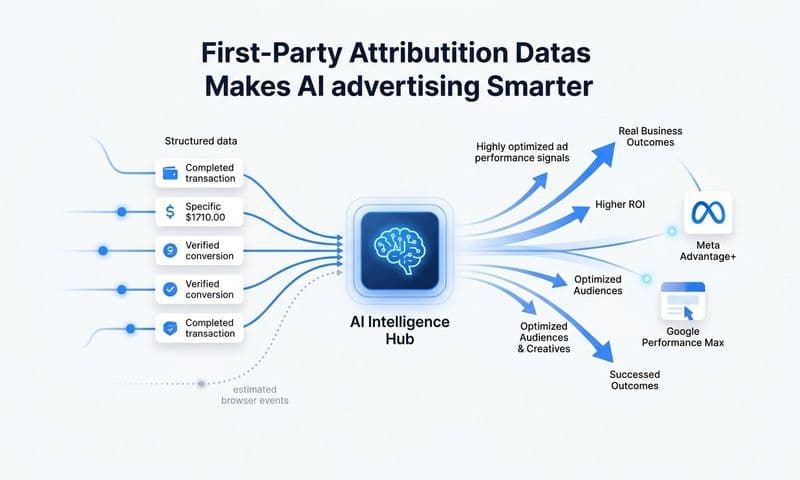
Server-side tracking solves these problems by moving the tracking logic off the user's browser and onto your server. Instead of relying on a pixel to fire in a user's browser, server-side tracking captures events directly from your server and sends them to your analytics platform. This is a core reason why attribution is important in digital marketing, as incomplete data leads to flawed decisions.
For email attribution specifically, server-side tracking allows you to capture the email click event on your server the moment a user follows a link from your email. That event is then tied to a persistent user identifier, which follows the user through subsequent sessions and ultimately connects to their conversion event, even if that conversion happens on a different device or days later.
Connecting your email platform, website, and CRM through a unified tracking layer is what makes this work. The email platform generates the click event, your server captures it, and that data flows into the same system that tracks your paid ad clicks and website behavior. The result is a single, unified timeline of every touchpoint a user experienced before converting.
This is exactly where Cometly's server-side tracking becomes a critical part of the setup. Cometly fills the gaps that client-side pixels miss by capturing email touchpoints accurately and tying them to downstream CRM and revenue events. Instead of losing attribution data to browser limitations, you get a complete record of how email clicks contribute to conversions alongside every other channel in your marketing mix.
Success indicator: You know server-side tracking is working when you can see email click events sitting alongside ad clicks and website visits in one unified customer journey timeline. If email clicks are appearing as dark traffic or unattributed sessions in your analytics, that is a signal that server-side tracking is not yet in place.
Step 4: Connect Your Email Platform, CRM, and Ad Channels in One System
Siloed data is the biggest enemy of accurate email attribution measurement. You might have rich engagement data in your email service provider, detailed deal stages in your CRM, and ad performance data in Google Ads and Meta. But if those three systems never talk to each other, you cannot answer the question that actually matters: which email campaigns are driving revenue?
The goal of this step is to create a single system of record where every touchpoint, from ad click to email engagement to CRM conversion, feeds into one unified view of the customer journey. Adopting a unified marketing measurement approach is not just a nice-to-have. It is the infrastructure that makes attribution possible.
Start with your email service provider and CRM integration. Most modern ESPs offer native integrations or API connections to popular CRMs. The critical thing to configure here is the passing of unique identifiers. When a contact clicks an email link, that event should carry a contact ID, an email hash, or some other persistent identifier that allows your CRM to match that click to a specific contact record. Without this, you end up with anonymous click events that cannot be tied to deals or revenue.
Once your ESP and CRM are connected, map out which CRM events you want to trigger attribution records. When a deal moves to "closed won," that event should pull in all the touchpoints associated with that contact, including the email campaigns they engaged with. If you use Salesforce, a dedicated Salesforce marketing attribution integration can streamline this process significantly.
The next layer is connecting your ad channels. Email does not operate in isolation. A prospect who clicked a Google ad last week and then converted after receiving your nurture email represents a journey that spans two channels. If those channels are not connected in one system, you will either over-credit the email or over-credit the ad, depending on which platform you are looking at.
Cometly is built specifically for this kind of integration work. It connects your ad platforms, CRM, and website data to build a complete customer journey view that includes email engagement alongside every other channel. Rather than switching between your ESP dashboard, your CRM, and your ad platform reports, you get one unified view where email's role in the journey is visible and attributable.
Practical tip: When setting up integrations, test with a handful of known contacts first. Follow a test contact through your email sequence, trigger a conversion event, and then check whether that journey appears correctly in your attribution system. Catching integration gaps early saves hours of troubleshooting later.
Step 5: Choose the Right Attribution Model for Your Email Strategy
With your tracking infrastructure in place and your data sources connected, you now face one of the most strategic decisions in email attribution measurement: which model do you use to assign credit?
Attribution models are the rules that determine how credit for a conversion is distributed across the touchpoints in a customer journey. There is no universally correct answer, but there are models that fit certain email strategies better than others. Here is a breakdown of the main options and when each one makes sense:
First-touch attribution: Gives 100% of the credit to the first touchpoint in the journey. This model works well if you want to understand which channels are best at generating new awareness. However, it will often undervalue email since email rarely initiates a brand relationship from scratch.
Last-touch attribution: Gives 100% of the credit to the final touchpoint before conversion. This is the default model in many analytics tools, and it is also the model that most consistently undervalues email. Because email frequently plays a mid-funnel nurture role, the final click before conversion is often a direct visit or a paid ad retargeting click. Email did the work of nurturing the prospect, but last-touch gives it no credit.
Linear attribution: Distributes credit equally across all touchpoints in the journey. This model is a strong choice for businesses with longer nurture sequences where email plays a consistent role across multiple touches. It acknowledges that every interaction contributed to the conversion rather than awarding all credit to a single moment.
Time-decay attribution: Gives more credit to touchpoints that occurred closer to the conversion. This model can work well for shorter sales cycles but may still undervalue early-funnel email touches in longer journeys.
Position-based (U-shaped) attribution: Gives the most credit to the first and last touchpoints, with the remaining credit distributed across the middle. This is a good fit when email primarily assists conversions rather than initiating or closing them, since it acknowledges the middle-of-funnel role without ignoring it entirely.
The honest answer is that no single model tells the complete story. The most valuable approach is to compare multiple models side by side. When you look at email's attributed revenue under last-touch versus linear versus position-based, you will often find a significant difference. Exploring multi-touch attribution in marketing helps you understand that gap and how much influence email has that simpler models are failing to capture.
Cometly's multi-touch attribution lets you toggle between models and compare email's contribution across all of them in one view. This is not just an analytical exercise. It gives you the evidence to make the case for email's true value when reporting to stakeholders who are used to seeing last-click numbers.
Step 6: Analyze Results and Optimize Your Email Spend
You have defined your conversions, tagged your emails, implemented server-side tracking, connected your data sources, and chosen your attribution models. Now comes the part that actually moves the needle: using the data to make smarter decisions.
Start by identifying which email campaigns, sequences, and individual sends are driving the most attributed revenue. Look beyond aggregate numbers and dig into the specifics. Which campaign names appear most frequently in high-converting customer journeys? Which sequence positions, such as email three of a seven-part drip, seem to consistently appear before a conversion event? These patterns are where your optimization opportunities live.
Look for signals in the journey data. Do certain subject lines correlate with higher downstream conversion rates, not just higher open rates? Do emails sent at specific times of day appear more often in converting journeys? Does a particular CTA placement, such as the utm_content value you set up in Step 2, drive more revenue than others? Understanding what types of questions marketing attribution can answer helps you frame this analysis with real evidence rather than assumptions.
Use these insights to reallocate your effort and budget. Scale the email flows that consistently appear in converting journeys. Pause or redesign sequences that generate clicks but never show up in attributed revenue. Test new approaches, such as different send cadences or content formats, with the confidence that you will be able to measure their actual revenue impact rather than just their engagement metrics.
There is one more optimization lever that many email marketers overlook: feeding better conversion data back to your paid ad platforms. When you know which contacts convert after engaging with your email sequences, you can use that enriched audience data to improve your ad targeting. Cometly's Conversion Sync sends enriched, conversion-ready events back to platforms like Meta and Google. This means the ad platform algorithms get better signals about which types of users actually convert, which improves targeting, reduces wasted spend, and creates a virtuous cycle between your email strategy and your paid media performance.
Success indicator: You know your email attribution measurement system is working when you can sit in a budget review meeting and say, with data to back it up, exactly how much revenue email contributed last quarter, which specific campaigns drove that revenue, and how email's contribution compares to your paid channels. That is the shift from reporting on activity to reporting on impact.
Putting It All Together
Email marketing attribution measurement is not a one-time setup. It is an ongoing system that gets more powerful as your data matures and as you refine your conversion definitions, tagging conventions, and model comparisons over time.
Here is a quick checklist to confirm you are on track:
1. Conversion events and revenue goals are clearly defined and documented across your team.
2. Every email link uses a standardized UTM tagging framework with consistent naming conventions.
3. Server-side tracking is capturing touchpoints that browser-based tracking misses due to ad blockers, cookie restrictions, and cross-device behavior.
4. Your email platform, CRM, and ad channels feed into one unified system with unique identifiers stitching records together.
5. You have selected and compared attribution models that reflect email's real role in your customer journey.
6. You are actively using attribution insights to optimize campaigns and feed better conversion data back to your ad platforms.
When these pieces are in place, you stop guessing about email's value and start making budget decisions backed by real revenue data. Platforms like Cometly make this process significantly easier by connecting every touchpoint, from ad click to email engagement to CRM conversion, in one place. The result is a clear, accurate picture of how email fits into your broader marketing strategy so you can scale what works with confidence.
Ready to stop leaving email attribution to guesswork? Get your free demo and see how Cometly captures every touchpoint across your entire customer journey so you can make every marketing dollar count.