You've launched your Facebook ads. Traffic is flowing. Your pixel is firing. But when you check your bank account, the math doesn't add up. Sound familiar? Here's what's probably happening: you're serving purchase-focused ads to people who've never heard of your brand, while ignoring prospects who've already shown interest. It's like proposing marriage on a first date—too much, too soon.
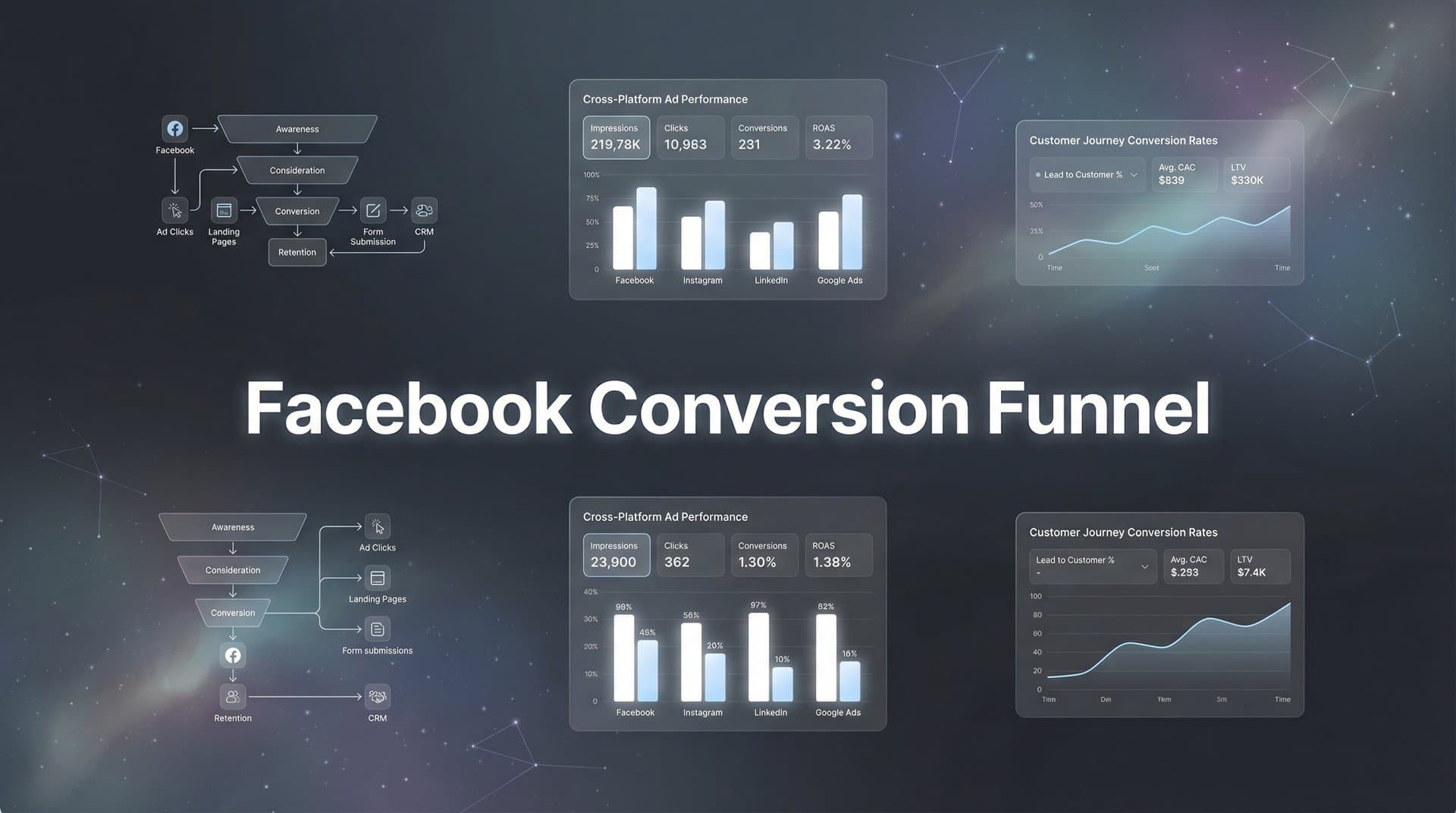
A properly structured Facebook conversion funnel changes this entirely. Instead of treating every prospect the same, you guide them through awareness, consideration, and decision stages with messaging that matches where they are in their journey. Cold audiences get educated. Warm audiences get convinced. Hot audiences get the offer.
This guide walks you through building a complete Facebook conversion funnel from scratch. We'll cover audience setup, campaign structure, ad creative strategy, and tracking configuration. By the end, you'll have a systematic approach to turning cold audiences into paying customers—and you'll know exactly which touchpoints drive your conversions.
The best part? Once this system is running, it becomes a revenue-generating machine that works while you sleep. Let's build it.
Step 1: Map Your Funnel Stages and Define Conversion Events
Before you touch Ads Manager, you need clarity on what each funnel stage accomplishes and how you'll measure it. Think of this as drawing your roadmap before starting the journey.
Your funnel has three distinct stages. Top-of-funnel (awareness) introduces your brand to cold audiences who don't know you exist. The conversion event here might be a 3-second video view, a page engagement, or a landing page visit. You're not asking for the sale—you're asking for attention.
Middle-of-funnel (consideration) nurtures people who've shown initial interest. These prospects have engaged with your content, visited your website, or watched your videos. Your conversion events here typically include lead form submissions, add-to-cart actions, or specific page visits that indicate deeper interest. This is where education turns into evaluation.
Bottom-of-funnel (decision) targets high-intent prospects ready to convert. These are people who've added items to cart, initiated checkout, or submitted lead forms. Your conversion event is the actual purchase, booking, or qualified lead. This is where you ask for the commitment.
Now open Facebook Events Manager and set up custom conversions for each stage. Go to Events Manager, select your pixel, click "Custom Conversions," then "Create Custom Conversion." Define each conversion with clear naming conventions: "TOF - Video View 75%", "MOF - Lead Form Submit", "BOF - Purchase". This naming system keeps your reporting clean as your funnel grows.
Before moving forward, verify your Meta Pixel fires correctly for all events. Use the Facebook Pixel Helper Chrome extension and test each conversion action yourself. Click through your funnel as a customer would. Watch the helper confirm each event fires. If something's broken here, everything downstream will be inaccurate—learn more about Facebook pixel tracking to avoid common setup mistakes.
This foundation determines everything else. Rushed setup here means wasted budget later. Take the extra 30 minutes to get this right.
Step 2: Build Your Audience Segments for Each Funnel Stage
Your funnel stages mean nothing without the right audiences feeding them. This is where most advertisers get lazy—they build one audience and call it done. You need precision here.
Start with cold audiences for top-of-funnel. These are people who've never interacted with your brand. Build Lookalike audiences from your customer list, website visitors, or past purchasers. Start with 1% Lookalikes for the tightest match, then test 2-3% as you scale. Layer in interest-based targeting that aligns with your ideal customer profile. If you sell project management software, target people interested in productivity tools, business software, and entrepreneurship.
The key with cold audiences: cast a wide net, but make it relevant. You want reach, but not random reach. A 1% Lookalike of your best customers will outperform generic interest targeting every time.
Next, build warm audiences for mid-funnel. These prospects have raised their hand through some initial engagement. Create custom audiences from 75% video viewers (not 3-second views—you want real attention), people who've engaged with your Facebook or Instagram page in the past 30 days, and website visitors who've spent at least 10 seconds on site. Add in people who've visited specific pages like your pricing page or product demos.
For bottom-of-funnel, build hot audiences from high-intent actions. These are people who've added items to cart in the last 14 days, submitted lead forms, initiated checkout but didn't complete, or visited your site 3+ times in the past week. These behaviors scream intent. Your job is to close the deal.
Here's the critical part most advertisers miss: configure exclusions to prevent audience overlap. Your mid-funnel campaigns should exclude people who've already converted. Your bottom-of-funnel campaigns should exclude recent purchasers. Your top-of-funnel should exclude everyone in your warm and hot audiences. Without these exclusions, you'll waste budget showing awareness ads to people ready to buy.
Set this up in Ads Manager under each ad set's audience section. In the "Exclude" field, add your custom audiences from warmer funnel stages. This ensures each prospect sees the right message at the right time—not random ads based on which campaign happens to win the auction.
Think of audience segmentation like sorting mail. You wouldn't send the same letter to a stranger, a friend, and a family member. Your Facebook audiences deserve the same consideration.
Step 3: Structure Your Campaign Architecture in Ads Manager
Now that you have your conversion events and audiences defined, it's time to build the campaign structure that brings them together. This is where strategy becomes execution.
Create separate campaigns for each funnel stage. Don't try to cram everything into one campaign with different ad sets—Meta's algorithm optimizes at the campaign level, and mixing objectives confuses it. Your top-of-funnel campaign uses the Awareness or Engagement objective. Mid-funnel uses Traffic or Lead Generation. Bottom-of-funnel uses Conversions or Sales.
Name your campaigns clearly: "TOF - Awareness - Cold Audiences", "MOF - Consideration - Warm Audiences", "BOF - Conversions - Hot Audiences". Six months from now when you're managing 15 campaigns, you'll thank yourself for this clarity.
Budget allocation matters more than most advertisers realize. A common starting point: allocate 60% of your budget to top-of-funnel, 25% to mid-funnel, and 15% to bottom-of-funnel. This seems backward—why spend more on cold audiences than hot ones? Because your hot audiences are small. You need to constantly feed new prospects into the top to keep your warm and hot audiences full.
We compare the leading options in our ad spend management software roundup.
As your funnel matures, adjust these ratios based on performance. If your mid-funnel is converting efficiently, shift more budget there. If your top-of-funnel isn't generating enough qualified warm audiences, increase that spend. The ratios aren't rules—they're starting points.
Decide between Campaign Budget Optimization (CBO) and ad set budgets. CBO lets Meta's algorithm distribute your budget across ad sets automatically, which works well once you have conversion data. Ad set budgets give you manual control, which is better during testing phases. For most advertisers, start with ad set budgets until you understand what's working, then switch to CBO for scaling.
Finally, set appropriate attribution windows for each campaign type. Meta defaults to 7-day click and 1-day view, but your bottom-of-funnel campaigns might benefit from 1-day click attribution to see immediate impact. Top-of-funnel might need longer windows to capture delayed conversions. Test both and let the data guide you—understanding Facebook ads attribution is essential for accurate performance measurement.
Your campaign architecture is the skeleton of your funnel. Build it sturdy, because everything else hangs on this structure.
Step 4: Develop Stage-Specific Ad Creative and Messaging
Here's where most Facebook funnels fall apart: advertisers build perfect audience segments and campaign structures, then slap the same generic ad across all stages. Your messaging must match the prospect's mindset at each funnel stage.
Top-of-funnel creative focuses on education and problem awareness. These prospects don't know you exist, so don't lead with your product. Lead with the problem you solve. Use video content that hooks attention in the first 3 seconds—ask a question, make a bold statement, or show a relatable pain point. "Spending hours every week on manual data entry?" hits harder than "Try our automation software."
Your TOF ads should feel like valuable content, not sales pitches. Think educational videos, how-to guides, industry insights, or entertaining content related to your niche. The goal is to build awareness and position your brand as helpful. Format-wise, video performs best here—use short-form content (15-30 seconds) optimized for mobile viewing with captions. Make sure you follow Facebook video ads size specifications for optimal delivery.
Middle-of-funnel creative shifts to social proof and product demonstration. These prospects know who you are—now they're evaluating whether you're credible. Use customer testimonials, case studies with specific results, product demo videos showing your solution in action, and comparison content that positions you against alternatives.
Carousel ads work exceptionally well in mid-funnel. Each card can highlight a different feature, benefit, or customer success story. This format lets prospects engage deeply without leaving Facebook. Your messaging here should address objections: "But does it actually work?" Show them it does with real examples.
Bottom-of-funnel creative is direct and conversion-focused. These prospects are ready to buy—they just need the final push. Use single image or video ads with clear offers, limited-time promotions, free trial CTAs, or risk-reversal guarantees. Your copy should create urgency without being manipulative: "Last chance for 20% off" works better than fake countdown timers.
The headline should state the offer clearly. The primary text should overcome the final objection. The CTA button should match the conversion goal—"Shop Now" for e-commerce, "Sign Up" for SaaS, "Learn More" for high-ticket services. Remove any friction between the ad and the conversion.
One creative principle applies across all stages: test multiple variations. Build 3-5 different ads per funnel stage with varying hooks, formats, and angles. Let Meta's algorithm identify winners during the learning phase, then double down on what works. Your best-performing creative will surprise you—it's rarely what you expect.
Step 5: Configure Tracking to Measure True Funnel Performance
You can build the perfect funnel, but without accurate tracking, you're flying blind. This step separates profitable campaigns from budget drains.
Start with server-side tracking using Meta's Conversions API. The standard Meta Pixel relies on browser cookies, which iOS privacy changes and ad blockers increasingly block. Server-side tracking sends conversion data directly from your server to Meta, bypassing these limitations. This isn't optional anymore—it's essential for accurate Facebook conversion tracking.
Set up Conversions API through your website platform, tag manager, or a dedicated integration tool. The technical setup varies by platform, but the concept is consistent: when a conversion happens on your site, your server sends that event data to Meta alongside the pixel data. This redundancy dramatically improves tracking accuracy.
Next, connect your CRM to track leads through to actual revenue. Facebook might report 50 leads, but if only 5 became customers, your real cost-per-acquisition is 10x higher than Meta's dashboard suggests. Integrate your CRM with your attribution system to see which Facebook campaigns generated leads that actually closed. This revenue-based attribution reveals your true ROI.
Use UTM parameters consistently across all funnel campaigns. Structure them logically: utm_source=facebook, utm_medium=paid, utm_campaign=tof-awareness-lookalike, utm_content=video-hook-a. These parameters let you track traffic sources in Google Analytics and attribute conversions back to specific campaigns, ad sets, and even individual ads. Proper Facebook campaign tracking depends on consistent UTM implementation.
Build custom reports to visualize funnel flow and identify drop-off points. In Meta Ads Manager, create a custom column set that shows metrics relevant to each funnel stage. For top-of-funnel: impressions, CPM, 3-second video views, cost per video view. For mid-funnel: link clicks, CTR, cost per click, landing page views. For bottom-of-funnel: conversions, cost per conversion, ROAS.
The goal isn't just collecting data—it's identifying where prospects fall out of your funnel. If your TOF drives cheap video views but your MOF gets expensive clicks, your content isn't engaging enough. If your MOF gets great traffic but your BOF conversions are weak, your offer or landing page needs work. Tracking reveals these insights.
Consider using a dedicated Facebook attribution platform that shows multi-touch attribution across your entire funnel. These tools show exactly which touchpoints contributed to each conversion, not just the last click. When you can see that a prospect watched your TOF video, clicked your MOF carousel ad, then converted from your BOF offer, you understand the full journey. That insight lets you optimize intelligently instead of guessing.
Step 6: Launch, Monitor, and Optimize Your Funnel
Your funnel is built. Now comes the part where most advertisers sabotage themselves: they launch campaigns and immediately start tweaking. Resist this urge.
Start with learning phase best practices. Meta's algorithm needs approximately 50 conversion events per week per ad set to exit learning phase and optimize effectively. During this period, avoid making significant changes—each edit resets the learning phase and delays optimization. Let your campaigns run for at least 3-7 days before making judgments.
Monitor stage-specific metrics, not vanity numbers. For top-of-funnel, watch CPM and hook rate (percentage of people who watch past 3 seconds). High CPMs suggest audience saturation or poor targeting. Low hook rates mean your creative isn't grabbing attention. Aim for hook rates above 30% and CPMs appropriate for your industry.
For mid-funnel, focus on CTR and cost per click. These metrics reveal whether your warm audiences find your content compelling enough to take action. CTRs below 1% suggest weak creative or messaging mismatch. High CPCs indicate competition or audience fatigue. Test new creative angles when these metrics decline.
For bottom-of-funnel, ROAS and cost per acquisition are your north stars. These tell you whether your funnel actually makes money. Track these daily. If your target CPA is $50 and you're seeing $75, either your offer needs strengthening or your audience isn't qualified enough. If ROAS drops below your breakeven point, pause and diagnose before burning more budget. Mastering Facebook conversion optimization is critical for maintaining profitable performance.
Identify and fix funnel leaks by analyzing stage-to-stage conversion rates. What percentage of people who see your TOF ads engage enough to enter your MOF audiences? What percentage of MOF engagers take high-intent actions that move them to BOF? If 10,000 people see your TOF content but only 50 become MOF prospects, your awareness content isn't relevant enough. If 1,000 MOF prospects generate only 5 BOF conversions, your consideration content isn't persuasive. Use conversion funnel analytics to pinpoint exactly where prospects drop off.
Scale winning combinations by increasing budgets on high-performing ad sets—but do it gradually. Doubling budgets overnight can disrupt the algorithm. Increase by 20-30% every few days, monitoring for performance drops. When you find a winning combination of audience, creative, and offer, milk it until performance degrades, then test new variations. For a comprehensive approach to growth, explore strategies for how to scale Facebook ads without killing performance.
Set up automated rules in Ads Manager to pause underperforming ad sets automatically. For example: "If CPA exceeds $100 for 3 consecutive days, pause ad set." These rules prevent runaway spending while you sleep. Just don't make them too aggressive—give campaigns room to fluctuate naturally.
The optimization process never ends. Your best-performing creative will eventually fatigue. Your audiences will saturate. Your competitors will copy your approach. Continuous testing and refinement separate consistently profitable funnels from flash-in-the-pan wins. Dedicate time each week to analyzing performance, testing new creative, and expanding successful campaigns.
Putting It All Together
Your Facebook conversion funnel is now structured to guide prospects from first impression to purchase with intentional messaging at each stage. You've mapped your funnel stages with clear conversion events, built audience segments with proper exclusions, structured campaigns with appropriate objectives and budgets, developed stage-specific creative, and configured tracking to measure true performance.
The key to long-term success is accurate tracking—without it, you're optimizing blind. Use this checklist to verify your setup: funnel stages mapped with clear conversion events, audience segments built with proper exclusions, campaigns structured with appropriate objectives and budgets, stage-specific creative loaded and approved, tracking configured including server-side events, and monitoring dashboards ready.
Start with this foundation, let your campaigns exit learning phase, then optimize based on real performance data. The first two weeks will feel uncertain. You'll question whether it's working. Resist the urge to make drastic changes. Give the system time to gather data and optimize.
Once your funnel hits its rhythm, you'll notice something powerful: predictable revenue. You'll know that X amount spent on TOF generates Y warm prospects, which converts to Z customers. That predictability lets you scale confidently instead of gambling on ad spend.
Remember, your funnel isn't static. Markets shift. Audiences evolve. Creative fatigues. The most successful Facebook advertisers treat their funnels as living systems that require ongoing attention and optimization. Block time each week to review performance, test new angles, and refine your approach.
Ready to elevate your marketing game with precision and confidence? Discover how Cometly's AI-driven recommendations can transform your ad strategy—Get your free demo today and start capturing every touchpoint to maximize your conversions.