You are spending thousands on ads, your pipeline is healthy, and revenue keeps climbing. But when you open your ad platform dashboards, the conversion numbers tell a completely different story. Sound familiar?
Underreported conversions are one of the most costly problems in digital advertising today. When your platforms miss conversions, the downstream effects compound quickly: ad algorithms optimize toward the wrong audiences, you lose confidence in scaling winning campaigns, and leadership starts questioning the value of paid media altogether.
The gap between actual conversions and what platforms report has widened significantly in recent years. Privacy changes like Apple's App Tracking Transparency, browser restrictions on third-party cookies, cross-device user journeys, and longer B2B sales cycles all contribute to conversion data going missing. The result is that marketers are making budget decisions based on incomplete data, often cutting the very campaigns that drive the most revenue.
This guide walks you through a practical, sequential process to diagnose where your conversions are disappearing and implement fixes that close the reporting gap. Whether you are running campaigns on Meta, Google, TikTok, or multiple platforms simultaneously, these steps will help you recapture lost conversion data and build a reporting foundation you can actually trust.
By the end, you will have a clear action plan to audit your current setup, fix technical tracking gaps, implement server-side solutions, validate your data, and feed better signals back to your ad platforms so their algorithms can do what they are designed to do: find more of your best customers.
Step 1: Audit Your Current Tracking Setup to Find the Gaps
Before you can fix underreported conversions, you need to know exactly how large the problem is. Most marketers have a vague sense that their numbers are off, but without a structured audit, you are guessing at the solution rather than diagnosing the actual cause.
Start by pulling your actual conversion numbers from your source of truth. This might be your CRM, your payment processor, your Shopify backend, or your internal database. Count the total conversions over the last 30 days, then compare that figure against what each ad platform reports for the same period. The difference between those two numbers is your reporting gap, and it is the metric you are trying to close.
Break this comparison down by platform and by campaign. You may find that Google Ads is relatively close to your backend numbers while Meta shows a much larger discrepancy, or vice versa. Identifying which platforms have the biggest gaps tells you where to prioritize your effort. For a deeper look at platform-specific issues, explore the common causes of underreporting conversions in ad platforms.
Next, check your pixel and tag implementation across every key page in your funnel. This means landing pages, thank you pages, checkout confirmation pages, and any other conversion-critical URLs. Use browser developer tools to inspect network requests, or lean on dedicated debugging tools like Meta Pixel Helper, Google Tag Assistant, or the equivalent for your other platforms.
As you audit, look for these common technical culprits:
Pixels firing on the wrong pages: A purchase event firing on the product page instead of the order confirmation page will inflate your numbers, while a missing tag on the confirmation page will deflate them.
Duplicate event firing: If both your tag manager and a hardcoded script are firing the same event, you may be double-counting conversions and skewing your data in the opposite direction.
Redirect chains stripping UTM parameters: When URLs redirect through multiple hops, UTM parameters often get dropped, causing conversions to appear as direct traffic rather than attributing back to the originating campaign. This is a well-documented problem covered in detail in our guide on UTM parameters not capturing conversions.
Tag manager misconfigurations: Triggers set to fire on "all pages" instead of specific confirmation pages, or variables pulling the wrong values, are more common than you might expect.
Consent banners blocking scripts: If your cookie consent banner is set up to block all tracking until a user accepts, and a significant portion of your visitors decline or ignore the banner, those pixel fires never happen.
Document everything you find. A simple spreadsheet with platform name, expected conversions, reported conversions, gap percentage, and suspected cause gives you a prioritized action list for the steps ahead. Starting with a 30-day window gives you enough data to be statistically meaningful without drowning in historical noise.
Step 2: Diagnose Privacy and Browser-Related Tracking Losses
Once you have quantified the gap, the next question is: why does it exist? Technical misconfigurations account for some of the loss, but a growing portion of underreported conversions comes from privacy changes and browser-level restrictions that no pixel implementation can fully overcome on its own.
Understanding these causes is essential because the fix for a misconfigured pixel is different from the fix for iOS tracking limitations. Treating them as the same problem leads to incomplete solutions.
Apple's App Tracking Transparency, introduced with iOS 14.5, requires apps to explicitly ask users for permission before tracking their activity across other apps and websites. A large portion of iOS users opt out of this tracking. When they do, platforms like Meta and TikTok cannot receive conversion events from those users through standard pixel-based tracking. This means a meaningful segment of your converting audience may be completely invisible to your ad platform dashboards. For a focused walkthrough of this challenge, see our article on tracking conversions after the iOS update.
Safari's Intelligent Tracking Prevention adds another layer of complexity. Safari caps first-party cookies set via JavaScript at seven days, and in some cases as little as 24 hours. For businesses with longer consideration cycles, this is a significant problem. A user who clicks your ad, spends a week researching, and then converts on day eight will not be attributed back to that original click. The conversion happens, your CRM records it, but your ad platform sees nothing.
Firefox's Enhanced Tracking Protection and the rise of browser-based ad blockers further reduce pixel fire rates across a meaningful portion of web traffic. Ad blockers are particularly prevalent in tech-savvy demographics, which may be highly relevant depending on your target audience. If you are exploring alternatives to cookie-dependent methods, our guide on tracking conversions without cookies covers practical approaches.
Cross-device journeys create yet another attribution gap. A user sees your ad on their phone during a morning commute, does more research on their laptop at work, and completes the purchase on their tablet at home. Client-side tracking relies on cookies tied to a single browser on a single device. It has no reliable way to stitch those three sessions together into one customer journey.
The core takeaway from this diagnostic step is this: client-side, browser-based tracking alone is no longer sufficient for accurate conversion reporting. It was designed for a simpler internet, and the privacy landscape has fundamentally changed. The good news is that the solution exists, and it is the focus of the next step.
Step 3: Implement Server-Side Tracking to Bypass Client-Side Limitations
Server-side tracking is the most impactful technical fix available for underreported conversions. Instead of relying on a browser pixel to fire and transmit conversion data, server-side tracking sends conversion events directly from your server to the ad platform. Browser restrictions, ad blockers, and cookie limitations become irrelevant because the data never passes through the user's browser at all.
Here is how the core setup works. When a user completes a conversion on your website or app, your server captures that event and sends it directly to the ad platform's API. Meta calls this the Conversions API (CAPI). Google refers to it as Enhanced Conversions. TikTok has its own Events API. Each platform has built these server-side solutions specifically to address the tracking gaps created by the privacy changes described in Step 2.
The technical implementation varies by platform, but the general pattern is consistent. You configure your server or a middleware layer to listen for conversion events, enrich those events with available user data (hashed email addresses, phone numbers, and other identifiers that help platforms match events to users), and then send them to the platform API in near real-time. If you are running TikTok campaigns specifically, our guide on how to track TikTok ad conversions accurately walks through the platform-specific nuances.
This is where a platform like Cometly significantly reduces the complexity. Cometly's server-side tracking captures conversion data at the server level and syncs it across your ad platforms automatically. Rather than building and maintaining separate API integrations for Meta, Google, and TikTok, you connect once and Cometly handles the distribution. Events that browser pixels miss are recovered and reported accurately.
One critical detail to address during implementation is deduplication. If you are running both a browser pixel and a server-side integration simultaneously (which is recommended for maximum coverage), you need to ensure you are not counting the same conversion twice. Both Meta's CAPI and Google's Enhanced Conversions have deduplication mechanisms built in. You match pixel events and server events using a shared event ID, and the platform automatically removes duplicates. Make sure your implementation assigns consistent event IDs across both tracking methods.
After implementation, give the system seven to fourteen days to accumulate data before evaluating results. You should see your platform-reported conversions move noticeably closer to your backend or CRM numbers during that window. If the gap has narrowed substantially, your server-side setup is working. If it has not, revisit your event matching quality and check that your server is successfully sending events to the platform APIs without errors.
Step 4: Connect Your CRM and Revenue Data to Close Attribution Gaps
Server-side tracking solves a significant portion of the underreporting problem, but it still operates primarily at the point of an online conversion event. For businesses with longer sales cycles, high-ticket products, or B2B sales processes, the conversion that matters most often happens days, weeks, or even months after the initial ad click. And that is where CRM integration becomes essential.
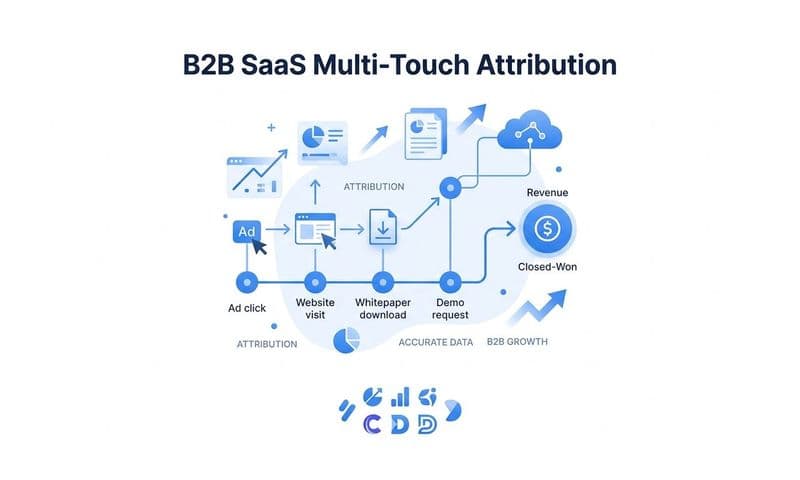
Think about a typical B2B scenario. A prospect clicks a LinkedIn or Google ad, fills out a lead form, and enters your CRM as a new contact. Over the next three weeks, they attend a demo, receive a proposal, and eventually sign a contract. The revenue event that your CFO cares about happened 21 days after the original click. Ad platforms, which default to attribution windows of seven days post-click for Meta and 30 days for Google, may never connect that closed deal back to the campaign that started the journey. Understanding how to track offline conversions from online ads is critical for bridging this gap.
The fix is to connect your CRM directly to your attribution platform so that downstream events like qualified leads, opportunities, and closed revenue are tied back to the originating ad. This means integrating tools like HubSpot, Salesforce, or Pipedrive, as well as payment systems like Stripe or Shopify, so that every stage of the funnel is visible alongside the ad data that influenced it.
Cometly connects your ad platforms, CRM, and website data to track the full customer journey from first click to revenue. When a deal closes in your CRM weeks after the initial ad interaction, Cometly attributes that revenue back to the correct campaign, ad set, and creative. This eliminates the scenario where your best-performing campaigns appear to have low ROI simply because the revenue they generate falls outside the platform's attribution window. For lead-focused businesses, our article on tracking conversions for lead generation provides additional strategies.
As you set up this integration, verify that your conversion events are being attributed to the right level of granularity. You want to see revenue tied back not just to a campaign, but to specific ad sets and individual creatives. This level of detail is what allows you to make confident decisions about which ads to scale and which to pause. If conversions are lumping into "direct" or "unattributed" buckets, trace back through your integration to find where the attribution chain is breaking down.
Step 5: Sync Enriched Conversion Data Back to Ad Platforms
At this point in the process, you have recovered lost conversion data through server-side tracking and connected your CRM for full-funnel visibility. Now it is time to close the loop by sending that enriched data back to the ad platforms themselves.
This step matters because ad platform algorithms do not just report on your campaigns. They actively optimize them. Meta's Advantage+ campaigns, Google's Smart Bidding strategies, and similar automation tools rely on conversion signals to decide who to show your ads to, how much to bid, and when to serve impressions. When those algorithms are working from incomplete conversion data, they optimize toward the wrong outcomes. They may be finding plenty of clicks and form fills while missing the fact that only a specific audience segment actually converts into paying customers.
By syncing your corrected, enriched conversion data back to the platforms, you give their algorithms the complete picture they need to work effectively. This is done through several mechanisms depending on the platform. Meta accepts offline conversion imports and server-side events through CAPI. Google supports Enhanced Conversions and offline conversion imports. Each platform has its own process, but the principle is the same: send them better data so they can make better decisions on your behalf. Understanding the cost of not doing this is explored in our piece on wasted ad budget on untracked conversions.
Cometly's Conversion Sync feature automates this process. It feeds enriched, conversion-ready events back to Meta, Google, and other platforms in near real-time. This includes not just the fact that a conversion occurred, but the quality signals that help algorithms distinguish between a low-value lead and a high-value customer. The richer the signal, the smarter the optimization.
Timing matters here. Conversion events sent close to real-time are more valuable to ad algorithms than batched imports sent days later. Real-time or near-real-time syncing allows the algorithm to adjust bidding and targeting within the current campaign cycle rather than waiting for a delayed data import to influence future cycles.
Give this feedback loop two to four weeks to show measurable results. You should begin to see improvements in campaign delivery efficiency, more stable cost per acquisition trends, and better audience targeting as the algorithm recalibrates based on your enriched conversion data. Campaigns that previously appeared to underperform may start showing stronger results simply because the algorithm now has accurate data to work with.
Step 6: Validate Your Data and Compare Attribution Models
Implementing fixes without validating them is like changing your car's oil without checking the dipstick afterward. This final step ensures that your efforts have actually closed the reporting gap and sets up an ongoing process to catch new discrepancies before they compound.
Start with a validation check covering the 14 to 30 days since you implemented your server-side tracking and CRM integration. Pull your backend or CRM conversion numbers and compare them against your corrected platform data. The gap should be meaningfully smaller than what you documented in Step 1. If it is not, revisit the earlier steps to identify what is still missing.
Once your data accuracy is confirmed, the next layer of insight comes from comparing attribution models. Different models tell different stories about which campaigns deserve credit for a conversion. Last-touch attribution gives all the credit to the final interaction before conversion. First-touch attribution credits the first ad a user clicked. Linear attribution spreads credit evenly across all touchpoints. Time-decay models give more credit to interactions closer to the conversion event. To understand how first-touch models work in practice, read our explanation of first touch conversions.
None of these models is universally correct. Each one reveals something different about your customer journey. A campaign that looks weak under last-touch attribution may turn out to be a critical awareness driver under first-touch or linear models. Without comparing models, you risk making budget decisions based on a single, potentially misleading perspective. Our article on tracking conversions across multiple touchpoints dives deeper into how multi-touch analysis strengthens your decision-making.
Cometly's multi-touch attribution and analytics dashboard lets you compare these models side by side. You can see which campaigns are truly driving revenue across the full funnel versus which ones simply appear to perform well because they happen to be the last touchpoint before a conversion that was influenced by five other interactions.
Set up a recurring cadence to maintain this validation process. A weekly or biweekly comparison of platform-reported conversions against your CRM or backend numbers takes less than 30 minutes once the process is established, and it ensures that new tracking issues do not go undetected for months. Tracking setups break. Pixels stop firing after site updates. APIs throw errors. Regular monitoring is what keeps your data trustworthy over time.
Putting It All Together: Your Action Plan for Accurate Conversion Reporting
Fixing underreported conversions is not a one-time project. It is an ongoing practice that directly impacts your ability to scale paid advertising with confidence. Here is a quick checklist to keep you on track:
1. Audit your tracking setup and quantify the gap between platform-reported and actual conversions.
2. Identify privacy and browser-related causes of data loss, including iOS ATT, Safari ITP, and cross-device journey gaps.
3. Implement server-side tracking to capture events that client-side pixels miss, using Meta CAPI, Google Enhanced Conversions, or a platform like Cometly that handles the integration for you.
4. Connect your CRM and revenue data for full-funnel attribution so that closed deals and downstream revenue are tied back to the originating ad.
5. Sync enriched conversion data back to ad platforms to improve their algorithmic optimization and targeting accuracy.
6. Validate your data regularly and compare attribution models to maintain accuracy and catch new discrepancies early.
When your conversion data is accurate, everything downstream improves. Your ad algorithms find better audiences. Your budget allocation reflects reality. You can scale the campaigns that actually drive revenue instead of the ones that simply look good on a last-touch dashboard.
Cometly is built to help marketers and agencies solve this exact problem. It captures every touchpoint from ad click to CRM event, connects that data to real revenue, and feeds enriched signals back to the platforms that need them most. Start with Step 1 today, and within a few weeks, you will have a reporting foundation you can trust. Get your free demo and start capturing every conversion your campaigns are already earning.