

You're staring at your analytics dashboard, watching thousands of dollars flow into your marketing campaigns each month, and one question keeps nagging at you: which channels are actually driving revenue? Your Facebook Ads manager shows impressive conversion numbers. Google Analytics credits organic search. Your sales team swears the leads from LinkedIn are the highest quality. Everyone's claiming credit, but the numbers don't add up.
This is the attribution puzzle that every data-driven marketer faces. And the solution isn't finding the "perfect" attribution model—it's choosing the right one for your specific situation.
Here's the uncomfortable truth: pick the wrong attribution model, and you'll make decisions based on misleading data. You might double down on channels that look effective but actually drain your budget. Or worse, you'll cut spending on touchpoints that quietly drive your most valuable customers, simply because they don't get credit in your current setup.
The good news? You don't need a PhD in data science to make this decision well. You just need a systematic approach that matches your attribution model to your actual business reality—not someone else's best practices or the latest marketing trend.
This guide walks you through exactly that process. We'll map your customer journey, clarify what you're really trying to measure, audit your data quality, and systematically narrow down which attribution approach will give you actionable insights rather than vanity metrics. By the end, you'll have a clear framework for making this choice with confidence and a plan for validating whether it's actually working.
Step 1: Map Your Customer Journey and Sales Cycle Length
Before you can choose an attribution model, you need to understand what you're actually trying to attribute. This starts with mapping how customers move from first awareness to final purchase in your business.
Pull up your CRM and analytics platforms. Look at your last 50-100 conversions and trace them backward. How many touchpoints did each customer interact with before converting? Was it a single ad click followed by immediate purchase? Or did they visit your site five times over three weeks, download a guide, attend a webinar, and then finally request a demo?
The pattern you discover here is critical. If most customers convert within 1-3 days with only 1-2 touchpoints, you're dealing with a short, simple sales cycle. Think e-commerce impulse purchases or low-cost SaaS tools. In these scenarios, simpler attribution models often work perfectly well because there simply aren't many touchpoints to distribute credit across.
But if your typical customer journey spans weeks or months with 5+ touchpoints across multiple channels, you're in different territory entirely. This is common in B2B, high-ticket e-commerce, or any business with a considered purchase. Here, single-touch attribution models will systematically mislead you because they ignore most of the journey.
Document the average length of your sales cycle in days. Then note the median number of touchpoints. These two numbers are your North Star for model selection.
One warning: don't rely on assumptions about what your customer journey "should" look like based on industry benchmarks. Your actual data matters more than averages. A B2B software company might assume they have a long, complex sales cycle, but if they're selling a $50/month tool with self-service signup, their reality might be much simpler than expected.
Pay special attention to the channels involved at different stages. Are customers discovering you through paid social, researching via organic search, and converting through direct traffic? Or does everything happen in a single session from a Google Ad? The complexity of your channel interactions will determine how sophisticated your attribution approach needs to be.
This mapping exercise should take a few hours, not weeks. You're looking for patterns, not perfection. Once you have a clear picture of your typical journey length and touchpoint count, you're ready to move forward.
Step 2: Define What You're Actually Trying to Measure
Here's where many marketers go wrong: they choose an attribution model before clarifying what question they're trying to answer. Different models reveal different insights, and the "right" one depends entirely on your current business priorities.
Are you primarily focused on awareness and top-of-funnel growth? If you're in expansion mode and need to understand which channels are best at introducing new audiences to your brand, you might prioritize models that give significant credit to first touchpoints. You want to know what's filling the funnel, even if those channels don't directly close deals.
Or are you optimizing for lead quality and revenue efficiency? If you're past the growth-at-all-costs phase and need to maximize ROI, you'll want models that emphasize bottom-funnel performance. You care less about which channel got someone's attention and more about which channels are present when high-value customers actually convert.
Maybe you're somewhere in between—trying to understand the full journey because you suspect that certain channels are doing important work in the middle that neither first-touch nor last-touch models would capture. This is the reality for many businesses with considered purchases.
Write down your primary measurement goal in one sentence. "I need to understand which channels are most effective at generating qualified leads that close." Or "I need to identify which awareness channels are filling our funnel with prospects who eventually convert." Or "I need to see the full influence of each channel across the entire journey."
This clarity matters because different attribution models are designed to answer different questions. First-click attribution tells you about discovery. Last-click tells you about conversion. Multi-touch models attempt to tell you about influence throughout the journey. None of these perspectives is inherently "better"—they're just different lenses on the same data.
Here's the twist: you might actually need different models for different questions. Many sophisticated marketers use multiple attribution views simultaneously. They might use first-click to evaluate awareness campaigns, last-click to optimize conversion campaigns, and a multi-touch model to understand overall channel contribution. There's no rule that says you must pick one and ignore the others.
The key is knowing which question you're asking at any given moment and using the model that best answers it. If you're deciding whether to increase your podcast sponsorship budget, you probably care about first-touch attribution because podcasts typically play an awareness role. If you're optimizing your retargeting campaigns, last-click might be more relevant.
Once you've defined your primary measurement goal, you can evaluate which model types naturally align with that objective. This alignment is what turns attribution from a vanity exercise into a decision-making tool.
Step 3: Evaluate Your Channel Mix and Data Quality
Even the most sophisticated attribution model is worthless if it's built on incomplete or inaccurate data. Before you commit to any approach, you need to audit what you're actually tracking and identify the gaps that could skew your results.
Start by listing every marketing channel you're currently running. Paid search, paid social, organic search, email, content marketing, partnerships, events, direct mail—everything. Now ask yourself: can I accurately track conversions from each of these channels back to revenue?
This is where things get uncomfortable for most marketers. You might have solid tracking for your digital channels but no real visibility into how your trade show booth or podcast sponsorships contribute to pipeline. Or you're tracking website conversions beautifully but losing visibility when leads move into your CRM and sales process.
These gaps matter enormously. If you're running an attribution model that only sees half your marketing touchpoints, it will systematically over-credit the channels you can track and ignore the ones you can't. You'll end up making budget decisions based on incomplete information.
Pay special attention to cross-device and cross-platform tracking. With iOS privacy changes and cookie deprecation, traditional client-side tracking often misses significant portions of the customer journey. If someone clicks your Facebook ad on their phone, researches on their laptop, and converts on their tablet, can your tracking connect those dots? Understanding how attribution breaks after iOS updates is essential for maintaining accurate data.
This is where server-side tracking becomes essential. By capturing events on your server rather than relying solely on browser cookies, you can maintain more complete visibility into customer journeys even as privacy restrictions tighten. If you're not using server-side tracking yet, this should be a priority before you invest heavily in sophisticated attribution modeling.
Audit your data quality by spot-checking recent conversions. Pick ten customers who converted last week and manually trace their journey through your systems. Can you see all their touchpoints? Are conversions being properly attributed to channels, or are you seeing a lot of "direct" or "unknown" traffic that's actually coming from somewhere specific?
Look at your channel interaction patterns. Are certain channels consistently appearing together in customer journeys? Understanding these relationships helps you choose models that accurately reflect how your channels work together rather than in isolation.
Document any significant tracking gaps you discover. If you're missing data from key channels, you have two options: fix the tracking before implementing a complex attribution model, or choose a simpler model that focuses on the channels you can track accurately. There's no shame in the latter approach—it's better to have reliable data on 80% of your channels than unreliable data on 100%.
One more critical point: ensure your conversion definitions are consistent across platforms. If Google Ads counts a conversion differently than your CRM, your attribution analysis will be comparing apples to oranges. Standardize what constitutes a conversion and make sure all your systems agree. Learn more about fixing attribution discrepancies to ensure data consistency.
Step 4: Match Model Types to Your Marketing Reality
Now that you understand your customer journey, your measurement goals, and your data quality, you can systematically evaluate which attribution models actually make sense for your situation. Let's break down the main options and when each one fits.
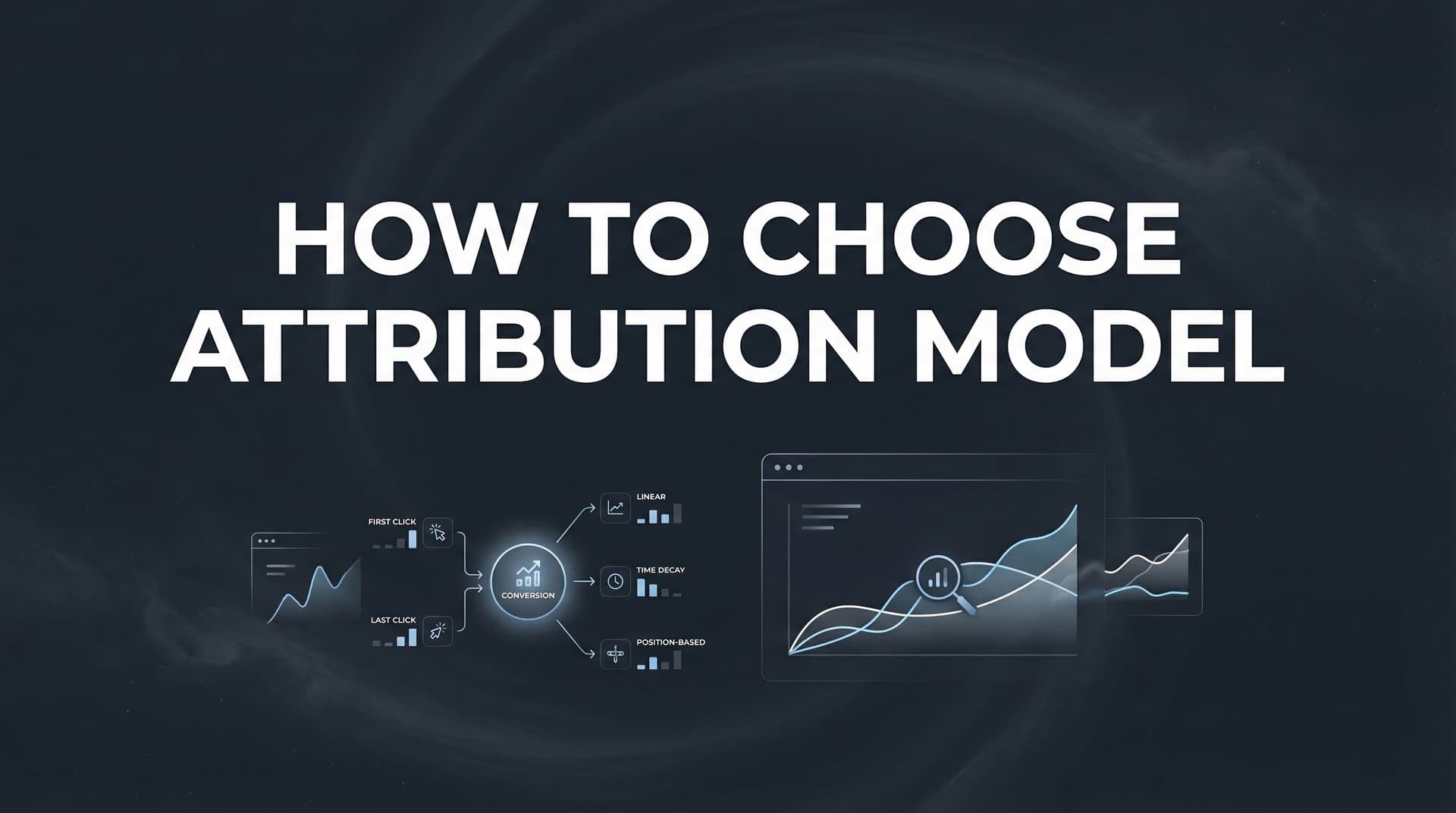
Single-Touch Models: First-Click and Last-Click
First-click attribution gives all credit to the first touchpoint in the customer journey. It answers the question: "What made this person aware of us?" This model makes sense when you're primarily focused on top-of-funnel performance and want to understand which channels are best at introducing new audiences to your brand.
Last-click attribution does the opposite—it gives all credit to the final touchpoint before conversion. It tells you: "What closed this deal?" This works well for businesses with very short sales cycles where the first and last touch are often the same thing, or when you're specifically optimizing conversion-focused campaigns like retargeting.
The limitation of both models is obvious: they ignore everything in between. If your customer journey typically involves multiple touchpoints over time, single-touch models will systematically misrepresent how your channels work together.
Multi-Touch Models: Linear, Time-Decay, and Position-Based
Linear attribution distributes credit equally across all touchpoints in the journey. If someone interacted with five different channels before converting, each gets 20% credit. This model acknowledges that multiple channels contribute, but it assumes they all contribute equally—which is rarely true.
Time-decay attribution gives more credit to touchpoints closer to conversion, based on the assumption that recent interactions matter more. This often aligns well with how marketing actually works—the channels someone engaged with yesterday probably influenced their decision more than channels they saw a month ago.
Position-based attribution (also called U-shaped) typically gives 40% credit to the first touch, 40% to the last touch, and splits the remaining 20% among middle touchpoints. This model reflects the reality that discovery and conversion moments are often most critical, while middle touches play a supporting role.
These multi-touch models work well for businesses with longer sales cycles and multiple touchpoints. They provide a more nuanced view than single-touch models, though they still rely on assumptions about how credit should be distributed.
Data-Driven Attribution: Let the Algorithm Decide
Data-driven attribution uses machine learning to analyze your actual conversion data and determine how much credit each touchpoint should receive based on its statistical contribution to conversions. Instead of using predetermined rules, it learns from your specific patterns.
This sounds ideal, but it has requirements. Data-driven models need significant conversion volume to work effectively—typically hundreds of conversions per month as a minimum. If you're converting 20 times per month, there's not enough data for the algorithm to identify meaningful patterns.
Data-driven attribution also requires consistent tracking across all channels and sufficient journey diversity. If 90% of your conversions follow nearly identical paths, the algorithm won't have enough variation to learn from.
Making Your Selection
Based on your journey mapping from Step 1, narrow down to 2-3 candidate models. If you have a simple funnel with 1-3 touchpoints and a sales cycle under a week, start with last-click and consider first-click as an alternative view. If you have a complex journey with 5+ touchpoints over weeks or months, focus on multi-touch models—time-decay or position-based are good starting points. If you have high conversion volume and sophisticated tracking, data-driven attribution becomes worth testing.
The goal isn't to pick the "perfect" model right now. It's to identify 2-3 candidates that match your reality and goals, which you'll test in the next step.
Step 5: Run a Comparative Analysis Before Committing
Here's where theory meets reality. Before you commit to an attribution model and start making budget decisions based on it, you need to see how different models would actually change your perspective on channel performance.
Take your last 60-90 days of conversion data and apply your 2-3 candidate models to the same dataset. Most analytics platforms and attribution tools let you view the same data through different attribution lenses. If your platform doesn't support this, you can export the data and analyze it manually, though that's more time-intensive.
Create a comparison table showing how much credit each channel receives under each model. You'll likely see significant differences. A channel that looks like your top performer under last-click attribution might drop to third place under first-click. A channel that seems mediocre under single-touch models might show much stronger contribution under multi-touch approaches. For a deeper dive, explore this comparison of attribution models to understand the nuances.
These discrepancies aren't a problem—they're revealing important truths about how your channels actually function in the customer journey. The question is: which perspective aligns best with your business reality and goals?
Test the insights against what you know about your marketing. If your attribution model is telling you that a brand awareness channel is your top revenue driver, but you know that channel primarily reaches cold audiences who rarely convert immediately, something's off. Your model might be over-crediting that channel because of how you've defined the attribution window or because you're missing data from other touchpoints.
Look for channels that show dramatically different performance across models. These are channels that play specific roles in your funnel. A channel that gets high credit in first-click but low credit in last-click is primarily an awareness driver. A channel that's the opposite is a conversion driver. Channels that maintain consistent credit across models are all-around contributors.
Understanding these roles helps you make better decisions regardless of which model you ultimately choose. You'll know which channels to invest in for growth versus efficiency, and you won't accidentally cut a valuable awareness channel because it doesn't show up in last-click attribution.
If possible, run a validation test. Take your attribution insights and use them to make a small budget reallocation. If your chosen model suggests Channel A is undervalued and Channel B is overvalued, shift 10-20% of budget from B to A and measure the results. Did overall performance improve as predicted? Or did the model mislead you?
This kind of testing takes time, but it's the only way to truly validate whether your attribution model is providing actionable insights or just different numbers. Some marketers find that their comparative analysis reveals they should use multiple models simultaneously rather than committing to a single view. That's a perfectly valid conclusion.
The goal of this step is to move from theoretical model selection to empirical validation. You want confidence that the model you choose will actually improve your decision-making, not just give you different metrics to report.
Step 6: Implement, Monitor, and Iterate on Your Choice
You've done the analysis and selected your attribution model. Now comes the implementation phase, which is less about technical setup and more about building it into your decision-making process.
First, ensure your chosen model is properly configured in your attribution platform. Verify that your attribution windows are set correctly—how far back should the model look for touchpoints? A 30-day window captures different journeys than a 90-day window. Your sales cycle length from Step 1 should guide this decision. Generally, set your attribution window to at least 1.5x your average sales cycle length to capture complete journeys.
Establish baseline metrics under your new attribution model. Document how each channel performs in your chosen view so you have a reference point for future comparisons. This baseline is critical because you'll need it to identify when things change and your model might need adjustment.
Set up a review cadence. For most businesses, quarterly attribution reviews make sense. More frequent than that and you're reacting to noise rather than signal. Less frequent and you might miss important shifts in your marketing landscape. During each review, ask: Are the insights from this model still aligning with our business results? Have we added new channels or changed our mix significantly? Is our sales cycle changing?
Watch for warning signs that your model needs adjustment. If you're seeing attribution results that contradict what you know about channel performance, that's a red flag. If you've significantly changed your channel mix—adding new platforms or cutting others—your model might need recalibration. Understanding common attribution model accuracy problems helps you identify when recalibration is necessary.
Remember that attribution models are tools for decision-making, not sources of absolute truth. If your chosen model suggests cutting a channel that you have strong evidence is valuable, don't blindly follow the model. Investigate why there's a disconnect. Is the model missing data? Are you measuring the wrong thing? Is the channel playing a role that your model doesn't capture well?
Plan for iteration. Your first choice doesn't have to be your permanent choice. As your business evolves, your attribution approach should evolve with it. A startup in rapid growth mode might start with simple last-click attribution and graduate to more sophisticated multi-touch models as their funnel becomes more complex. A mature company might shift from multi-touch to data-driven attribution as their conversion volume grows.
Document your attribution methodology and share it with your team. Everyone making marketing decisions should understand how performance is being measured and what the model does and doesn't capture. This transparency prevents misinterpretation and ensures that attribution insights actually inform strategy rather than just generating reports.
Putting It All Together
Choosing an attribution model isn't about finding the one "correct" answer that works for every business. It's about understanding your specific customer journey, clarifying what you need to measure, and selecting an approach that gives you actionable insights rather than misleading data.
The framework we've walked through gives you a systematic process: map your journey and sales cycle to understand what you're attributing, define your measurement goals so you know what question you're asking, audit your data quality to ensure your foundation is solid, match model types to your reality rather than following trends, run comparative analysis to validate your choice, and implement with a plan for ongoing iteration.
Most importantly, remember that attribution is a means to an end, not the end itself. The goal isn't to have the most sophisticated model or to perfectly distribute credit across every touchpoint. The goal is to make better marketing decisions—to confidently scale what's working and cut what isn't.
Here's your quick implementation checklist: Map your typical customer journey length and complexity by analyzing recent conversions. Define your primary measurement goal in one clear sentence. Audit your tracking setup and identify any significant data gaps. Select 2-3 candidate attribution models that match your journey and goals. Run comparative analysis on 60-90 days of data before committing. Review and adjust your approach quarterly as your marketing evolves.
Ready to see how different attribution models would change your marketing decisions? Platforms like Cometly let you compare models side-by-side with your actual data, capturing every touchpoint from ad clicks to CRM events. You can analyze performance across attribution approaches, get AI-powered recommendations on which channels to scale, and feed better conversion data back to your ad platforms for improved targeting.
The right attribution model gives you clarity in a complex marketing landscape. It helps you understand not just what happened, but why it happened and what to do next. Start with the framework in this guide, test your assumptions with real data, and build an attribution approach that actually drives better decisions. Get your free demo today and start capturing every touchpoint to maximize your conversions.


