You're spending thousands on ads every month. Your dashboard shows conversions. Your sales team says leads are weak. The numbers don't match. Sound familiar?
This disconnect isn't just frustrating—it's expensive. When your tracking data is inaccurate, you make decisions based on fiction. You scale campaigns that aren't actually working. You cut budgets from channels that drive your best customers. You optimize toward metrics that don't correlate with revenue.
The root cause? Most tracking setups have gaps. Browser restrictions block your pixels. Ad blockers prevent data collection. Customers switch between devices, appearing as different people. Your CRM and ad platforms don't talk to each other. UTM parameters are inconsistent across campaigns.
Here's the good news: these problems are fixable. You don't need to accept incomplete data as the cost of doing business. This guide walks you through six concrete steps to diagnose what's broken, implement solutions that work, and build a tracking system you can actually trust. We'll start with quick wins—auditing your current setup to find the biggest gaps—then move into more advanced fixes like server-side tracking and cross-device identity resolution.
By the end, you'll have a systematic approach to capturing more customer touchpoints, connecting your data sources, and making marketing decisions based on numbers that reflect reality.
Step 1: Audit Your Current Tracking Setup for Gaps
You can't fix tracking problems you haven't identified. Start by running a diagnostic that compares what your ad platforms report versus what actually happened in your business.
Pull conversion data from three sources for the same time period: your ad platform dashboards (Meta, Google, LinkedIn), your website analytics, and your CRM or sales system. Export the numbers into a spreadsheet. Look at the totals first. If Meta says you got 500 conversions but your CRM only shows 350 new leads, you have a 30% data gap.
Now dig deeper into the patterns. Which campaigns show the biggest discrepancies? Are certain traffic sources consistently underreporting? Does mobile traffic have worse tracking accuracy than desktop? These patterns tell you where to focus your fixes.
Check for the most common technical culprits. Open your website in an incognito browser and complete a conversion yourself. Use your browser's developer tools to verify your tracking pixel fires on the thank-you page. Look for error messages in the console. Check if you have duplicate tracking codes—multiple pixels firing for the same event inflates your numbers artificially.
Inspect your key conversion pages: form submission pages, checkout completion, account signup confirmations. Is the tracking code present on every critical page? Does it fire before the page redirects? Many tracking failures happen simply because the pixel loads too slowly or sits on the wrong page entirely.
Document everything you find. Create a simple spreadsheet that lists: platform name, reported conversions, actual conversions, accuracy percentage, and identified issues. This becomes your baseline. When you implement fixes in the following steps, you'll compare against these numbers to measure improvement.
One more critical check: verify your conversion event definitions match across platforms. If your Facebook pixel counts "Add to Cart" as a conversion but your analytics only counts completed purchases, you're comparing apples to oranges. Standardize your conversion definitions before you try to reconcile the data.
Step 2: Implement Server-Side Tracking to Bypass Browser Limitations
Here's what's killing your tracking accuracy: browser restrictions. iOS App Tracking Transparency blocks tracking across apps. Safari's Intelligent Tracking Prevention limits cookie lifespan. Chrome is phasing out third-party cookies. Ad blockers prevent pixels from firing entirely.
Client-side tracking—the traditional method where JavaScript pixels fire in the user's browser—simply can't capture complete data anymore. Too many barriers sit between your tracking code and the user's actions.
Server-side tracking solves this by moving data collection to your server. Instead of relying on the user's browser to send conversion data to ad platforms, your server sends it directly. No browser restrictions. No ad blockers. No iOS limitations.
Here's how it works: when someone converts on your website, your server receives that information (form submission, purchase completion, account creation). Your server then sends that conversion data directly to Meta via the Conversions API, to Google via Enhanced Conversions, or to other platforms via their server-side endpoints.
Start with your highest-spend platform. If you run significant Meta ads, implement the Conversions API first. You'll need to set up server-side tracking with a server endpoint that receives conversion events from your website, then formats and sends them to Meta's API. Most marketing platforms and attribution tools can handle this automatically—you connect your ad account, map your conversion events, and the system handles the server-side transmission.
For Google Ads, set up Enhanced Conversions. This involves sending hashed customer data (email, phone number, address) along with your conversion events. Google uses this first-party data to match conversions to ad clicks, even when cookies are blocked or users switch devices.
The technical implementation varies based on your website platform. If you use Shopify, WooCommerce, or similar platforms, look for server-side tracking apps or plugins. If you have custom development, you'll need to build the server endpoint that captures conversion data and forwards it to ad platforms.
Once implemented, verify data flows correctly. Check your ad platform's Events Manager (Meta) or Conversion Tracking (Google) to confirm server events are arriving. Compare the volume of server-side events to your previous client-side tracking. You should see an increase in tracked conversions—that's the data you were missing before.
Keep both client-side and server-side tracking running simultaneously. Ad platforms use both data sources to create a more complete picture. The server-side events fill gaps where client-side tracking fails, while client-side data provides additional context like user behavior on your site.
Step 3: Connect Your CRM to Capture Full-Funnel Conversions
Your ad platform thinks it drove 200 conversions last month. Your sales team closed 40 deals. Which number matters more?
Most tracking stops at the lead capture moment—form submission, demo request, trial signup. But that's just the beginning of the customer journey. If you're only tracking top-of-funnel actions, you're optimizing toward volume, not revenue. The campaigns that generate the most leads might not generate the best customers.
This is where CRM integration becomes critical. Your CRM holds the truth about what happens after the initial conversion: which leads get qualified, which enter sales conversations, which actually buy, and how much revenue they generate.
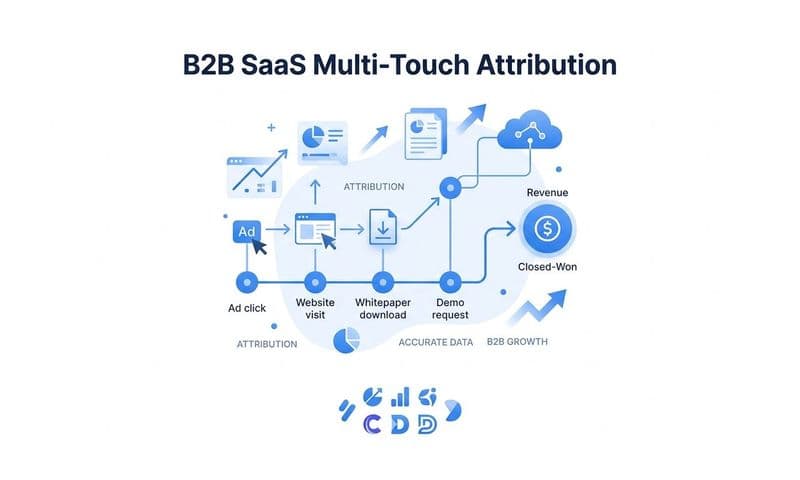
Map out your complete customer journey. For B2B companies, this might look like: ad click → landing page visit → form submission → lead created → sales qualified → opportunity created → closed won. For e-commerce, it's simpler: ad click → product view → add to cart → purchase → repeat purchase.
Each of these stages represents a meaningful conversion event you should track. Don't just count form fills—track when leads get marked as qualified in your CRM. Track when opportunities are created. Track when deals close and how much revenue they bring.
Connect your CRM to your attribution system. Most modern CRMs (HubSpot, Salesforce, Pipedrive) offer API integrations or native connections to marketing platforms. For example, HubSpot attribution tracking allows you to pass data bidirectionally: send ad source information into your CRM when leads are created, and pull revenue data back out when deals close.
Configure your tracking to send revenue events back to your ad platforms. When a deal closes in your CRM, that information should flow back to Meta, Google, and other platforms you advertise on. This trains the ad platform algorithms on what actual customers look like, not just what leads look like.
The result? You can compare campaigns based on customer acquisition cost and revenue generated, not just cost per lead. You might discover that the campaign with the highest lead volume has the lowest close rate. Or that a small campaign with expensive clicks actually drives your highest-value customers.
Step 4: Standardize UTM Parameters Across All Campaigns
Inconsistent UTM parameters create tracking chaos. When one campaign uses "utm_source=facebook" and another uses "utm_source=Facebook" and a third uses "utm_source=fb", your analytics treats them as three separate sources. Your data fragments across dozens of variations of the same channel.
Create a UTM naming convention and enforce it across every campaign. Document the exact format for each parameter: source (where traffic comes from), medium (how they arrived), campaign (specific campaign name), content (ad variation), and term (keyword for paid search). Understanding what UTM tracking is and how it helps your marketing is essential for maintaining clean data.
Here's a simple standard that works: use lowercase for everything, replace spaces with underscores, use descriptive but concise names. For source, use the platform name: facebook, google, linkedin, twitter. For medium, use the traffic type: cpc, social, email, referral. For campaign, use a clear identifier: product_launch_q1, webinar_series_feb, retargeting_cart_abandoners.
Build a UTM template spreadsheet. Create columns for each parameter with dropdown menus of approved values. Add a formula column that automatically generates the full UTM-tagged URL. Share this with everyone who creates campaigns—marketing, sales, partnerships, anyone building links.
Common mistakes break tracking silently. Inconsistent capitalization is the biggest culprit—"Facebook" and "facebook" appear as different sources in analytics. Special characters like spaces, commas, or quotes break URL parsing. Missing parameters leave gaps in your attribution data. Copying UTM codes between campaigns without updating the campaign name creates confusion about which campaign actually drove results.
If you already have messy UTM data polluting your analytics, you can clean it retroactively. Most analytics platforms let you create filters or data transformation rules. Set up rules that standardize common variations: convert all "facebook", "Facebook", "FB" values to a single "facebook" source. Group similar campaign names under consistent labels.
The goal is consistency, not perfection. Pick a standard that makes sense for your team and stick to it religiously. Every campaign, every link, every time. When everyone follows the same convention, your attribution data becomes reliable enough to actually use for optimization decisions.
Step 5: Enable Cross-Device and Cross-Platform Identity Resolution
Your customer sees your Instagram ad on their phone during lunch. They click through, browse your site, but don't convert. That evening, they search your brand name on their laptop and complete a purchase. Your tracking sees two different people—one who clicked the ad but didn't convert, and another who arrived via organic search and bought immediately.
This cross-device gap distorts everything. Your Instagram campaign looks ineffective because conversions aren't attributed to it. Your organic search traffic looks amazing because it gets credit for conversions that started elsewhere. You make budget decisions based on incomplete customer journeys.
Identity resolution solves this by connecting the dots. When the same person interacts with your marketing across multiple devices or platforms, the system recognizes them as one individual and stitches their journey together. Understanding the cross-device user tracking challenges and solutions is critical for modern marketers.
The key is first-party data—information users voluntarily provide that uniquely identifies them. Email addresses are the most reliable identifier. When someone enters their email on your mobile site and later on your desktop site, you can match those sessions to the same person. User IDs work similarly if people log into an account on your site.
Implement user identification in your tracking setup. When someone submits a form or logs in, capture that identifier and associate it with their current session. Send this identifier along with your conversion events to ad platforms. Meta and Google can use email addresses or phone numbers (sent in hashed format for privacy) to match conversions back to ad clicks, even across devices.
For the most complete view, connect all your ad platforms to a central attribution system. Instead of each platform tracking in isolation, feed all your marketing touchpoints into one place that can see the complete customer journey. A comprehensive cross-platform tracking setup ensures that when someone clicks a Facebook ad on mobile, later clicks a Google ad on desktop, then converts, the attribution system connects all three touchpoints to one person.
Test your identity resolution by following a known conversion through your entire system. Have a team member complete a test purchase using a unique email address. Click through multiple campaigns on different devices before converting. Then trace that email through your tracking system. Can you see all the touchpoints? Does the system recognize them as one customer journey? If not, you have gaps to fix.
The limitation: identity resolution only works when you have identifying information. Anonymous browsing sessions can't be connected across devices. But even partial identity resolution dramatically improves tracking accuracy compared to treating every device as a separate user.
Step 6: Set Up Ongoing Tracking Validation and Monitoring
Tracking doesn't break once and stay broken—it degrades over time. Website updates move your tracking code. New campaigns launch with incorrect UTM parameters. Platform API changes break integrations. Team members modify conversion events without documenting changes.
Build a weekly tracking health check into your routine. Every Monday morning, compare data across three sources: ad platform reported conversions, your attribution tool conversions, and your CRM new leads or sales. Look for sudden discrepancies. If Meta reported 100 conversions last week but your CRM only shows 60 new leads, something broke in the past seven days.
Set up automated alerts for tracking anomalies. Most analytics platforms let you configure alerts when metrics drop below expected ranges. Create alerts for: conversion volume drops more than 30% day-over-day, ad platform conversions diverge more than 20% from CRM data, or key conversion events stop firing entirely.
Establish a testing protocol for any changes that could affect tracking. Before launching new website features, test that conversion pixels still fire correctly. Before starting new campaigns, verify UTM parameters follow your naming convention. After platform updates or integrations, check that data flows properly end-to-end. Following best practices for tracking conversions accurately will help maintain data integrity over time.
Document your entire tracking setup in a shared document. List every tracking pixel installed, where it's placed, what events it captures, and how it's configured. Map out your data flow: where conversion data originates, which systems it passes through, and where it ultimately lands. Include screenshots of key configurations.
This documentation serves two purposes. First, it helps team members troubleshoot problems without reverse-engineering your setup from scratch. Second, it prevents knowledge loss when team members leave. The marketer who implemented your tracking six months ago might not be around when something breaks.
Schedule quarterly tracking audits beyond your weekly checks. Every three months, repeat the comprehensive audit from Step 1. Compare current accuracy rates to your baseline. Identify new gaps that have emerged. Update your documentation to reflect any changes. This proactive approach catches problems before they significantly impact your data quality. When issues arise, knowing how to fix attribution discrepancies quickly becomes invaluable.
Putting It All Together
Here's your implementation checklist. Start with Step 1: audit your current setup and document baseline accuracy by comparing ad platform data to CRM reality. Move to Step 2: implement server-side tracking for your primary ad platforms to recover data lost to browser restrictions. Continue with Step 3: connect your CRM to track revenue-level conversions, not just lead volume. Then Step 4: standardize UTM parameters across all campaigns to prevent data fragmentation. Add Step 5: enable cross-device identity resolution using first-party data like email addresses. Finally, Step 6: set up ongoing validation and monitoring to catch tracking degradation early.
Start with the audit—you can't improve what you haven't measured. Most marketers see the biggest immediate gains from server-side tracking implementation, as it recovers data previously blocked by iOS restrictions, ad blockers, and cookie limitations.
The reality? Maintaining accurate tracking across multiple ad platforms, your website, and your CRM requires constant attention. For teams managing significant ad spend across multiple channels, manually stitching together data sources becomes unsustainable. A dedicated marketing attribution software automates much of this process—connecting your ad platforms, CRM, and website to track the complete customer journey without manual reconciliation.
Cometly handles this systematically: it captures every touchpoint from ad clicks to CRM events, connects them into unified customer journeys, and feeds enriched conversion data back to ad platforms to improve their optimization. The platform's AI analyzes your complete attribution data to identify which campaigns actually drive revenue, not just leads.
Ready to elevate your marketing game with precision and confidence? Discover how Cometly's AI-driven recommendations can transform your ad strategy—Get your free demo today and start capturing every touchpoint to maximize your conversions.