If you have ever stared at your Facebook Ads Manager numbers and felt like something was off, you are not alone. Many marketers notice a persistent gap between what Facebook reports as conversions and what actually shows up in their CRM or revenue dashboards. That gap is not a coincidence.
Browser privacy updates, iOS tracking restrictions, ad blockers, and cookie limitations have made it harder than ever to get a clear picture of which Facebook ads are truly driving results. The tracking landscape in 2026 is more fragmented than it has ever been, and the marketers who ignore this reality are making budget decisions on fundamentally flawed data.
Here is what that looks like in practice. You scale a campaign because Facebook says it is converting well. But when you check your CRM, the numbers do not add up. You cut spend on another campaign that looked underperforming, only to later realize it was quietly driving qualified leads that converted weeks later through a different channel. Every misattributed conversion is a decision made in the dark.
When your tracking is inaccurate, every choice you make about budget allocation, creative testing, and audience targeting is built on shaky ground. You end up overspending on campaigns that look good on paper but underperform in reality, while cutting spend on ads that are generating real revenue behind the scenes.
This guide walks you through exactly how to track Facebook ads accurately in 2026. From foundational pixel audits to advanced server-side tracking and multi-touch attribution, these seven steps will help you close the data gap and make confident, data-driven decisions about your ad spend. Whether you are running campaigns for an ecommerce brand, a SaaS company, or managing ads at an agency, this is the process that turns unreliable reporting into a competitive advantage.
Step 1: Audit Your Current Facebook Pixel and Events Setup
Before you add anything new to your tracking stack, you need to understand what is actually working right now. A broken or incomplete pixel setup is the single most common cause of inaccurate Facebook ad tracking, and many marketers are running campaigns without realizing their pixel is misfiring, duplicated, or missing key events entirely.
Start by opening Meta Events Manager and reviewing your pixel activity. You are looking for two things: whether events are firing at all, and whether they are firing on the right pages with the right parameters. A Purchase event that fires on your homepage instead of your order confirmation page is worse than no Purchase event, because it inflates your reported conversions with false data.
Install the Meta Pixel Helper Chrome extension to get a real-time view of what your pixel is doing on any page. Load your key conversion pages, such as your checkout confirmation, lead form thank-you page, or trial signup page, and verify that the correct standard events are triggering. The events you should confirm include Purchase, Lead, AddToCart, InitiateCheckout, and ViewContent, depending on your funnel.
Pay close attention to event parameters. A Purchase event without the correct value and currency parameters means Facebook cannot optimize for revenue, only for raw conversion counts. If you are running an ecommerce store, missing content IDs can also break your dynamic product ads. For a deeper dive into common pixel problems, see our guide on how to fix Facebook pixel tracking issues.
Common errors to look for during your audit:
Duplicate pixels: Multiple pixel instances firing on the same page will double-count events and make your data completely unreliable. This often happens after platform migrations or when multiple team members have touched the site code.
Missing events on key pages: If your AddToCart event fires but InitiateCheckout does not, you have a blind spot in your funnel visibility. Map out every step in your conversion path and verify each one has the correct event.
Incorrect or missing parameters: Check that value, currency, and content IDs match your actual transaction data. Mismatched parameters reduce your Event Match Quality score and weaken Facebook's ability to optimize your campaigns.
Once you have identified the issues, fix them systematically. Remove duplicate pixel instances, correct event placements, and add missing parameters. Then test across multiple devices, including mobile, since iOS behavior can differ from desktop. A clean, accurate pixel setup is the foundation everything else in this guide builds on.
Step 2: Configure the Conversions API for Server-Side Tracking
Even with a perfectly configured pixel, browser-side tracking alone is no longer sufficient. Since Apple's iOS 14.5 App Tracking Transparency update, a significant portion of your audience can opt out of cross-app tracking entirely. Add in the growing prevalence of ad blockers and increasing browser cookie restrictions, and you are looking at a tracking setup that misses a meaningful share of real conversions. Understanding these iOS tracking limitations for Facebook ads is essential for any serious advertiser.
The solution is Meta's Conversions API, often called CAPI. Instead of relying on a browser cookie to send event data to Facebook, CAPI sends conversion events directly from your server to Meta's servers. Browser limitations do not affect it. Ad blockers cannot block it. It captures conversions that the pixel simply cannot see.
The result is a more complete data set for Facebook's algorithm to optimize against. When Meta has better conversion data, it can better identify which users are likely to convert, which directly improves your targeting and return on ad spend over time.
There are two main paths to setting up CAPI:
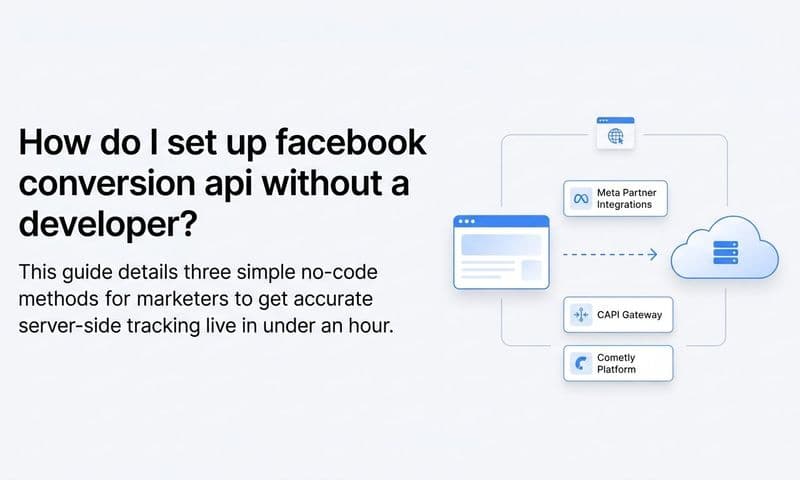
Platform-native integration: If you are running on Shopify, WordPress, or another major platform, Meta offers direct integrations that can be enabled in a few clicks. Shopify's Meta channel, for example, includes a built-in CAPI connection. This is the fastest path if your platform supports it.
Server-side tracking tool or attribution platform: For more control and cross-platform visibility, tools like Cometly handle server-side event collection and send enriched conversion data to Meta on your behalf. This approach also works across multiple platforms and gives you a unified view of your tracking data outside of Facebook's own reporting.
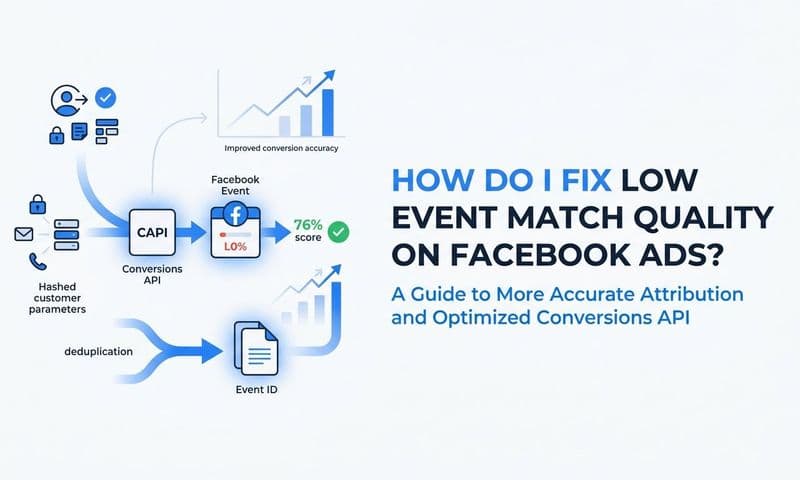
One critical detail when running both the pixel and CAPI simultaneously: you must configure event deduplication. Without it, the same conversion will be reported twice once by the browser pixel and once by the server, inflating your numbers. Meta uses an event ID to deduplicate events, so you need to ensure both the pixel and your CAPI setup are sending the same event ID for the same conversion event.
After setup, check your Event Match Quality score in Meta Events Manager. This score, on a scale of 1 to 10, reflects how well your server events are matching to actual Facebook users. Higher scores mean better optimization. To improve it, send as many customer data parameters as you can with each event, including email, phone number, and browser data, all hashed for privacy.
Server-side tracking is not optional in 2026. It is the baseline for anyone who wants accurate Facebook ad data. If you want to explore the best options available, check out our roundup of Facebook ads tracking solutions.
Step 3: Implement UTM Parameters and a Consistent Naming Convention
Facebook's own reporting tells you how Facebook sees your campaigns. UTM parameters tell you how your campaigns actually perform in the real world, tracked independently by Google Analytics, your CRM, and any other analytics tool you use. These two data sources should inform each other, and UTMs are the bridge that makes that possible.
Every Facebook ad you run should have UTM parameters appended to the destination URL. Here is the recommended structure:
utm_source: facebook
utm_medium: paid
utm_campaign: {campaign.name}
utm_content: {ad.name}
utm_term: {adset.name}
The curly brace values in the campaign, content, and term parameters are Facebook's dynamic URL parameters. Instead of manually entering the campaign or ad name for every single ad, Facebook automatically populates these fields with the actual names from your account. This is essential for running UTMs at scale without creating a maintenance nightmare.
Consistent naming conventions are just as important as the UTMs themselves. If one campaign is named "Q2-Prospecting-US" and another is named "q2 prospecting united states," your analytics data will treat them as completely separate campaigns. Cross-platform analysis becomes messy and unreliable.
Establish a naming convention before you launch any campaign and document it for your entire team. A simple structure like [Quarter]-[Objective]-[Audience]-[Region] works well for most accounts. Apply it uniformly across campaigns, ad sets, and ads. If you are also running ads on other platforms, our guide on tracking for Facebook and Google ads covers how to keep your naming conventions consistent across channels.
Common UTM mistakes that will corrupt your data:
Forgetting UTMs on retargeting campaigns: Retargeting traffic is often the highest-converting traffic in an account. If it is not tagged, you cannot attribute those conversions correctly in your CRM or analytics tools.
Inconsistent capitalization: Google Analytics treats "Facebook" and "facebook" as different sources. Standardize on lowercase for all UTM values.
Not using dynamic parameters: Manually entering campaign names means any campaign rename will break your historical UTM data. Dynamic parameters update automatically and save hours of maintenance work.
Once UTMs are in place, you can cross-reference Facebook's reported conversions with what your CRM or Google Analytics shows for the same traffic. Discrepancies will point you toward specific tracking gaps to investigate further.
Step 4: Connect Your CRM and Revenue Data to Close the Attribution Loop
Here is the core problem with relying solely on Facebook's conversion reporting: Facebook can tell you that an ad led to a form submission. It cannot tell you whether that lead turned into a paying customer three weeks later. For businesses with any kind of sales cycle, this is a critical blind spot.
Facebook's reported conversions often do not match your actual sales or qualified leads, and the gap is not always about tracking errors. Sometimes it is structural. Facebook optimizes for the conversion event you tell it to optimize for, which is typically a form fill, a trial signup, or a purchase. But if your actual revenue comes from a subset of those conversions, such as leads that pass a qualification threshold or trials that upgrade to paid plans, then you are optimizing for the wrong signal. Understanding why Facebook ads show wrong conversion data can help you identify where these structural gaps exist.
Connecting your CRM closes this loop. When you link HubSpot, Salesforce, or a similar platform to your attribution setup, you can trace a click all the way through to closed revenue. You can see not just which ads drove leads, but which ads drove qualified leads that your sales team actually closed.
This changes how you evaluate campaign performance entirely. An ad that generates a high volume of low-quality leads might look great in Facebook Ads Manager but show poor downstream revenue in your CRM. An ad targeting a narrower audience might generate fewer conversions but close at a much higher rate. Without CRM connectivity, you cannot see this difference.
Cometly is built specifically for this kind of end-to-end visibility. It connects your ad platforms, CRM, and website to track the entire customer journey in real time, capturing every touchpoint from the initial ad click through to CRM events and closed revenue. This gives you a unified view of what your Facebook spend is actually generating, not just what Facebook's pixel can observe.
The practical difference is significant. Tracking conversions tells you what Facebook reports. Tracking revenue tells you what your business actually earns. Learning how to track marketing ROI accurately is what separates marketers who scale confidently from those who are always guessing.
Step 5: Use Multi-Touch Attribution to See the Full Customer Journey
Facebook's default attribution window is 7-day click and 1-day view. That means Facebook takes credit for any conversion that happens within seven days of someone clicking your ad, or within one day of someone viewing it without clicking. This is not inherently wrong, but it gives you a very narrow and Facebook-centric view of what is actually driving your results.
Think about how your customers actually behave. A prospect might click a Facebook ad, browse your site, leave without converting, find you again through a Google search a week later, and then convert after receiving a follow-up email. Facebook's reporting attributes that conversion to the ad click. Google Analytics might attribute it to organic search. Your email platform might claim it as an email conversion. Everyone is right from their own perspective, and all of them are incomplete. This is a common source of Google Ads and Facebook Ads attribution conflict that multi-touch models help resolve.
Multi-touch attribution solves this by distributing credit across all the touchpoints that contributed to a conversion. The main models each take a different approach:
First-touch attribution: Gives all credit to the first interaction. Useful for understanding which channels are best at generating initial awareness.
Last-touch attribution: Gives all credit to the final touchpoint before conversion. Shows what closes deals but ignores everything that built the relationship.
Linear attribution: Distributes credit equally across all touchpoints. Gives a balanced view of the full journey without overweighting any single channel.
Time-decay attribution: Gives more credit to touchpoints closer to the conversion. Useful for shorter sales cycles where recent interactions are more influential.
Data-driven attribution: Uses machine learning to assign credit based on actual conversion path data. The most accurate model for accounts with sufficient conversion volume.
For longer sales cycles or high-consideration purchases, multi-touch attribution is especially important. Facebook ads often play a critical role in top-of-funnel awareness that eventually leads to revenue, but that role is invisible in last-click models.
Cometly's multi-touch attribution lets you compare models side by side and see how credit shifts across channels depending on which model you apply. This gives you a much more honest picture of what your Facebook spend is actually contributing to your overall revenue, and helps you make smarter decisions about where to invest.
Step 6: Feed Accurate Conversion Data Back to Facebook's Algorithm
Getting accurate data into your own analytics is only half the equation. The other half is sending better data back to Facebook so its algorithm can do its job more effectively.
Facebook's ad delivery system is a machine learning engine. It optimizes based on the conversion signals you send it. If those signals are incomplete, delayed, or based on low-quality events, the algorithm optimizes for the wrong outcomes. It finds more people who fill out forms, not more people who actually buy. It maximizes the metric you are feeding it, not the business outcome you actually care about.
Conversion syncing addresses this directly. The concept is straightforward: instead of only sending raw pixel events to Meta, you push verified, enriched conversion events from your attribution platform back to Meta's Conversions API. Our detailed guide on how to sync conversion data to Facebook ads walks through the full process. These events include richer customer data, better matching parameters, and in some cases, downstream revenue signals that the pixel never captured.
Cometly's Conversion Sync feature does exactly this. It sends enriched, conversion-ready events back to Meta, giving the platform's optimization engine better data to work with. The result is improved targeting, more efficient ad delivery, and better return on ad spend over time.
The compounding effect here is worth understanding. Better data leads to better optimization. Better optimization leads to better results. Better results generate even better conversion data to feed back into the system. Over time, this flywheel effect can meaningfully improve Facebook ads performance with data without any changes to creative or targeting.
To verify your synced conversions are working correctly, check Meta Events Manager after enabling conversion sync. Look for your server events appearing with strong Event Match Quality scores. If your EMQ score is below 6, investigate which customer data parameters you can add to improve matching. An EMQ score of 8 or above indicates strong matching and gives Facebook's algorithm the signal quality it needs to optimize effectively.
Step 7: Validate Your Data and Build an Ongoing Tracking Routine
Setting up accurate tracking is not a one-time task. Pixels break. UTMs get misconfigured. CAPI connections can stop sending data after a platform update. The marketers who maintain accurate tracking over time are the ones who build a regular validation routine into their workflow.
Start by establishing a cross-reference check between your three main data sources: Facebook Ads Manager, your CRM, and your attribution platform. These numbers will never match exactly because they use different attribution logic and different counting windows. But they should be in a reasonable range of each other. Significant discrepancies, such as Facebook reporting twice the conversions your CRM shows, are a signal to investigate immediately.
Key metrics to monitor on a weekly or biweekly basis:
Event Match Quality score: Check this in Meta Events Manager for all active pixel and CAPI events. A sudden drop in EMQ often indicates a tracking configuration change or a data quality issue.
Conversion count discrepancies: Compare Facebook-reported conversions against CRM records for the same time period. Note the gap and track whether it is growing or shrinking over time.
UTM consistency: Spot-check incoming traffic in your analytics tool to confirm UTMs are populating correctly. Missing or malformed UTMs mean unattributed traffic accumulating in your direct or unknown channel buckets.
Conversion sync status: Verify that your enriched events are being received and matched in Meta Events Manager. A sync that stopped working a week ago can silently degrade your campaign optimization.
Cometly's analytics dashboard and AI-powered recommendations make this routine faster and more actionable. Instead of manually pulling reports from multiple platforms, you can see your attribution data, event health, and campaign performance in one place. The AI identifies high-performing ads and surfaces data anomalies that might indicate a tracking issue before it significantly affects your results.
Know when to dig deeper. If you see a sudden drop in Event Match Quality, investigate whether a site update changed your event parameters. If attributed revenue drops unexpectedly, check whether your CAPI connection is still active. If you are struggling with persistent data problems, our guide on how to fix Facebook ads tracking issues covers the most common root causes and solutions. Proactive monitoring keeps small tracking issues from becoming major data problems.
Your Tracking Checklist and Next Steps
Tracking Facebook ads accurately in 2026 requires more than installing a pixel and hoping for the best. The privacy landscape has changed, customer journeys have become more complex, and the gap between what Facebook reports and what your business actually earns has never been wider for marketers who rely on default setups.
By working through these seven steps, you build a tracking system that gives you real confidence in your data. Here is a quick checklist to keep handy:
1. Pixel and events verified and firing correctly on all key conversion pages, with accurate parameters.
2. Conversions API configured with proper event deduplication to prevent double-counting.
3. UTM parameters and naming conventions applied consistently across all campaigns, ad sets, and ads.
4. CRM connected to trace clicks all the way through to qualified leads and closed revenue.
5. Multi-touch attribution enabled so you can see the full customer journey, not just Facebook's slice of it.
6. Conversion sync active to feed enriched, verified events back to Meta's algorithm.
7. Weekly tracking audit scheduled to catch data issues before they affect your decisions.
Each step builds on the one before it. A clean pixel foundation makes server-side tracking more effective. Accurate server-side data improves your multi-touch attribution. Better attribution data fed back to Meta improves your campaign optimization. The whole system compounds over time.
If you want to simplify this entire process and get accurate attribution across all your ad channels in one place, Cometly brings all of these pieces together. From server-side tracking and CRM connectivity to multi-touch attribution and conversion sync, it gives you the complete picture you need to stop guessing and start scaling with confidence. Get your free demo today and start capturing every touchpoint to maximize your conversions.