Your Facebook Ads Manager says you drove 150 conversions last month. Your CRM shows 60 closed deals. Your finance team is asking why ad spend keeps climbing while actual revenue stays flat. Sound familiar?
This gap between reported and actual conversions is one of the most frustrating problems in performance marketing today. And it is getting worse. Since Apple's iOS 14.5 update introduced App Tracking Transparency in 2021, the data Facebook receives about off-platform conversions has shrunk considerably. Add Safari's Intelligent Tracking Prevention, Firefox's Enhanced Tracking Protection, and the growing use of ad blockers, and you have a perfect storm of data degradation.
Here is why this matters beyond just having clean reports: Facebook's ad delivery algorithm optimizes based on the conversion signals it receives. When those signals are incomplete or inaccurate, the algorithm cannot find your best customers. It optimizes for the wrong people, burns budget on low-quality clicks, and reports inflated conversion numbers that make bad campaigns look good.
The result is misallocated budgets, poor optimization decisions, and a growing lack of confidence in your data. If you cannot trust your numbers, you cannot scale with confidence.
The good news is that the gap between reported and actual conversions is closeable. It requires a layered approach that combines proper pixel configuration, server-side tracking, Conversions API setup, UTM discipline, smart attribution modeling, and feeding enriched data back to Facebook's algorithm. None of these steps is particularly complex on its own, but most advertisers are missing two or three of them, which is enough to compromise the whole system.
This guide walks you through all six steps in order. By the time you reach the end, you will have a clear action plan to improve Facebook ad tracking accuracy and build the reliable data foundation your campaigns need to grow.
Step 1: Audit Your Facebook Pixel and Events Configuration
Before you add anything new, you need to know what is actually working. Most tracking problems start with a pixel that is misfiring, misconfigured, or duplicated without anyone realizing it. A thorough audit is the foundation everything else builds on.
Start with the Meta Pixel Helper Chrome extension. Install it, then visit every key page on your website: your homepage, landing pages, product pages, thank-you pages, and checkout confirmation pages. The extension will show you which pixel events are firing, whether they contain the right parameters, and whether any errors exist. Pay close attention to pages where conversions happen, because a missing or broken event there is the most costly gap you can have.
Next, open Facebook Events Manager and review your event activity. Look for three common problems:
Duplicate pixel fires: If your pixel fires twice on the same page, Facebook double-counts the event. This inflates conversion numbers and corrupts your optimization data. Duplicates often happen after site migrations, theme changes, or when multiple team members have added tracking code independently. Understanding what a tracking pixel is and how it works can help you identify these issues faster.
Missing event parameters: Standard events like Purchase and AddToCart should include value, currency, and content IDs. Without these parameters, Facebook cannot optimize for purchase value and your dynamic ads will not function properly. Check that every event sends the parameters relevant to its purpose.
Misconfigured custom events: Custom events that do not map to actual conversion actions waste your eight Aggregated Event Measurement slots. Every event should correspond to a meaningful step in your funnel.
Speaking of AEM: domain verification is a prerequisite for Aggregated Event Measurement to work correctly. Go to Facebook Business Settings, navigate to Brand Safety and then Domains, and verify your domain by adding a DNS TXT record or a meta tag to your site. Without this step, iOS 14.5+ conversions will not be attributed properly.
Once your domain is verified, configure your eight prioritized conversion events in Events Manager under Aggregated Event Measurement. Rank them by business importance. Your highest-priority event (typically Purchase or Qualified Lead) should be listed first, because Facebook will only report the highest-priority event that fires during a session for iOS users. For a deeper dive into pixel configuration issues, read our guide on Facebook pixel tracking and how to fix data loss.
Success indicator: Events Manager shows consistent event firing with no errors across all key pages. Your prioritized events reflect your actual conversion funnel, and your domain verification status shows as verified.
Step 2: Implement Server-Side Tracking to Bypass Browser Limitations
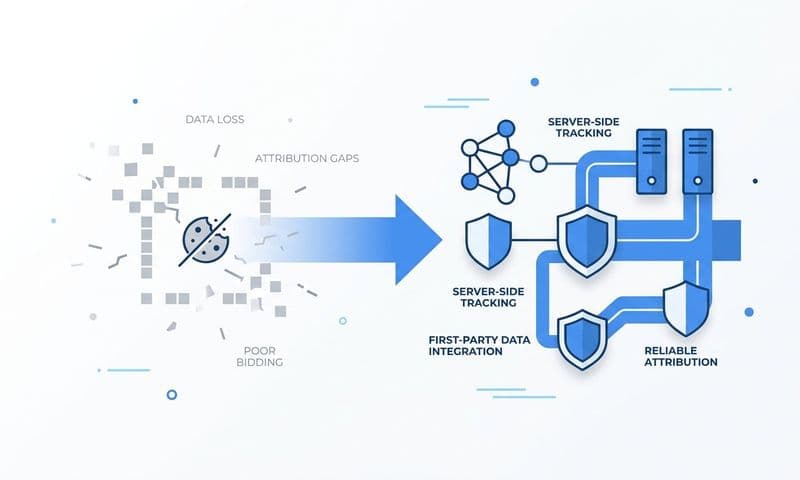
Here is the core problem with relying entirely on the Facebook pixel: the pixel lives in the browser, and the browser is increasingly hostile to tracking. Ad blockers prevent the pixel from loading. Safari's Intelligent Tracking Prevention limits cookie lifespans. iOS App Tracking Transparency prompts users to opt out of cross-app tracking. Every one of these factors silently erodes your conversion data.
The fix is to move your tracking off the browser entirely. That is exactly what server-side tracking does.
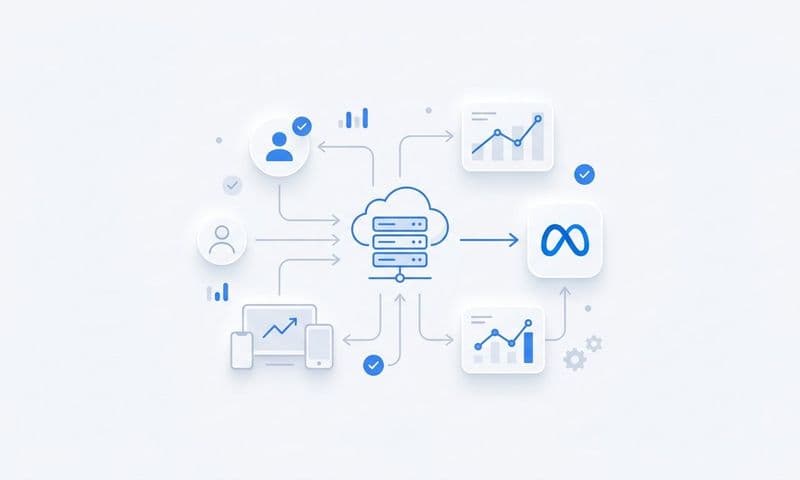
Instead of relying on JavaScript running in a user's browser to send conversion data to Facebook, server-side tracking sends that data directly from your web server to Facebook's API. The browser never touches it. Ad blockers cannot block it. Safari's cookie restrictions do not affect it. If you want to understand the technical differences in more detail, our comparison of server-side tracking vs pixel tracking breaks it all down.
Think of it like this: the pixel is a messenger who has to travel through a city full of roadblocks. Server-side tracking is a direct phone call that bypasses the city entirely.
There are a few practical ways to implement server-side tracking:
Meta Conversions API Gateway: Meta offers a self-hosted gateway option that you can deploy through cloud providers. It requires more technical setup but gives you direct control over your data pipeline.
Partner integrations: Platforms like Shopify, WooCommerce, and various tag management systems offer native Conversions API integrations that reduce the technical lift significantly.
Dedicated attribution platforms: Tools like Cometly handle server-side tracking automatically without requiring heavy developer involvement. Cometly connects your ad platforms, CRM, and website to capture every conversion event server-side, giving Facebook a complete and accurate picture of your customer journey.
There is one critical pitfall to avoid: deduplication. If you run both pixel tracking and server-side tracking simultaneously (which you should, because the combination gives you the best coverage), Facebook will receive two signals for the same conversion. Without deduplication, it counts both, inflating your numbers and corrupting your optimization data.
The solution is the event_id parameter. Assign the same unique event_id to both the browser pixel event and the server-side CAPI event for the same conversion. Facebook uses this ID to recognize that both signals represent the same event and counts it only once. Our article on why server-side tracking is more accurate explains the full attribution benefits of this approach.
Success indicator: Your Event Match Quality score in Events Manager climbs toward 6.0 or above (on Meta's 1-to-10 scale), and the gap between your tracked conversions and your actual CRM data begins to narrow.
Step 3: Set Up the Meta Conversions API With Proper Deduplication
Server-side tracking and the Conversions API are closely related, but CAPI is the specific mechanism through which your server sends conversion data directly to Facebook. Getting it configured correctly, especially the deduplication piece, is what separates a tracking setup that works from one that creates more problems than it solves.
Here is how to approach the setup:
1. Choose your implementation method. You can connect through a partner integration (Shopify, WooCommerce, and many CRMs have native CAPI connections), through a direct API implementation if you have developer resources, or through a platform like Cometly that handles the connection automatically. For most marketing teams without dedicated engineering support, a partner integration or a platform like Cometly is the fastest and most reliable path.
2. Send customer parameters for better match rates. CAPI events are matched to Facebook accounts using customer data signals. The more signals you send, the higher your Event Match Quality score. Key parameters include hashed email addresses, hashed phone numbers, IP addresses, and user agent strings. All personally identifiable information is hashed using SHA-256 before it leaves your server, so privacy is maintained while match rates improve.
3. Configure deduplication using a shared event_id. As mentioned in the previous step, every CAPI event needs an event_id that matches the corresponding pixel event. Generate a unique ID for each conversion event (a UUID or timestamp-based ID works well) and pass it through both your pixel and your CAPI implementation. Facebook's deduplication logic will handle the rest. If your conversion numbers still look inflated, check out our guide on why conversion tracking numbers are wrong for additional troubleshooting steps.
4. Test your setup using the Test Events tool. In Events Manager, navigate to the Test Events tab and use the provided test code to fire test events through your CAPI implementation. You will be able to see whether events are being received, whether customer parameters are being matched, and whether deduplication is working correctly. Do not skip this step. A CAPI setup that is live but misconfigured is worse than no CAPI at all.
Success indicator: Events Manager shows both browser and server events with a high match quality score. When you review your conversion data, you do not see duplicate entries, and the total conversion count aligns more closely with your CRM records.
Step 4: Enforce Consistent UTM Parameters Across Every Campaign
UTM parameters are not glamorous. They are not a new technology. But they remain one of the most reliable tools in your tracking stack because they operate independently of Facebook's pixel, cookies, or attribution windows. When everything else breaks, UTMs still tell you where traffic came from.
The way UTMs improve Facebook ad tracking accuracy is simple: they give you a second data layer that you can cross-reference against Facebook's reported numbers in Google Analytics or your CRM. If Facebook claims 100 conversions but your UTM-tagged traffic in Google Analytics shows 40, you know there is a discrepancy worth investigating. For a deeper look at how these two approaches compare, read our article on UTM tracking vs attribution software.
Build a standardized naming convention and document it for your entire team. A clean structure looks like this:
utm_source: facebook (always lowercase, always consistent)
utm_medium: paid (distinguishes paid traffic from organic)
utm_campaign: use a consistent format like [product]-[objective]-[date], for example: software-conversions-may2026
utm_content: the specific ad name or creative identifier
utm_term: the audience or ad set name
Use Facebook's dynamic URL parameters to auto-populate these fields and eliminate human error. Parameters like {campaign.name}, {adset.name}, and {ad.name} automatically pull the correct values when your ad is served. This means you do not need to manually update UTMs every time you create a new campaign.
If you're evaluating vendors, our Shopify dynamic ad generator breakdown can help.
One critical step that most teams miss: capture UTM data in your CRM. Use hidden form fields on your lead forms to pass UTM values into your CRM records at the point of conversion. This means every lead and every closed deal carries source information all the way through the funnel, so you can tie revenue back to specific Facebook campaigns without relying solely on pixel data. Our guide on UTM parameter tracking best practices covers this workflow in detail.
The most common pitfall is inconsistent formatting. Mixed capitalization (Facebook vs. facebook vs. FACEBOOK) creates separate line items in your analytics reports and makes it impossible to aggregate data accurately. Establish a rule: lowercase only, no spaces (use hyphens), and enforce it with a shared naming document that the whole team references before launching any campaign.
Success indicator: Every Facebook campaign URL contains properly formatted UTM parameters. Your Google Analytics or CRM shows clean, consistent source data that you can use to verify Facebook's reported conversions.
Step 5: Choose the Right Attribution Model for Your Business
Even with perfect pixel configuration, server-side tracking, and UTM discipline, your data can still mislead you if you are using the wrong attribution model. Attribution is not just a technical setting. It is a fundamental decision about how you assign credit for conversions, and the wrong choice can make bad campaigns look great and great campaigns look average.
Facebook's default attribution window is 7-day click and 1-day view. This means Facebook takes credit for a conversion if someone clicked your ad within the past seven days or viewed your ad within the past day before converting. For impulse purchases with short consideration cycles, this window is often appropriate. But for B2B products, high-ticket services, or anything with a longer decision-making process, a 7-day window can miss a significant portion of your actual conversions. Our deep dive into Facebook ads attribution explains how to navigate these limitations.
Last-click attribution: Gives 100% of the credit to the final touchpoint before conversion. Simple to understand, but it systematically undervalues awareness and consideration campaigns that introduced the customer to your brand earlier in the journey.
First-click attribution: Gives 100% of the credit to the first touchpoint. Useful for understanding which campaigns drive initial discovery, but it ignores all the nurturing that happened between first touch and conversion.
Multi-touch attribution: Distributes credit across all touchpoints in the customer journey. This gives you a more accurate picture of which campaigns contribute to revenue at every stage of the funnel, not just the last step.
For advertisers with longer sales cycles, the real problem is that Facebook's attribution window closes before the sale happens. A prospect might click your Facebook ad, enter a nurture sequence, and convert three weeks later. Facebook never sees that conversion, so it marks the campaign as underperforming and reallocates budget away from it.
This is where a touchpoint attribution tracking platform becomes essential. Cometly connects ad clicks to CRM events across the full customer journey, so you can see which Facebook ads actually drive revenue rather than just tracking surface-level metrics like clicks or form submissions. When your attribution data reflects real business outcomes, you can make budget decisions with confidence instead of guesswork.
Success indicator: Your attribution data aligns more closely with actual CRM revenue. You can identify which campaigns drive qualified leads and closed deals, not just the cheapest clicks.
Step 6: Feed Enriched Conversion Data Back to Facebook's Algorithm
All of the previous steps improve your ability to see what is happening. This final step is about using that visibility to make Facebook's algorithm smarter, which ultimately improves your campaign performance.
Here is the core principle: Facebook's algorithm optimizes based on the conversion signals you send it. If you only send top-of-funnel signals like page views and form submissions, the algorithm optimizes for people who fill out forms. Some of those people will become customers. Many will not. The algorithm has no way to know the difference because you never told it.
When you feed downstream conversion data back to Facebook, including qualified lead status, sales opportunities, and actual closed revenue, you give the algorithm the context it needs to find more people who look like your actual buyers. Understanding why marketing data accuracy matters for ROI helps illustrate why this step has such an outsized impact on performance.
Practically, this means connecting your CRM to Facebook's Conversions API so that when a lead closes in your CRM, that event is sent back to Facebook with the associated ad click data. The algorithm learns that the people who convert from specific campaigns are worth more, and it adjusts delivery accordingly.
Cometly's Conversion Sync feature does exactly this. It sends enriched, conversion-ready events back to Meta, improving the algorithm's ability to identify and target high-value customers similar to your best buyers. Instead of optimizing for form fills, you are optimizing for revenue.
To validate that this data loop is working, compare Facebook-reported conversions against your CRM data on a weekly basis. Track the gap over time. As your enriched data flows back to Facebook and the algorithm recalibrates, you should see the gap narrow, your cost per qualified lead decrease, and your overall ROAS improve.
The key insight here is that better data in produces better optimization out. Every improvement you make to your tracking accuracy compounds through the algorithm's learning process, creating a flywheel effect where cleaner data leads to better targeting, which leads to more conversions, which produces more data to learn from.
Success indicator: Facebook's algorithm begins delivering ads to higher-quality prospects. Your cost per qualified lead decreases, and the conversion data Facebook reports aligns more closely with the revenue your CRM records.
Your Facebook Tracking Accuracy Checklist
Improving Facebook ad tracking accuracy is not a one-time project. It is an ongoing discipline that requires regular auditing, consistent processes, and a willingness to layer multiple tracking methods together. Here is a quick recap of everything covered in this guide:
1. Pixel and events audited: Domain verified in Business Settings, no duplicate pixel fires, all key events include the right parameters, and eight AEM events prioritized by business importance.
2. Server-side tracking implemented: Conversions are captured server-to-server, bypassing browser limitations, ad blockers, and iOS restrictions that degrade pixel data.
3. Conversions API live with deduplication: CAPI is sending hashed customer parameters to improve match rates, and event_id deduplication prevents double-counting.
4. UTM naming convention enforced: Every campaign uses consistent, lowercase UTM parameters, dynamic variables auto-populate ad-level data, and UTM values are captured in your CRM.
5. Attribution model matched to your sales cycle: You are not relying on a default attribution window that closes before your customers convert, and your attribution data reflects actual revenue rather than proxy metrics.
6. Enriched conversion data flowing back to Facebook: Downstream CRM events and revenue data are synced back to Meta, helping the algorithm optimize for your best buyers rather than just form fills.
Each of these steps reinforces the others. A strong pixel foundation makes your CAPI data more reliable. Accurate CAPI data improves your Event Match Quality. Better match quality means the enriched data you send back to Facebook has more impact on the algorithm.
Platforms like Cometly bring all of these pieces together in one place, connecting your ad platforms, CRM, and website so you can see the full customer journey and make data-driven scaling decisions without stitching together a dozen separate tools.
If you are ready to close the gap between reported and actual conversions and give Facebook's algorithm the data it needs to find your best customers, Get your free demo of Cometly today and start building the accurate tracking foundation your campaigns deserve.