You log into Facebook Ads Manager, and the numbers look great. Conversions are up, cost per acquisition looks healthy, and the algorithm seems to be doing its job. Then you open your CRM or payment processor and reality hits: the actual sales and leads are a fraction of what Facebook is claiming. Sound familiar?
Inaccurate conversion data in Facebook Ads is one of the most expensive problems a digital marketer can face. The gap between what Facebook reports and what actually happened is not just a reporting inconvenience. It directly corrupts your optimization decisions, misleads your budget allocation, and feeds bad signals to the very algorithm responsible for spending your money.
The root causes are well-documented: Apple's App Tracking Transparency framework significantly reduced the data Facebook receives from iOS users after the iOS 14.5 update. Browser-level protections like Safari's Intelligent Tracking Prevention and Firefox's Enhanced Tracking Protection block pixel fires before they ever reach Facebook. Ad blockers strip out tracking scripts entirely. And on top of all that, misconfigured pixels, duplicated events, and mismatched attribution windows compound the problem further.
Here is what makes this particularly dangerous: Facebook's ad delivery algorithm relies on conversion data to decide who to target, how much to bid, and which creative to show. When that data is inaccurate, the algorithm optimizes toward the wrong outcomes. Campaigns that appear profitable start bleeding money. Budgets get shifted toward channels that look good on paper but are not actually driving revenue.
The good news is that this is a solvable problem. This guide walks you through six concrete steps to diagnose where your conversion data is breaking down, fix the underlying issues, and build a tracking setup that gives you numbers you can actually trust. Each step builds on the last, so work through them in order for the best results.
Step 1: Audit Your Current Facebook Pixel and Events Setup
Before you can fix inaccurate conversion data in Facebook Ads, you need to understand exactly what your current setup is doing. Many tracking problems are not caused by sophisticated technical failures. They are caused by basic misconfigurations that have gone unnoticed for months.
Start in Facebook Events Manager. Navigate to your pixel and review the list of events that have fired in the last seven days. Look at the event count relative to your actual conversion volume. If you see a Purchase event firing three times more often than your actual sales, something is wrong. If you see no Lead events firing at all despite running a lead generation campaign, something is equally wrong.
Install the Meta Pixel Helper Chrome extension and walk through your key conversion pages manually. Visit your landing page, your form submission page, and your thank-you or confirmation page. The extension will show you which events are firing, when they fire, and whether there are any errors. Pay close attention to these common issues:
Duplicate pixels: If your pixel code was added through both a tag manager and a hardcoded script on the same page, it will fire twice per visit. This is one of the most common causes of inflated conversion numbers, and it is a key reason Facebook overreports conversions in many accounts.
Events firing on the wrong pages: A Purchase event should only fire on your order confirmation page. If it is firing on your checkout page or product page instead, every visitor to those pages gets counted as a conversion.
Missing events on confirmation pages: If your thank-you page does not have a conversion event, Facebook never learns about the actual conversion. This leads to under-reporting and poor algorithm optimization.
Incorrect event parameters: Standard events like Purchase should include value and currency parameters. If these are missing or passing incorrect values, Facebook cannot optimize for revenue and your ROAS calculations will be wrong.
Also check whether your pixel is firing multiple times on a single page load due to single-page application behavior or route changes. This is especially common on React or Vue-based sites where page transitions do not trigger a full reload.
Success indicator: Your Events Manager dashboard shows each conversion event firing once per actual conversion, the event counts roughly align with your expected user flow, and the Meta Pixel Helper shows no errors or warnings on your key pages.
Step 2: Cross-Reference Facebook Data Against Your Source of Truth
Facebook's reporting is self-reported data. The platform is telling you what it believes happened based on the signals it received. Your CRM, payment processor, or backend system is telling you what actually happened. These are fundamentally different things, and you need to treat them accordingly.
Your CRM or payment processor is your source of truth. Not Facebook Ads Manager.
To measure the gap, pull a date-range comparison. Choose a specific time period, such as the last 30 days, and export your Facebook-reported conversions for each campaign. Then pull the actual conversion records from your CRM or Stripe or whatever backend system you use for the same date range. Line them up side by side.
As you analyze the discrepancy, look for patterns beyond the raw numbers. Ask yourself these questions:
Is Facebook consistently over-reporting? This often points to duplicate pixel fires, events triggering on the wrong pages, or an attribution window that is capturing conversions that happened organically or through other channels. If your ads are showing conversions but no actual sales, this is likely the root cause.
Is Facebook under-reporting? This typically signals that iOS users, ad blocker users, or users on privacy-focused browsers are converting but Facebook is not seeing those events due to browser restrictions blocking the pixel.
Does the discrepancy vary by campaign or ad set? If certain campaigns show much larger gaps than others, the issue may be specific to certain landing pages, audiences, or creative types rather than a systemic tracking failure.
Attribution windows play a significant role here. Facebook's default attribution setting is 7-day click and 1-day view. This means Facebook will take credit for any conversion that happens within seven days of a click on your ad or within one day of someone viewing your ad, even if they never clicked. If your buyer journey is short, this window may be reasonable. If you are selling a higher-consideration product where people research for weeks before buying, this window can cause Facebook to claim credit for conversions that were actually driven by other channels or organic search.
Document the gap clearly. Write down the percentage difference and the absolute number difference for each campaign. This baseline measurement is how you will know whether your fixes are actually working after you implement the steps that follow.
Step 3: Implement Server-Side Tracking with the Conversions API
Browser-based pixel tracking was built for a different era of the internet. When Apple introduced App Tracking Transparency with iOS 14.5, requiring apps to get explicit user permission before tracking, the landscape changed permanently. A large portion of iOS users opt out of tracking, which means Facebook's pixel on your website never receives data about their conversions. Add in Safari's Intelligent Tracking Prevention, Firefox's Enhanced Tracking Protection, and the growing use of ad blockers, and you have a significant portion of your converting audience effectively invisible to browser-based tracking. This is precisely why Facebook Ads stopped working after iOS 14 for so many advertisers.
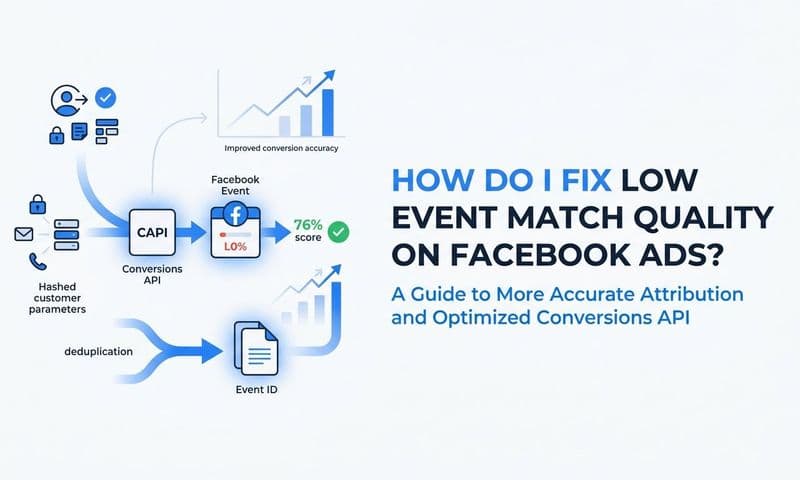
Meta's Conversions API, often called CAPI, is the solution. Instead of relying on a browser script to send conversion data to Facebook, server-side tracking sends that data directly from your server to Meta's API. The conversion happens, your server records it, and your server sends the event to Facebook. The browser's privacy settings, ad blockers, and cookie restrictions are bypassed entirely because the data never travels through the browser.
The result is more complete conversion data reaching Facebook, which directly improves the algorithm's ability to optimize your campaigns.
There is one critical technical consideration when setting up CAPI: event deduplication. If you run both the browser pixel and the Conversions API simultaneously (which is recommended for maximum coverage), the same conversion can be sent to Facebook twice. Once from the pixel firing in the browser, and once from your server. Without deduplication, Facebook counts both as separate conversions, which inflates your numbers just as badly as the original problem. For a deeper walkthrough of the technical setup, see this guide to setting up Conversion API for Facebook.
Deduplication works by assigning a unique event ID to each conversion. When both the pixel and CAPI send the same event with the same event ID, Facebook recognizes them as duplicates and counts only one. Setting this up correctly is essential.
For teams without dedicated developer resources, implementing CAPI from scratch can be complex. This is where platforms like Cometly provide real value. Cometly's server-side tracking automatically syncs verified conversion events back to Facebook through the Conversions API, handling the technical implementation and deduplication logic without requiring you to write custom server code or manage API integrations manually.
Success indicator: After implementing server-side tracking, check your Event Match Quality score in Events Manager. This is Meta's metric for how well your server events are matching to actual Facebook users. A higher score means more of your conversions are being attributed correctly. You should also see fewer conversions labeled as "estimated" in your reports, which is Facebook's way of flagging that it had to model or extrapolate conversion data rather than receive it directly.
Step 4: Configure Proper UTM Parameters and First-Party Tracking
Even with a well-configured pixel and server-side tracking in place, you should never rely solely on Facebook's own reporting to verify your results. UTM parameters give you an independent layer of verification that does not depend on Facebook's attribution logic at all.
UTM parameters are tags you add to your ad URLs that tell your analytics platform exactly where a visitor came from. When someone clicks your Facebook ad and lands on your site, the UTM parameters travel with them in the URL. Your analytics platform records the visit along with those source parameters. If that visitor converts, you have an independent record of the conversion that came from Facebook, without relying on Facebook to tell you it happened.
To make this work reliably, you need a consistent UTM naming convention across every campaign, ad set, and ad. A typical structure looks like this:
utm_source: facebook
utm_medium: paid-social
utm_campaign: your-campaign-name
utm_content: your-ad-name-or-creative-id
The key word is consistent. If some campaigns use "Facebook" with a capital F and others use "facebook" in lowercase, your analytics will treat them as different sources. If some ads are missing UTM parameters entirely, those conversions become invisible in your independent tracking layer.
Beyond UTM parameters, first-party data collection on your own domain is increasingly important. When a visitor fills out a form or completes a purchase, capture their UTM data and store it alongside their lead or order record in your CRM. This creates a durable, first-party record of the traffic source for every conversion, independent of cookies, browser restrictions, or platform reporting windows. Understanding how to track Facebook Ads accurately across these layers is what separates reliable data from guesswork.
Common mistakes to avoid include using different naming conventions across team members or agencies, forgetting to add UTM parameters to retargeting campaigns or ad sets created in bulk, and failing to configure your CRM or form tool to capture and store the UTM values passed through the URL.
Success indicator: When you pull a conversion report from your analytics platform filtered by utm_source=facebook, the numbers should roughly align with what Facebook reports after accounting for attribution window differences. This cross-reference gives you confidence that your tracking is capturing real traffic and real conversions.
Step 5: Align Attribution Models to Match Your Sales Cycle
Even with perfect technical tracking, you can still end up with misleading data if your attribution model does not match how your customers actually buy. This is a less obvious problem but just as damaging to your optimization decisions.
Facebook's default attribution window is 7-day click and 1-day view. For a business selling a low-cost impulse purchase where someone clicks an ad and buys within minutes, this window is probably fine. But for a business selling software, professional services, or any product with a longer consideration phase, this window creates real distortions. A thorough understanding of Facebook Ads attribution is essential for diagnosing these issues.
Consider a buyer who clicks your Facebook ad on a Monday, reads your blog posts and reviews over the next two weeks, then converts through a Google search on day 15. Facebook's 7-day click window would not attribute that conversion to your Facebook campaign, even though Facebook was the first touchpoint that introduced the buyer to your brand. Meanwhile, Google Ads might claim full credit for the conversion through its own attribution window.
The reverse problem also occurs. Facebook's 1-day view attribution means it can claim credit for a conversion from someone who merely saw your ad in their feed without clicking, as long as they converted within 24 hours. For businesses where organic and direct traffic are also significant, this inflates Facebook's reported contribution.
To address this, go into your Facebook Ads Manager campaign settings and review your attribution window. Adjust it to match your actual sales cycle length. If your average time from first touch to purchase is three to four weeks, a 7-day click window will under-report Facebook's true contribution. If your cycle is very short, a 28-day window will over-report it.
This is where multi-touch attribution becomes genuinely valuable. Rather than giving all credit to the last click or the first click, multi-touch attribution distributes credit across all the touchpoints that contributed to a conversion. This gives you a much more accurate picture of which channels and campaigns are actually moving buyers through your funnel.
Cometly's multi-touch attribution connects every touchpoint from the initial ad click through to the CRM close, giving you visibility into the complete customer journey rather than a single-platform view. This is especially important for businesses running campaigns across multiple channels where the buyer journey spans several interactions before converting.
Success indicator: Your attribution model reflects your actual sales cycle length, and your reported ROAS in Facebook aligns more closely with the revenue your CRM shows came from Facebook-sourced leads during the same period.
Step 6: Feed Corrected Conversion Data Back to Facebook's Algorithm
Here is something many marketers miss: fixing your tracking is only half the job. The other half is making sure Facebook's algorithm receives the corrected, accurate conversion signals it needs to optimize your campaigns effectively.
Facebook's ad delivery system is a machine learning algorithm. It learns from the conversion data it receives and adjusts targeting, bidding, and delivery accordingly. If it has been receiving incomplete or inaccurate conversion data for weeks or months, it has been making optimization decisions based on bad information. Fixing your tracking going forward is necessary, but you also need to actively feed better data back into the system.
This is where server-side conversion syncing becomes more than just a tracking fix. When you send enriched, verified conversion events back to Meta through the Conversions API, you are giving the algorithm higher-quality signals to learn from. Each event can include customer data like email address and phone number (hashed for privacy) that helps Facebook match the conversion to an actual user profile. This improves your Event Match Quality score and helps the algorithm understand who your real customers are, not just who Facebook's pixel thought might have converted. Ensuring marketing data accuracy at this stage has a direct impact on your long-term growth.
Cometly's Conversion Sync feature is built specifically for this purpose. It takes the clean, deduplicated conversion data verified through your CRM and other backend sources and sends it back to Facebook in a format the algorithm can act on. The conversions Facebook receives through this sync reflect real outcomes, not estimated or modeled data. Over time, the algorithm learns to target audiences that look like your actual buyers rather than audiences that look like users who triggered a pixel event.
The compounding effect of this is significant. Better conversion data leads to better audience targeting. Better targeting leads to higher-quality traffic. Higher-quality traffic leads to more real conversions. More real conversions feed even better data back into the algorithm. Each campaign cycle builds on the last.
This is the difference between a campaign that slowly degrades in performance as the algorithm chases phantom conversions and a campaign that improves over time because it is learning from real outcomes. If you have been wasting money on Facebook Ads due to poor data, this feedback loop is how you reverse the trend.
Success indicator: Within a few weeks of feeding corrected conversion data back to Facebook, you should see more stable cost per acquisition numbers, improved delivery performance, and Facebook-reported conversions trending closer to what your CRM actually shows. The algorithm's behavior becomes more predictable because it is working from accurate information.
Putting It All Together
Inaccurate conversion data in Facebook Ads is not a minor reporting annoyance. It is a direct threat to your campaign performance, your budget efficiency, and your ability to make confident marketing decisions. Every dollar the algorithm misallocates because of bad conversion signals is a dollar that could have driven real results.
Here is a quick-reference checklist of everything covered in this guide:
1. Audit your Facebook pixel and events setup using Events Manager and the Meta Pixel Helper extension. Eliminate duplicate fires, fix misplaced events, and verify that conversion events include correct parameters.
2. Cross-reference Facebook-reported conversions against your CRM or payment processor data. Document the gap so you can measure improvement after implementing fixes.
3. Implement server-side tracking with the Conversions API to bypass browser restrictions and iOS tracking limitations. Set up event deduplication to prevent double-counting.
4. Configure consistent UTM parameters across every campaign, ad set, and ad. Capture UTM data at the lead or order level in your CRM as an independent verification layer.
5. Align your attribution window and model to match your actual sales cycle. Consider multi-touch attribution for a complete view of which touchpoints drive revenue.
6. Feed corrected, enriched conversion data back to Facebook's algorithm so it can optimize targeting and bidding based on real outcomes.
Work through these steps in order. Start with the audit today, because you cannot fix what you have not yet measured. Each step builds on the previous one, and the cumulative effect of all six working together is a tracking setup that gives you genuine confidence in your data.
Cometly brings all of these fixes together in one platform. It connects your ad platforms, CRM, and website tracking to give you a single source of truth for attribution and optimization. From server-side tracking and conversion syncing to multi-touch attribution and AI-powered recommendations, it is built for marketers who need accurate data and actionable insights without the complexity of stitching together multiple tools.
Ready to stop guessing and start making decisions based on numbers you can trust? Get your free demo today and see how Cometly captures every touchpoint to give your campaigns the accurate data they need to perform.