You open Facebook Ads Manager on a Monday morning, coffee in hand, and the numbers look great. Conversions are up, your return on ad spend looks strong, and the campaign you launched last week seems to be crushing it. Then you pull up your CRM. Or your Shopify dashboard. Or your payment processor. And the numbers don't match. Not even close.
Sound familiar? You're not alone, and more importantly, you're not imagining things. The gap between what Facebook reports and what actually happened in your business is one of the most common frustrations in paid advertising today. It's not a glitch, and it's not Facebook playing tricks on you. It's a structural feature of how Facebook tracks, attributes, and reports conversions.
Understanding why this happens is the first step toward fixing it. Several interconnected forces drive the discrepancy: Facebook's broad attribution windows, its reliance on self-reported data, the impact of Apple's iOS privacy changes, view-through conversion counting, and cross-platform overlap that leads to duplicate credit. Each of these inflates your numbers in its own way, and together they can make a mediocre campaign look like a winner.
The good news is that this problem is solvable. With the right approach to attribution and independent tracking, you can cut through the noise and make budget decisions based on what's actually driving revenue. Let's break down exactly what's happening inside Facebook's reporting engine and what you can do about it.
How Facebook's Attribution Model Inflates Your Numbers
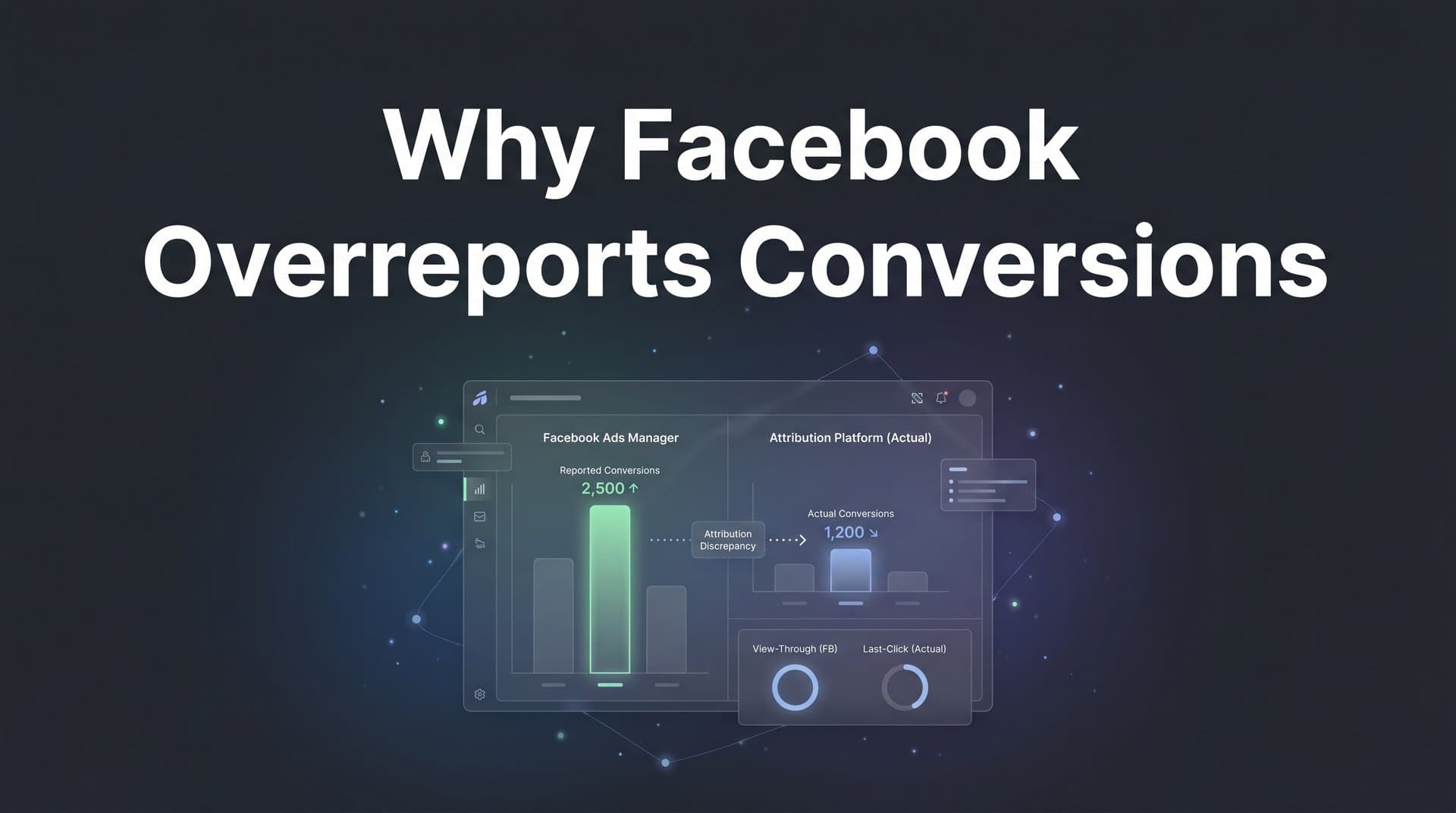
To understand why Facebook overreports conversions, you first need to understand how it counts them. Facebook uses an attribution model that assigns credit for a conversion to any ad a user interacted with (or even just saw) within a defined time window. The default setting is a 7-day click and 1-day view attribution window, which means Facebook will claim credit for a conversion if someone clicked one of your ads within the past seven days or simply viewed your ad within the past day.
That "1-day view" part is where things get complicated fast.
View-through attribution means that if someone scrolls past your ad on their Facebook feed, doesn't click it, goes about their day, and then later visits your website and makes a purchase, Facebook counts that as a conversion driven by your ad. They saw it. That's it. No click, no direct engagement, just an impression. And yet your Ads Manager reports it as a win.
Think about how many people see your ads every day. A significant portion of them were probably already considering your product, had already visited your site, or found you through Google or word of mouth. Facebook is essentially taking credit for conversions that were already in motion, attributing them to ad exposure that may have had little or nothing to do with the final decision.
There's also a deeper structural problem here: Facebook is both the player and the referee. It runs your ads, and it also measures whether those ads worked. There's no independent verification layer. Facebook's pixel fires on your website, Facebook's servers process the data, and Facebook's dashboard shows you the results. Every part of that chain is controlled by Meta. This creates an inherent conflict of interest that even well-intentioned engineers can't fully eliminate from the system.
Compare this to how a neutral third-party attribution tool works. An independent platform pulls data from your actual CRM, your payment processor, and your ad accounts, then reconciles them to show you what actually happened. Facebook's self-attribution model has no such reconciliation step. For a deeper look at this issue, explore why Facebook ads show wrong data in the first place.
The 7-day click window also deserves scrutiny. A week is a long time in the buying journey. Someone might click your Facebook ad on Monday, do extensive research across multiple channels, read reviews, see a Google retargeting ad, get an email from you, and finally convert the following Sunday. Facebook claims full credit for that conversion because the original click happened within seven days. Every other channel that contributed gets nothing.
This isn't unique to Facebook. Most ad platforms use self-attribution models that favor their own reporting. But Facebook's combination of long click windows and view-through counting makes it particularly aggressive in claiming credit, which is why the gap between Facebook's numbers and your actual backend data tends to be so pronounced.
The iOS Privacy Shift and What It Did to Facebook's Data
If Facebook's attribution model was the foundation of the overreporting problem, Apple's App Tracking Transparency framework poured gasoline on it. When iOS 14.5 launched in April 2021, it introduced a requirement that apps must explicitly ask users for permission to track them across other apps and websites. The majority of iOS users opted out, and that decision sent shockwaves through Facebook's entire measurement infrastructure.
Before ATT, Facebook's pixel could follow users across the web with relative precision. When someone clicked an ad, visited your site, and completed a purchase, that journey was trackable end to end. After ATT, a large chunk of that tracking became impossible for iOS users. Facebook could see the ad impression or click, but it lost visibility into what happened next on your website or app. Many advertisers found that their Facebook ads stopped working after iOS 14 as a direct result.
So what did Facebook do? It filled the gaps with modeling.
Statistical modeling, powered by machine learning, is how Facebook now estimates conversions it can no longer directly observe. It looks at the users it can track, identifies patterns in their behavior, and then extrapolates those patterns to the users it can't track. If 10% of trackable users who clicked a certain ad converted, Facebook might model that a similar percentage of untrackable users also converted, and report those estimated conversions alongside the real ones.
The problem is that modeled conversions are estimates, not facts. They're educated guesses based on available signals, and they introduce a layer of uncertainty that Facebook's dashboard doesn't always make obvious. When you look at your conversion count in Ads Manager, you're often looking at a blend of directly observed conversions and statistically modeled ones, with no clear label distinguishing the two. Understanding tracking conversions after the iOS update is essential for navigating this new reality.
Meta introduced Aggregated Event Measurement (AEM) as part of its response to iOS 14.5. AEM limits the number of conversion events an advertiser can track per domain and aggregates data to protect user privacy. It also introduced delayed reporting, meaning conversion data can take up to 72 hours to populate. This delay, combined with modeling, means the numbers you see in Ads Manager on any given day are partially real, partially estimated, and partially incomplete.
The Conversions API (CAPI) was also introduced as a server-side solution to help advertisers send conversion signals directly from their servers to Facebook, bypassing browser-based tracking limitations. CAPI is genuinely useful and a step in the right direction. But here's the catch: even with CAPI, Facebook still applies its own attribution logic and modeling to the data it receives. You're sending better signals, but Facebook is still the one interpreting them through its own lens.
The net result is a reporting environment where a meaningful portion of the conversions Facebook shows you were never directly observed. They were inferred. And inferred data, by definition, carries error. That error almost always skews toward inflation, because Facebook's models are trained to attribute value to ad exposure.
Double Counting, Cross-Platform Overlap, and Duplicate Conversions
Here's a scenario that plays out constantly in multi-channel marketing: a user sees your Facebook ad on their phone during their morning commute. They don't click. Later that day, they search for your product on Google, click a Google Shopping ad, browse your site, and leave without buying. That evening, they come back directly, type your URL into their laptop browser, and complete a purchase.
How many platforms claim credit for that conversion? Potentially all three. Facebook claims it via view-through attribution. Google claims it because the user clicked a Google ad earlier in the day. And your direct traffic channel gets credit too because the final session was direct. One real conversion, multiple claims. This is why tracking conversions across multiple ad platforms with a unified system is so critical.
This is the cross-platform overlap problem, and it's one of the most significant contributors to why Facebook overreports conversions relative to your actual business results. When you add up the conversions reported by Facebook, Google, and any other ad platform you're running, the total almost always exceeds your actual sales or leads by a substantial margin. Each platform is operating in its own silo, using its own attribution logic, and claiming full credit for conversions that were influenced by multiple touchpoints.
Cross-device tracking compounds this further. The same user might interact with your ads on their phone, their tablet, and their desktop before converting. Facebook's identity graph does attempt to stitch these devices together using logged-in Facebook accounts, but it's imperfect. When device matching fails, a single user's journey can be counted as multiple separate conversion paths, each one credited to your campaign. Solving the challenge of tracking conversions across devices requires tools that go beyond what any single ad platform offers.
Retargeting campaigns are especially prone to this kind of inflation. When you run a retargeting campaign, you're by definition targeting people who have already shown interest in your product. These are warm audiences who were already likely to convert with or without seeing your retargeting ad. Facebook still takes full credit when they do convert, even if the retargeting ad was more of a reminder than the actual driver of the decision.
This doesn't mean retargeting doesn't work. It often does. But it means that the conversion numbers Facebook reports for retargeting campaigns are particularly difficult to interpret accurately, because the counterfactual (what would have happened without the ad) is almost impossible to measure within Facebook's own reporting interface.
How to Spot Overreported Conversions in Your Account
Recognizing that Facebook overreports is one thing. Identifying exactly how much it's inflating your numbers requires a more hands-on audit. The good news is that you don't need sophisticated tools to start spotting the discrepancy. You just need to compare the right numbers.
Start with a simple reconciliation exercise. Pull your Facebook Ads Manager conversion data for a specific time period, say the last 30 days. Then pull the actual conversion data from your CRM, your payment processor, or your backend analytics for the same period. Filter by the same traffic source if possible. If Facebook is reporting significantly more conversions than your backend shows, you've confirmed the overreporting gap. Many advertisers find this gap is substantial, often large enough to meaningfully change how they evaluate campaign performance. This phenomenon is closely related to why ads show conversions but no sales in your actual records.
Next, audit your attribution settings inside Ads Manager. Go to your campaign reporting view and look at the "Attribution Setting" column. Check what window your campaigns are using. If you're running on the default 7-day click, 1-day view setting, try switching your reporting view to 7-day click only and see how the numbers change. The difference between those two views will show you exactly how many conversions Facebook is attributing to view-through rather than actual clicks. For many advertisers, this single change reveals a significant source of inflation.
There are also behavioral red flags worth watching for in your account. If your Facebook-reported conversions spike during a period when your actual revenue or lead volume stays flat, that's a signal. If a campaign shows a high reported ROAS but you can't trace that performance to actual revenue growth in your business, that's another warning sign. Learning how to focus on Facebook marketing analytics that track revenue rather than vanity metrics can help you cut through the noise.
Another useful diagnostic is to look at your conversion event breakdown. In Ads Manager, you can often see how many conversions came from clicks versus views. If a large percentage of your reported conversions are view-through, you should treat those numbers with significant skepticism, especially for upper-funnel campaigns where users are unlikely to convert immediately after seeing an ad.
The goal of this audit isn't to dismiss Facebook advertising as ineffective. It's to build an accurate picture of what's actually working so you can make smarter decisions about where to invest your budget.
Fixing the Data Gap With Independent Attribution
Diagnosing the problem is only half the battle. The real question is what you do about it. And the answer comes down to this: stop relying on Facebook to grade its own homework.
When you use Facebook's self-reported data as your primary source of truth, you're making budget decisions based on numbers that have a structural bias toward making Facebook look good. That leads to real consequences: overspending on campaigns that appear to be performing but aren't actually driving revenue, and underspending on channels that are genuinely effective but don't get proper credit in Facebook's reporting.
Independent, third-party attribution solves this by introducing a neutral measurement layer that doesn't have a stake in the outcome. Instead of asking Facebook how many conversions Facebook drove, you track the entire customer journey from an external vantage point, connecting ad clicks to CRM events, to actual revenue, across every channel and touchpoint. The ability to track conversions across multiple touchpoints is what separates accurate attribution from platform-biased reporting.
Server-side tracking is a critical piece of this puzzle. Unlike browser-based tracking (which relies on cookies and JavaScript pixels that can be blocked by ad blockers, browser privacy settings, or iOS restrictions), server-side tracking sends conversion data directly from your server to your attribution platform. This bypasses the limitations that have made browser-based measurement increasingly unreliable, giving you a more complete and accurate picture of what's actually happening. Many forward-thinking advertisers are now focused on tracking conversions without cookies to future-proof their measurement stack.
This is exactly where a platform like Cometly makes a meaningful difference. Cometly connects your ad platforms, your CRM, and your website to track the entire customer journey in real time. Instead of seeing Facebook's version of events, you see what actually happened: which ad a user clicked, what they did on your site, whether they became a lead in your CRM, and whether that lead eventually converted into revenue.
Cometly's multi-touch attribution models distribute credit across all the touchpoints that contributed to a conversion, rather than letting a single platform claim everything. This gives you a far more accurate view of how your marketing mix is actually performing, and it reveals which channels are genuinely driving results versus which ones are benefiting from attribution inflation.
There's also a virtuous cycle at play here. When you feed accurate, enriched conversion data back to Facebook's algorithm through Cometly's Conversion Sync, you're giving Meta better signals to optimize against. Facebook's ad delivery algorithm performs better when it receives high-quality conversion data. By sending cleaner, more accurate events back to the platform, you improve targeting, reduce wasted spend, and get better results from your campaigns over time. Better data in means better performance out.
This approach transforms attribution from a passive reporting exercise into an active performance improvement tool. You're not just measuring more accurately; you're creating the conditions for your campaigns to actually perform better.
Smarter Decisions Start With Accurate Data
Here's the core truth about why Facebook overreports conversions: it's not intentional deception. It's the result of structural incentives, privacy-driven data gaps, and attribution models that are designed to be generous in claiming credit. Facebook built a system that measures its own performance, uses broad attribution windows, fills data gaps with statistical modeling, and counts impressions as meaningful conversion signals. Each of those decisions makes sense from Facebook's perspective. Together, they create a reporting environment that systematically overstates results.
Marketers who take Facebook's numbers at face value risk making decisions that look smart on paper but hurt the business in practice. They scale campaigns that aren't actually working. They cut channels that are contributing but don't get credit. They optimize toward a ROAS number that doesn't reflect real revenue. And over time, these compounding misallocations add up to significant wasted spend.
The path forward is clear: independent attribution, server-side tracking, and a multi-touch view of the customer journey. When you measure from a neutral vantage point, you stop optimizing for Facebook's version of success and start optimizing for your own. You see which campaigns are actually moving the needle, which channels deserve more budget, and where you're paying for conversions that would have happened anyway.
Cometly is built for exactly this challenge. It gives you real-time attribution across every touchpoint, connects your ad data to your actual CRM and revenue records, and uses AI to surface the insights you need to make confident budget decisions. You get the full picture, not just the part Facebook wants you to see.
Ready to elevate your marketing game with precision and confidence? Discover how Cometly's AI-driven recommendations can transform your ad strategy. Get your free demo today and start capturing every touchpoint to maximize your conversions.