You open Facebook Ads Manager, and the numbers look great. Fifty conversions, solid cost per acquisition, campaigns trending in the right direction. Then you check your CRM, and something does not add up. Thirty sales. Maybe thirty-two if you stretch it. That gap between what Facebook reports and what actually happened in your business is not a glitch. It is not a one-time anomaly. It is a structural feature of how platform-based advertising attribution works, and it affects nearly every advertiser running campaigns on Meta.
The problem runs deeper than most marketers realize. When your reported conversion numbers are inflated, you make decisions based on false confidence. You scale campaigns that are not actually performing. You cut budgets from channels that deserve more credit. You feed your team reports that do not reflect reality, and strategy suffers as a result.
Understanding why Facebook ads show wrong data is not just an academic exercise. It is a prerequisite for spending your budget wisely. This article walks through the exact mechanisms behind the discrepancy, from attribution windows and iOS privacy changes to pixel misfires and cross-platform double-counting. More importantly, it shows you what you can do about each one.
The Attribution Window Trap: How Facebook Counts Conversions Differently Than You Do
Here is where the confusion starts for most advertisers. Facebook's default attribution window credits a conversion to an ad if the user clicked on that ad within the last seven days, or simply viewed the ad within the last one day. That sounds reasonable on the surface. In practice, it creates significant over-reporting.
Think about what that actually means. A user sees your Facebook ad on Monday but does not click. On Tuesday, they search Google for your product, click an organic result, and buy. Facebook counts that as a conversion driven by your ad. Your CRM records it as an organic sale. Both systems are technically doing what they were designed to do, but you end up with two completely different stories about what drove that revenue.
View-through conversions are particularly problematic. When Facebook counts someone who merely saw an ad as a conversion driver, the bar is extremely low. A user could have scrolled past your ad in under a second, converted through a completely unrelated channel, and still be attributed to your Facebook campaign. Understanding attribution window limitations is critical to interpreting these numbers correctly.
The seven-day click window compounds this further. Consider a customer who clicked your ad last Wednesday, bounced from your site, then returned six days later through a direct URL they had bookmarked. Facebook attributes that conversion to the original click. Your checkout system records it as a direct visit. Neither is lying, but neither is giving you the complete picture either.
What makes this particularly tricky is that Facebook's attribution model is designed to show Facebook's value. That is not a conspiracy. It is simply how platform-native attribution works. Every platform measures its own contribution using its own rules, and those rules tend to be generous. The result is a gap between what Facebook reports and what your backend systems record, and that gap grows wider as your campaigns run across more channels and longer time horizons.
The fix starts with understanding that Facebook's reported numbers are not meant to be your single source of truth. They are one signal among many. Adjusting your attribution window settings in Ads Manager, turning off view-through conversions if they are skewing your data, and comparing Facebook's numbers against your CRM regularly are all basic steps that help you start seeing the real picture.
iOS Privacy Changes and the Browser Tracking Breakdown
When Apple introduced App Tracking Transparency with iOS 14.5, it fundamentally changed what Facebook could see. Users gained the ability to opt out of cross-app tracking with a single tap, and a significant portion of them did exactly that. For Facebook, this meant losing visibility into what users did after leaving the app, which is where most conversions actually happen.
To compensate, Meta introduced Aggregated Event Measurement and began using statistical modeling to estimate conversions it could no longer directly track. This is important to understand: a meaningful portion of the conversions you see in your Ads Manager today are not tracked events. They are modeled estimates based on patterns from users who did allow tracking. If you have noticed a decline in accuracy, you are not alone — many advertisers have experienced Facebook ads stopped working after iOS 14 in exactly this way.
Statistical modeling is not inherently bad. It can be a reasonable approach to filling data gaps. But it introduces a layer of uncertainty that many advertisers do not account for when making budget decisions. Modeled conversions can over-estimate in some scenarios and under-estimate in others, depending on the user segment and the modeling accuracy at any given time.
Browser-level tracking restrictions add another layer of complexity. Safari has blocked third-party cookies for years. Firefox followed. Chrome, the dominant browser globally, has been moving toward giving users more control over cookie usage. The Facebook pixel relies on browser-based cookies to track user behavior across sessions and domains. As those cookies become less reliable, pixel-based tracking becomes less accurate. Adopting first-party data tracking for ads is becoming essential in this environment.
The practical result is a dual problem. Some conversions that did happen do not get tracked because the pixel cannot see them through cookie restrictions or ad blockers. Other conversions get over-attributed because modeled data fills the gaps optimistically. You end up with numbers that are simultaneously too high in some campaigns and too low in others, with no easy way to tell which is which just by looking at Ads Manager.
This is not a temporary problem waiting to be solved. The direction of travel in the privacy landscape is clear, and it points toward less tracking, not more. Advertisers who rely exclusively on pixel-based, client-side tracking are building their strategy on an increasingly unstable foundation. The solution, which we will cover in depth shortly, involves moving tracking infrastructure to the server side where it is insulated from browser restrictions entirely.
Pixel Fires, Duplicate Events, and Technical Misconfigurations
Even setting aside privacy changes and attribution model differences, many advertisers are dealing with a more straightforward problem: their tracking setup is technically broken in ways they have not noticed.
Duplicate pixel fires are one of the most common culprits. This happens frequently on thank-you pages or order confirmation screens where multiple tracking scripts are installed. If your Facebook pixel fires twice on the same page load, or if a page reload triggers a second event, Facebook counts two conversions from one actual sale. Learning how to fix Facebook ads tracking issues starts with identifying these duplicate events.
Misconfigured event tracking is another widespread issue. Standard events like "Purchase" or "Lead" need to be set up correctly with the right parameters, including value and currency for purchase events. When these are misconfigured, Facebook either fails to count real conversions or counts the wrong events as conversions. Custom conversions based on URL patterns can also misfire if your URL structure changes or if the pattern is too broad.
On the flip side, under-reporting happens when the pixel loads too slowly, fails to fire on certain devices, or is blocked entirely by ad blockers and browser extensions. A portion of your real customers are never tracked at all, which means your CRM will show more sales than Facebook reports in those cases. This is one of the key reasons Facebook ads are not tracking conversions accurately for many businesses.
Here is a quick diagnostic approach to identify these issues. Start with Facebook's Events Manager and navigate to the Test Events tool. This lets you fire events in real time and see exactly what Facebook is receiving. Look for duplicate events firing on the same page, events firing with incorrect parameters, or events that should be firing but are not showing up at all.
Check for duplicate pixel installations: Use the Meta Pixel Helper browser extension to confirm that only one pixel is firing per page, and that each event fires only once per user action.
Audit your thank-you page carefully: This is the most common location for duplicate fires. Confirm that your purchase event fires exactly once, triggered by the transaction itself rather than by the page load.
Review your event parameters: Make sure purchase events are passing accurate revenue values. Incorrect values distort your cost-per-acquisition reporting even when the conversion count is right.
Test across browsers and devices: An event that works perfectly in Chrome may fail silently in Safari. Run your test events across multiple environments to catch inconsistencies.
Fixing technical tracking issues is often the fastest way to improve data quality, because these are problems entirely within your control, unlike iOS privacy limitations or attribution model differences.
Cross-Platform Blind Spots: Why Facebook Takes Credit for Conversions It Did Not Drive
Here is a scenario that plays out constantly for multi-channel advertisers. A customer first discovers your brand through a Google search ad. Three days later, they see your Facebook retargeting ad and click it. The next morning, they open a promotional email and click through to buy. Who gets credit for that conversion?
Google Ads says it drove the conversion because of the initial click. Facebook says it drove the conversion because of the retargeting click within its attribution window. Your email platform says it drove the conversion because the final click before purchase came from the email. Your actual total conversions: one. Your total reported conversions across all three platforms: three. This Google Ads and Facebook Ads attribution conflict is one of the most common sources of inflated numbers.
This is the cross-platform attribution overlap problem, and it is one of the most significant reasons why the sum of all your platform-reported conversions almost always exceeds your actual sales. Every platform uses its own attribution model, measures its own touchpoints, and naturally favors its own contribution. None of them have visibility into what the other platforms are doing.
Facebook is not uniquely guilty here. Google, LinkedIn, TikTok, and every other ad platform does the same thing. But because Facebook's attribution window is relatively generous and view-through conversions are enabled by default, the over-claiming tends to be particularly pronounced on Meta campaigns. Understanding why ads show conversions but no sales often comes down to this exact dynamic.
The deeper problem is what this does to your decision-making. If you trust each platform's self-reported numbers, you will believe that every channel is performing well, even when some are genuinely not pulling their weight. You will struggle to identify which channels deserve more budget and which should be scaled back, because the numbers from each platform are not comparable on equal terms.
The solution is independent, multi-touch attribution. Rather than asking each platform how it performed, you use a third-party system that tracks the entire customer journey from first touch to conversion, assigns credit across all touchpoints using a consistent model, and gives you a unified view of what actually drove revenue. This approach removes the inherent bias of platform-native attribution and gives you numbers you can actually use to make allocation decisions.
Multi-touch attribution is not about finding one channel to credit exclusively. It is about understanding how your channels work together and giving each one proportional credit based on its actual role in the customer journey. That is a fundamentally more accurate and more useful way to evaluate performance than relying on any single platform's self-reported data.
Server-Side Tracking: Bypassing the Browser Problem
If browser-based tracking is increasingly unreliable, the logical response is to move your tracking off the browser entirely. That is exactly what server-side tracking does, and it is the most impactful technical change most advertisers can make to improve data accuracy right now.
With traditional pixel-based tracking, the conversion event is fired by code running in the user's browser. That means it is subject to everything that can go wrong in the browser environment: ad blockers, cookie restrictions, slow loading times, script conflicts, and iOS privacy settings. If any of those factors interfere, the event either does not fire or fires incorrectly.
Server-side tracking works differently. When a conversion happens, your server sends the event data directly to Facebook's Conversions API, bypassing the browser entirely. The user's browser settings, ad blockers, and cookie restrictions are irrelevant because the data never passes through the browser at all. Learning how to sync conversion data to Facebook Ads through server-side methods is one of the most effective steps you can take.
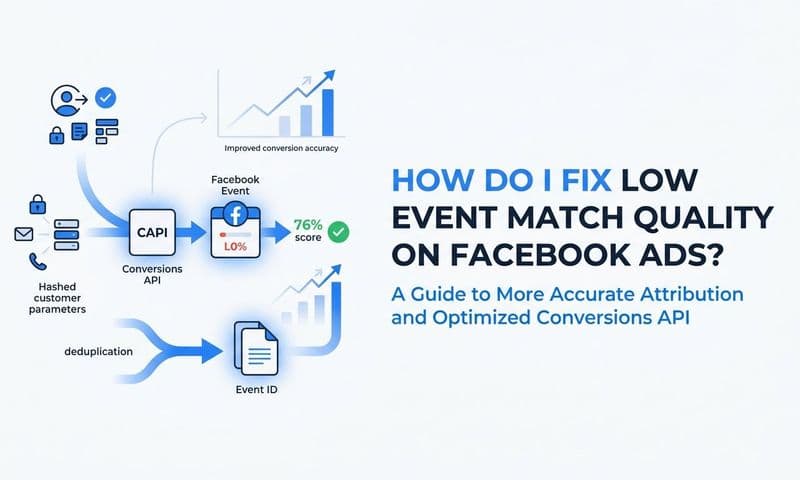
Meta actively recommends using both the pixel and the Conversions API together, a setup often called redundant tracking or deduplication mode. The pixel handles what it can see, the Conversions API handles what the pixel misses, and Facebook's deduplication logic prevents double-counting when both sources report the same event. The result is more complete conversion data with fewer gaps caused by browser-side limitations.
The benefits extend beyond just accurate reporting. When you feed Facebook's algorithm cleaner, more complete conversion data, it improves the algorithm's ability to optimize your campaigns. Facebook's machine learning depends on conversion signals to identify high-value audiences and adjust bidding. When those signals are incomplete or noisy, optimization suffers. Better data in means better targeting and better results out.
This is where tools like Cometly's Conversion Sync become genuinely valuable. Rather than sending raw, incomplete pixel data back to Meta, Conversion Sync sends enriched, server-side conversion events that include the full context of each customer interaction. This gives Facebook's algorithm a much stronger signal to work with, which translates into more efficient ad delivery and better return on spend over time.
Server-side tracking is not a perfect solution to every data accuracy problem. It does not resolve attribution window disagreements or cross-platform double-counting. But it does address the browser-level tracking breakdown that has become one of the biggest sources of inaccuracy since iOS 14, and it is a foundational piece of any serious tracking infrastructure in the current privacy landscape.
Building a Single Source of Truth for Your Ad Data
All of the individual fixes covered so far point toward the same underlying principle: you cannot rely on any single ad platform to tell you the truth about your marketing performance. What you need is an independent system that connects all your data sources and gives you a unified, unbiased view of what is actually driving revenue.
Building that system starts with connecting three layers of data. First, your ad platforms: Facebook, Google, TikTok, LinkedIn, wherever you are spending. Second, your website tracking, ideally through server-side events that are not subject to browser limitations. Third, your CRM or backend sales data, which represents the ground truth of what actually happened. The right attribution tool for Facebook Ads can bring all of these layers together seamlessly.
When those three layers talk to each other, you can do something that is impossible when you look at each platform in isolation: you can compare what Facebook reports against what your CRM shows, identify the discrepancy, and understand what is causing it. That comparison is the foundation of trustworthy reporting.
Multi-touch attribution models layer on top of this unified data to give you a realistic picture of how your channels work together. Instead of each platform claiming full credit for every conversion it touched, a multi-touch model distributes credit across all the touchpoints in a customer's journey based on a consistent methodology. Linear models give equal credit to every touch. Time-decay models give more credit to touchpoints closer to conversion. Data-driven models use statistical analysis to assign credit based on actual patterns in your data. None of them are perfect, but all of them are more honest than any single platform's self-reported numbers.
Cometly is built specifically to tie all of this together. It captures every touchpoint across your customer journeys, from the first ad click to the final conversion, and connects that data to your actual revenue outcomes. The AI-powered analytics layer identifies which ads and campaigns are genuinely driving results, not just which ones are claiming credit. Ultimately, the goal is to improve Facebook Ads tracking accuracy so every budget decision is grounded in real performance data.
The result is a marketing operation where your decisions are grounded in reality. You scale what is actually working. You cut what is not. You understand how your channels interact rather than viewing them in silos. That clarity is what separates marketers who consistently improve their return on ad spend from those who are perpetually guessing.
Putting It All Together
Facebook showing wrong data is not a bug. It is a predictable outcome of how platform-based attribution works in a world where privacy restrictions are tightening, browsers are limiting tracking, and every ad platform is measuring its own contribution using its own rules.
The causes are specific and addressable. Attribution windows that credit conversions to ads that had little to do with them. iOS privacy changes that force Facebook to rely on modeled estimates rather than real tracked events. Technical pixel issues that create both duplicate counting and missed conversions. Cross-platform attribution overlap where every channel claims full credit for the same sale.
The fixes are equally specific. Adjust your attribution window settings and disable view-through conversions if they are distorting your data. Audit your pixel setup and use Facebook's Test Events tool to catch technical misconfigurations. Implement server-side tracking through the Conversions API to bypass browser limitations. Adopt independent, multi-touch attribution to eliminate cross-platform double-counting. And connect all your data sources into a unified analytics system so you always have a reliable ground truth to compare against.
Each of these steps moves you closer to data you can actually trust and decisions you can make with confidence. The marketers who understand these dynamics and build the right infrastructure around them are the ones who consistently outperform their competitors, not because they are spending more, but because they know where their money is actually going.
Ready to stop guessing and start scaling with accurate data? Get your free demo of Cometly today and see how AI-driven attribution and server-side tracking can give you a clear, trustworthy picture of every dollar you spend.