

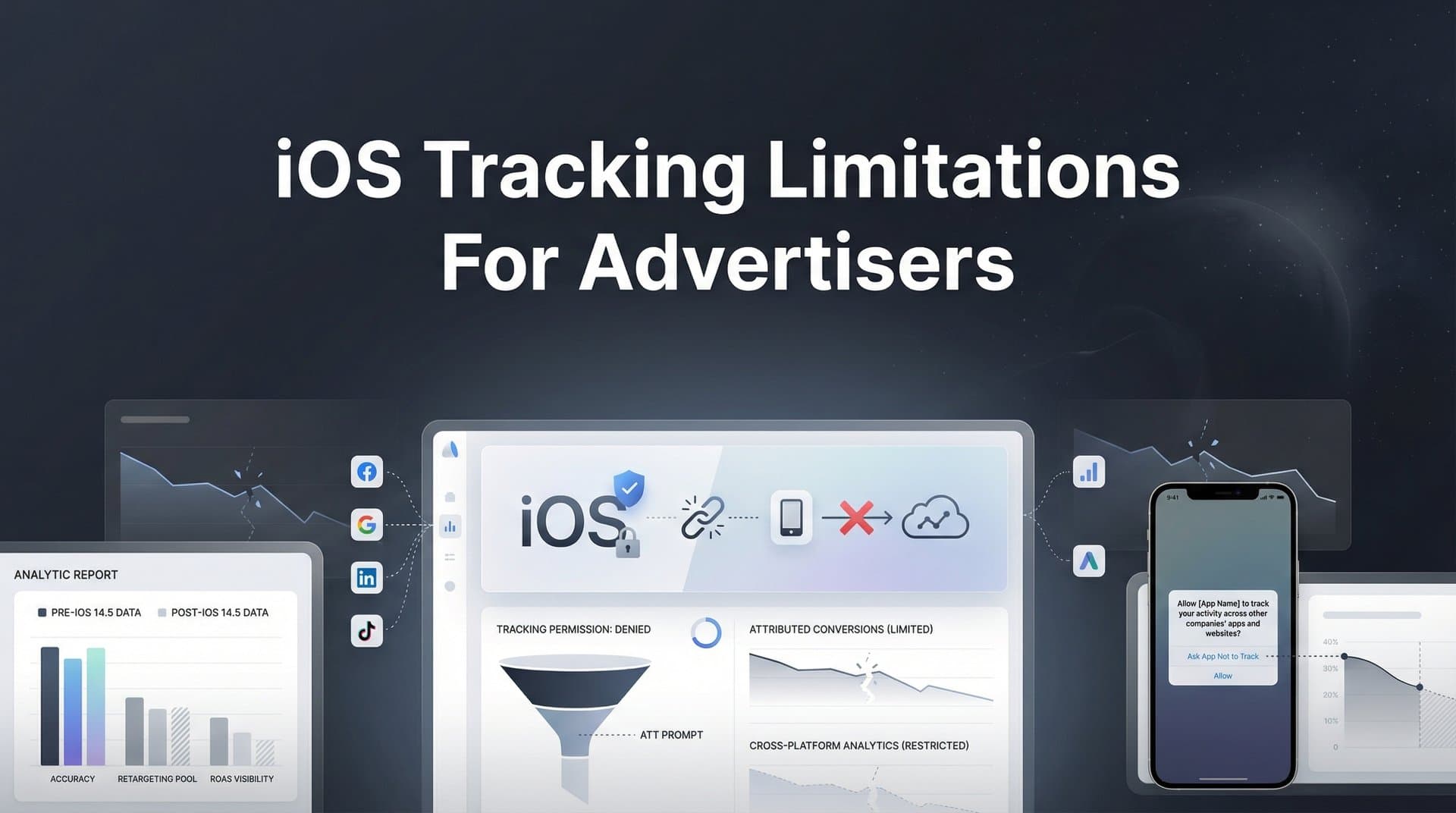
Your Facebook campaigns used to give you clear answers. You knew which ads drove purchases, which audiences converted best, and where to invest more budget. Then everything changed. Conversion data started arriving days late. Attribution windows shrunk. Your retargeting audiences stopped performing. The culprit? Apple's privacy framework fundamentally altered how advertisers can track iOS users, and the impact ripples through every campaign you run.
If you're running paid ads in 2026, you're navigating a landscape where traditional tracking methods no longer work for a significant portion of your audience. The challenge isn't going away. Apple has made privacy restrictions a permanent feature of iOS, and other platforms are following suit. But here's the reality: some advertisers are thriving in this environment while others struggle with incomplete data and declining performance.
This guide breaks down exactly what changed, why it matters for your campaigns, and how to build an attribution strategy that works regardless of platform restrictions. You'll understand the technical mechanisms behind iOS tracking limitations and discover practical solutions that restore the marketing visibility you need to scale with confidence.
How Apple's Privacy Framework Reshaped Mobile Advertising
Apple introduced App Tracking Transparency (ATT) with iOS 14.5 in April 2021, fundamentally changing the rules for mobile advertising. Before ATT, apps could track user activity across other apps and websites by default. The IDFA (Identifier for Advertisers) was automatically available to advertisers, enabling detailed tracking of user behavior, ad interactions, and conversions across the iOS ecosystem.
ATT flipped this model entirely. Now, every app must explicitly ask users for permission before tracking their activity beyond that specific app. When you open an app for the first time after updating to iOS 14.5 or later, you see a prompt asking whether you'll allow the app to track your activity. Most users, when presented with a direct question about tracking, decline.
The technical mechanism works like this: When a user opts out of tracking, the app cannot access their IDFA. Without the IDFA, advertisers lose the ability to connect that user's actions across different apps and websites. You can't build a complete picture of their journey from seeing your ad on Instagram to making a purchase on your website if they're using Safari on iOS. Understanding how to fix iOS 14 tracking limitations has become essential for modern advertisers.
This isn't just about losing a tracking identifier. The restriction extends to any data sharing that would enable cross-app or cross-site tracking. Apps cannot use alternative identifiers, fingerprinting techniques, or workarounds to reconstruct user-level tracking without explicit consent. Apple enforces these rules through App Store review processes, and violations can result in app rejection or removal.
The distinction between device-level tracking and aggregated data approaches became critical. Device-level tracking (what advertisers relied on for years) connects specific actions to individual devices and users. You could see that User A clicked your ad, browsed three product pages, abandoned their cart, then returned two days later to complete a purchase. That granular, user-level data is now restricted for iOS users who decline tracking.
Instead, advertisers must work with aggregated or modeled data. Aggregated data shows trends and patterns across groups of users without revealing individual journeys. Modeled data uses statistical techniques to estimate conversions and attribution when direct tracking isn't available. Both approaches provide less precision and certainty than the device-level tracking advertisers previously enjoyed.
The shift affects more than just iOS app advertising. Because many users browse the web on Safari (iOS's default browser), and Safari implements aggressive tracking prevention measures aligned with Apple's privacy stance, the impact extends to mobile web campaigns. Your Facebook ads targeting iPhone users face tracking limitations whether those users interact with your ad in-app or through Safari.
The Real Impact on Campaign Performance and Attribution
The technical restrictions translate into concrete problems for advertisers running campaigns. Conversion tracking breaks down in several ways that directly affect your ability to optimize and scale. You're not just missing data points. You're losing the signals that ad platform algorithms need to function effectively.
Delayed reporting became the new normal. Instead of seeing conversions appear in your dashboard within minutes or hours, you now wait 24 to 72 hours for attribution data from iOS users. This delay makes real-time optimization impossible. When you're testing new ad creative or adjusting targeting, you can't quickly identify what's working because half your conversion data arrives days late.
Missing conversions create a more serious problem. When users decline tracking, many conversions simply don't get attributed to your campaigns at all. Your ads dashboard shows fewer conversions than actually occurred, making profitable campaigns appear unprofitable. You might pause a winning ad set because the data suggests it's not performing, when in reality it's driving conversions that aren't being reported. This is why understanding conversion tracking iOS limitations is critical for accurate campaign assessment.
Audience data accuracy deteriorated significantly. Your retargeting audiences, built from website visitors or app users, now miss iOS users who declined tracking. Your lookalike audiences, which rely on data about your best customers, train on incomplete datasets that exclude a large segment of your actual customer base. The algorithms build audiences based on partial information, reducing targeting precision.
The cascade effect on ad platform algorithms represents the most significant long-term challenge. Facebook's algorithm, Google's Smart Bidding, and other automated optimization systems learn from conversion signals. They test different audiences, placements, and creative variations, then shift budget toward what drives results. When conversion signals are delayed, incomplete, or missing entirely, these algorithms cannot learn effectively.
Think about how this affects campaign learning phases. When you launch a new Facebook campaign, the algorithm needs approximately 50 conversions per ad set within seven days to exit the learning phase and optimize effectively. If you're only receiving attribution for 60% of your actual conversions due to iOS tracking limitations, the algorithm takes much longer to gather sufficient data. Your campaigns remain in learning phase longer, perform less efficiently, and cost more per conversion.
Cross-device and cross-platform journey measurement became nearly impossible for iOS users. A common customer path involves seeing your ad on Instagram (iOS app), clicking through to your website on Safari (iOS browser), then later returning on a desktop computer to complete the purchase. With tracking restrictions at each iOS touchpoint, you lose visibility into this journey. Implementing cross-platform attribution tracking helps recover visibility into these fragmented customer journeys.
This attribution breakdown affects budget allocation decisions. When you can't accurately measure which channels and campaigns drive conversions, you risk cutting budget from effective campaigns and investing more in channels that appear to perform well only because they receive last-click attribution credit for conversions initiated elsewhere.
SKAdNetwork and Apple's Alternative: Benefits and Gaps
Apple didn't eliminate attribution entirely. They introduced SKAdNetwork (SKAN) as a privacy-preserving alternative that allows advertisers to measure app install campaigns without compromising user privacy. Understanding how SKAN works and where it falls short helps you set realistic expectations and identify where you need supplementary solutions.
SKAdNetwork operates on an aggregated attribution model. When a user installs your app after clicking an ad, SKAN sends a conversion notification to the ad network, but this notification contains limited information and arrives with significant delays. The system intentionally obscures individual user data while still providing advertisers with campaign performance insights.
Here's how the technical flow works: An ad network displays your app install ad. A user clicks the ad and installs your app. After the user opens the app, SKAN starts a timer. The timer runs for a conversion window (typically 24 to 72 hours, depending on configuration). During this window, your app can send a conversion value to SKAN representing the user's in-app actions. At the end of the timer, SKAN sends an attribution postback to the ad network with the install attribution and conversion value.
The conversion value system represents SKAN's most significant limitation for detailed attribution. Originally, SKAN allowed only 64 possible conversion values (0-63). Later versions expanded this, but you're still working with a limited set of values to represent all possible user actions. You need to map complex user behavior (multiple purchases, subscription upgrades, in-app events) into these discrete values. Many advertisers are now exploring pixel tracking alternatives for iOS users to supplement SKAN's limitations.
To illustrate the challenge: If you want to track first purchase, subscription start, and high-value customer status, you must assign specific conversion values to represent these states. Value 10 might mean "installed but no action," value 20 means "made first purchase," value 30 means "subscribed," and value 40 means "high lifetime value customer." You're compressing rich behavioral data into simplified categories.
The delayed attribution windows create optimization challenges. You launch a campaign and wait up to three days to receive attribution data. During those three days, you're making budget and targeting decisions without feedback about what's working. For advertisers accustomed to real-time optimization based on hourly performance data, this delay fundamentally changes campaign management workflows.
SKAN provides no user-level data whatsoever. You cannot see individual user journeys, build detailed user profiles, or create sophisticated retargeting segments based on specific behaviors. The attribution data arrives aggregated at the campaign level. You learn that Campaign A drove 100 installs with an average conversion value of 25, but you cannot identify which specific users came from that campaign or what actions they took.
This lack of user-level data makes retargeting nearly impossible through SKAN alone. You cannot build an audience of "users who installed the app but didn't subscribe" or "users who made one purchase but haven't returned in 30 days." These retargeting strategies, which many advertisers rely on for efficient customer acquisition and retention, require user-level tracking that SKAN deliberately avoids.
For web-based businesses (rather than app-based), SKAN provides no solution at all. The framework only works for app install attribution. If you're running e-commerce, SaaS, or lead generation campaigns that drive users to websites rather than apps, SKAN offers no tracking capabilities. You need entirely different approaches to maintain attribution accuracy for iOS web traffic.
Server-Side Tracking: Bypassing Browser and App Restrictions
Server-side tracking emerged as the most effective solution for maintaining conversion visibility in the iOS-restricted environment. Instead of relying on browser cookies or device identifiers that privacy frameworks restrict, server-side tracking captures conversion events directly from your backend systems and sends them to ad platforms through server-to-server connections.
The fundamental difference lies in where the tracking occurs. Traditional client-side tracking (the pixel on your website or SDK in your app) runs in the user's browser or device. It's subject to all the restrictions that browsers and operating systems impose: cookie blocking, tracking prevention, identifier restrictions. Server-side tracking runs on your servers, completely independent of the user's device or browser settings. This represents one of the most effective cookieless tracking methods for advertisers available today.
Here's how the flow works in practice: A user clicks your Facebook ad on their iPhone. They land on your website, browse products, and complete a purchase. Your website backend (your server) records this purchase in your database. Your server then sends a conversion event directly to Facebook's Conversions API, including details about the purchase: order value, products purchased, customer information. This server-to-server communication bypasses all iOS tracking restrictions because it never relies on cookies or device identifiers on the user's device.
The technical requirements for implementing server-side tracking involve several components. First, you need backend systems capable of capturing conversion events. This typically means your CRM, e-commerce platform, or custom application database. These systems must record customer actions: form submissions, purchases, subscription signups, qualified leads.
Second, you need event mapping logic that translates your internal conversion events into the format ad platforms expect. When someone completes a purchase in your system, you must map that event to Facebook's "Purchase" event or Google's "conversion" event, including all relevant parameters: transaction value, currency, product IDs, customer identifiers.
Third, you need integration infrastructure that sends these events to ad platforms in real-time or near-real-time. Facebook provides the Conversions API (CAPI) for this purpose. Google offers enhanced conversions and server-side tagging through Google Tag Manager. These integrations require authentication, proper event formatting, and reliable delivery mechanisms. Following best practices for tracking conversions accurately ensures your server-side implementation delivers reliable data.
The customer matching component is critical for attribution accuracy. When your server sends a conversion event to an ad platform, it needs to include information that helps the platform match this conversion to the original ad click. This typically involves sending hashed customer identifiers: email addresses, phone numbers, or other data that the ad platform can match to their user database. The platform uses this matching to attribute the conversion to the correct campaign, ad set, and ad.
Server-side tracking maintains data accuracy regardless of iOS privacy settings because it operates completely outside the device-level restrictions. Whether a user opts into or out of app tracking, whether they block cookies in Safari, whether they use content blockers or VPNs, your server-side tracking captures the conversion when it occurs in your backend systems. The conversion data flows from your server to the ad platform without touching the user's device.
This approach provides several advantages beyond simply bypassing iOS restrictions. Server-side data is typically more accurate because it captures conversions at the source of truth (your actual transaction database) rather than relying on tracking pixels that can be blocked or fail to fire. You can send richer conversion data, including customer lifetime value, product categories, subscription tiers, and custom parameters that help ad platforms optimize more effectively.
The challenge lies in implementation complexity. Server-side tracking requires technical resources: backend development, API integration, data pipeline management. You need systems that can reliably capture events, format them correctly, and deliver them to multiple ad platforms. For businesses without strong technical teams, this represents a significant hurdle compared to simply adding a tracking pixel to your website.
Building an iOS-Resilient Attribution Strategy
Adapting to iOS tracking limitations requires more than implementing a single solution. You need a comprehensive attribution strategy that combines multiple data sources and tracking methods to maintain visibility into campaign performance and customer journeys. The goal is building measurement infrastructure that works regardless of platform privacy changes.
Multi-touch attribution forms the foundation of an iOS-resilient strategy. Instead of relying solely on last-click attribution (which becomes increasingly unreliable when tracking is restricted), multi-touch attribution assigns credit to all touchpoints in the customer journey. When a customer sees your Instagram ad, clicks your Google search ad, and later converts through a direct visit, multi-touch attribution recognizes all three touchpoints contributed to the conversion.
Implementing multi-touch attribution in an iOS-restricted environment requires connecting data from multiple sources. You need ad platform data (clicks, impressions, costs), website analytics data (sessions, pageviews, user behavior), and conversion data from your backend systems (purchases, leads, subscriptions). By combining these data sources, you can reconstruct customer journeys even when individual tracking points fail due to privacy restrictions. Using conversion tracking software for multiple ad platforms simplifies this data consolidation process.
First-party data collection becomes essential. Every interaction you can track directly (form submissions, account registrations, email opens, purchase history) provides attribution signals that don't depend on third-party cookies or device identifiers. When customers log into your website or app, you can connect their behavior across sessions and devices using your own customer database rather than relying on tracking technologies that privacy frameworks restrict.
CRM integration ties everything together. Your CRM (or customer database) serves as the central source of truth about customer identities and conversions. When you connect your ad platforms, website tracking, and CRM, you can match ad clicks to customer records to conversion events. This connection enables attribution even when traditional tracking methods fail.
Here's a practical example: A user clicks your Facebook ad on their iPhone but doesn't convert immediately. Later, they return to your website on their laptop and submit a lead form. Your CRM captures their email address from the form submission. Your attribution system matches this email to the same email associated with their earlier Facebook ad click (sent via Conversions API with the click data). Now you can attribute the lead to the Facebook campaign, even though the conversion happened on a different device and traditional cookie-based tracking would have missed the connection.
Feeding enriched conversion data back to ad platforms improves algorithm performance in the privacy-restricted environment. When you send conversions via server-side tracking, include as much detail as possible: customer lifetime value predictions, product categories, purchase frequency, subscription tier. This enriched data helps ad platform algorithms identify patterns and optimize toward high-value conversions, partially compensating for the loss of user-level tracking data. Platforms designed for marketing attribution and revenue tracking can automate this enrichment process.
Ad platforms use the conversion data you send to train their optimization algorithms. When you provide detailed, accurate conversion information through server-side tracking, the algorithms learn which audiences, placements, and creative variations drive valuable outcomes. Over time, this learning improves targeting precision and campaign efficiency, even without device-level tracking.
The key is consistency and completeness. Send every conversion event, not just a sample. Include all relevant parameters. Ensure your server-side tracking captures conversions that client-side pixels miss. The more complete and accurate your conversion data, the better ad platforms can optimize your campaigns.
Regular attribution model comparison helps you understand how different approaches affect budget allocation decisions. Compare last-click attribution, first-click attribution, linear attribution, and time-decay attribution models. Understand how each model distributes credit across your marketing channels. In an iOS-restricted environment, the differences between models often reveal which channels are being under-credited due to tracking limitations.
Testing and validation ensure your attribution strategy actually works. Implement conversion lift studies, holdout tests, and incrementality measurement to verify that your attribution data reflects reality. When tracking is imperfect, these validation methods help you separate signal from noise and make confident optimization decisions.
Moving Forward with Confidence
iOS tracking limitations represent a permanent shift in digital advertising, not a temporary obstacle to overcome. Apple has made privacy restrictions a core feature of their platform, and the trend toward greater privacy controls continues across the industry. Google announced plans for privacy changes in Chrome, and regulations like GDPR and CCPA reinforce the movement toward user privacy and data protection.
Advertisers who adapt by implementing robust server-side tracking and comprehensive attribution systems maintain competitive advantage. While others struggle with incomplete data and declining campaign performance, businesses with proper measurement infrastructure continue to optimize effectively and scale profitably. The gap between advertisers with sophisticated attribution and those relying on outdated tracking methods will only widen.
The investment in proper attribution pays dividends beyond simply adapting to iOS restrictions. When you build measurement systems based on first-party data, server-side tracking, and multi-touch attribution, you create marketing infrastructure that works regardless of platform changes. Future privacy updates won't disrupt your campaigns because you're not dependent on tracking methods that platforms can restrict.
Your attribution strategy should evolve continuously. As ad platforms release new measurement tools, as privacy regulations change, as customer behavior shifts, your measurement infrastructure must adapt. Regular audits of your tracking implementation, ongoing testing of new attribution approaches, and continuous improvement of data quality ensure you maintain accurate marketing visibility.
The marketers who thrive in this environment view attribution as a strategic advantage rather than a technical requirement. They invest in proper implementation, they connect their data sources comprehensively, and they use attribution insights to make smarter budget allocation decisions. They understand that accurate measurement enables better optimization, and better optimization drives better results.
Ready to elevate your marketing game with precision and confidence? Discover how Cometly's AI-driven recommendations can transform your ad strategy. Get your free demo today and start capturing every touchpoint to maximize your conversions.



