You're spending thousands—maybe millions—on Facebook ads, Google campaigns, LinkedIn sponsorships, and email nurture sequences. Your dashboard shows clicks, impressions, and conversions. But here's the question that keeps you up at night: which of these channels actually drives revenue?
For US marketers, this isn't just an academic exercise. It's a daily reality that determines whether your budget gets renewed or slashed. The American market throws unique curveballs at attribution: consumers bounce between smartphones, tablets, and desktops. Privacy regulations vary by state. iOS updates have turned mobile tracking into a guessing game. And your customers? They're researching on Instagram at lunch, comparing options on their laptop at night, and converting three weeks later after a retargeting email.
Marketing attribution analysis is the systematic process of connecting these dots—of understanding which touchpoints genuinely contribute to conversions and which ones just happen to be present when someone finally buys. This isn't about giving participation trophies to every channel that touched a customer. It's about building a framework that shows you where to invest more, where to cut back, and how to scale with confidence instead of hope.
Understanding the Mechanics: What Attribution Analysis Actually Measures
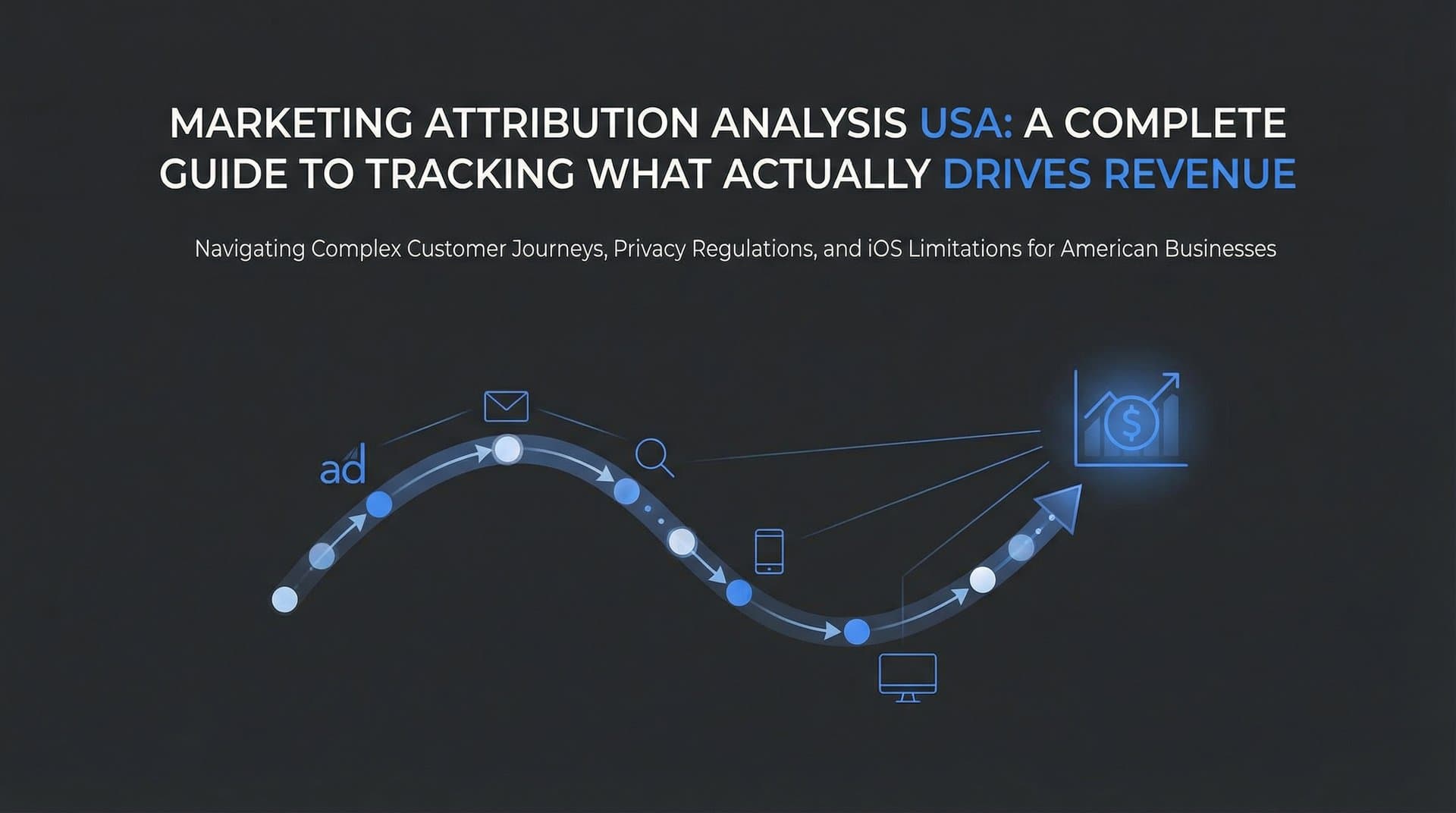
Marketing attribution analysis is the process of identifying which marketing touchpoints contribute to conversions and assigning appropriate credit to each one. Think of it as building a map of your customer's journey from first awareness to final purchase, then determining which stops along that route actually mattered.
The foundation starts with data collection. When someone clicks your Facebook ad, visits your website, downloads a guide, receives an email, and eventually converts, you need to capture each of these interactions. This happens through multiple tracking mechanisms working in concert.
Tracking pixels fire when someone lands on your site, recording where they came from and what they do. UTM parameters in your URLs tag traffic sources so you can distinguish organic social from paid campaigns. Server-side tracking captures data directly from your server rather than relying on browser-based cookies that can be blocked or deleted. CRM integration connects online behavior to actual revenue by linking anonymous website visitors to known contacts and closed deals.
Here's where many marketers get confused: attribution and analytics aren't the same thing. Analytics tells you what happened—you got 5,000 clicks, 200 leads, and 20 customers. Attribution tells you why it happened—which specific combination of touchpoints led to those 20 customers, and how much credit each touchpoint deserves.
Google Analytics might show you that 40% of your traffic comes from organic search. But attribution analysis reveals that while organic search starts many journeys, paid retargeting ads are what actually close deals. Without attribution, you might cut your retargeting budget because it shows fewer "first clicks." With attribution, you realize it's your closer.
The technical implementation requires connecting your ad platforms, website analytics, email system, and CRM into a unified view. When these systems talk to each other, you can follow an individual from their first anonymous website visit through multiple interactions until they become a paying customer with a name and revenue attached.
This unified tracking enables you to answer questions like: Does someone who engages with both email and paid ads convert faster than someone who only sees ads? Do customers who start on mobile but convert on desktop have higher lifetime value? Which channel combination produces the lowest cost per acquisition?
Decoding Attribution Models: How Different Approaches Assign Credit
Attribution models are the rules you use to distribute credit across touchpoints. Choosing the right model isn't about finding the "correct" answer—it's about selecting a framework that reflects how your business actually works.
Single-touch models assign 100% of the credit to one touchpoint. First-touch attribution gives all credit to whatever brought someone into your world initially. If they discovered you through an Instagram ad, that ad gets full credit even if they converted three weeks later after seeing five more touchpoints. This model makes sense when you're primarily focused on awareness and lead generation, or when your sales cycle is extremely short.
Last-touch attribution does the opposite—it gives all credit to the final interaction before conversion. If someone clicked a retargeting ad and immediately purchased, that ad gets 100% credit regardless of the blog post, email sequence, and webinar that came before. Many ad platforms default to last-touch because it makes their performance look better, but it systematically undervalues everything that happened earlier in the journey.
Multi-touch models recognize that customer journeys involve multiple influences. Linear attribution splits credit equally across all touchpoints. If someone had five interactions before converting, each gets 20% credit. It's simple and democratic, but it assumes your first touchpoint matters as much as your last, which often isn't true.
Time-decay attribution gives more credit to touchpoints closer to conversion. The retargeting ad someone saw yesterday gets more weight than the blog post they read three weeks ago. This model reflects the reality that recent interactions often have more influence on purchase decisions, especially for products with shorter consideration periods.
Position-based attribution (also called U-shaped) assigns 40% credit to the first touchpoint, 40% to the last, and splits the remaining 20% among everything in between. It recognizes that both discovery and closing matter most, while middle touchpoints play a supporting role. This works well for B2B companies where initial awareness and final decision points are critical.
Data-driven attribution uses machine learning to analyze thousands of customer journeys and determine which touchpoints actually correlate with conversions. Instead of applying arbitrary rules, it looks at patterns: people who engage with webinars convert at higher rates, so webinars get more credit. Those who click display ads but never convert mean display ads get less credit. The model continuously learns and adjusts based on your actual data.
AI-powered attribution takes this further by considering additional factors like touchpoint sequence, time between interactions, and even external variables like seasonality. It can identify that email followed by a demo request is more valuable than the reverse order, or that LinkedIn ads work better for enterprise deals while Facebook drives smaller purchases. Understanding how machine learning can be used in marketing attribution helps you leverage these advanced capabilities.
The model you choose should match your business reality. Short sales cycles with few touchpoints? Single-touch models might suffice. Complex B2B sales with multiple decision-makers and a three-month evaluation period? You need multi-touch or data-driven attribution to understand the full picture.
The American Attribution Landscape: Privacy, Platforms, and Fragmentation
US marketers face attribution challenges that make this already complex process even harder. The American market isn't just large—it's uniquely complicated by privacy regulations, platform changes, and consumer behavior patterns.
Apple's App Tracking Transparency framework fundamentally changed mobile attribution. When iOS users can opt out of tracking, and most do, the data you receive about mobile ad performance becomes incomplete. That Facebook ad campaign driving mobile traffic? You're seeing a fraction of the actual conversions because iOS users who opted out don't show up in your attribution data. You're making budget decisions based on partial information.
The privacy landscape varies dramatically across states. California's CCPA sets strict requirements for data collection and consumer rights. Virginia, Colorado, Connecticut, and Utah have passed their own laws with different definitions and requirements. More states are following. As a US marketer, you're not navigating one privacy regulation—you're managing a patchwork of state-level rules that affect how you can track and attribute conversions.
This fragmentation means your attribution setup needs to be flexible enough to comply with different regulations depending on where your customers live. A visitor from California has different opt-out rights than someone from Texas. Your tracking needs to respect these differences while still providing useful attribution data.
Cross-device tracking adds another layer of complexity. American consumers are heavy multi-device users. They research products on their phone during their commute, compare options on their work laptop, and make purchases on their home tablet. Each device switch can break your attribution chain if you're relying solely on cookies.
When someone clicks your Instagram ad on mobile but converts on desktop three days later, can you connect those dots? Without proper cross-device tracking, you'll attribute that sale to whatever they clicked last on desktop—probably a retargeting ad—while completely missing the Instagram ad that started the journey. You end up over-investing in retargeting and under-investing in top-of-funnel mobile campaigns. Implementing cross-channel marketing attribution software helps solve this fragmentation problem.
The American market's size and diversity mean customer journeys vary significantly by region, demographic, and product category. Attribution models that work for e-commerce brands selling to millennials in urban areas might not reflect the reality of B2B software sales to enterprise companies in the Midwest. Your attribution framework needs to account for these variations rather than applying one-size-fits-all assumptions.
Implementing Your Attribution Framework: From Audit to Action
Building effective attribution analysis starts with understanding what you're currently tracking and where the gaps exist. Most marketing teams have some tracking in place, but it's often incomplete or inconsistent across channels.
Start with a comprehensive audit of your existing setup. Check whether tracking pixels are properly installed on all pages, especially conversion pages like checkout confirmations and thank-you pages. Verify that UTM parameters follow a consistent naming convention across all campaigns—inconsistent tagging creates data chaos that makes attribution impossible. Test your forms to ensure they're capturing source information and passing it to your CRM.
Look for common gaps: Are phone call conversions being tracked? What about offline events or in-person sales influenced by digital marketing? Can you connect a website visitor's anonymous behavior to their known identity once they fill out a form? These blind spots distort your attribution data by systematically undercounting certain channels. Understanding marketing attribution for phone calls is essential for businesses that rely on inbound calls.
Once you understand your current state, choose an attribution model that matches your business reality. Consider your typical sales cycle length. If customers usually convert within days, time-decay or last-touch models might work. If your sales cycle spans months with numerous touchpoints, you need multi-touch attribution to avoid over-crediting whatever happened to be last.
Think about your channel mix and marketing goals. Running mostly brand awareness campaigns at the top of the funnel? First-touch attribution helps you understand which channels are best at generating new prospects. Focused on conversion optimization with heavy retargeting? Position-based models that credit both first and last touch give you a more complete picture.
For businesses with significant data and complex journeys, data-driven attribution provides the most accurate insights by learning from your actual conversion patterns rather than applying predetermined rules. However, it requires substantial traffic volume to generate reliable results—typically thousands of conversions across multiple touchpoints. Learning how to build a marketing attribution model helps you customize your approach.
Implement server-side tracking to capture data that client-side pixels miss. When tracking happens on your server rather than in the user's browser, you bypass ad blockers, cookie restrictions, and privacy settings that block traditional pixels. Server-side tracking is particularly crucial for maintaining attribution accuracy as browsers continue restricting third-party cookies and users become more privacy-conscious.
This requires technical implementation: setting up server-side tags, configuring your server to send conversion data to ad platforms, and ensuring your CRM integrates properly with your attribution system. The upfront effort pays off with dramatically more accurate data, especially for mobile traffic and privacy-focused users who would otherwise be invisible in your attribution reports.
Translating Attribution Insights Into Smarter Budget Allocation
Attribution data only creates value when you use it to make better decisions. The goal isn't to generate pretty reports—it's to understand which channels deserve more budget and which ones are underperforming.
Start by distinguishing between initiating channels and converting channels. Some channels excel at introducing new people to your brand but rarely close deals. Others are terrible at generating cold traffic but excel at converting warm prospects. Both matter, but they deserve different evaluation criteria and budget allocation strategies.
Look at your attribution reports to identify assist channels—touchpoints that appear frequently in converting customer journeys but rarely get last-touch credit. Content marketing often falls into this category. A blog post might not directly drive conversions, but customers who engage with your content convert at higher rates. Without attribution analysis, you might cut your content budget because it shows few "direct" conversions. With attribution, you see its true value as an assist.
Use attribution data to optimize your channel mix. If your analysis shows that customers who engage with both paid search and email convert 3x faster than those who only see one channel, you have a clear directive: invest in strategies that get prospects into both channels. Maybe that means growing your email list through paid search campaigns, or retargeting email subscribers with search ads.
Attribution reveals optimal budget reallocation opportunities. Perhaps your data shows that LinkedIn drives fewer total conversions than Facebook, but LinkedIn-sourced customers have 50% higher lifetime value. That insight might justify shifting budget toward LinkedIn despite lower conversion volume, because you're optimizing for revenue, not just conversion count. Understanding marketing revenue attribution ensures you're measuring what truly matters.
Feed your attribution insights back to ad platforms to improve their algorithms. Most platforms now accept conversion data from external sources through APIs. When you send enriched conversion data—including which conversions are high-value customers versus low-value ones—the platform's AI can optimize toward better prospects. This creates a feedback loop where better attribution leads to better targeting, which leads to better results.
Make incremental changes and measure the impact. Attribution analysis isn't about making massive budget swings based on one month of data. It's about identifying patterns, testing hypotheses, and gradually optimizing your mix. If attribution suggests a channel is underperforming, reduce its budget by 20% and watch what happens to overall performance before making bigger cuts.
Avoiding Attribution Pitfalls That Corrupt Your Data
Even sophisticated marketers make attribution mistakes that lead to flawed conclusions and poor budget decisions. Recognizing these pitfalls helps you build a more accurate attribution framework.
The biggest mistake is over-relying on platform-reported conversions. Facebook claims credit for a sale. Google says it drove the same conversion. LinkedIn reports it too. Add up what each platform claims, and you've apparently generated 300% of your actual revenue. This happens because each platform uses last-touch attribution within its own reporting, counting any conversion where they were involved regardless of other touchpoints.
Your attribution system needs to be the single source of truth that deduplicates conversions and assigns credit based on your chosen model. Trust your attribution platform's numbers, not the inflated figures each ad platform reports. Reviewing common marketing attribution challenges helps you anticipate and avoid these issues.
Many attribution models ignore offline touchpoints entirely. If your business includes phone sales, in-person consultations, or events, these interactions must be captured in your attribution framework. A customer might research online, call your sales team, receive a follow-up email, and then purchase. If you're only tracking digital touchpoints, you're missing the phone call that was probably the most influential moment in their journey.
Implement call tracking that ties phone conversions back to the marketing source that drove them. Capture event attendance and connect it to digital behavior. Integrate your CRM to include offline sales activities in your attribution analysis.
Attribution windows—the timeframe during which you give credit to touchpoints—often don't match actual customer behavior. A seven-day attribution window might work for impulse purchases, but it systematically undercounts the value of awareness campaigns for products with longer consideration periods. If your typical customer takes three weeks to decide, but your attribution window is seven days, you're only seeing part of the journey.
Set attribution windows based on your actual sales cycle. Analyze how long it typically takes from first touch to conversion, then configure your attribution window to capture that full journey. Different products or customer segments might need different windows.
Another common error is treating all conversions equally. A $50 customer and a $5,000 customer both count as one conversion, but they have dramatically different value. If your attribution analysis doesn't weight conversions by revenue or lifetime value, you might optimize toward channels that drive volume but not profit. Revenue-based attribution ensures you're optimizing for business outcomes, not just conversion counts.
Moving Forward With Attribution That Actually Works
Marketing attribution analysis isn't optional anymore—it's fundamental infrastructure for US marketers navigating privacy restrictions, rising ad costs, and increasingly complex customer journeys. The days of relying on platform-reported metrics and gut instinct are over. The marketers who win are those who understand exactly which touchpoints drive revenue and allocate budgets accordingly.
Start by auditing your current tracking setup to identify gaps in data collection. Choose an attribution model that reflects your actual sales cycle and business model, not just the default settings in your analytics platform. Implement server-side tracking to maintain accuracy despite browser restrictions and privacy regulations. Most importantly, use your attribution insights to make concrete budget decisions—reallocate spend toward high-performing channels, optimize your channel mix, and feed better data back to ad platforms.
The American market's unique challenges—iOS privacy changes, state-level regulations, cross-device behavior—make attribution harder but also more valuable. When your competitors are flying blind, accurate attribution becomes a competitive advantage. You can scale with confidence because you know what's working. You can weather budget cuts because you can prove which channels are essential. You can enter new markets because you understand which channel combinations drive results.
Attribution analysis transforms marketing from an art into a science. It replaces "we think this is working" with "we know this drives X revenue." That certainty is what allows you to grow sustainably instead of hoping your next campaign works out.
Ready to elevate your marketing game with precision and confidence? Discover how Cometly's AI-driven recommendations can transform your ad strategy—Get your free demo today and start capturing every touchpoint to maximize your conversions.