You're staring at your dashboard, reviewing last month's campaign performance. Meta Ads reports 150 conversions. Google Ads claims 142. Your email platform says it drove 87. Add them up and you've got 379 conversions—except your actual sales total is 203.
Sound familiar?
This isn't a tracking error. It's the natural result of running campaigns without proper marketing attribution. Each platform sees part of the customer journey and claims full credit for the conversion. The result? Inflated metrics, confused budget decisions, and zero clarity on what's actually working.
Marketing attribution solves this problem by revealing which touchpoints genuinely contribute to conversions and how much credit each deserves. It's the difference between guessing where to spend your next dollar and knowing with confidence which channels drive real revenue. This guide breaks down everything you need to understand about attribution—from basic concepts to practical implementation—so you can make smarter decisions about your ad spend.
Understanding the Fundamentals: What Attribution Actually Measures
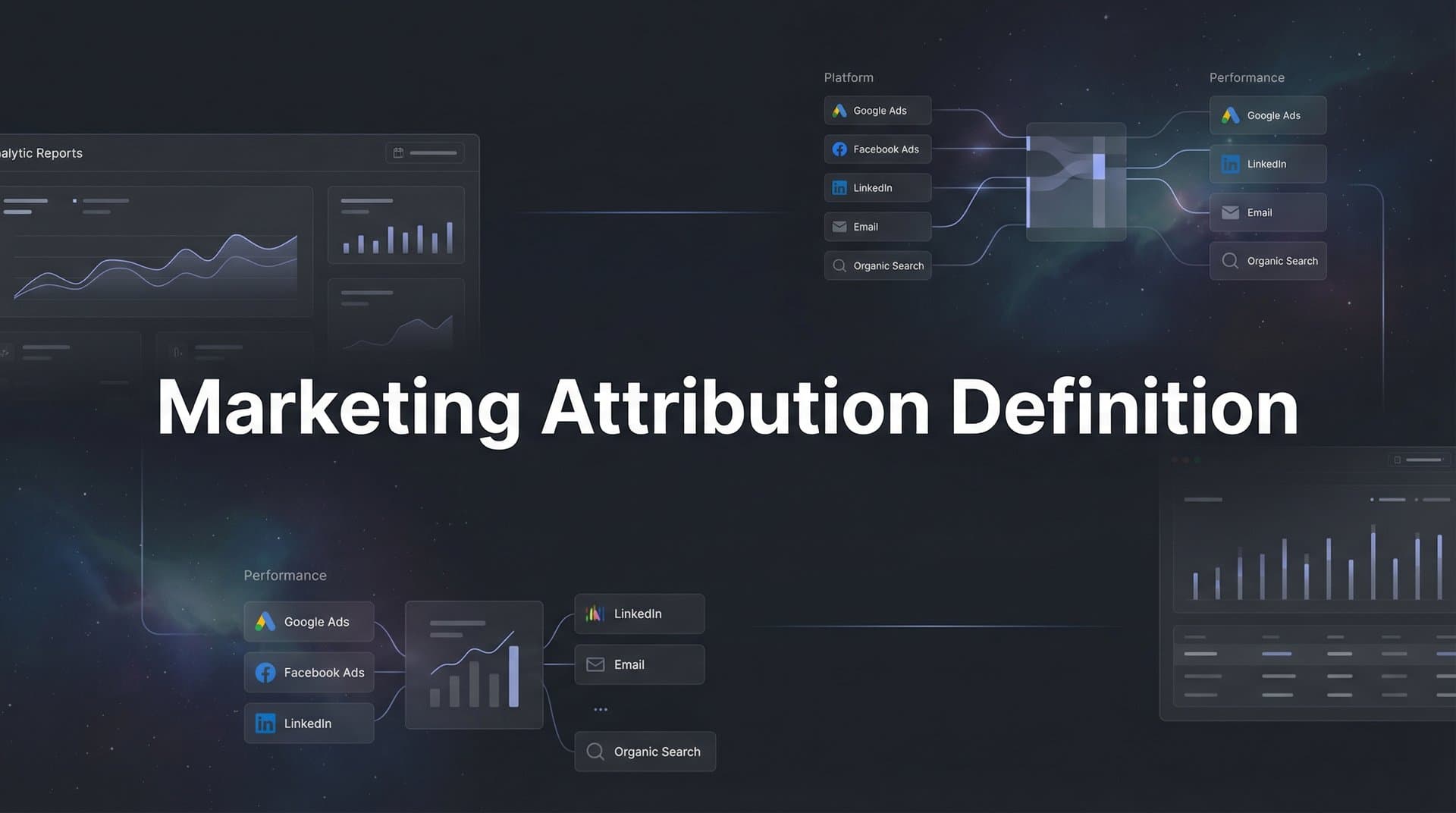
Marketing attribution is the analytical process of identifying which marketing touchpoints contribute to conversions and assigning appropriate credit to each interaction. Think of it as connecting the dots between every ad click, email open, and website visit that leads to a purchase.
Here's why this matters: Your customers don't see an ad and immediately buy. They discover your brand through a Google search. They click a Facebook ad three days later. They visit your website directly a week after that. They finally convert after clicking an email. That's four touchpoints—and without attribution, you can't tell which ones actually influenced the decision.
The customer journey concept is central to understanding attribution. Modern buyers interact with brands across multiple channels and devices before making a purchase decision. A B2B software buyer might have ten or more touchpoints over several weeks. An ecommerce shopper might have five interactions in a single day across different devices.
Without attribution, marketers face a critical problem: they rely on platform-reported metrics that systematically overcount conversions. Meta counts every conversion where someone clicked a Meta ad within the attribution window. Google does the same for Google Ads. Each platform operates in its own silo, unaware of the other touchpoints in the journey.
This creates what's known as the attribution gap—the difference between the sum of platform-reported conversions and your actual conversion total. The gap exists because platforms double-count, triple-count, and sometimes quadruple-count the same conversions.
Proper attribution eliminates this confusion by creating a single source of truth. It tracks the complete customer journey across all channels, then applies consistent rules to determine which touchpoints deserve credit. Instead of each platform claiming 100% credit for 200 conversions, attribution might reveal that Google introduced 80 customers, Meta nurtured 120, and email closed 150—with significant overlap between them.
The business impact is immediate. When you know which channels actually drive conversions, you can confidently shift budget from underperforming campaigns to proven winners. You can identify which ad creatives work best at different stages of the journey. You can stop wasting money on channels that look good in platform reports but don't actually contribute to revenue.
Decoding Attribution Models: How Credit Gets Assigned
Attribution models are the rules that determine how credit gets distributed across touchpoints in a customer journey. Different models serve different purposes, and understanding them helps you choose the right approach for your business. For a deeper dive into this topic, explore our guide on attribution model definition marketing.
First-Click Attribution: This single-touch model assigns 100% of the credit to the first interaction a customer has with your brand. If someone discovers you through a Google search, clicks a Meta ad two days later, then converts via email, Google gets all the credit.
First-click attribution makes sense when your primary goal is understanding awareness channels. It answers the question: "Where do my customers first hear about us?" But it completely ignores everything that happens after that initial touch, which means you're blind to which channels actually convince people to buy.
Last-Click Attribution: The opposite approach—100% credit goes to the final touchpoint before conversion. In the same journey above, email would get all the credit because it was the last interaction.
Last-click is the default model in most analytics platforms because it's simple. But it systematically undervalues awareness and consideration channels. Your Facebook ads might be doing the heavy lifting to generate interest, but last-click attribution gives them zero credit if customers ultimately convert through a different channel.
Linear Attribution: This multi-touch model distributes credit equally across all touchpoints. If there are five interactions in the journey, each gets 20% of the credit. You can learn more about how this works in our article on linear model marketing attribution.
Linear attribution acknowledges that multiple channels contribute to conversions, which is more realistic than single-touch models. However, it assumes every touchpoint has equal influence, which rarely reflects reality. The ad that introduces someone to your brand probably has different impact than the retargeting ad they see right before purchasing.
Time-Decay Attribution: This model gives more credit to touchpoints closer to the conversion. The most recent interaction gets the most credit, with earlier touches receiving progressively less.
Time-decay makes intuitive sense for businesses with shorter sales cycles where recent interactions matter most. But it can undervalue the awareness stage—the channels that get customers into your funnel in the first place.
Position-Based Attribution: Also called U-shaped attribution, this model assigns 40% credit to the first touch, 40% to the last touch, and distributes the remaining 20% among middle interactions.
Position-based attribution recognizes that introducing customers and closing them are both critical. It's particularly useful for businesses with distinct awareness and conversion channels. However, the 40-40-20 split is arbitrary—your actual customer journey might not follow this pattern.
Data-Driven Attribution: This is where AI and machine learning enter the picture. Instead of applying predetermined rules, data-driven models analyze your actual conversion data to determine which touchpoints statistically correlate with conversions. Our guide on how machine learning can be used in marketing attribution explores this approach in detail.
Data-driven attribution adapts to your specific business. It might discover that certain channels are particularly influential at specific stages of the journey. It can identify that some touchpoint combinations lead to higher conversion rates than others. The model continuously learns and adjusts as customer behavior evolves.
The catch? Data-driven attribution requires significant conversion volume to generate reliable insights. If you're only getting 50 conversions per month, there isn't enough data for machine learning to identify meaningful patterns.
The Modern Attribution Challenge: Why Traditional Methods Break Down
Attribution was already complex before 2021. Then Apple released iOS 14.5 with App Tracking Transparency, and the entire landscape shifted overnight.
Here's what changed: Apple now requires apps to explicitly ask users for permission to track their activity across other apps and websites. The vast majority of users decline. This means traditional pixel-based tracking—the foundation of digital advertising attribution—suddenly became far less reliable for iOS users.
The impact extends beyond Apple devices. Browser-based cookie restrictions continue to tighten across Chrome, Safari, and Firefox. Third-party cookies, which advertisers have relied on for decades to track users across websites, are being systematically eliminated. Even first-party cookies face increasing limitations.
Cross-device journeys compound the problem. Your customer might see an ad on their phone during their morning commute, research your product on their work laptop during lunch, and finally purchase on their tablet that evening. Traditional cookie-based tracking treats these as three separate users because cookies can't follow people across devices.
Platform silos create another layer of confusion. Meta, Google, TikTok, and other ad networks each operate their own tracking systems. They measure conversions independently using their own attribution windows and methodologies. None of them see the complete picture of how their ads interact with touchpoints on other platforms. Understanding these common attribution challenges in marketing analytics is essential for modern marketers.
This fragmentation leads to the conversion inflation problem we discussed earlier. Each platform optimizes its algorithm based on incomplete data about which ads drive conversions. They're making decisions with one eye closed, which means their optimization recommendations become less reliable over time.
The result is a measurement crisis. Marketers can no longer trust platform-reported metrics as reliable indicators of true performance. Budget allocation decisions based on these inflated numbers lead to overspending on channels that appear effective but don't actually drive incremental revenue.
Server-Side Tracking: Building a Reliable Attribution Foundation
The solution to modern attribution challenges lies in fundamentally changing how you capture conversion data. Instead of relying on browser-based tracking that privacy updates have compromised, server-side tracking captures data directly—bypassing browser limitations entirely.
Here's how it works: When a customer interacts with your website or completes a conversion, that event gets sent directly from your server to your attribution platform. It doesn't depend on cookies. It doesn't rely on JavaScript that ad blockers can disable. It creates a direct, reliable data pipeline that privacy updates can't disrupt.
Server-side tracking captures events that browser-based pixels miss. When someone converts on mobile after declining tracking permission, traditional pixels lose that data. Server-side tracking still captures it because the conversion happens on your server regardless of browser settings.
But capturing individual events is only part of the solution. The real power comes from connecting data across your entire marketing stack—ad platforms, CRM, website analytics, and any other system that touches the customer journey. Our comprehensive guide on attribution marketing tracking covers this integration process.
This creates a unified view that no single platform can provide on its own. You can see that the lead who converted today first clicked a Google ad three weeks ago, engaged with two Facebook ads last week, opened three marketing emails, and visited your pricing page twice before purchasing. Every touchpoint connects to a single customer record.
This comprehensive tracking enables accurate multi-touch attribution. You're not guessing which channels contributed to the conversion—you're tracking the actual sequence of events that led there. You can analyze patterns across hundreds or thousands of customer journeys to understand which touchpoint combinations consistently drive results.
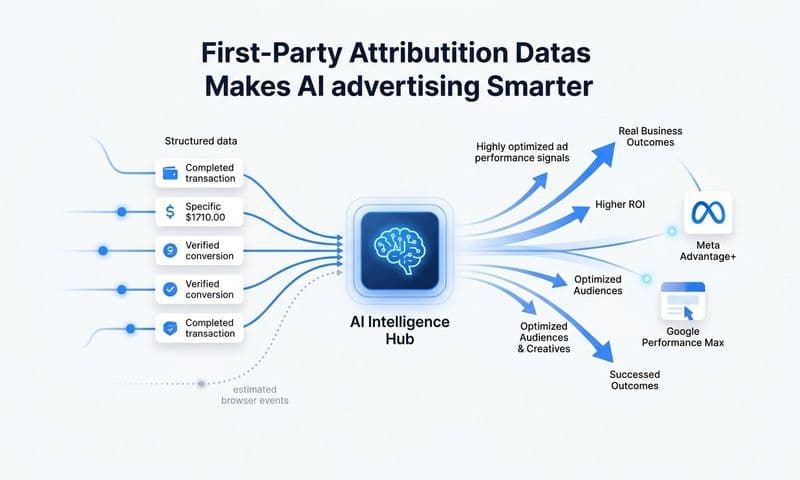
The benefits extend beyond attribution reporting. When you feed this enriched conversion data back to ad platforms, you dramatically improve their optimization algorithms. Meta's algorithm learns which specific audiences and creative combinations lead to actual purchases, not just clicks. Google's Smart Bidding gets accurate conversion signals that help it bid more effectively on valuable traffic.
This creates a virtuous cycle: Better data leads to better ad platform optimization, which drives more efficient conversions, which generates more data to improve optimization further. Marketers who implement server-side tracking often see immediate improvements in campaign performance as ad algorithms receive reliable conversion signals for the first time in months.
Implementation Framework: Making Attribution Work for Your Business
Understanding attribution concepts is one thing. Implementing them effectively is another. Here's a practical framework for putting attribution into practice.
Step 1: Establish Comprehensive Tracking Across All Touchpoints
Start by auditing every point where customers interact with your brand. This includes ad clicks across all platforms, website visits, form submissions, email interactions, phone calls, CRM activities, and purchase events. Each interaction needs to be captured and connected to a customer identity.
Implement UTM parameters consistently across all campaigns so you can track which specific ads, campaigns, and channels drive traffic. Use a standardized naming convention—inconsistent tagging creates gaps in your attribution data that undermine the entire system.
Connect your ad platforms, analytics tools, CRM, and any other relevant systems to your attribution platform. The goal is creating a single database that captures every touchpoint in the customer journey, regardless of where it occurs. If you're evaluating solutions, check out our comparison of digital marketing attribution software tools.
Step 2: Choose an Attribution Model Aligned With Your Business Goals
Your attribution model should reflect how customers actually buy from you. If you have a short sales cycle where most conversions happen within days, last-click or time-decay attribution might work well. If you have a longer B2B sales cycle with multiple touchpoints over weeks or months, multi-touch marketing attribution becomes essential.
Consider your business priorities. If your primary challenge is generating awareness and getting new customers into your funnel, first-click attribution helps you understand which channels excel at introduction. If you're focused on conversion optimization, last-click or position-based models reveal which touchpoints close deals.
Many sophisticated marketers don't rely on a single model. They analyze their data through multiple attribution lenses to understand different aspects of performance. You might use first-click to evaluate awareness channels, position-based for overall performance assessment, and data-driven for budget allocation decisions.
Step 3: Use Attribution Insights to Optimize Budget Allocation
This is where attribution transforms from interesting data into revenue impact. Review your attribution reports to identify which channels consistently contribute to conversions across customer journeys. Look for patterns in high-value customer paths.
Reallocate budget from channels that generate clicks but don't contribute to conversion paths toward channels that repeatedly appear in successful customer journeys. This doesn't always mean cutting underperforming channels entirely—sometimes they play a valuable role at specific stages of the funnel.
Test incremental budget changes and measure the impact on conversion volume and quality. Attribution data helps you predict how budget shifts will affect performance, but testing validates those predictions. Increase spend on a high-attribution channel by 20% and track whether conversion volume increases proportionally.
Use attribution insights to refine your channel strategy beyond just budget allocation. If certain channels work particularly well together—perhaps Google Search introduces customers who later convert through Facebook retargeting—you can structure campaigns specifically to leverage those synergies. Learn more about measuring performance across platforms with our guide on cross channel attribution marketing ROI.
Scaling With Confidence: From Reactive Reporting to Proactive Growth
Attribution data becomes truly powerful when you shift from using it for reporting to using it for proactive optimization and scaling decisions. This is where modern attribution platforms leverage AI to transform raw data into actionable recommendations.
Start by identifying your highest-performing ads and campaigns across all channels. Attribution reveals which specific creative variations, audience segments, and messaging approaches drive conversions—not just clicks or impressions. You can see that certain ad combinations consistently appear in successful customer journeys while others rarely contribute to conversions despite generating traffic.
This insight enables confident scaling. When you know which campaigns actually drive revenue, you can increase budget aggressively on proven winners without the usual anxiety about wasting spend. You're not scaling based on platform-reported ROAS that might be inflated—you're scaling based on true attribution data that shows real conversion contribution.
AI-powered attribution platforms take this further by analyzing patterns across thousands of customer journeys to identify opportunities human analysts might miss. They can detect that certain touchpoint sequences lead to higher conversion rates, or that specific audience segments respond particularly well to certain channel combinations. Explore how data science for marketing attribution enables these advanced insights.
These platforms generate proactive recommendations: "Increase budget on Campaign X by 30% based on strong attribution performance" or "This audience segment shows high conversion rates when targeted with both Google and Facebook ads simultaneously." Instead of spending hours analyzing reports to find insights, AI surfaces the most impactful opportunities automatically.
Feeding enriched conversion data back to ad platforms creates another scaling advantage. When Meta, Google, and other networks receive accurate conversion signals that include attribution context, their algorithms optimize more effectively. They learn which audiences and creative combinations lead to actual purchases rather than just clicks or low-quality conversions.
This improved optimization means your campaigns perform better at scale. As you increase budget, ad platforms can maintain or even improve efficiency because they're optimizing toward true conversion events rather than partial data. You avoid the common problem where scaling budget leads to declining ROAS because the algorithm runs out of qualified audiences.
The shift from reactive to proactive optimization fundamentally changes how marketing teams operate. Instead of reviewing last month's performance and making adjustments for next month, you're receiving real-time insights that enable daily optimization decisions. Instead of debating which channels deserve more budget based on conflicting platform reports, you're making confident allocation decisions based on unified attribution data.
Transforming Attribution Data Into Marketing Confidence
Marketing attribution isn't just a technical exercise in tracking clicks and assigning credit. It's the foundation for making confident, data-driven decisions about where to invest your marketing budget and how to scale campaigns that actually drive revenue.
The marketers who win in today's privacy-focused landscape are those who've moved beyond relying on platform-reported metrics that systematically overcount conversions. They've implemented comprehensive tracking that captures every touchpoint across the customer journey. They've connected their ad platforms, CRM, and analytics into a unified view that reveals true performance.
This complete picture enables the kind of confident optimization that transforms marketing from a cost center into a predictable growth engine. You know which channels introduce customers, which ones nurture consideration, and which ones close conversions. You can allocate budget based on actual contribution to revenue rather than vanity metrics that look good but don't drive business results.
Modern attribution platforms take this further by feeding enriched conversion data back to ad platforms, improving their optimization algorithms so your campaigns perform better at scale. AI-powered recommendations surface opportunities to scale high-performing campaigns and optimize underperforming ones before they waste significant budget.
The difference between guessing where to spend your next marketing dollar and knowing with confidence which investments will drive returns—that's the power of proper attribution. It's the difference between hoping your campaigns work and having data that proves what's working and why.
Ready to elevate your marketing game with precision and confidence? Discover how Cometly's AI-driven recommendations can transform your ad strategy—Get your free demo today and start capturing every touchpoint to maximize your conversions.