

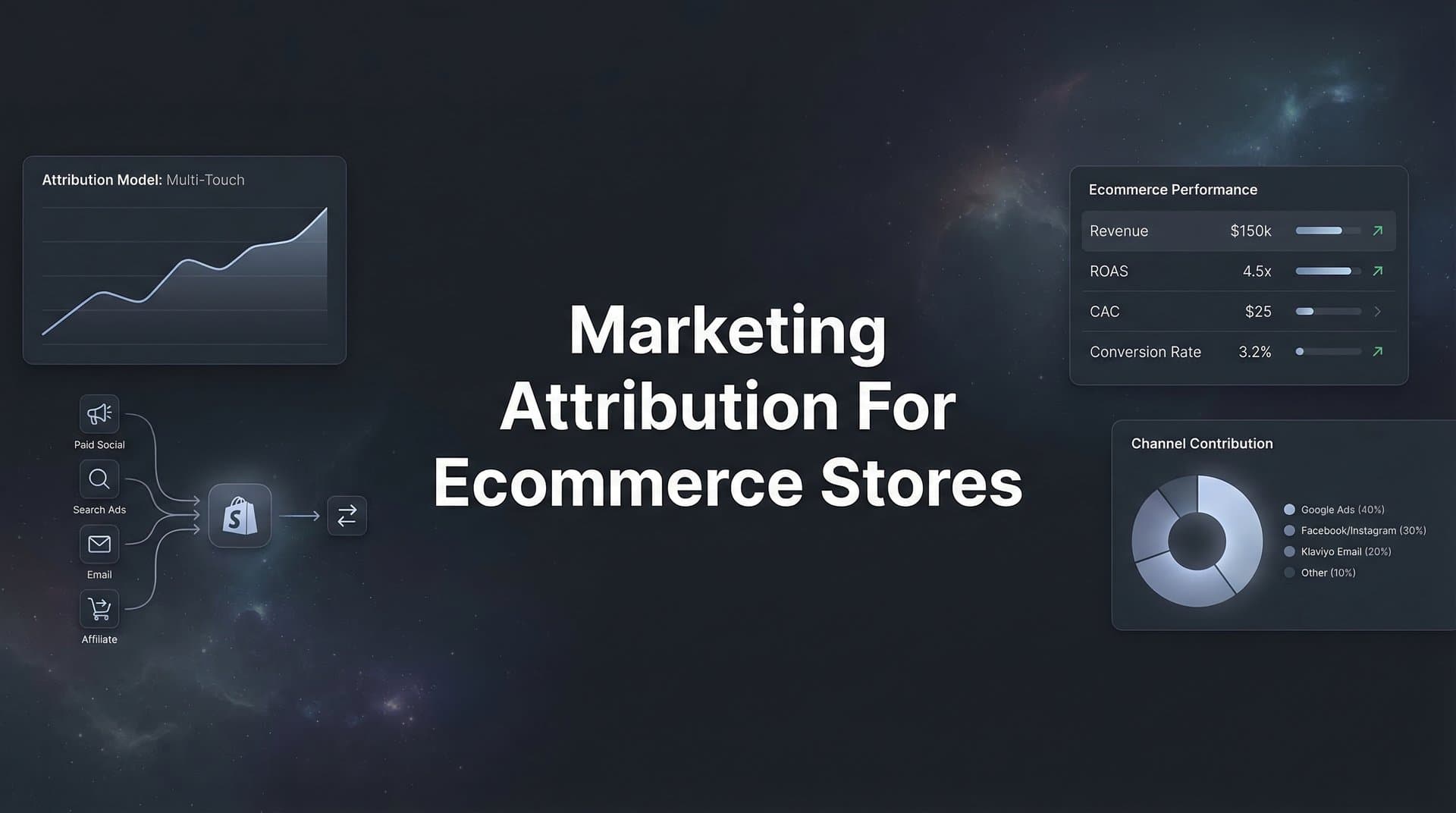
You're running Meta ads that generate hundreds of clicks. Google Shopping campaigns that fill your cart. Email sequences that keep subscribers engaged. Maybe even influencer partnerships that create buzz. But when someone finally hits "purchase," which of those touchpoints actually deserves credit for the sale?
This isn't just an academic question. Without accurate marketing attribution, you're making budget decisions based on incomplete data. You might be scaling channels that look impressive on paper but don't actually drive revenue. Or starving the campaigns that quietly convert at the end of the customer journey.
The problem gets worse as your store grows. More channels mean more complexity. More touchpoints mean more confusion about what's working. And with iOS restrictions, ad blockers, and cookie deprecation making browser-based tracking less reliable, the data you're seeing in your ad dashboards might be missing 30-40% of actual conversions.
This guide walks you through setting up marketing attribution for your ecommerce store from scratch. Not the theoretical version—the practical, step-by-step implementation that works whether you're on Shopify, WooCommerce, BigCommerce, or any other platform.
By the end, you'll have a system that tracks the complete customer journey, connects ad clicks to actual purchases, and gives you the clarity to confidently scale what works while cutting what doesn't. Let's get started.
Step 1: Audit Your Current Tracking Setup and Identify Gaps
Before you build a proper attribution system, you need to understand what you're working with right now. Most ecommerce stores have tracking in place—it's just incomplete, inconsistent, or broken in ways that aren't immediately obvious.
Start by documenting every tracking pixel and tag currently installed on your store. Open your browser's developer tools or use a tag inspector extension to see what's firing. You're looking for Meta Pixel, Google Analytics, Google Ads conversion tracking, TikTok Pixel, Pinterest Tag, and any other platform-specific tracking codes.
Common Issues You'll Likely Find: Duplicate pixels firing multiple times per page load, creating inflated metrics. Missing event tracking on critical pages like checkout confirmation or add-to-cart actions. UTM parameters that break or disappear during the checkout process. Tracking codes that were installed months ago but never properly configured.
Next, list every marketing channel you're actively spending money on. Paid social, paid search, display advertising, affiliate programs, influencer partnerships, email marketing, SMS campaigns. For each channel, ask yourself: Can I currently see which specific campaigns, ads, or messages drive actual purchases? If the answer is "sort of" or "I think so," that's a gap.
Now compare the data across platforms. Check the conversion numbers reported in your Meta Ads Manager against what Google Analytics shows for the same time period. Look at what your ecommerce platform's native analytics reports versus what your ad platforms claim. These numbers will never match perfectly, but significant discrepancies—like 50% differences—signal serious tracking problems that require proper attribution tracking for ecommerce.
Document everything you find. Create a simple spreadsheet with columns for: tracking method, platform, status (working/broken/missing), and notes about specific issues. This becomes your roadmap for the fixes you'll implement in the next steps.
The goal isn't perfection at this stage. You're just establishing a baseline understanding of where your data is solid and where it's full of holes. Most stores discover they're only tracking 60-70% of their customer journey accurately, which means they're making major budget decisions based on incomplete information.
Step 2: Implement Server-Side Tracking for Accurate Data Collection
Here's the uncomfortable truth about browser-based tracking in 2026: it's fundamentally broken for accurate attribution. iOS privacy features block a significant portion of tracking. Ad blockers strip out pixels before they can fire. Third-party cookies are disappearing across all major browsers. Safari's Intelligent Tracking Prevention actively works against the tracking methods most stores rely on.
The result? Your Meta Pixel might be missing 30-40% of conversions. Your Google Analytics data has gaps you can't see. And the conversion numbers in your ad dashboards are increasingly disconnected from reality.
Server-side tracking solves this by moving data collection from the browser to your server. Instead of relying on JavaScript pixels that users can block, your server sends conversion data directly to ad platforms through their APIs. This happens behind the scenes, unaffected by browser restrictions or privacy tools.
Setting Up Server-Side Connections: Start with Meta's Conversions API and Google's Enhanced Conversions. These tools let you send purchase data, email addresses, and other conversion signals directly from your server to the ad platforms. When someone completes a purchase, your server sends that event data in real time, ensuring the platforms receive accurate conversion information even if their browser pixel was blocked.
Most modern ecommerce platforms support server-side tracking through apps or built-in integrations. On Shopify, you can use apps that automatically configure Conversions API connections—many stores find success with dedicated attribution software for Shopify stores. WooCommerce users can implement server-side tracking through plugins or custom code. The technical complexity varies, but the principle remains the same: your server becomes the source of truth for conversion data.
Configure the events you're sending carefully. At minimum, send: page views, add to cart actions, initiate checkout events, and completed purchases. Include as much data as you can: purchase value, product IDs, customer email (hashed for privacy), and the original traffic source if available.
Testing is critical. Run test purchases through your store and verify the data appears correctly in your ad platform's Events Manager. Check that purchase values match, that events fire at the right time, and that no duplicate events are being sent. Compare server-side event counts against your browser pixel for a few days—you should see server-side capturing 15-30% more conversions than the pixel alone.
This step takes the most technical effort, but it's non-negotiable for accurate attribution. Browser-based tracking will only get less reliable over time. Server-side tracking ensures you're collecting complete data regardless of browser restrictions, giving you a solid foundation for everything that follows.
Step 3: Connect Your Ad Platforms, CRM, and Ecommerce Data
Accurate attribution requires seeing the complete picture: what happened before the purchase, during the purchase, and after the purchase. That means connecting three critical data sources: your advertising platforms, your customer database or CRM, and your ecommerce platform's transaction data.
Start by integrating all your paid advertising accounts into a unified system. This includes Meta Ads, Google Ads, TikTok Ads, Pinterest Ads, and any other platforms where you're spending money. The goal is to pull ad spend, impressions, clicks, and platform-reported conversions into one place where you can compare them against actual sales data.
Most attribution platforms offer direct integrations with major ad networks. Connect each account and verify that campaign data is flowing correctly. You should see your ad spend, campaign names, ad set details, and individual ad creative performance all synchronized and updating in real time.
Linking Your Customer Database: Your CRM or customer database contains the post-purchase story that ad platforms can't see. Repeat purchase behavior, lifetime value, customer support interactions, subscription status—all the data that tells you whether a customer acquired through a specific channel is actually valuable long-term.
Connect your CRM to your attribution system so you can track the full customer lifecycle. When someone makes their first purchase from a Meta ad, you want to see not just that initial conversion, but their second purchase three months later, their third purchase six months after that, and their total spending over time. This reveals which channels acquire customers who stick around versus those who buy once and disappear. Implementing marketing attribution platforms for revenue tracking makes this visibility possible.
Map the complete customer journey from first touchpoint to final conversion. This means tracking: the initial ad click or organic visit, subsequent visits from different channels, email opens and clicks, cart abandonment and recovery, and the final purchase. Each interaction should be connected to a specific customer using first-party data like email addresses or customer IDs.
First-party data is your competitive advantage here. While competitors rely on increasingly unreliable third-party cookies, you're using data customers give you directly: email addresses, account logins, purchase history. This creates a persistent customer identity that works across devices and sessions, giving you accurate journey mapping even when someone researches on mobile but purchases on desktop.
The result is a unified view where you can see: Customer A clicked a Meta ad on Monday, visited from Google search on Wednesday, opened an email on Friday, and purchased on Saturday. That's the level of detail you need for accurate attribution, and it only comes from connecting all your data sources into one system.
Step 4: Choose and Configure Your Attribution Model
Now that you're collecting complete data, you need to decide how to distribute credit for conversions across the multiple touchpoints in your customer journeys. This is where attribution models come in—and choosing the right one dramatically affects which channels look successful.
Understanding the Main Models: First-touch attribution gives 100% credit to the initial interaction. If someone clicked a Meta ad, then visited from Google search, then purchased from an email link, the Meta ad gets all the credit. Last-touch does the opposite—the email gets 100% credit in that scenario. Linear attribution splits credit evenly across all touchpoints. Time-decay gives more weight to interactions closer to the purchase. Data-driven models use machine learning to assign credit based on which touchpoints statistically increase conversion likelihood.
For most ecommerce stores, multi-touch marketing attribution provides a more accurate picture than single-touch models. Your customers rarely see one ad and immediately purchase. They discover you through one channel, research through another, get reminded by a third, and finally convert through a fourth. Single-touch models dramatically overvalue either your top-of-funnel awareness channels or your bottom-of-funnel conversion channels while ignoring everything in between.
Start with a position-based model (also called U-shaped attribution). This gives 40% credit to the first touch, 40% to the last touch, and splits the remaining 20% among middle interactions. It acknowledges that both discovery and conversion moments matter while still accounting for the nurture touches in between.
Configure your attribution window based on your typical sales cycle. If most customers purchase within a week of first discovering you, a 7-day window makes sense. If you sell higher-priced items where people research for months, you might need a 30-day or even 90-day window. Check your ecommerce analytics to see the average time between first visit and purchase—that's your baseline.
Set Up Model Comparison: Don't commit to a single model immediately. Configure your attribution system to show results under multiple models simultaneously. Create comparison views where you can see how first-touch, last-touch, linear, and position-based models each value your channels differently. Understanding attribution model ecommerce marketing principles helps you interpret these differences correctly.
This reveals important insights. If a channel looks amazing under first-touch attribution but terrible under last-touch, it's great for awareness but weak at closing sales. If the opposite is true, you're getting bottom-of-funnel conversions but not building your audience. Channels that perform well across multiple models are your most reliable drivers of actual revenue.
The model you choose shapes your budget decisions, so choose thoughtfully. But remember: no model is perfectly "correct." They're all different lenses for viewing the same customer journey data. The goal is picking one that aligns with your business priorities while understanding its limitations.
Step 5: Build Your Attribution Dashboard and Key Reports
Raw attribution data is useless without clear reporting that turns it into actionable decisions. You need dashboards that show true channel performance, customer journey patterns, and the specific campaigns driving profitable growth.
Start by creating a channel performance view that shows true ROAS (return on ad spend) for each marketing channel. This isn't the ROAS reported in your ad platform—that's often inflated by self-attribution bias. This is ROAS based on your attribution model, showing actual revenue generated divided by actual spend, accounting for the complete customer journey.
Break this down by campaign and ad creative level. You want to see which specific campaigns within each channel perform best, and which individual ads or ad sets drive the most efficient conversions. This granular view reveals opportunities to scale winning creative or pause underperforming campaigns that look fine at the channel level but waste budget at the detail level.
Customer Journey Path Analysis: Build reports showing the most common sequences of touchpoints that lead to conversions. You might discover that customers who see a Meta ad, then visit from organic search, then click an email link convert at 3x the rate of single-touch journeys. Or that Google Shopping clicks followed by direct visits signal high purchase intent.
These patterns inform your strategy. If you see that email is rarely the first touch but frequently the last touch, it's a closing channel, not an acquisition channel. If TikTok ads appear early in many conversion paths but rarely last, they're building awareness that other channels convert. Understanding these roles helps you set appropriate expectations and budgets for each channel. Robust marketing analytics for ecommerce stores makes this level of insight achievable.
Configure alerts for significant changes. Set up notifications when: a channel's ROAS drops below your target threshold, conversion volume changes by more than 20% week-over-week, or data stops flowing from a connected platform (signaling a tracking break). These alerts let you catch problems quickly instead of discovering them weeks later during monthly reviews.
Build profit-focused reports that connect marketing spend to actual profit margins, not just revenue. A $100 sale might look great, but if your product cost is $70 and your ad spend was $40, you're losing money. Include product costs and other variable expenses in your reporting so you can see true profitability by channel, campaign, and even customer segment.
Your dashboard should answer these questions at a glance: Which channels are actually profitable? Which campaigns should I scale? Which customer acquisition sources lead to the highest lifetime value? Where am I wasting budget? If your reporting can't answer these clearly, keep refining until it can.
Step 6: Feed Better Data Back to Ad Platforms for Improved Targeting
Attribution isn't just about reporting—it's about creating a feedback loop that makes your advertising more effective. The conversion data you collect can be sent back to ad platforms to improve their machine learning algorithms, resulting in better targeting, optimization, and overall performance.
Start by sending enriched conversion events to Meta, Google, and TikTok through their respective APIs. These platforms use conversion data to train their algorithms on who converts and who doesn't. The more complete and accurate your conversion data, the better they become at finding similar high-value customers and optimizing delivery toward likely converters.
This is where server-side tracking pays dividends beyond just accurate reporting. By sending conversion events directly from your server, you're providing platforms with data they might have missed through browser-based tracking. This additional signal improves their optimization, often noticeably within days of implementation. Effective performance marketing attribution depends on this continuous data exchange.
Configure Value-Based Optimization: Don't just tell platforms when conversions happen—tell them how much each conversion is worth. Send actual purchase values with every conversion event. This enables value optimization, where the platform's algorithm learns to prioritize showing ads to people likely to make higher-value purchases, not just any purchase.
For subscription businesses or products with repeat purchase patterns, consider sending lifetime value data instead of just initial purchase value. If you know that customers acquired from certain demographics or interests typically spend $500 over their lifetime, feed that signal back to the platform. The algorithm can then optimize for long-term value rather than just first purchase.
Set up audience sync to create better lookalike audiences based on your highest-value customers. Use your attribution data to identify customers with the best combination of: high initial purchase value, high lifetime value, low acquisition cost, and strong retention. Export these customer lists and upload them to your ad platforms as the seed audiences for lookalike targeting.
These lookalikes will dramatically outperform ones based on all converters or platform-defined "best customers." You're giving the algorithm a precise definition of what success looks like for your specific business, not just generic conversion behavior.
Monitor the Discrepancy: Compare what your ad platforms report as conversions against what your attribution system shows. Some difference is normal—platforms use different attribution windows and methodologies. But significant gaps (30%+ differences) indicate either tracking problems or severe self-attribution bias from the platform.
Use your attribution data as the source of truth for budget decisions while understanding that platform-reported metrics will differ. The platforms need to see conversions to optimize effectively, so keep feeding them data through their APIs. But base your actual scaling decisions on your independent attribution data, not the inflated numbers in the ad dashboard.
This feedback loop creates a virtuous cycle: better data leads to better optimization, which leads to better results, which generates more data to further improve optimization. It's the difference between hoping your ads work and systematically improving their performance based on complete, accurate information.
Your Attribution System Is Now Live—Here's Your Quick Implementation Checklist
Let's recap what you've built. You've audited your existing tracking and documented all active marketing channels, identifying gaps in your current data collection. You've implemented server-side tracking to capture conversion data that browser pixels miss, ensuring accurate reporting regardless of iOS restrictions or ad blockers. You've connected all your ad platforms, CRM, and ecommerce data into a unified system that tracks complete customer journeys.
You've selected a multi-touch attribution model appropriate for your sales cycle, giving you a realistic view of how different channels contribute to conversions. You've built dashboards showing true channel performance, customer journey patterns, and campaign-level profitability. And you've configured the feedback loop that sends enriched conversion data back to ad platforms, improving their targeting and optimization over time.
With proper marketing attribution in place, you're no longer guessing which campaigns drive revenue. You can see exactly which channels acquire valuable customers, which campaigns waste budget, and which customer journey patterns lead to the highest lifetime value. You have the clarity to confidently scale winning channels and cut spend on what isn't working.
The difference this makes compounds over time. Every budget decision becomes more informed. Every campaign optimization is based on complete data rather than partial signals. Every dollar you spend works harder because you're directing it toward proven winners instead of spreading it across channels that look busy but don't convert.
Start with Step 1 today. Audit your current tracking setup and identify the gaps. Within a few weeks, you'll have the complete attribution system that transforms how you make marketing decisions. The stores that implement this properly don't just improve their ROAS by 20-30%—they fundamentally change how they approach marketing, moving from reactive budget shuffling to strategic growth based on data they can trust.
Ready to elevate your marketing game with precision and confidence? Discover how Cometly's AI-driven recommendations can transform your ad strategy—Get your free demo today and start capturing every touchpoint to maximize your conversions.


