

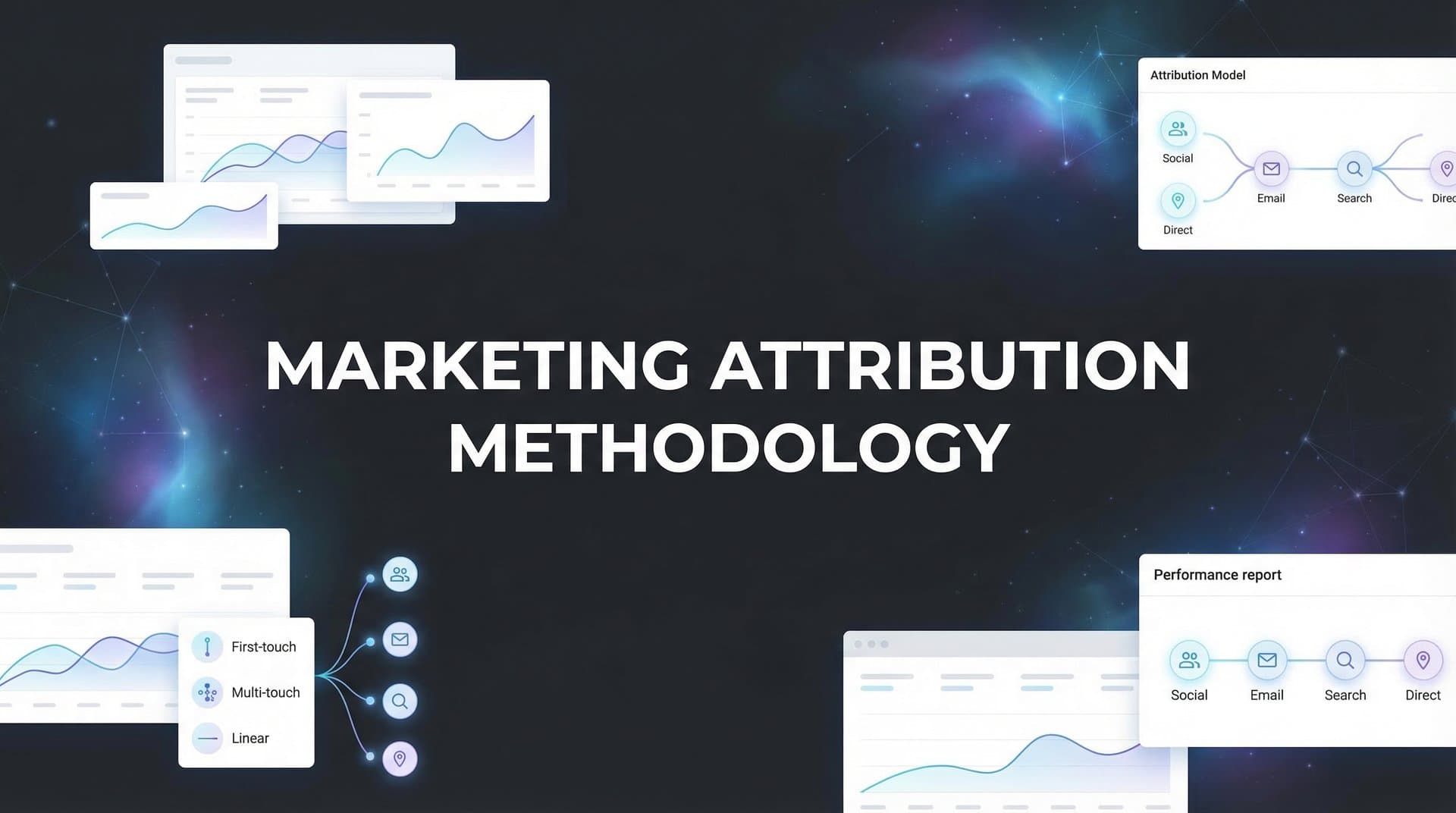
You're running campaigns across Google, Meta, LinkedIn, and maybe TikTok. Your CRM shows closed deals rolling in. But when your CEO asks which channels are actually driving revenue, you freeze. Google Ads claims credit for 40% of conversions. Meta says it's responsible for 35%. Your analytics tool shows completely different numbers. Everyone's taking credit for the same sales, and you have no idea what's real.
This isn't a tracking problem. It's a methodology problem.
Marketing attribution methodology is the systematic approach to answering the question every marketer faces: which campaigns are actually making us money? It's not just about picking a model from a dropdown menu. It's about building a complete system that captures every touchpoint, applies consistent logic to assign credit, and gives you data you can actually trust to make budget decisions.
This guide breaks down how attribution methodologies work, when to use different approaches, and how to implement a system that shows you what's really driving results. By the end, you'll know exactly how to stop guessing and start knowing where your revenue comes from.
The Building Blocks: What Makes an Attribution Methodology Work
Marketing attribution methodology is the complete set of rules, processes, and logic that determines how conversion credit gets distributed across the touchpoints in a customer journey. Think of it as the operating system for your marketing measurement—not just the calculator that splits credit, but the entire infrastructure that captures data, processes it, and turns it into actionable insights.
The methodology has three core components working together. First, touchpoint identification—the system that recognizes and logs every interaction a customer has with your marketing. This includes ad clicks, email opens, website visits, webinar attendance, and CRM events like sales calls or demos. If your methodology can't see a touchpoint, it can't include it in the analysis.
Second, data collection methods—how you actually capture and store information about those touchpoints. This is where server-side tracking, pixel implementation, UTM parameters, and platform integrations come into play. Your data collection strategy determines the quality and completeness of the information flowing into your marketing attribution analytics system.
Third, credit distribution rules—the logic that decides how much credit each touchpoint receives for a conversion. This is what most people think of as "the attribution model," but it's just one piece of the larger methodology.
Here's what matters: attribution models and attribution methodology aren't the same thing. A model is the formula—like linear, time-decay, or first-click. The methodology is the complete approach, including how you collect data, which touchpoints you track, how you handle cross-device journeys, and how you connect everything together to create a unified view.
Many marketers implement an attribution model without building the methodology to support it. They pick "multi-touch attribution" in their analytics tool but never connect their CRM data or track offline events. The model runs calculations, but the underlying data is incomplete, so the insights are worthless.
A solid attribution methodology captures the full story. It tracks the LinkedIn ad that introduced someone to your brand, the Google search that brought them back three days later, the email sequence that nurtured them, the webinar they attended, and the sales call that closed the deal. Then it applies consistent logic to understand which touchpoints actually influenced the decision.
Single-Touch vs. Multi-Touch: Choosing Your Framework
The first major decision in your attribution methodology is whether to use a single-touch or multi-touch framework. This choice shapes everything else about how you measure marketing effectiveness.
Single-touch attribution assigns 100% of the credit to one touchpoint in the customer journey. First-click attribution gives all credit to the first interaction—the ad or search that introduced someone to your brand. Last-click attribution gives all credit to the final touchpoint before conversion—the last ad clicked or email opened before someone bought.
Single-touch methodologies make sense in specific scenarios. If you run direct-response campaigns with short sales cycles—someone sees an ad, clicks, and buys within the same session—last-click attribution can work. You're essentially measuring immediate response, not a multi-step journey. First-click attribution works when you want to understand pure awareness impact, like measuring which channels introduce new audiences to your brand.
But here's the limitation: single-touch attribution ignores everything except one moment. If someone discovered you through a Facebook ad, researched you via Google three times, read five blog posts, attended a webinar, and then converted after clicking a retargeting ad, single-touch attribution pretends none of that journey happened. It assigns all credit to either the first or last touchpoint and calls it a day.
Multi-touch attribution distributes credit across multiple touchpoints in the journey. Linear attribution splits credit evenly—if there were five touchpoints, each gets 20%. Time-decay attribution gives more weight to touchpoints closer to conversion, based on the logic that recent interactions influenced the decision more. Position-based (also called U-shaped) attribution gives more credit to the first and last touchpoints while distributing the remainder across the middle interactions. Understanding what is a marketing attribution model helps you select the right approach for your business.
Then there's data-driven attribution, which uses machine learning to analyze actual conversion patterns and assign credit based on which touchpoints statistically correlate with higher conversion rates. Instead of using predetermined rules, data-driven models learn from your specific customer behavior.
So how do you choose? Consider these factors:
Sales cycle length: If your average customer journey spans weeks or months with multiple research phases, multi-touch attribution makes sense. If people convert in a single session, single-touch works fine.
Number of active channels: Running campaigns across six platforms with email nurture and content marketing? You need multi-touch to understand how they work together. Running only Google Ads with direct-response goals? Single-touch might suffice.
Business model: High-ticket B2B sales with demos and sales calls require multi-touch attribution to capture the full influence journey. E-commerce with impulse purchases can often work with simpler models.
Team resources: Multi-touch attribution requires more sophisticated tracking infrastructure, data integration, and ongoing analysis. Single-touch is simpler to implement but gives you limited insight.
The right framework depends on your specific situation. But here's the trend: as marketers run more channels and customer journeys get more complex, multi-touch methodologies become essential for understanding what actually drives results.
Data Collection: The Foundation Everything Depends On
Your attribution methodology is only as good as the data feeding it. This is where most attribution implementations fail—not because marketers choose the wrong model, but because the underlying data is incomplete, inaccurate, or fragmented.
Modern marketers face significant tracking challenges. iOS privacy updates starting with iOS 14.5 dramatically reduced the ability to track users across apps and websites. Cookie deprecation means third-party cookies that once tracked cross-site behavior are disappearing. Cross-device journeys—someone researching on mobile and converting on desktop—create gaps in visibility. Each of these factors means traditional tracking methods miss significant portions of the customer journey. These are among the most common attribution challenges in marketing analytics that teams face today.
This is why server-side tracking has become a critical component of attribution methodology. Instead of relying solely on browser-based pixels and cookies that can be blocked or restricted, server-side tracking sends event data directly from your server to analytics and ad platforms. This approach captures more complete data, isn't affected by ad blockers, and provides better accuracy across devices.
But even perfect tracking of website events isn't enough. A complete attribution methodology requires connecting multiple data sources to see the full picture.
Your ad platforms—Google, Meta, LinkedIn, TikTok—each track their own clicks and conversions. Your website analytics tracks sessions and page views. Your CRM tracks leads, demos, sales calls, and closed deals. Your email platform tracks opens and clicks. Offline events like phone calls, trade show meetings, or in-person demos happen outside any digital tracking.
The methodology challenge is connecting all these data sources into a unified view of the customer journey. When someone clicks a Facebook ad, visits your site three times via Google, fills out a form, receives five nurture emails, books a demo, and then closes as a customer in your CRM, your attribution system needs to see and connect all of those events as one journey.
This requires consistent tracking conventions. UTM parameters need to follow a standard structure across all campaigns. Conversion events need to be defined consistently—what counts as a lead, what counts as a qualified opportunity, what counts as a sale. User identification needs to work across platforms—connecting the anonymous website visitor to the email subscriber to the CRM contact.
Many attribution platforms only see part of the story. Google Analytics tracks website behavior but doesn't see what happens in your CRM after someone becomes a lead. Your CRM tracks sales pipeline but doesn't see the ad clicks and website visits that happened before someone filled out a form. Each platform claims credit based only on what it can see, which is why platform-reported attribution numbers never match. This is why many teams explore marketing attribution software vs traditional analytics to find better solutions.
A robust attribution methodology solves this by centralizing data from all sources. It captures ad platform data, website events, CRM updates, and offline touchpoints in one system. Then it uses consistent user identification to stitch together the complete journey and apply attribution logic across the entire path to conversion.
Implementing Your Methodology Step by Step
Building an effective attribution methodology isn't a one-time setup—it's a systematic implementation process. Here's how to do it right.
Step 1: Audit Your Current Tracking Setup
Start by mapping what you can actually see today. Which touchpoints are you tracking? Which platforms are connected? Where are the gaps? Open your analytics tool and trace a few recent conversions backward. Can you see every touchpoint in the journey, or are there black holes where visibility disappears?
Check your tracking implementation. Are pixels firing correctly on key pages? Are UTM parameters being used consistently across campaigns? Is your CRM receiving conversion data from your website? Can you connect a closed deal back to the original ad that started the journey? Proper attribution marketing tracking requires visibility into every step.
Identify specific data gaps. Maybe you can see ad clicks and website visits but not what happens after someone becomes a lead. Maybe you track digital touchpoints but miss offline events like phone calls or demo meetings. Maybe you can see individual platform data but can't connect it into unified customer journeys.
This audit shows you exactly what needs to be fixed before any attribution model can provide accurate insights.
Step 2: Select Your Attribution Model
Based on your business goals and customer journey complexity, choose the attribution model that makes sense. If you have a short sales cycle with limited touchpoints, start with last-click or linear. If you have a complex B2B journey with multiple nurture stages, use position-based or time-decay. If you have enough conversion volume and want the most sophisticated approach, implement data-driven attribution.
The key is matching the model to your reality. Don't implement multi-touch attribution if you're only running one channel—you'll add complexity without gaining insight. Don't use last-click if your typical customer interacts with your brand 15 times before converting—you'll miss the full story.
Step 3: Connect Your Data Sources
This is where the methodology comes together. Integrate your ad platforms, website analytics, CRM, and any other systems that track customer interactions. Establish consistent UTM conventions so campaign data flows cleanly across platforms. Implement server-side tracking to improve data accuracy and capture events that browser-based tracking might miss.
Set up conversion sync to send accurate conversion data back to your ad platforms. When someone becomes a lead or closes as a customer in your CRM, that event should flow back to Google and Meta so their algorithms can optimize for actual business outcomes, not just website actions.
Create user identification that works across devices and platforms. When someone visits your site anonymously, then fills out a form, then converts, your system should recognize these as the same person and connect the touchpoints into one journey.
Step 4: Build Reporting Dashboards
Your attribution methodology needs to surface insights you can actually use. Build dashboards that show channel performance based on attributed revenue, not just clicks or impressions. Create reports that compare how different channels work together—which combinations drive the highest conversion rates?
Set up regular reporting cadences. Weekly reviews of campaign performance, monthly analysis of attribution trends, quarterly deep dives into customer journey patterns. The methodology only creates value when insights lead to action.
Common Mistakes That Skew Your Data
Even with a solid methodology in place, specific mistakes can undermine the accuracy of your attribution insights.
Relying solely on platform-reported data is the most common error. Google Ads says it drove 50 conversions. Facebook says it drove 45. LinkedIn claims 30. Add them up and you get 125 conversions, but your actual conversion total is 80. What happened? Each platform is claiming credit for the same conversions because they each see only their own touchpoint. Platform-reported attribution is inherently biased—every platform wants to prove its value, so it attributes conversions to itself whenever possible.
The solution is using an independent attribution platform that sees all touchpoints across all channels. When you have a unified view, you can apply consistent attribution logic and get numbers that actually match reality. Reviewing the top digital marketing attribution software options can help you find the right solution.
Ignoring offline touchpoints and CRM events creates massive blind spots. Many attribution implementations only track digital touchpoints—ad clicks, website visits, email opens. But what about the sales call that convinced someone to buy? The demo that addressed their concerns? The trade show conversation that introduced them to your solution? If your attribution methodology doesn't include these offline events, you're missing critical pieces of the journey and over-crediting the digital touchpoints you can see.
Connect your CRM data to your attribution system. Track phone calls, demos, sales meetings, and offline events as touchpoints in the journey. The most influential moment in a B2B sale might be a 30-minute demo call, not the ad click that happened three weeks earlier. Implementing marketing attribution for phone calls ensures you capture these critical interactions.
Changing attribution models too frequently makes it impossible to identify real trends. If you use last-click attribution in January, switch to linear in February, and try time-decay in March, you can't compare performance month-over-month because you're using different measurement methodologies. What looks like a performance change might just be a measurement change.
Pick an attribution model and stick with it long enough to gather meaningful data. You need at least a full quarter, ideally longer, to understand true performance trends and make informed optimization decisions. If you must change models, run both in parallel for a transition period so you can understand how the change affects your reporting.
Turning Insights Into Budget Decisions
Attribution methodology creates value when it drives better marketing decisions. Here's how to use attribution data to optimize performance and scale what works.
Start by identifying underperforming channels. Look at attributed revenue per dollar spent across all channels. If LinkedIn is generating $2 in attributed revenue for every $1 spent while display ads are generating $0.50, you have a clear reallocation opportunity. Shift budget from underperforming channels to those driving better returns. Understanding channel attribution in digital marketing helps you make these decisions with confidence.
But go deeper than channel-level analysis. Look at campaign performance within channels. Maybe Facebook overall is performing well, but specific campaign types or audience segments are driving most of the results. Attribution data shows you which creative approaches, targeting strategies, and campaign structures actually convert.
Use attribution insights to understand channel relationships. You might discover that LinkedIn ads rarely drive direct conversions but frequently appear early in high-value customer journeys. Someone sees your LinkedIn ad, doesn't click, but searches for your brand later and converts. Single-touch attribution would give LinkedIn zero credit. Multi-touch attribution reveals its role in introducing high-intent prospects to your brand.
This is where feeding accurate conversion data back to ad platforms becomes crucial. When you send enriched conversion events—including actual revenue value, customer quality, and full journey context—back to Google and Meta, their algorithms can optimize for the outcomes that matter. Instead of optimizing for any conversion, they learn to prioritize the traffic patterns that lead to high-value customers.
This creates a continuous improvement loop. Your attribution methodology shows which campaigns drive real revenue. You reallocate budget to scale what works. You send better conversion data back to ad platforms so their AI can find more customers like your best ones. The platforms deliver better traffic. Your attribution data improves. The cycle repeats.
The marketers who win aren't necessarily spending more—they're measuring better and optimizing faster. They know which campaigns drive revenue because their attribution methodology captures the complete journey. They make budget decisions based on data, not guesses. They feed their ad platforms the conversion data needed to improve targeting and optimization.
Building a System That Shows What Actually Works
Marketing attribution methodology isn't about picking a model from a dropdown menu and calling it done. It's about building a complete system for understanding customer journeys—from the first touchpoint that introduces someone to your brand through every interaction until they become a customer.
The methodology includes how you collect data, which touchpoints you track, how you connect multiple data sources into a unified view, and which attribution logic you apply to assign credit. Each component matters. Perfect attribution logic applied to incomplete data produces worthless insights. Complete data without the right framework to analyze it creates confusion, not clarity.
The foundation everything depends on is accurate data collection. Server-side tracking, consistent UTM conventions, integrated data sources, and the ability to connect digital and offline touchpoints into complete customer journeys. Get the data right, and the attribution insights follow. Skip the data infrastructure, and even the most sophisticated attribution model can't help you.
The marketers who understand this stop arguing about whether first-click or last-click is better and start building systems that capture every touchpoint, apply consistent logic, and surface insights that drive real budget decisions. They know which campaigns drive revenue because they can see the complete journey. They optimize based on data, not platform claims or gut feelings.
If you're still guessing which campaigns drive results, or if your platform-reported numbers never match reality, it's time to evaluate your attribution methodology. Not just the model you're using, but the complete system—data collection, source integration, tracking accuracy, and reporting infrastructure.
Ready to elevate your marketing game with precision and confidence? Discover how Cometly's AI-driven recommendations can transform your ad strategy—Get your free demo today and start capturing every touchpoint to maximize your conversions.



