

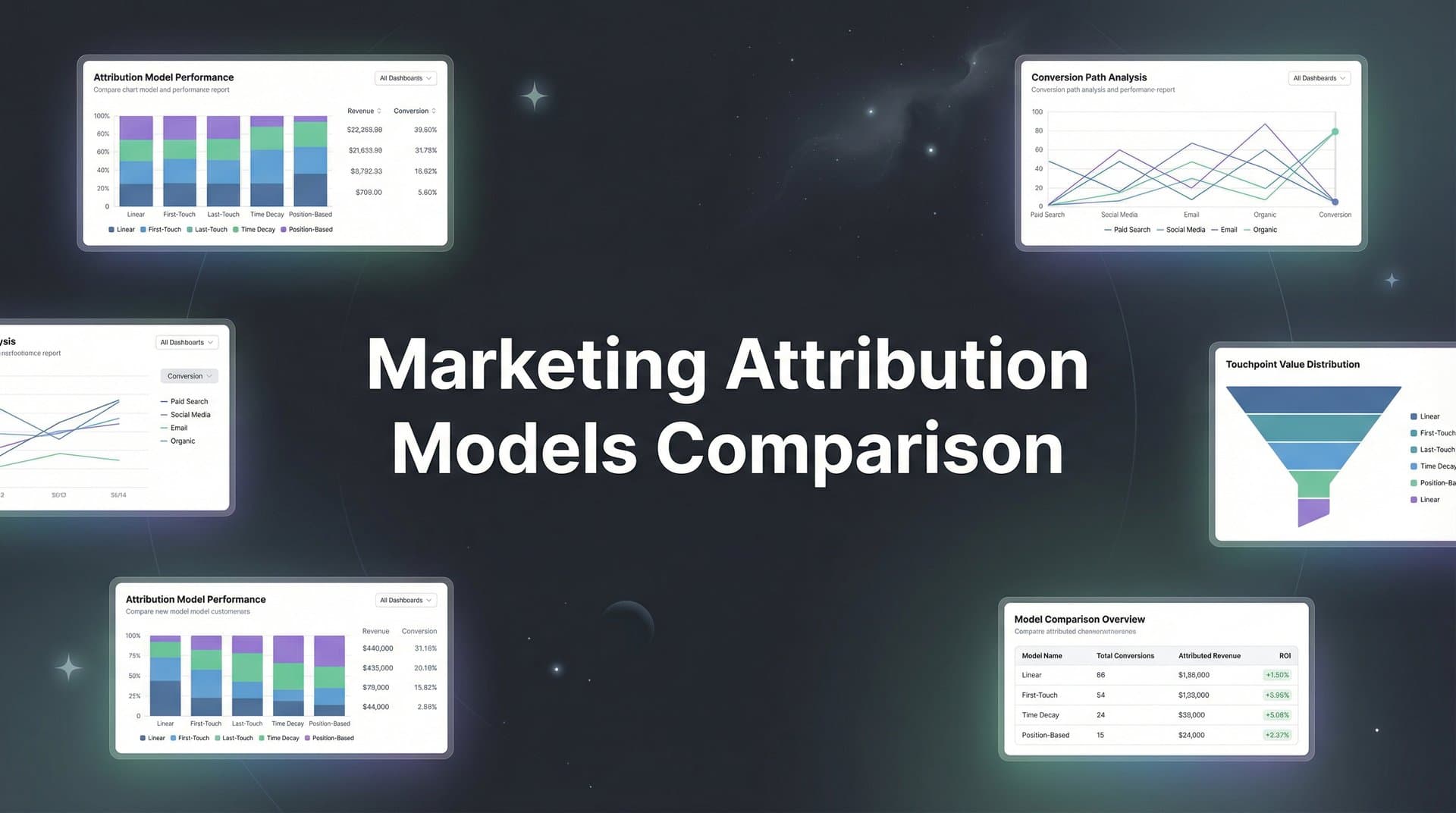
You're running campaigns across Google, Meta, email, and maybe even TikTok. A customer clicks your Facebook ad, reads a blog post, opens an email, and finally converts through a Google search. Which channel gets the credit? The answer depends entirely on which attribution model you choose, and that choice fundamentally shapes how you allocate your marketing budget.
Most marketers rely on default last-click attribution without realizing they're crediting only the final touchpoint while ignoring every interaction that built awareness and trust. This creates a distorted view of performance, often leading to budget cuts for channels that actually drive discovery and consideration.
The challenge is not just understanding what attribution models exist, but knowing which one aligns with your business goals, sales cycle, and customer journey complexity. A B2B company with a six-month sales cycle needs a completely different approach than an e-commerce brand optimizing for immediate purchases.
This guide breaks down seven distinct attribution models, comparing how each one distributes credit, when it works best, and what blind spots it creates. By the end, you will understand which model fits your marketing strategy and how to implement it effectively.
1. First-Touch Attribution
The Challenge It Solves
When you're investing heavily in top-of-funnel activities like content marketing, social media, or display advertising, you need to measure whether those efforts actually introduce new prospects to your brand. First-touch attribution answers the question: which channels are best at generating awareness and starting customer relationships?
Without first-touch visibility, you might cut budget from channels that excel at discovery simply because they rarely appear as the final touchpoint before conversion. This model ensures awareness-focused channels get recognized for their role in building your pipeline.
The Strategy Explained
First-touch attribution assigns 100% of the conversion credit to the very first marketing interaction a customer has with your brand. If someone discovers you through an Instagram ad, then later visits through email and organic search before purchasing, Instagram gets full credit.
This model operates on the principle that without that initial introduction, the customer journey would never have started. It prioritizes the channels that bring new people into your ecosystem, making it particularly valuable for measuring brand awareness campaigns and top-of-funnel performance.
The simplicity of first-touch makes it easy to implement and understand. You are essentially asking: where did this customer first hear about us? That clarity helps marketing teams justify investments in channels designed to reach cold audiences. For a deeper dive into how different types of attribution models in digital marketing work, understanding first-touch is essential.
Implementation Steps
1. Ensure your tracking captures the first touchpoint by implementing cookies or session tracking that persists throughout the customer journey, not just the most recent interaction.
2. Set up your analytics platform to identify and store the initial referral source, whether it's a specific ad campaign, organic channel, or referral link.
3. Create reporting dashboards that show which channels drive the most first-touch conversions, then compare this data against your last-touch reports to identify gaps in channel performance perception.
Pro Tips
First-touch works best when combined with a secondary attribution model for comparison. Use it alongside last-touch or linear attribution to get a complete picture of channel performance across the entire funnel. This dual-model approach helps you balance awareness investments with conversion optimization.
2. Last-Touch Attribution
The Challenge It Solves
Direct response marketers need to know which channels close deals and drive immediate conversions. When your primary goal is optimizing for transactions rather than awareness, last-touch attribution cuts through the noise by focusing exclusively on what triggers the final purchase decision.
This model addresses the specific challenge of conversion optimization. If you're running performance campaigns with clear ROI targets, you need to identify which touchpoints have the strongest correlation with completed purchases, not just initial interest.
The Strategy Explained
Last-touch attribution gives 100% of the conversion credit to the final interaction before a customer converts. If someone discovered you through a podcast mention, clicked a Facebook ad two weeks later, and finally purchased after clicking a Google search ad, Google gets all the credit.
Most ad platforms use last-touch attribution by default because it aligns with their business model of proving direct conversion impact. This makes last-touch the easiest model to implement since it often requires no additional configuration beyond standard conversion tracking.
The model assumes that the final touchpoint is the most influential in driving the conversion decision. While this oversimplifies complex customer journeys, it provides clear, actionable data for optimizing bottom-of-funnel performance. Understanding the importance of attribution models in marketing helps you recognize when last-touch creates blind spots.
Implementation Steps
1. Verify that your conversion tracking accurately captures the immediate referral source before each conversion, ensuring no data gaps between the final click and the completed transaction.
2. Configure your analytics platform to prioritize the most recent touchpoint when attributing conversions, overriding any earlier interactions in the customer journey.
3. Build reports that segment last-touch conversions by channel, campaign, and ad creative to identify which bottom-of-funnel tactics drive the highest conversion rates.
Pro Tips
Last-touch attribution works exceptionally well for short sales cycles and impulse purchases where the final touchpoint genuinely drives the decision. However, be cautious about over-investing in branded search and retargeting, which often capture demand created by other channels. Compare last-touch results with first-touch data to avoid crediting channels that simply harvest existing intent.
3. Linear Attribution
The Challenge It Solves
When customers interact with your brand multiple times before converting, single-touch models create an incomplete picture by ignoring most of the journey. Linear attribution solves the problem of recognizing that every touchpoint contributes to building trust, awareness, and purchase intent.
This model is particularly valuable when you run integrated campaigns across multiple channels and need to understand how different marketing activities work together rather than compete for credit. It prevents the distortion that happens when only the first or last interaction gets recognized.
The Strategy Explained
Linear attribution distributes conversion credit equally across every touchpoint in the customer journey. If someone interacts with five different marketing touchpoints before converting, each one receives 20% of the credit regardless of when it occurred or what type of interaction it was.
This democratic approach assumes that all interactions contribute equally to the conversion outcome. While this may not reflect reality perfectly, it provides a balanced view that prevents extreme over-crediting of single touchpoints.
Linear attribution works best for organizations that want to acknowledge the cumulative effect of their marketing efforts without making assumptions about which interactions matter most. It's a middle-ground approach that avoids the blind spots of first-touch and last-touch models. For a comprehensive comparison of attribution models for marketers, linear attribution serves as an important baseline.
Implementation Steps
1. Configure your attribution platform to track all customer interactions across channels, not just paid media clicks, including email opens, content downloads, and social media engagement.
2. Set up your reporting to divide conversion value equally among all documented touchpoints, ensuring your analytics system can handle multi-touch tracking without defaulting to single-touch models.
3. Create comparison reports that show how linear attribution results differ from last-touch data to identify which channels are being under-credited in default reporting.
Pro Tips
Linear attribution provides the most value when your customer journey typically involves 3-7 touchpoints. If journeys are extremely long with dozens of interactions, linear attribution may dilute the importance of truly influential moments. Use this model when you want to ensure no channel gets ignored, but be prepared to supplement it with more sophisticated models as your attribution strategy matures.
4. Time-Decay Attribution
The Challenge It Solves
Customer intent typically strengthens as they move closer to a purchase decision. Early touchpoints might generate awareness, but interactions that happen days or hours before conversion often signal serious buying intent. Time-decay attribution solves the challenge of weighting touchpoints based on their proximity to the conversion event.
This model addresses the limitation of linear attribution, which treats a casual blog read from three months ago the same as a product comparison page visit from yesterday. Time-decay recognizes that recency matters when measuring influence on purchase decisions.
The Strategy Explained
Time-decay attribution assigns progressively more credit to touchpoints as they get closer to the conversion event. The most recent interaction receives the highest credit, while earlier touchpoints receive exponentially less based on how far back they occurred.
The model typically uses a seven-day half-life by default, meaning a touchpoint from seven days ago receives half the credit of one from today. This decay continues backward through the customer journey, ensuring recent interactions dominate the attribution calculation.
Time-decay strikes a balance between recognizing the full journey while acknowledging that proximity to conversion often correlates with influence. It's particularly effective for understanding which touchpoints move prospects from consideration to decision. Implementing proper attribution marketing tracking is essential for time-decay models to function accurately.
Implementation Steps
1. Choose your decay rate based on your typical sales cycle length, using shorter half-lives for quick purchase decisions and longer ones for complex B2B sales.
2. Implement tracking that timestamps every customer interaction accurately, since time-decay models require precise timing data to calculate weighted credit properly.
3. Build reports that compare time-decay attribution against linear and last-touch models to identify which channels excel at closing deals versus building awareness.
Pro Tips
Time-decay works exceptionally well for businesses with clear consideration phases where customer intent builds over days or weeks. Adjust your decay rate based on your actual sales cycle. If most customers convert within 48 hours of their first interaction, use a shorter half-life. For longer sales cycles, extend it to avoid over-crediting the final touchpoints at the expense of earlier relationship-building interactions.
5. Position-Based (U-Shaped) Attribution
The Challenge It Solves
Both the first interaction that introduces your brand and the final touchpoint that triggers conversion play critical roles in the customer journey. Position-based attribution solves the challenge of recognizing these two key moments while still acknowledging that middle interactions contribute to the overall conversion path.
This model addresses the reality that discovery and closing are often the most influential stages in a customer journey, even though nurturing touchpoints in between help maintain interest and build trust.
The Strategy Explained
Position-based attribution, also called U-shaped attribution, assigns 40% of the credit to the first touchpoint, 40% to the last touchpoint, and distributes the remaining 20% equally among all middle interactions. This creates a "U" shape when you graph credit distribution across the journey.
The model operates on the principle that introducing someone to your brand and closing the deal are the two most important moments, but it avoids completely ignoring the nurturing that happens in between. If a customer has seven total touchpoints, the first gets 40%, the last gets 40%, and the five middle interactions each receive 4%.
Position-based attribution works well for marketers who want to balance awareness and conversion measurement without treating all touchpoints equally. It's a compromise between single-touch and fully distributed models. Learn more about marketing attribution models explained to understand when U-shaped attribution fits your strategy.
Implementation Steps
1. Configure your attribution platform to identify first and last touchpoints in each customer journey, then calculate the number of middle interactions to determine how to split the remaining 20%.
2. Set up reporting that shows how position-based credit differs from your current attribution model, paying special attention to which middle-funnel channels gain or lose credit.
3. Use position-based insights to optimize both your awareness campaigns and your conversion tactics while maintaining some budget for nurturing activities that support the full journey.
Pro Tips
Position-based attribution excels when your marketing strategy clearly separates awareness campaigns from conversion campaigns, with nurturing activities in between. It's particularly valuable for e-commerce and SaaS businesses with moderate sales cycles. However, if your customer journeys are very short with only 2-3 touchpoints, position-based attribution will behave very similarly to linear attribution, making it less valuable as a distinct model.
6. W-Shaped Attribution
The Challenge It Solves
B2B marketers often deal with multi-stage customer journeys where lead creation represents a critical milestone between initial awareness and final conversion. W-shaped attribution solves the challenge of recognizing three pivotal moments: first touch, lead creation, and opportunity creation or conversion.
This model addresses the complexity of B2B sales cycles where becoming a marketing qualified lead or sales qualified lead represents a significant progression that deserves credit alongside the initial discovery and final purchase.
The Strategy Explained
W-shaped attribution distributes credit across three major milestones: 30% to the first touch, 30% to the interaction that created a lead, 30% to the interaction that created an opportunity or conversion, and the remaining 10% split among all other touchpoints. This creates a "W" pattern when visualizing credit distribution.
The model requires you to define what constitutes a lead creation event, typically a form submission, demo request, or qualification threshold. This middle milestone receives equal weight to the first and last touches, reflecting its importance in B2B pipeline development.
W-shaped attribution is specifically designed for businesses with defined sales stages and longer customer journeys. It recognizes that moving from anonymous visitor to identified lead is just as important as the initial discovery or final close. Companies running attribution for B2B marketing campaigns often find W-shaped models align best with their pipeline stages.
Implementation Steps
1. Define your lead creation event clearly in your CRM and analytics platform, ensuring it triggers consistently when prospects reach your qualification threshold.
2. Implement tracking that connects the touchpoint that directly preceded lead creation, not just the first and last interactions in the overall journey.
3. Build reports that show which channels drive first touches, which drive lead creation, and which drive opportunity conversion to understand where each channel excels in your funnel.
Pro Tips
W-shaped attribution delivers the most value for B2B companies with clear lead stages and sales cycles longer than 30 days. It helps you identify which channels excel at awareness versus lead nurturing versus closing. However, implementing W-shaped attribution requires tight integration between your marketing automation platform and your attribution system, so ensure your tracking infrastructure can support the complexity before committing to this model.
7. Data-Driven Attribution
The Challenge It Solves
Rule-based attribution models make assumptions about which touchpoints matter most, but they don't account for your unique customer behavior patterns. Data-driven attribution solves this by analyzing actual conversion paths to determine which interactions genuinely influence purchase decisions based on your specific data.
This model addresses the limitation of one-size-fits-all approaches by using machine learning to identify patterns that human-defined rules might miss. It adapts to your business instead of forcing your business to fit predetermined attribution logic.
The Strategy Explained
Data-driven attribution uses machine learning algorithms to analyze thousands of conversion paths, comparing customers who converted against those who didn't. The algorithm identifies which touchpoints appear more frequently in successful journeys and assigns credit based on their statistical correlation with conversions.
The model continuously learns from new data, adjusting credit distribution as customer behavior patterns change. If your data shows that customers who engage with email after seeing a Facebook ad convert at significantly higher rates, the algorithm will credit both touchpoints appropriately based on their combined influence.
Data-driven attribution requires substantial conversion volume to produce reliable insights. The algorithms need enough data points to distinguish meaningful patterns from random noise, which typically means hundreds of conversions per month across multiple touchpoints. Leveraging data science marketing attribution techniques can help you maximize the value of algorithmic models.
Implementation Steps
1. Ensure you have sufficient conversion volume before implementing data-driven attribution, typically at least 400 conversions per month with diverse touchpoint combinations.
2. Implement comprehensive tracking across all marketing channels so the machine learning algorithm has complete data about customer journeys, not just paid media interactions.
3. Allow the algorithm several weeks to analyze patterns before making major budget decisions based on its recommendations, giving it time to establish baseline patterns and confidence levels.
Pro Tips
Data-driven attribution represents the most sophisticated approach, but it's not always the best choice for every business. If you have limited conversion volume or very simple customer journeys, rule-based models may provide clearer insights with less complexity. However, for businesses with diverse marketing channels and sufficient data, data-driven attribution often reveals optimization opportunities that rule-based models miss entirely. The key is ensuring your tracking infrastructure captures complete customer journey data, including server-side tracking to overcome browser-based limitations.
Choosing Your Attribution Strategy
Selecting the right attribution model is not about finding a universal answer but about matching your measurement approach to your specific business goals and customer journey complexity. Start by identifying your primary objective: if brand awareness drives your strategy, first-touch may serve you well. For conversion-focused teams, last-touch or time-decay often provides clearer insights.
The most effective approach involves testing multiple models simultaneously to understand how different perspectives reveal different optimization opportunities. Compare first-touch against last-touch to see which channels drive discovery versus conversion. Layer in linear or position-based attribution to understand the full journey contribution.
As your marketing matures and conversion volume increases, consider graduating to data-driven attribution. The machine learning approach adapts to your unique customer behavior patterns rather than forcing predetermined assumptions about touchpoint value.
Remember that attribution models only work as well as the data they analyze. Browser-based tracking limitations and privacy changes have made accurate multi-touch attribution more challenging. Server-side tracking solutions provide more complete customer journey data, feeding your attribution analysis with the accuracy needed for confident decision-making.
The best marketing teams use attribution platforms that let them compare models in real time, feeding better data back to ad platforms for improved targeting and ROI. This creates a virtuous cycle where better attribution leads to better optimization, which generates more conversions and even richer attribution insights.
Ready to elevate your marketing game with precision and confidence? Discover how Cometly's AI-driven recommendations can transform your ad strategy. Get your free demo today and start capturing every touchpoint to maximize your conversions.



