You're spending $50,000 a month across Google, Meta, LinkedIn, and TikTok. Your dashboard shows conversions coming from everywhere. Google claims credit for 200 conversions. Meta says they drove 180. LinkedIn reports 95. The math doesn't add up—and when you check your CRM, only 150 actual customers came through. Which platform is telling the truth? Which ads actually worked?
This isn't just a reporting headache. It's a strategic crisis. Without knowing which channels truly drive revenue, you're flying blind on budget decisions. You might be doubling down on platforms that look good on paper but deliver minimal actual value. Or worse, you could be cutting budgets from the channels that quietly drive your most profitable customers.
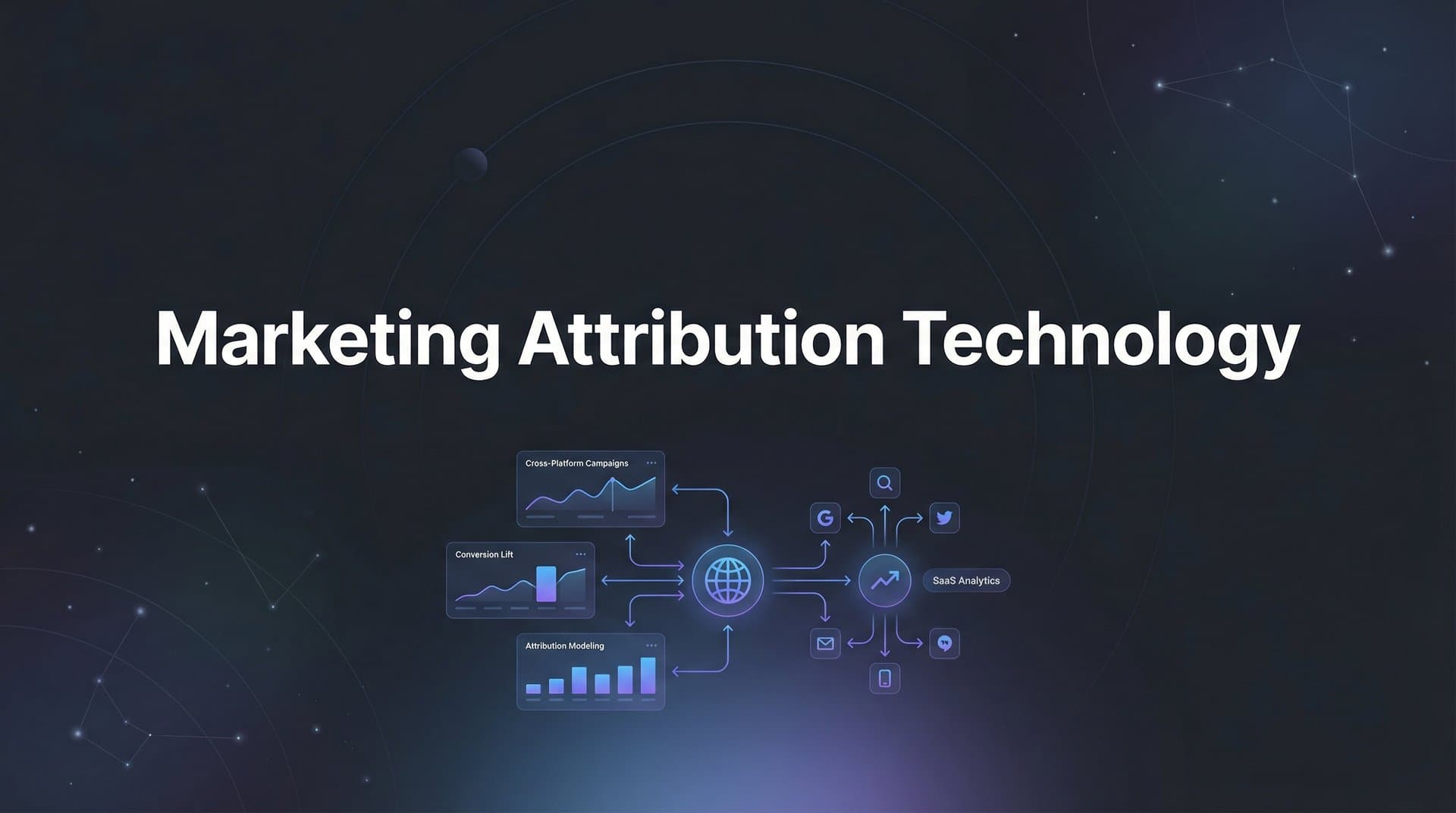
Marketing attribution technology solves this puzzle. It's the infrastructure that tracks every customer touchpoint across your entire marketing ecosystem—from the first ad impression to the final purchase—and connects those interactions to actual revenue outcomes. In today's privacy-first landscape where traditional tracking methods are breaking down, understanding how attribution technology works isn't optional anymore. It's the foundation of data-driven marketing decisions.
The Engine Behind Revenue Visibility
Marketing attribution technology is software that tracks customer touchpoints across channels and assigns credit to the interactions that influence conversions. Think of it as a sophisticated tracking system that follows your customers' entire journey—from the moment they first encounter your brand through every click, view, and engagement until they become paying customers.
The technology operates through several core components working in concert. Tracking pixels and scripts capture initial interactions—when someone clicks your Facebook ad or visits your website from an organic search. Server-side integrations connect directly to your ad platforms, CRM, and analytics tools to collect data that browsers can't capture. Identity resolution technology stitches together anonymous sessions with known user data, recognizing that the person who clicked your LinkedIn ad on Monday is the same person who filled out a form on Wednesday and purchased on Friday.
Data unification pulls all these disparate signals into a single source of truth. Your Google Ads data, Meta conversions, email engagement metrics, and CRM revenue all flow into one system where they can be analyzed together rather than in isolation.
This stands in sharp contrast to basic platform analytics. When you look at Google Ads reporting, you're seeing only what Google can observe—clicks on their ads and conversions they can attribute to those clicks. Meta's dashboard shows only Meta's perspective. Neither platform sees the full picture of how their ads interact with your other marketing efforts. Understanding the difference between marketing attribution software vs traditional analytics is crucial for making this transition.
Here's where it gets interesting: attribution technology reveals that your customer didn't just click one ad and convert. They saw your Meta ad on their phone during their morning commute. Later that day, they searched for your brand name on Google and clicked your search ad. They visited your site twice more over the next week—once from an email and once by typing your URL directly. Finally, they converted after clicking a retargeting ad.
Without attribution technology, each platform claims full credit for that conversion. With it, you understand the actual sequence of events and can make informed decisions about which touchpoints genuinely influenced the outcome. You see not just where conversions happen, but how they happen—which fundamentally changes how you allocate budget and optimize campaigns.
Why Platform-Native Analytics Fall Short
Every ad platform operates as a walled garden. Google wants to prove Google works. Meta wants to prove Meta works. LinkedIn wants to prove LinkedIn works. The problem? They're all measuring the same conversions and claiming credit for them.
This creates the "walled garden" problem where attribution becomes a zero-sum game fought by platforms that can only see their own slice of reality. When a customer converts, Google's tracking pixel fires and records a conversion. Meta's pixel fires and records the same conversion. If you're running LinkedIn ads, their pixel fires too. Suddenly, one actual customer has generated three reported conversions across three platforms.
The math breaks down completely when you try to reconcile platform reporting with actual business outcomes. Your platforms collectively report 500 conversions this month. Your CRM shows 300 new customers. Which 200 conversions are phantom credit? Which platforms are over-reporting? You can't tell from platform dashboards alone. These attribution challenges in marketing analytics affect virtually every marketing team running multi-channel campaigns.
iOS 14+ tracking limitations have made this problem exponentially worse. When Apple introduced App Tracking Transparency in 2021, they fundamentally changed how mobile tracking works. Users can now opt out of cross-app and cross-site tracking. Most do. The result? Pixel-based tracking that once captured 90% of mobile conversions now captures closer to 50-60%.
Your Facebook pixel fires when someone clicks your ad on their iPhone. But if they've opted out of tracking, that pixel can't follow them to your website. It can't see when they convert. Facebook's reporting shows the click but misses the conversion—making profitable campaigns look like they're failing. Or worse, the conversion gets attributed to a different source entirely because Facebook lost the thread of the customer journey.
This isn't just a reporting inconvenience. It actively degrades ad platform algorithms. When Facebook's AI doesn't receive accurate conversion data, it can't optimize effectively. It doesn't know which audiences, creatives, and placements actually drive results. The algorithm optimizes based on incomplete information, which means your campaigns perform below their potential.
The gap between reported conversions and actual CRM revenue data reveals another critical limitation. Platform analytics show you conversions—form fills, purchases, sign-ups. But they don't connect those conversions to actual revenue outcomes. That lead from Google Ads might have converted into a $500 customer. That lead from Meta might have become a $5,000 customer. Platform dashboards treat them identically. Your business shouldn't.
Without technology that bridges the gap between ad platforms and CRM data, you're optimizing for conversion volume rather than conversion value. You're making budget decisions based on which platforms drive the most leads, not which platforms drive the most revenue. That's how marketing teams end up scaling channels that generate lots of activity but minimal profit. Implementing proper marketing revenue attribution solves this disconnect.
The Identity Resolution Challenge
Platform analytics also struggle with cross-device and cross-session tracking. Your customer researches on their phone during lunch. They compare options on their work laptop in the afternoon. They make the final purchase on their home computer that evening. To platform analytics, these look like three different people. Attribution technology connects these sessions to reveal they're one customer journey across three devices.
Attribution Models: Choosing How Credit Gets Assigned
Once you're tracking the complete customer journey, you face a new question: how do you assign credit to the touchpoints that influenced the conversion? This is where attribution models come in—the rules that determine which interactions get credit for driving revenue.
First-touch attribution gives 100% credit to the first interaction a customer has with your brand. If someone clicked your Facebook ad three weeks before converting, that ad gets all the credit regardless of what happened afterward. This model answers the question "What's bringing new people into our funnel?" It's useful for understanding top-of-funnel performance and brand awareness efforts. The limitation? It completely ignores everything that happened between first touch and conversion.
Last-touch attribution does the opposite—it gives 100% credit to the final touchpoint before conversion. If a customer clicked your Google search ad right before purchasing, that ad gets all the credit. This model reveals what's closing deals, which makes it popular for understanding bottom-of-funnel performance. But it ignores the awareness and consideration touchpoints that made that final click possible.
Linear attribution distributes credit equally across all touchpoints. If a customer had five interactions before converting, each interaction receives 20% credit. This approach acknowledges that multiple touchpoints contributed to the outcome. The downside? It treats all interactions as equally valuable, which rarely reflects reality. The awareness ad someone saw three weeks ago probably didn't influence the conversion as much as the retargeting ad they clicked yesterday. For a deeper dive into these frameworks, explore our guide on what is marketing attribution model.
Time-decay attribution assigns more credit to touchpoints closer to the conversion. Recent interactions receive higher credit scores while earlier touchpoints receive less. This model reflects the reality that recency often matters—the touchpoints immediately before conversion typically have more influence than those weeks earlier. It's particularly useful for businesses with shorter sales cycles where momentum matters.
Position-based attribution (also called U-shaped) gives the most credit to first and last touchpoints—typically 40% each—with the remaining 20% distributed among middle interactions. This model acknowledges that both introducing someone to your brand and closing the deal matter most. It's popular for B2B companies where both awareness and conversion touchpoints play critical roles.
Multi-Touch Attribution: The Complete Picture
Multi-touch attribution moves beyond simple rule-based models to consider the actual influence of each touchpoint. Instead of applying predetermined credit distribution rules, multi-touch attribution analyzes patterns across thousands of customer journeys to understand which touchpoint combinations actually drive conversions.
This approach provides a more complete picture for complex buyer journeys. When customers interact with your brand 8-12 times before converting—common in B2B and considered-purchase B2C—single-touch models miss the forest for the trees. A robust multi-touch marketing attribution platform reveals that customers who see your LinkedIn ad, then visit your blog, then attend your webinar have a 3x higher conversion rate than those who only interact with one channel.
The key is matching your attribution model to your business reality. If you're running e-commerce with impulse purchases, last-touch attribution might suffice because most customers convert quickly after discovering you. If you're selling enterprise software with 6-month sales cycles and 15+ touchpoints per deal, you need multi-touch attribution to understand the complex interplay between awareness content, nurture sequences, and sales interactions.
Consider your channel mix too. If you're primarily running bottom-of-funnel search campaigns, last-touch attribution makes sense. If you're mixing brand awareness campaigns, retargeting, email nurture, and content marketing, multi-touch attribution becomes essential to understanding how these channels work together rather than competing for credit.
Server-Side Tracking: The Foundation of Accurate Data
Browser-based tracking is breaking. Ad blockers strip out pixels. Privacy settings block cookies. iOS restrictions limit mobile tracking. If your attribution technology relies solely on what browsers can capture, you're working with incomplete data. Server-side tracking solves this by moving data collection from the browser to your server.
Here's how it works: instead of relying on JavaScript pixels that load in someone's browser, server-side tracking sends conversion data directly from your server to ad platforms and analytics tools. When someone converts on your website, your server records the conversion and transmits that data through secure server-to-server connections.
This bypasses browser limitations entirely. Ad blockers can't strip out tracking that never touches the browser. iOS restrictions don't apply to server-side data transmission. Cookie consent requirements become simpler because you're collecting first-party data on your own infrastructure rather than dropping third-party cookies in browsers.
The accuracy improvement is substantial. Browser-based tracking might capture 60% of conversions in today's privacy-focused environment. Server-side tracking captures 95%+ because it doesn't depend on browser cooperation. You're no longer guessing at performance based on partial data—you're making decisions based on complete conversion information. The best software for tracking marketing attribution now prioritizes server-side capabilities for this reason.
First-party data collection is the other critical advantage. When you collect data on your own servers before sending it to platforms, you own that data. You control how it's structured, enriched, and transmitted. You can append CRM data to conversions before sending them to ad platforms—telling Facebook not just that a conversion happened, but that it was a $5,000 customer rather than a $500 customer.
Feeding Better Data to Ad Platform Algorithms
This is where server-side tracking transforms from a measurement improvement to an optimization advantage. Ad platforms like Meta and Google use conversion data to train their algorithms. The more accurate and complete your conversion data, the better their AI can optimize your campaigns.
When you send server-side conversion data back to ad platforms through Conversion API (Meta) or Enhanced Conversions (Google), you're giving their algorithms information they couldn't capture through browser pixels alone. You're telling them which clicks actually converted, which audiences drive real revenue, and which creative approaches work best.
The algorithm learns faster and optimizes more effectively. Your campaigns find better audiences because the AI knows which characteristics correlate with actual conversions. Your creative testing becomes more reliable because you're measuring real performance rather than partial data. Your budget allocation improves because platforms can identify which placements and times of day genuinely drive results.
This creates a virtuous cycle: better data leads to better optimization, which leads to better results, which generates more data to further improve optimization. Companies using server-side tracking consistently report 20-40% improvement in campaign efficiency—not because they changed their creative or targeting, but because they gave ad platforms the information needed to optimize effectively.
From Data Collection to Actionable Optimization
Collecting accurate data is only valuable if it drives better decisions. Marketing attribution technology transforms raw tracking data into actionable optimization insights by connecting ad clicks to CRM events and actual revenue outcomes.
The process starts with journey mapping. When someone clicks your Meta ad, attribution technology records that interaction and assigns it a unique identifier. As that person moves through your funnel—visiting your website, downloading a resource, requesting a demo, becoming a customer—each action gets tracked and connected to that initial ad click.
But the real power comes from connecting marketing touchpoints to CRM data. Your attribution platform doesn't just know someone converted. It knows they became a $8,000 annual contract customer. It knows they're in the healthcare vertical. It knows they came through a specific campaign targeting decision-makers at mid-market companies. This enriched data reveals which marketing efforts drive not just conversions, but valuable conversions.
Unified data enables budget reallocation based on true ROI rather than vanity metrics. Instead of comparing channels based on cost per lead, you compare them based on cost per qualified opportunity or cost per dollar of revenue. Understanding channel attribution in digital marketing helps you discover that LinkedIn generates fewer leads than Meta but those leads convert to customers at 3x the rate and spend 2x more. Suddenly, LinkedIn deserves more budget despite "worse" cost-per-lead numbers.
This shifts marketing optimization from a volume game to a value game. You stop asking "Which channel drives the most conversions?" and start asking "Which channel drives the most profitable customers?" The answers are often dramatically different.
AI-Powered Pattern Recognition
Modern attribution platforms use AI to identify patterns humans would miss. The AI analyzes thousands of customer journeys to find correlations between touchpoint sequences and outcomes. It might discover that customers who engage with both your webinar content and case study pages convert at 5x the rate of those who only visit one content type. Or that customers who interact with your brand on three different days before converting have 40% higher lifetime value than those who convert on their first visit.
These insights drive proactive optimization recommendations. Instead of just reporting what happened, AI-powered marketing attribution tools suggest what to do next. They recommend increasing budget on specific campaigns that show strong revenue correlation. They identify audiences that engage well but don't convert, suggesting remarketing strategies to close the gap. They flag campaigns that drive high-volume but low-value conversions, recommending either optimization or reallocation.
The result is a shift from reactive reporting to proactive strategy. You're not just looking at last month's performance and wondering what to change. You're receiving data-driven recommendations about where to invest, which campaigns to scale, and which optimizations will have the biggest impact on revenue.
Evaluating Attribution Solutions for Your Stack
Not all attribution platforms are built equally. Choosing the right solution requires evaluating several key criteria that determine whether the technology will actually deliver on its promises.
Integration depth with ad platforms and CRMs is the foundation. The platform needs native integrations with every ad channel you run—Meta, Google, LinkedIn, TikTok, and others. But "integration" isn't binary. Some platforms only pull basic campaign data. Others support bidirectional data flow, sending enriched conversion data back to ad platforms through Conversion APIs. The latter dramatically improves campaign performance because ad algorithms receive better training data.
CRM integration depth matters just as much. Can the attribution platform automatically sync with Salesforce, HubSpot, or your custom CRM to connect marketing touchpoints to actual revenue? Does it update in real-time or require manual exports? Can it track the full lifecycle from marketing-qualified lead through closed-won deal and beyond? Reviewing the top features of effective marketing attribution software helps you prioritize what matters most.
Real-time versus batch processing determines how quickly you can act on insights. Batch processing systems update once or twice daily, which means you're always looking at yesterday's data. Real-time processing lets you monitor campaign performance as it happens and make immediate optimization decisions. For fast-moving campaigns or high-spend accounts, real-time data is essential.
Model flexibility lets you analyze data through different attribution lenses. The best platforms support multiple models—first-touch, last-touch, linear, time-decay, position-based, and custom multi-touch models—so you can view performance from different angles and understand which model best reflects your business reality.
Red Flags to Watch For
Over-reliance on cookies is a major warning sign. If a platform's tracking depends primarily on third-party cookies, it's already obsolete. Cookie-based tracking is declining rapidly and will continue degrading. Solutions built on cookie-dependent technology will deliver increasingly incomplete data.
Lack of server-side options means the platform can't bypass browser limitations. This results in missing conversions, especially on iOS devices and among users with ad blockers. If a vendor can't clearly explain their server-side tracking capabilities, that's a red flag.
Limited platform support restricts your marketing flexibility. If the attribution platform only integrates with Meta and Google but not LinkedIn, TikTok, or emerging channels, you'll face gaps in your data as you expand your channel mix. Choose platforms with broad integration ecosystems and regular updates to support new channels.
Vague answers about data accuracy suggest the vendor doesn't have confidence in their tracking completeness. Ask specifically: "What percentage of conversions do you typically capture compared to CRM data?" and "How do you handle iOS tracking limitations?" If they dodge these questions or provide only general answers, that's concerning.
Questions to Ask Vendors
Implementation complexity determines how quickly you'll see value. Ask: "How long does typical implementation take?" and "What resources do we need on our team?" Some platforms require extensive developer time. Others offer plug-and-play integrations that marketing teams can implement independently. Our guide on questions for marketing attribution vendors provides a comprehensive framework for these conversations.
Ongoing support matters because attribution technology requires continuous optimization. Ask about their customer success model: "Do we get a dedicated support contact?" and "What does onboarding look like?" The best vendors provide strategic guidance, not just technical support.
Data accuracy verification should be built into the platform. Ask: "How do you validate tracking accuracy?" and "Can we compare your conversion data against our CRM to verify completeness?" Reputable vendors welcome accuracy audits because they're confident in their data quality.
Putting It All Together
Marketing attribution technology has evolved from a nice-to-have reporting tool to essential infrastructure for data-driven marketing teams. In an environment where privacy changes have broken traditional tracking methods and customers interact with brands across an expanding array of touchpoints, understanding which marketing efforts actually drive revenue isn't optional anymore.
The competitive advantage is clear: teams with accurate attribution know exactly which channels drive revenue. They make budget decisions based on real ROI rather than incomplete platform data. They optimize campaigns using enriched conversion data that improves ad platform algorithms. They connect marketing activity to actual business outcomes in their CRM.
Teams without attribution are guessing. They're making million-dollar budget decisions based on platform dashboards that claim credit for the same conversions. They're optimizing for vanity metrics that don't correlate with revenue. They're flying blind while competitors use data to systematically improve their marketing efficiency.
The technology infrastructure exists today to solve this problem. Server-side tracking bypasses browser limitations. Multi-touch attribution reveals how channels work together rather than compete for credit. AI-powered analysis identifies optimization opportunities humans would miss. Integration with CRMs connects marketing touchpoints to revenue outcomes.
The question isn't whether attribution technology matters—it's whether you're ready to move from guessing to knowing. Ready to elevate your marketing game with precision and confidence? Discover how Cometly's AI-driven recommendations can transform your ad strategy—Get your free demo today and start capturing every touchpoint to maximize your conversions.