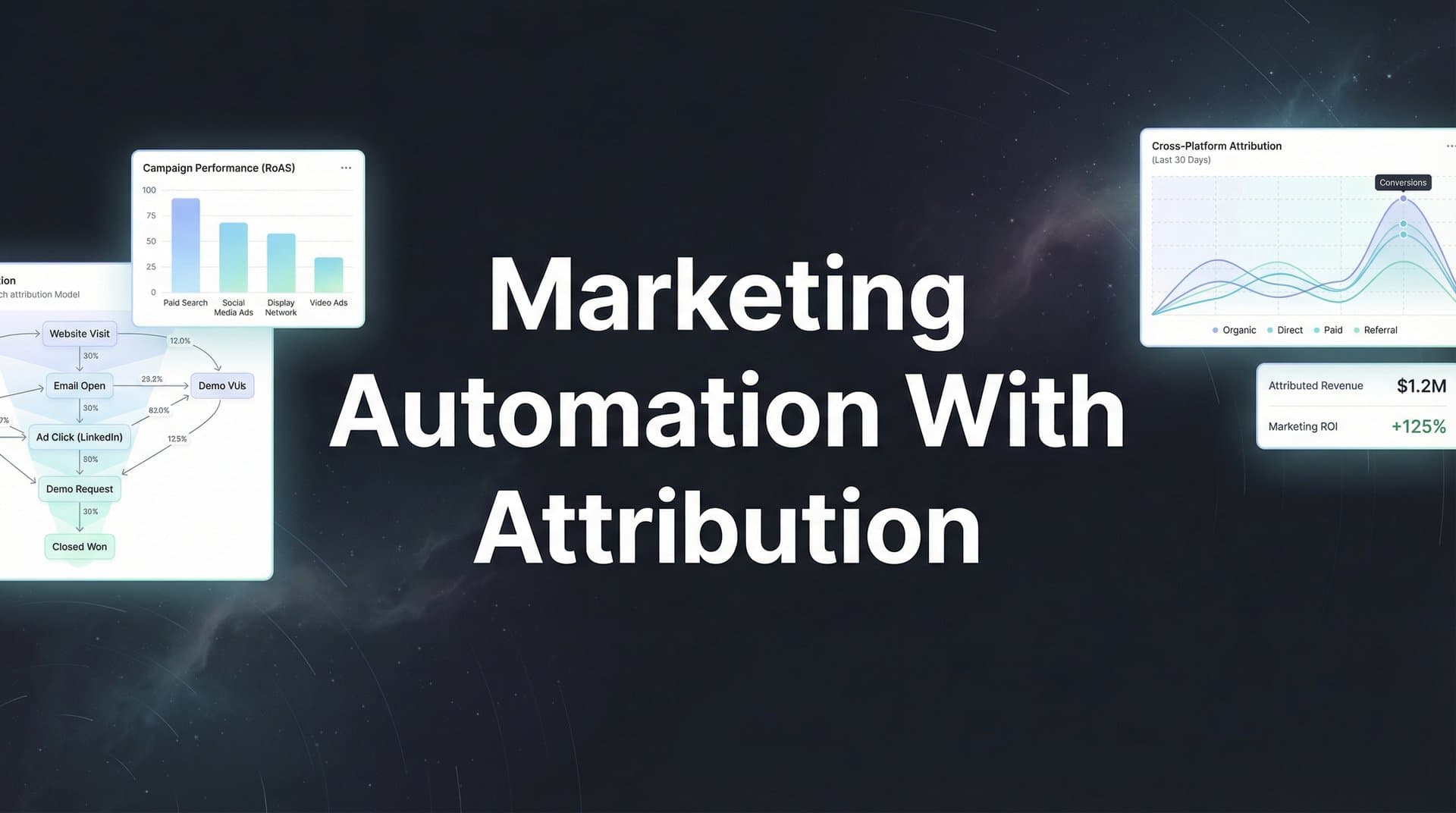
Marketing automation promises efficiency, but without proper attribution, you're essentially flying blind. You might be sending thousands of automated emails, triggering dozens of workflows, and nurturing leads across multiple channels, yet have no clear picture of which automated touchpoints actually convert.
The gap between automation activity and revenue impact is where most marketing teams struggle.
When you combine marketing automation with robust attribution tracking, you transform from a team that 'does marketing' into one that knows exactly which automated sequences, triggers, and campaigns generate pipeline and revenue. This guide walks you through seven battle-tested strategies to connect your automation efforts directly to business outcomes, giving you the clarity to scale what works and cut what doesn't.
1. Build a Unified Tracking Foundation Before You Automate
The Challenge It Solves
Most marketing teams rush into automation without establishing proper tracking infrastructure. They launch email sequences, set up retargeting campaigns, and build complex workflows, only to realize months later that they can't definitively connect any of it to actual revenue. You end up with activity metrics like open rates and click-throughs, but no clear line of sight to which automation efforts actually drive conversions.
This creates a dangerous situation where you're scaling blind, potentially doubling down on automations that feel productive but deliver minimal business impact.
The Strategy Explained
Think of your tracking foundation as the nervous system of your marketing operation. Before you automate anything at scale, you need consistent tracking infrastructure that captures every touchpoint and connects it to revenue outcomes.
This means establishing standardized UTM parameters across all campaigns, implementing server-side tracking to overcome browser limitations, and ensuring your automation platform talks directly to your CRM. Server-side tracking has become particularly critical as browser-based tracking faces increasing limitations from privacy changes and cookie deprecation.
The goal is creating a system where every automated email, ad click, and workflow trigger leaves a traceable footprint that follows the customer all the way to conversion and beyond. Understanding attribution marketing tracking fundamentals is essential before implementing any automation at scale.
Implementation Steps
1. Audit your current tracking setup by mapping every marketing touchpoint and identifying where data breaks or becomes inconsistent between platforms.
2. Establish a UTM naming convention document that every team member follows, covering campaign source, medium, campaign name, content, and term parameters for all automated campaigns.
3. Implement server-side tracking through a solution like Cometly that captures conversion events directly from your server, bypassing browser-based tracking limitations and providing more accurate data.
4. Connect your automation platform to your CRM with bi-directional data sync, ensuring lead activities flow into your CRM and conversion data flows back to your automation platform.
5. Test your tracking end-to-end by creating a test customer journey through your automations and verifying that every touchpoint appears correctly in your attribution system.
Pro Tips
Document your tracking standards in a shared resource that your entire team can access. Include specific examples of properly formatted UTM parameters for different campaign types. Schedule quarterly tracking audits to catch drift before it creates data gaps. Remember that tracking setup is not a one-time project but an ongoing discipline that requires maintenance as you add new automation workflows and channels.
2. Map Automation Touchpoints to Your Attribution Model
The Challenge It Solves
Your automation platform knows when someone opened an email or clicked a link. Your ad platform knows when someone clicked an ad. Your website analytics knows when someone visited a page. But none of these systems naturally understands how these touchpoints work together to drive conversions.
Without connecting these dots through an attribution model, you're left guessing which automated interactions actually matter. You might celebrate high open rates on a nurture sequence while the real revenue driver is a retargeting ad that comes three touchpoints later.
The Strategy Explained
Attribution models provide the framework for assigning credit to different marketing touchpoints along the customer journey. The key is choosing a model that reflects how your customers actually buy, then ensuring every automated touchpoint feeds into that model with proper tagging.
Multi-touch attribution models work particularly well for marketing automation because they acknowledge that conversion rarely happens from a single interaction. A customer might first click a Facebook ad, receive three nurture emails, click a retargeting ad, and then convert. Exploring multi-touch marketing attribution platforms can help you understand how to distribute credit across these touchpoints based on their influence.
The strategic advantage comes when you can see which automated sequences consistently appear in high-value conversion paths versus which ones are present but not influential.
Implementation Steps
1. Select an attribution model that matches your sales cycle length and typical customer journey complexity, with multi-touch models generally working better for complex B2B sales or high-consideration purchases.
If you're specifically running B2B campaigns, exploring a dedicated B2B marketing attribution platform can help you track long sales cycles and multi-stakeholder journeys with greater precision.
2. Tag every automated campaign with consistent identifiers that your attribution system can recognize, including email sequence name, workflow stage, and automation platform source.
3. Configure your attribution platform to recognize and categorize automation touchpoints separately from manual campaigns so you can analyze their specific contribution.
4. Create custom reports that show how automated touchpoints interact with other marketing activities in successful conversion paths.
5. Review attribution data monthly to identify which automation sequences consistently appear in high-value conversions versus which ones show activity but minimal influence.
Pro Tips
Start with a time-decay attribution model if you're unsure which approach fits your business best. This model gives more credit to touchpoints closer to conversion while still acknowledging earlier interactions. As you gather data, you can refine your model based on what you learn about your actual customer journey patterns. Pay special attention to automation sequences that appear frequently in conversion paths but receive little credit, these might be important supporting players that deserve continued investment even if they're not directly driving conversions.
3. Create Attribution-Informed Automation Triggers
The Challenge It Solves
Most automation triggers are based on simple behavioral signals like "opened email" or "visited pricing page." While these behaviors indicate interest, they don't necessarily predict conversion. You end up with automation workflows that activate based on activity rather than revenue potential, wasting resources on sequences that feel responsive but don't actually move prospects toward purchase.
This approach treats all engaged prospects equally when your attribution data could reveal that certain behavior combinations are far more predictive of conversion than others.
The Strategy Explained
Attribution data reveals patterns about which combinations of behaviors and touchpoints lead to conversion. By analyzing your successful conversion paths, you can identify high-signal behaviors that warrant immediate, personalized automation responses.
For example, your attribution data might show that prospects who visit your pricing page after clicking a specific email link convert at three times the rate of those who visit the pricing page through other paths. This insight lets you build triggers that recognize this high-value pattern and respond with appropriately aggressive automation. Leveraging data science for marketing attribution helps uncover these predictive patterns more effectively.
The strategic shift is moving from "respond to any activity" to "respond intelligently to revenue-predictive patterns." Your automation becomes more targeted and more effective because it's informed by actual conversion data rather than assumptions about what matters.
Implementation Steps
1. Analyze your attribution data to identify the most common touchpoint sequences in successful conversion paths, looking for patterns that repeat across multiple customers.
2. Calculate conversion rates for different behavior combinations to quantify which patterns are most predictive of revenue outcomes.
3. Build automation triggers that activate when prospects exhibit these high-converting behavior patterns, creating workflows specifically designed for prospects showing strong buying signals.
4. Set up conditional logic in your automation platform that considers not just individual actions but the sequence and timing of touchpoints based on what your attribution data shows converts best.
5. Monitor trigger performance by comparing conversion rates of attribution-informed triggers against your standard behavioral triggers to validate the approach.
Pro Tips
Start by identifying your top three highest-converting touchpoint sequences and build triggers around just those patterns. This focused approach lets you validate the strategy before expanding to more complex trigger logic. Remember that attribution-informed triggers should be more selective than standard triggers, activating less frequently but with higher conversion intent. If your new triggers activate as often as your old ones, you're probably not being selective enough about the patterns you're targeting.
4. Segment Audiences by Attribution-Revealed Value
The Challenge It Solves
Traditional segmentation relies on demographic data, firmographic attributes, or self-reported information. While these factors provide useful context, they don't tell you which prospects are most likely to convert based on how they actually interact with your marketing. You end up treating all enterprise leads the same or all email subscribers the same, missing critical differences in conversion potential.
This one-size-fits-all approach to automation sequences means you're either over-investing in low-potential prospects or under-investing in high-potential ones.
The Strategy Explained
Attribution data reveals which acquisition channels, campaign types, and touchpoint combinations produce the highest-value customers. By segmenting your audience based on these attribution insights, you can tailor automation sequences to match the conversion patterns of prospects from different sources.
Prospects who arrive through certain channels might convert quickly with minimal nurturing, while others need longer, more educational sequences. Understanding channel attribution in digital marketing shows you these patterns so you can match your automation intensity to actual conversion probability.
The power comes from treating prospects differently based not on who they are but on how they've interacted with your marketing and what that interaction pattern historically predicts about conversion likelihood.
Implementation Steps
1. Analyze conversion rates and time-to-conversion by original acquisition channel to understand which sources produce fast converters versus slow burners.
2. Create audience segments in your automation platform based on acquisition source and early touchpoint behavior that your attribution data shows correlates with conversion.
3. Build differentiated automation sequences for each segment, with aggressive, conversion-focused sequences for high-intent segments and longer educational nurtures for segments that historically need more touchpoints.
4. Set up dynamic segmentation that moves prospects between automation tracks based on their behavior matching patterns your attribution data shows predict conversion.
5. Compare conversion rates across your attribution-based segments to validate that your segmentation strategy actually produces meaningful performance differences.
Pro Tips
Pay special attention to acquisition channel as a segmentation variable. Your attribution data often reveals that prospects from certain channels convert at dramatically different rates even when they look similar demographically. A lead from a targeted LinkedIn campaign might need half the touchpoints of a lead from a broad awareness campaign. Build your automation sequences to reflect these real conversion patterns rather than treating all leads identically. Review your segment performance quarterly and be willing to merge or split segments as you gather more data about what actually predicts conversion.
5. Feed Attribution Data Back to Ad Platform Algorithms
The Challenge It Solves
Ad platforms like Meta and Google rely on conversion data to optimize their automated bidding and targeting. But if they only see browser-based conversions or immediate purchases, they're missing critical context about which clicks actually lead to revenue. This incomplete picture causes the algorithms to optimize for the wrong outcomes, potentially favoring cheap clicks that never convert while undervaluing touchpoints that contribute to high-value conversions.
The disconnect between what your attribution system knows and what your ad platforms see creates a fundamental optimization problem.
The Strategy Explained
Server-side conversion sync bridges the gap between your attribution system and ad platform algorithms. By sending enriched conversion data back to platforms like Meta and Google, you give their automated systems a more complete picture of which clicks and impressions actually drive revenue.
This is particularly powerful for businesses with longer sales cycles or offline conversions. Your attribution system might know that a Facebook click led to a $50,000 deal three months later, but without conversion sync, Facebook's algorithm never learns that this click was valuable. With proper data sync, the algorithm can optimize toward these high-value outcomes. Implementing marketing revenue attribution software makes this data synchronization seamless.
The result is ad platforms that automatically favor audiences and placements that drive real business outcomes rather than just immediate, low-value conversions.
Implementation Steps
1. Implement server-side tracking through a platform like Cometly that captures conversions regardless of browser limitations and connects them back to original ad clicks.
2. Configure conversion sync to send enriched conversion events back to your ad platforms, including conversion value, time delay, and attribution to specific campaigns.
3. Set up conversion events that match your actual business goals rather than just immediate website actions, including CRM-based conversions like qualified leads or closed deals.
4. Allow 30-60 days for ad platform algorithms to learn from the enriched data before expecting significant performance changes.
5. Monitor how campaign performance changes as algorithms optimize with better data, particularly watching for improvements in conversion value and downstream metrics.
Pro Tips
Don't just send conversion events back to ad platforms, send conversion values too. This lets algorithms optimize for revenue rather than just conversion volume. If you're in B2B or have a long sales cycle, consider sending qualified lead events back to ad platforms as a proxy for eventual revenue. This gives algorithms faster feedback while still optimizing for quality. Remember that conversion sync works best when you're patient enough to let algorithms relearn with better data. Resist the urge to make major campaign changes during the learning period.
6. Build Closed-Loop Reporting Between Automation and Revenue
The Challenge It Solves
Your automation platform shows you email open rates, workflow completion percentages, and engagement metrics. Your CRM shows you revenue, deal sizes, and sales cycle length. But these systems rarely talk to each other in a meaningful way, leaving you unable to answer the most important question: which automation efforts actually drive revenue?
This data disconnect means you're optimizing automation based on engagement metrics that might have zero correlation with actual business outcomes.
The Strategy Explained
Closed-loop reporting connects every automated touchpoint to its eventual revenue outcome. When a lead enters an automation sequence, receives three emails, clicks a retargeting ad, and converts three weeks later, closed-loop reporting shows you the complete journey and attributes revenue back to each touchpoint.
This visibility transforms how you evaluate automation performance. Instead of celebrating a nurture sequence with high open rates, you can see whether that sequence actually contributes to closed deals. You might discover that a low-engagement automation sequence consistently appears in high-value conversion paths, or that a popular sequence generates activity but zero revenue. Implementing email marketing attribution tracking is crucial for understanding how your automated email sequences contribute to conversions.
The strategic power comes from making every automation decision based on revenue impact rather than engagement proxies.
Implementation Steps
1. Ensure your CRM and automation platform share a common customer identifier so you can track individuals across both systems without data loss.
2. Set up bi-directional data sync where automation activities flow into your CRM and revenue outcomes flow back to your automation platform and attribution system.
3. Create reports that show revenue attribution by automation sequence, workflow, and individual email to understand which automated efforts drive actual business outcomes.
4. Build dashboards that display both engagement metrics and revenue metrics side by side so you can identify when these metrics diverge.
5. Establish a monthly review process where you analyze which automation sequences appear most frequently in successful conversion paths versus which ones show engagement but minimal revenue contribution.
Pro Tips
Pay attention to automation sequences that show low engagement but high revenue contribution. These are often your most valuable assets because they reach prospects at exactly the right moment even if they don't generate impressive open rates. Conversely, be willing to cut or drastically revise sequences that show high engagement but consistently fail to appear in successful conversion paths. Remember that closed-loop reporting often reveals a time lag between automation touchpoints and revenue outcomes. Build your analysis to account for your typical sales cycle length so you're not prematurely judging sequences that need time to show results.
7. Use AI-Powered Insights to Scale Winning Automations
The Challenge It Solves
Even with robust attribution data, identifying which automations to scale requires analyzing complex patterns across multiple campaigns, channels, and customer segments. Manual analysis is time-consuming and prone to missing subtle patterns that could reveal high-impact optimization opportunities. You end up making scaling decisions based on obvious winners while missing less apparent opportunities buried in your data.
The volume and complexity of modern marketing data exceeds what human analysis can effectively process, especially when you're trying to identify cross-channel patterns and interaction effects.
The Strategy Explained
AI-powered analytics platforms can process your attribution data to identify high-performing automation patterns that might not be obvious through manual analysis. These systems analyze which combinations of automation sequences, timing, channels, and audience segments produce the best results, then provide specific recommendations for scaling what works.
The advantage is moving from reactive analysis to proactive recommendations. Instead of you digging through reports to find insights, the AI surfaces opportunities like "prospects who receive email sequence A followed by retargeting campaign B convert at twice your average rate" or "automation workflow C performs exceptionally well with prospects from LinkedIn but underperforms with Google Ads traffic." Exploring AI-powered marketing attribution tools can help you identify these patterns automatically.
This intelligence layer helps you scale with confidence because recommendations are based on actual performance patterns across your entire marketing operation.
Implementation Steps
1. Implement an attribution platform with AI-powered recommendations like Cometly that analyzes your marketing data to identify high-performing campaigns and automation sequences.
2. Configure the AI system to access your complete attribution data including automation touchpoints, ad performance, and revenue outcomes so it has full context for analysis.
3. Review AI-generated recommendations weekly to identify specific automation sequences, audience segments, or channel combinations that the system identifies as high-performing.
4. Test AI recommendations by scaling suggested automations in controlled experiments before rolling them out broadly.
5. Track the performance of AI-recommended optimizations against your baseline to validate that the recommendations actually improve results.
Pro Tips
Treat AI recommendations as hypotheses to test rather than directives to blindly follow. The best approach combines AI pattern recognition with human strategic judgment. When the AI identifies a high-performing automation, dig into why it works before scaling it. This understanding helps you replicate the success in other areas rather than just copying the specific tactic. Remember that AI recommendations improve over time as they process more of your data. Early recommendations might be obvious, but the real value emerges as the system identifies subtle patterns that manual analysis would miss.
Putting It All Together
Implementing marketing automation with attribution is not a one-time setup but an ongoing optimization process. The marketers who win are those who treat attribution not as a reporting afterthought but as the intelligence layer that guides every automation decision.
Start with your tracking foundation this week. Audit your current setup and identify the gaps preventing you from connecting automation to revenue. This is your non-negotiable first step because everything else builds on having clean, consistent data.
From there, each subsequent strategy builds on the last. Map your automation touchpoints to your attribution model so you can see which sequences actually drive conversions. Use those insights to create smarter triggers and segment your audiences based on real conversion patterns rather than assumptions.
Feed your attribution data back to ad platforms so their algorithms optimize for actual business outcomes. Build closed-loop reporting that connects every automated touchpoint to revenue. Then leverage AI to identify and scale the patterns that work.
The transformation happens when you move from asking "did people engage with our automation?" to "which automations drove revenue and how do we scale them?" That shift in perspective, powered by robust attribution, separates marketing teams that generate activity from those that generate predictable business growth.
Ready to elevate your marketing game with precision and confidence? Discover how Cometly's AI-driven recommendations can transform your ad strategy. Get your free demo today and start capturing every touchpoint to maximize your conversions.