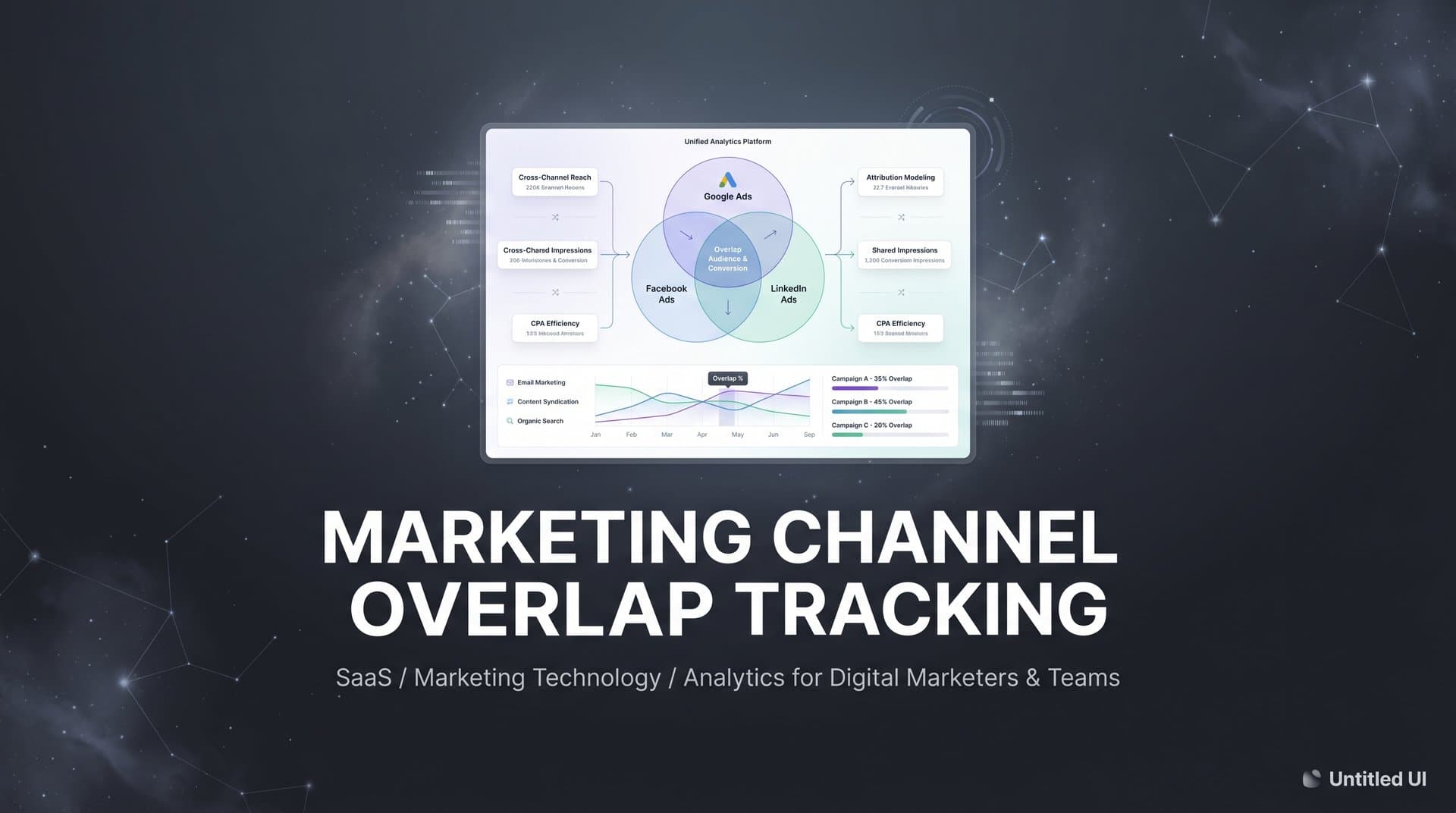
You're running five different marketing channels. Your paid social campaigns are generating clicks. Your Google Ads are converting. Your email sequences are nurturing leads. But here's the question that keeps you up at night: which combination of these touchpoints actually drives your best customers?
Most marketers look at channel performance in isolation. They see that Facebook generated 200 conversions and Google Ads generated 150, then call it a day. But this view misses the reality of how people actually buy.
Your highest-value customers don't convert from a single ad. They discover you on Instagram, research you through organic search, click a retargeting ad, read your emails, and then finally convert through a branded search campaign. Each touchpoint plays a role, but traditional analytics only credits the last one.
This is where marketing channel overlap tracking changes everything. Instead of viewing channels as competitors for credit, you start seeing them as collaborators in the conversion journey. You discover that your "underperforming" Facebook ads are actually introducing customers who later convert through higher-intent channels. You realize that email doesn't just drive direct conversions but significantly boosts the performance of your paid retargeting.
Without this visibility, you make budget decisions based on incomplete data. You might cut spending on channels that play crucial supporting roles. You might over-invest in channels that simply capture demand your other efforts created.
This guide walks you through building a complete channel overlap tracking system. You'll learn how to connect your data sources, implement multi-touch attribution, identify meaningful overlap patterns, and use those insights to optimize your marketing spend. By the end, you'll have a clear framework for understanding how your channels work together and where to invest for maximum impact.
Step 1: Map Your Current Marketing Channels and Touchpoints
Before you can track channel overlap, you need a complete picture of every place customers interact with your brand. This isn't just about listing your active campaigns. It's about documenting every potential touchpoint in the customer journey.
Start by creating a comprehensive channel inventory. Open a spreadsheet and list every marketing channel you're currently running. Include paid social platforms like Facebook, Instagram, LinkedIn, and TikTok. Add your paid search campaigns across Google Ads and Microsoft Advertising. Document your email marketing sequences, organic social presence, SEO efforts, affiliate partnerships, and any referral programs.
Don't forget the channels that seem obvious. Direct traffic matters because it often represents brand recall from earlier touchpoints. Organic search captures intent that your other channels may have sparked. Even offline channels like events, direct mail, or podcast sponsorships create touchpoints that influence online behavior.
Next, map where each channel typically appears in the customer journey. Some channels excel at awareness. Your display ads and top-of-funnel social content introduce your brand to new audiences. Other channels shine during consideration. Retargeting campaigns, comparison content, and nurture email sequences help prospects evaluate their options.
Then you have conversion-focused channels. Branded search campaigns capture high-intent traffic. Bottom-of-funnel email sequences push prospects toward purchase. Understanding these natural roles helps you identify which overlaps make sense and which might signal inefficiency.
Now comes the critical part: identifying your tracking gaps. Walk through a typical customer journey and ask yourself where data might go missing. If someone clicks your Instagram ad on mobile but converts on desktop three days later, does your system connect those dots? If a prospect attends your webinar and later converts through a paid search ad, can you see that sequence?
Common tracking gaps include cross-device journeys, offline-to-online transitions, and long consideration windows where cookies expire. Note every potential blind spot in your current setup. These gaps are where attribution breaks down and channel overlap becomes invisible.
Document everything in a visual customer journey map. Show the typical path from first awareness to final conversion, with all the channels that might appear along the way. Mark the places where channels commonly overlap. For example, many customers discover brands through paid social, research through organic search, and convert through paid search.
Your success indicator here is simple: you should have a comprehensive document showing every active channel, its typical role in the journey, and the known tracking gaps in your current system. This becomes your roadmap for the implementation steps ahead.
Step 2: Implement Unified Tracking Across All Channels
Channel overlap tracking only works when all your channels feed data into a single system. Right now, your Facebook Ads data lives in Facebook. Your Google Ads data lives in Google. Your email data lives in your ESP. These silos make it impossible to connect the dots across touchpoints.
Start with UTM parameters and naming conventions. This is foundational work that determines whether your future analysis will be clean or chaotic. Create a standardized UTM structure and stick to it religiously across every campaign and platform.
Your UTM parameters should include source (the platform), medium (the traffic type), campaign (the specific campaign name), content (the ad variant), and term (for paid search keywords). Use consistent naming formats. If you use underscores in one campaign and hyphens in another, your reporting will be a mess. Learn more about UTM tracking and how it helps your marketing.
For example, a Facebook ad campaign might use: utm_source=facebook, utm_medium=paid_social, utm_campaign=q2_product_launch, utm_content=video_ad_v1. Apply the same logic across every channel. Document your naming conventions in a shared guide so everyone on your team follows the same rules.
Next, connect your ad platforms to a central attribution system. This is where a platform like Cometly becomes essential. You need a system that can ingest data from Facebook Ads, Google Ads, LinkedIn, your CRM, your email platform, and your website analytics, then stitch it all together into unified customer journeys.
Connect each advertising platform through its API. This allows your attribution system to pull campaign data, ad spend, and conversion events automatically. Link your CRM to track when leads progress through your sales pipeline. Connect your email platform to capture nurture sequences and engagement data.
Server-side tracking is critical for accuracy in 2026. Browser privacy changes and iOS updates have made client-side tracking increasingly unreliable. Cookies get blocked, tracking scripts get disabled, and conversions go unrecorded. Server-side tracking bypasses these limitations by sending data directly from your server to your attribution platform.
Implement server-side tracking for your key conversion events. When someone completes a purchase, fills out a lead form, or starts a free trial, that event should be recorded server-side. This ensures you capture the conversion even if the user has ad blockers enabled or has opted out of app tracking.
Configure your attribution platform to receive data from all these sources. Set up conversion tracking pixels on your website. Install the necessary tracking scripts in your checkout flow. Configure webhook integrations between your CRM and attribution system so lead events flow automatically.
Test everything thoroughly. Run test conversions through different channel combinations and verify they appear correctly in your attribution platform. Click a Facebook ad, then convert. Click a Google ad, then convert. Go through a multi-touch journey across several channels and confirm each touchpoint gets recorded.
Your success indicator: when you look at your attribution platform, you should see data flowing in from every active marketing channel. Every conversion should show the complete path of touchpoints that led to it, not just the last click. If you're still seeing isolated channel data without connected journeys, your tracking isn't unified yet.
Step 3: Configure Multi-Touch Attribution Models
Single-touch attribution models like last-click or first-click tell you which channel closed the deal or started the journey, but they completely ignore everything in between. Multi-touch attribution distributes credit across all the touchpoints that contributed to a conversion.
Understanding the different attribution models helps you choose the right one for your business. First-touch attribution gives all credit to the initial touchpoint. This makes sense if you're focused on awareness and want to understand which channels introduce new customers. But it ignores all the nurturing and consideration work that happened afterward.
Last-touch attribution does the opposite. It gives all credit to the final touchpoint before conversion. This works if you have a short sales cycle and customers typically convert immediately. But for most businesses, it over-credits bottom-funnel channels while ignoring the awareness and consideration channels that made the conversion possible.
Linear attribution distributes credit evenly across all touchpoints. If a customer had five interactions before converting, each gets 20% of the credit. This is more balanced but treats all touchpoints as equally important, which usually isn't true.
Time-decay attribution gives more credit to touchpoints closer to the conversion. This reflects the reality that recent interactions often have more influence on the final decision. But it can undervalue the awareness channels that started the journey.
Position-based attribution (also called U-shaped) gives more weight to the first and last touchpoints, with remaining credit distributed to the middle interactions. This acknowledges that introducing a customer and closing the deal are both critical moments.
Data-driven attribution uses machine learning to analyze your actual conversion paths and assign credit based on statistical impact. This is the most sophisticated approach because it's based on your specific data rather than assumptions about how credit should be distributed.
For most businesses with multi-step sales cycles, data-driven attribution provides the most accurate view. It accounts for your unique customer journey patterns and adjusts credit distribution based on what actually drives conversions in your business.
Configure your chosen attribution model in your attribution platform. In Cometly, you can compare multiple attribution models side by side to see how different approaches change your understanding of channel performance. This comparison often reveals surprising insights about which channels are undervalued by last-click attribution.
Set your attribution window based on your sales cycle length. If customers typically convert within seven days of first interaction, a seven-day window works. If you have a longer B2B sales cycle where prospects research for weeks or months, you need a 30-day, 60-day, or even 90-day attribution window.
Configure your system to track the complete path from first click to final conversion. This means capturing every ad click, email open, website visit, and content engagement along the way. The more complete your path data, the more accurate your multi-touch attribution becomes.
Your success indicator: when you view a conversion in your attribution platform, you should see all the touchpoints that preceded it, with credit distributed across them according to your chosen model. You should be able to compare how different attribution models change your understanding of channel performance.
Step 4: Build Channel Overlap Reports and Visualizations
Raw attribution data is powerful but overwhelming. You need reports that surface meaningful overlap patterns so you can actually make decisions based on what you're seeing.
Start by building a channel combination report. This shows which pairs or sequences of channels appear most frequently in converting journeys. You might discover that paid social followed by paid search is your most common two-touch pattern, or that email followed by retargeting followed by branded search is your typical three-touch sequence.
In your attribution platform, create a report that groups conversions by their channel path. Filter for conversions that involved at least two touchpoints. Sort by frequency to see which combinations drive the most volume. This immediately reveals your most important channel partnerships.
Build a channel overlap matrix. This is a visual representation showing how often each channel appears alongside every other channel in conversion paths. You might see that Facebook and Google Ads overlap frequently, while LinkedIn and email rarely appear in the same journeys. This tells you which channel combinations to focus on optimizing. For deeper insights, explore marketing channel overlap measurement techniques.
Create time-lag analysis reports. These show the typical time between touchpoints in your converting journeys. You might find that customers usually convert within 24 hours of clicking a paid search ad, but the time between their first social media interaction and final conversion averages three weeks.
This timing data is crucial for budget planning. If you know that social media awareness typically leads to conversion three weeks later, you can anticipate the downstream impact of increasing or decreasing social spend. You can also optimize your retargeting windows to align with these natural consideration periods.
Build conversion path visualizations that show the most common sequences from first touch to conversion. These path reports reveal the typical journey structure for your customers. You might see that most high-value customers follow a pattern of paid social discovery, organic search research, email nurture, retargeting ad, and then branded search conversion.
Segment your overlap reports by conversion value. The channel combinations that drive high-value customers might look different from those that drive low-value ones. Create separate reports for different customer segments, product lines, or geographic regions to uncover segment-specific patterns.
Set up automated reporting so these overlap insights update regularly. You want to catch shifts in customer behavior as they happen, not discover them months later when reviewing quarterly data. Schedule weekly or monthly reports that highlight changes in your top channel combinations.
Your success indicator: you should have clear, visual reports showing which channel combinations appear most frequently in your conversions, how much time typically passes between touchpoints, and what the most common conversion paths look like. These reports should be easy enough for your entire team to understand and act on.
Step 5: Analyze Overlap Patterns to Find Attribution Insights
Reports show you what's happening. Analysis tells you what it means and what to do about it. This is where you transform overlap data into actionable insights that change how you allocate budget and optimize campaigns.
Start by identifying assist channels. These are channels that rarely get last-click credit but consistently appear earlier in high-value conversion paths. Look at your multi-touch attribution report and compare last-click credit to total influenced conversions for each channel.
You might discover that your podcast sponsorships or display ads generate few direct conversions but appear in the early stages of 60% of your high-value customer journeys. These channels are undervalued by last-click attribution but actually play a crucial role in customer acquisition.
Calculate the true cost per acquisition for each channel when accounting for multi-touch paths. If Facebook gets credit for assisting 500 conversions but only gets last-click credit for 100, your actual Facebook CPA is much lower than the last-click number suggests. This reframing often reveals that channels you thought were expensive are actually cost-effective when you account for their full contribution.
Identify synergistic channel combinations. Look for channel pairs that appear together more frequently than random chance would predict. If customers who interact with both email and paid search convert at twice the rate of those who only see one channel, that's a synergy worth investing in.
Analyze the performance of multi-touch journeys versus single-touch conversions. Compare the conversion rate, average order value, and customer lifetime value of customers who interacted with multiple channels versus those who converted from a single touchpoint. Often, multi-touch customers are more valuable because they're more engaged and informed.
Look for diminishing returns in channel overlap. Sometimes adding more touchpoints doesn't improve results. If customers who see five different channels before converting perform the same as those who see three, you might be over-saturating your audience. This insight helps you avoid wasting budget on excessive retargeting or redundant messaging. Understanding marketing channel overlap issues can help you identify these inefficiencies.
Examine the order of touchpoints in your highest-performing paths. Does paid social work better as an awareness channel followed by paid search, or the reverse? Does email perform better before or after retargeting ads? The sequence matters, and your overlap data reveals the optimal order.
Use AI-powered recommendations to surface patterns you might miss manually. Platforms like Cometly analyze your attribution data to identify high-performing channel combinations and suggest optimization opportunities. The AI might notice that increasing Facebook spend leads to a delayed increase in branded search conversions three weeks later, a pattern that would be hard to spot manually.
Your success indicator: you should have a clear list of insights including which channels are strong assisters, which channel combinations outperform single-channel journeys, what the true multi-touch CPA is for each channel, and where synergies exist that you can invest in further.
Step 6: Optimize Budget Allocation Based on Overlap Data
Insights without action don't improve results. This final step turns your overlap analysis into concrete budget changes that improve your marketing efficiency.
Start by reallocating spend toward high-assist channels that are undervalued by last-click attribution. If your analysis revealed that display ads or podcast sponsorships consistently appear in high-value conversion paths, increase investment in these channels even if they don't generate many direct conversions.
The key is understanding incremental value. Run a test by increasing spend on a high-assist channel and measuring the downstream impact on your conversion channels. When you increase Facebook spend, do you see a corresponding increase in branded search conversions two weeks later? That's evidence of incremental value that justifies the investment.
Optimize your channel sequencing based on what your overlap data revealed. If customers who see paid social before paid search convert better than those who see the sequence reversed, adjust your campaign targeting to encourage this path. Use retargeting audiences to guide customers through the optimal sequence.
Test reducing spend on channels that overlap heavily without adding incremental value. If your analysis shows that email and retargeting ads always appear together but performance doesn't improve with both versus either alone, you might be able to reduce one without hurting results.
Use your time-lag data to optimize retargeting windows and campaign timing. If customers typically convert three weeks after their first social media interaction, set your retargeting campaigns to intensify around that timeframe rather than bombarding users immediately.
Implement AI-powered budget optimization recommendations. Cometly's AI analyzes your attribution data to identify scaling opportunities across channel combinations. It might recommend increasing spend on Facebook because the data shows strong synergy with your Google Ads campaigns, or suggest shifting budget from generic display to more targeted placements that appear in high-value conversion paths.
Create budget allocation rules based on your overlap insights. For example, you might establish that for every dollar you spend on top-of-funnel awareness channels, you allocate 50 cents to mid-funnel retargeting to capitalize on the synergy between them. Learn how to effectively track revenue across marketing channels to validate your budget decisions.
Monitor your results closely after making changes. Track whether your optimizations improve overall ROAS, not just individual channel metrics. The goal is better total performance, which sometimes means accepting lower direct ROAS on assist channels if they improve the performance of your conversion channels.
Your success indicator: improved marketing efficiency with better ROAS and lower blended CPA across your entire channel mix. You should see stronger performance from channel combinations you've invested in and more efficient budget distribution based on true multi-touch contribution rather than last-click credit alone.
Putting It All Together
Tracking marketing channel overlap fundamentally changes how you understand campaign performance. Instead of viewing channels in isolation, you see the complete picture of how they collaborate throughout the customer journey. This visibility leads to smarter budget decisions, better optimization strategies, and improved marketing efficiency.
Use this checklist to verify your setup is complete. First, confirm all channels are mapped and documented with their typical roles in the customer journey. Second, ensure unified tracking is implemented with consistent UTM parameters across every campaign. Third, verify your multi-touch attribution model is configured and showing credit distribution across touchpoints. Fourth, check that overlap reports are built and accessible to your team. Fifth, review that initial patterns have been analyzed and insights documented. Finally, create a budget optimization plan based on your overlap data.
Review your overlap data monthly to catch shifts in customer behavior. Channel performance and customer preferences evolve constantly. What worked last quarter might not work this quarter. Regular analysis helps you stay ahead of these changes and continuously refine your channel mix.
The most successful marketers don't just track overlap—they actively optimize for it. They design campaigns that work together, create messaging sequences that guide customers through the optimal path, and allocate budget based on collaborative performance rather than individual channel metrics.
Ready to elevate your marketing game with precision and confidence? Discover how Cometly's AI-driven recommendations can transform your ad strategy. From capturing every touchpoint to analyzing channel overlap patterns to optimizing your spend across the full customer journey, Cometly provides the complete attribution infrastructure you need. Get your free demo today and start making data-driven decisions based on how your channels actually work together to drive conversions.