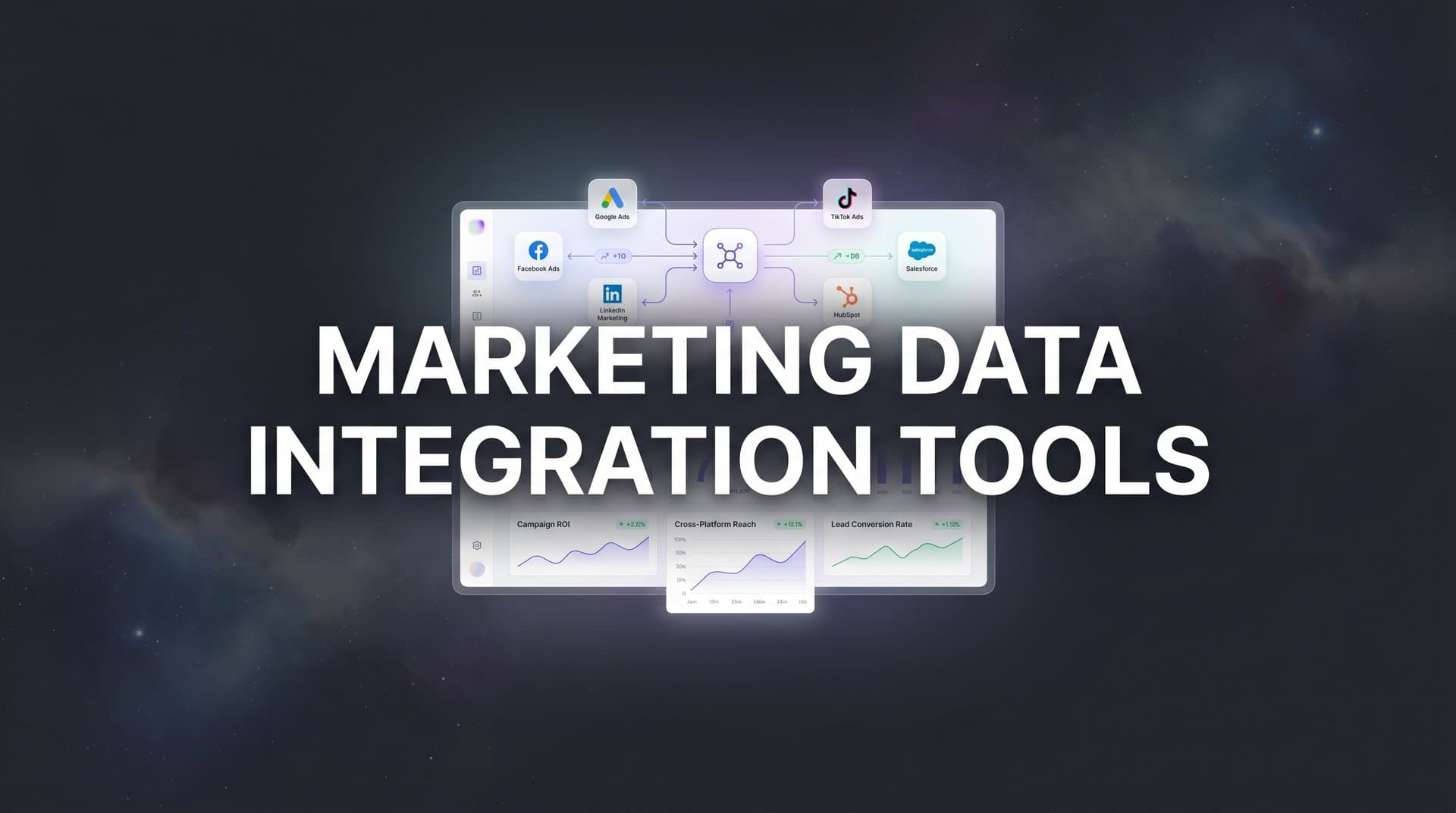
Marketing teams today run campaigns across dozens of platforms simultaneously. Meta, Google Ads, email tools, CRMs, e-commerce systems, and more all generate their own data in their own formats, with no natural way to connect them. The challenge is not generating data. It is making sense of all of it in one place.
Without proper integration, you end up with fragmented reporting, misattributed conversions, and ad spend that disappears into a black hole. Marketing data integration tools solve this by pulling information from multiple sources, unifying it, and making it actionable. Whether you need to sync conversion data back to ad platforms, build cross-channel dashboards, or pipe CRM events into your analytics stack, the right tool depends on your specific use case and technical resources.
We evaluated these tools based on ease of setup, depth of integrations, data accuracy, real-time capabilities, and value for marketing teams specifically. Here are the top marketing data integration tools available in 2026.
1. Cometly
Best for: Marketing teams that need attribution-focused integration connecting ad spend to real revenue.
Cometly is an AI-powered marketing attribution platform that integrates ad platforms, CRM, and website data to track the full customer journey and sync enriched conversion events back to ad platform algorithms.
 10 Best Marketing Data Integration Tools in 2026
Where This Tool Shines
Most data integration tools move raw data from point A to point B. Cometly goes further by connecting every touchpoint across the customer journey and telling you which ads and channels are actually driving revenue. This makes it particularly valuable for performance marketing teams who need more than a data warehouse dump.
The Conversion Sync feature is a standout capability. It feeds enriched, conversion-ready events back to Meta, Google, and other ad platforms, which improves the quality of data those platforms use for targeting and optimization. This creates a feedback loop where better data leads to better ad performance over time.
Key Features
Server-Side Tracking: Captures every touchpoint from ad clicks to CRM events, bypassing browser-level tracking limitations that affect data accuracy.
Multi-Touch Attribution: Tracks the full customer journey across all marketing channels so you can see every interaction that contributed to a conversion.
Conversion Sync: Sends enriched conversion data back to Meta, Google, and other ad platforms to improve their targeting and optimization algorithms.
AI-Powered Recommendations: Identifies high-performing ads and campaigns across every channel and surfaces actionable suggestions for where to scale.
Real-Time Analytics Dashboard: Connects ad spend directly to revenue in real time so you always know what is working and what is not.
Best For
Cometly is best suited for digital marketers, media buyers, and marketing teams running paid campaigns across multiple platforms who need accurate attribution and conversion data. It is especially useful for teams frustrated by the gap between ad platform reporting and actual business results.
Pricing
Custom pricing based on ad spend and integrations. A demo is available on request directly through the Cometly website.
2. Fivetran
Best for: Engineering and data teams that need fully automated pipelines to a cloud data warehouse.
Fivetran is a fully managed ELT platform that automates data pipelines from marketing sources to cloud data warehouses with 300+ pre-built connectors.
 10 Best Marketing Data Integration Tools in 2026
Where This Tool Shines
Fivetran's biggest advantage is that it handles the maintenance work that makes data pipelines so painful. When source APIs change, Fivetran automatically updates its connectors and migrates schemas without requiring manual intervention. For teams that have been burned by broken pipelines after an ad platform API update, this is a meaningful relief.
The platform is built for reliability at scale. If your organization's data strategy centers on a cloud warehouse like Snowflake, BigQuery, or Redshift, Fivetran is one of the most dependable ways to get marketing data flowing into it consistently.
Key Features
300+ Pre-Built Connectors: Covers all major ad platforms, marketing tools, CRMs, and business applications out of the box.
Automatic Schema Migration: Handles API and schema changes automatically, keeping pipelines running without manual fixes.
Incremental Data Syncing: Only moves new or changed data, which keeps costs and processing times efficient.
dbt Integration: Supports built-in data transformation workflows through native dbt compatibility.
SOC 2 Type II Certified: Enterprise-grade security for teams with strict data governance requirements.
Best For
Data engineering teams and analytics-forward organizations that need reliable, low-maintenance pipelines feeding a central data warehouse. Less suited for marketers who need plug-and-play reporting without technical support.
Pricing
Free tier available. Paid plans are usage-based, priced on Monthly Active Rows (MAR), making costs scale with your actual data volume.
3. Supermetrics
Best for: Marketing analysts who want to pull ad platform data directly into spreadsheets or BI tools.
Supermetrics is a marketing data pipeline tool designed to pull data from ad platforms and marketing tools into spreadsheets, BI dashboards, and data warehouses.
 10 Best Marketing Data Integration Tools in 2026
Where This Tool Shines
Supermetrics has built a strong reputation among marketing analysts because it meets them where they already work. If your team lives in Google Sheets or Looker Studio, Supermetrics makes it easy to pull in live data from Google Ads, Meta, LinkedIn, TikTok, and dozens of other platforms without writing a single line of code.
The scheduled refresh feature is particularly useful for teams that need reports to update automatically. Instead of manually exporting CSVs every Monday morning, Supermetrics can keep your dashboards current on a schedule you define.
Key Features
Deep Ad Platform Connectors: Pulls data from Google Ads, Meta Ads, LinkedIn Ads, TikTok Ads, and many more with field-level granularity.
Flexible Destinations: Sends data to Google Sheets, Excel, Looker Studio, BigQuery, Snowflake, and other common destinations.
Scheduled Refreshes: Automatically updates data on a schedule so reports stay current without manual intervention.
Pre-Built Templates: Includes reporting templates for common marketing KPIs to accelerate dashboard setup.
Data Blending: Combines data from multiple sources within a single report for cross-channel analysis.
Best For
Marketing analysts and small-to-mid-size teams who want quick access to ad platform data in familiar tools like Google Sheets or Looker Studio, without needing a full data engineering setup.
Pricing
Starts around $39 per month for basic connectors. Pricing scales based on the number of destinations and data sources you connect.
4. Funnel.io
Best for: Marketing teams that need a dedicated data hub for collecting, mapping, and transforming cross-channel data.
Funnel.io is a marketing data hub that collects, maps, and transforms data from advertising and marketing platforms before routing it to BI tools or warehouses.
 8 Best GDPR Compliant Attribution Software Tools in 2026
Where This Tool Shines
What separates Funnel.io from general-purpose ETL tools is its focus on data harmonization. Different ad platforms use different naming conventions, metrics, and structures. Funnel's built-in mapping and transformation rules let you standardize all of that before it reaches your dashboard or warehouse, which saves a significant amount of manual cleanup work.
The platform also handles practical details like automatic currency conversion and dimension grouping, which matter a lot for teams running international campaigns across multiple ad accounts.
Key Features
500+ Connectors: One of the broadest connector libraries in the marketing data space, covering advertising, analytics, and sales tools.
Data Mapping and Transformation: Built-in rules for harmonizing cross-platform data so metrics are consistent across sources.
Currency Conversion: Automatically converts spend data across currencies for multi-market campaigns.
Flexible Export Options: Routes data to warehouses, BI tools, and dashboards based on your existing stack.
Data Governance Features: Provides controls and audit capabilities suited to enterprise marketing teams.
Best For
Mid-market and enterprise marketing teams running complex, multi-channel campaigns who need clean, harmonized data before it reaches their reporting layer. Particularly useful for teams managing international ad budgets.
Pricing
Custom pricing. Typically starts in the mid-hundreds per month for growing teams, with enterprise contracts for larger organizations.
5. Segment (Twilio)
Best for: Product and marketing teams that need real-time event tracking and audience routing across tools.
Segment is a Customer Data Platform that collects user events from web, mobile, and server sources and routes them in real time to marketing, analytics, and data warehouse destinations.
 8 Best Attribution-Focused Platforms vs Segment: Which Approach Fits Your Marketing Stack in 2026
Where This Tool Shines
Segment's core strength is its single-API approach to event tracking. Instead of adding separate tracking code for every marketing tool you use, you instrument once with Segment and then route that data to any destination in your stack. Adding a new analytics tool or ad platform integration becomes a configuration change rather than a development project.
The identity resolution capabilities are also worth noting. Segment can stitch together user behavior across devices and sessions, giving you a more complete picture of how individuals interact with your brand before converting.
Key Features
Single Tracking API: Instrument your web, mobile, and server sources once and route data anywhere without additional development.
400+ Pre-Built Integrations: Connects to marketing, analytics, and data warehouse destinations out of the box.
Real-Time Event Streaming: Delivers user events to destinations in real time for immediate activation.
Identity Resolution: Stitches user behavior across devices and channels for a unified customer profile.
Protocols: Enforces data quality standards to prevent bad data from flowing into downstream tools.
Best For
Growth and product marketing teams at SaaS companies or e-commerce businesses who want a central event hub that feeds data to their entire marketing and analytics stack in real time.
Pricing
Free tier supports up to 1,000 visitors per month. Team plan starts at $120 per month. Business plan is custom pricing.
6. Stitch (Talend)
Best for: Developers and small data teams that need a simple, transparent ELT service without complexity.
Stitch is a simple, developer-friendly ELT service that replicates data from marketing and business applications to cloud data warehouses.
 9 Best Ad Platform Data Sync Tools for Marketers in 2026
Where This Tool Shines
Stitch earns its place on this list through simplicity and transparency. Setup is straightforward, pricing is row-based and easy to predict, and the platform does not try to be everything to everyone. For teams that just need reliable data replication to a cloud warehouse without a lot of configuration overhead, Stitch delivers.
The open-source Singer framework is a notable advantage for technical teams. If you need a connector that does not exist yet, Singer gives you a structured way to build it and contribute it back to the community.
Key Features
130+ Pre-Built Integrations: Covers major marketing platforms, databases, and SaaS applications.
Singer Framework: Open-source standard for building custom connectors if your source is not already supported.
Simple Setup: Minimal configuration required to get pipelines running, even for non-engineers.
Major Warehouse Support: Destinations include Snowflake, BigQuery, Redshift, and other leading warehouses.
Transparent Pricing: Row-based pricing model that is easy to understand and forecast.
Best For
Small data teams and developers who want a no-frills ELT tool that gets data into a warehouse reliably without a steep learning curve or unpredictable costs.
Pricing
Free plan available for up to 5 million rows per month. Paid plans scale based on row volume beyond that threshold.
7. Airbyte
Best for: Engineering teams that want full control over their data infrastructure with open-source flexibility.
Airbyte is an open-source data integration platform with 350+ connectors that can be self-hosted or used as a managed cloud service.
 10 Best Marketing Data Integration Tools in 2026
Where This Tool Shines
Airbyte's open-source model gives engineering teams something that managed services cannot: full control over their infrastructure and data. You can self-host it on your own servers, inspect the connector code, and customize behavior in ways that proprietary tools simply do not allow.
The Connector Development Kit makes it practical to build and maintain custom connectors, which matters for teams that use niche marketing tools or internal data sources that are not covered by commercial platforms. The community-contributed connector library also grows continuously, which expands coverage over time.
Key Features
350+ Connectors: Broad coverage including community-contributed connectors for less common sources.
Open-Source Core: Full infrastructure control with the ability to inspect, fork, and customize the platform.
Connector Development Kit: Structured framework for building custom connectors when existing ones do not cover your source.
Flexible Deployment: Available as self-hosted, cloud-managed, or hybrid depending on your infrastructure needs.
Incremental Sync and CDC: Supports incremental data syncing and change data capture for efficient, up-to-date pipelines.
Best For
Data engineering teams at companies with the technical resources to manage infrastructure and a need for flexibility that managed services cannot provide. Also a strong choice for cost-conscious teams who want to avoid per-row pricing at scale.
Pricing
Open-source self-hosted version is free. Airbyte Cloud uses usage-based pricing per credit for teams that prefer a managed option.
8. Zapier
Best for: Non-technical marketers who need lightweight, trigger-based automation between marketing tools.
Zapier is a no-code automation platform that connects thousands of apps through trigger-based workflows, enabling lightweight data syncing between marketing tools.
Where This Tool Shines
Zapier is the go-to option when you need to connect two tools quickly without involving a developer. Its trigger-and-action model is intuitive enough that most marketers can build useful workflows in under an hour. Think: new lead in your CRM automatically added to an email sequence, or a form submission that creates a task in your project management tool.
With over 7,000 app integrations, Zapier covers nearly every marketing tool on the market. For small teams or individual marketers managing a lean stack, it can handle a surprising amount of data movement without any code.
Key Features
7,000+ App Integrations: Covers virtually every marketing, sales, and productivity tool available.
No-Code Workflow Builder: Drag-and-drop interface with conditional logic and multi-step workflows accessible to non-technical users.
Filters and Formatters: Built-in tools for transforming and routing data within workflows.
Scheduled and Real-Time Triggers: Run automations instantly when events occur or on a defined schedule.
Tables Feature: Lightweight data storage for simple use cases that do not require a full database.
Best For
Solo marketers, small teams, and non-technical users who need quick, reliable automation between marketing tools without writing code. Not designed for high-volume data pipelines or complex transformations.
Pricing
Free plan includes 100 tasks per month. Starter plan at $19.99 per month. Professional plan at $49 per month with higher task limits and advanced features.
9. Improvado
Best for: Enterprise marketing teams that need automated data aggregation and reporting across hundreds of sources.
Improvado is an enterprise marketing analytics platform that automates data aggregation, harmonization, and visualization from hundreds of marketing and sales sources.
Where This Tool Shines
Improvado is built specifically for marketing teams at scale. While general-purpose ETL tools require significant configuration to produce marketing-ready reports, Improvado comes with pre-built marketing data models and dashboard templates designed around the KPIs that marketing teams actually care about.
The automated data harmonization is a meaningful time-saver for large organizations managing dozens of ad accounts and campaigns. Instead of manually reconciling data from different platforms, Improvado normalizes it automatically before it reaches your reporting layer.
Key Features
500+ Connectors: Comprehensive coverage of marketing, advertising, and sales data sources.
Pre-Built Marketing Data Models: Ready-to-use data structures designed around cross-channel marketing reporting.
Automated Harmonization: Deduplicates and normalizes data across sources without manual mapping work.
Custom Dashboard Templates: Pre-built visualizations for common marketing KPIs to accelerate reporting setup.
Enterprise Support: Dedicated customer success and support resources for large organizations.
Best For
Enterprise marketing teams and agencies managing significant multi-channel ad budgets who need a purpose-built platform rather than a general-purpose data pipeline tool.
Pricing
Custom enterprise pricing. Typically suited for organizations with substantial multi-channel advertising budgets and dedicated analytics resources.
10. Census
Best for: Data teams that need to activate warehouse data in marketing platforms, CRMs, and operational tools.
Census is a reverse ETL platform that syncs modeled data from cloud warehouses back into marketing platforms, CRMs, and operational tools.
Where This Tool Shines
Census solves a problem that traditional ETL tools do not address: getting data out of your warehouse and into the tools your marketing team actually uses. Once your data team has built clean, modeled data in Snowflake or BigQuery, Census lets you sync that data to ad platforms, CRMs, and email tools so it can drive real campaigns.
The Audience Hub feature is particularly useful for marketing teams. It allows non-technical marketers to build audience segments directly from warehouse data without writing SQL, then sync those audiences to Meta, Google, or any other destination for activation.
Key Features
Reverse ETL Syncing: Moves modeled data from Snowflake, BigQuery, Redshift, and Databricks into operational tools.
200+ Destination Integrations: Covers ad platforms, CRMs, email tools, and other marketing destinations.
Audience Hub: Enables marketers to build and sync audience segments from warehouse data without SQL knowledge.
Real-Time and Scheduled Syncs: Supports both immediate event-triggered syncs and scheduled batch updates.
Git-Based Version Control: Tracks changes to sync configurations for auditability and collaboration.
Best For
Data-mature organizations that already have a cloud warehouse and want to activate that data in their marketing and sales tools. Best used in combination with an ETL tool rather than as a standalone integration solution.
Pricing
Free tier available with limited syncs. Paid plans scale based on sync volume and the number of destination integrations.
Which Tool Is Right for Your Team?
The right marketing data integration tool depends entirely on what problem you are actually trying to solve. These tools span very different categories, and choosing the wrong one can leave you with data in a warehouse but no way to act on it, or automation workflows that cannot handle the volume you need.
If your primary goal is connecting ad spend to actual revenue and improving the quality of conversion data feeding your ad platforms, Cometly is the most direct solution. It is purpose-built for performance marketing teams who need attribution accuracy and conversion signal quality, not just raw data movement.
If you need to pipe marketing data into a cloud warehouse reliably, Fivetran and Airbyte are the strongest options, with Fivetran offering a fully managed experience and Airbyte providing open-source flexibility. For marketing analysts who want data in spreadsheets or BI tools without engineering support, Supermetrics or Funnel.io are natural fits.
For teams that already have a mature data warehouse and want to activate that data in their marketing tools, Census fills the reverse ETL gap. And for non-technical marketers who just need quick automation between tools, Zapier remains the most accessible starting point.
The best marketing data integrations do not just move data. They make it usable, accurate, and actionable. If you want to see how attribution-focused integration can sharpen your ad performance and surface the campaigns actually driving revenue, Get your free demo of Cometly and start capturing every touchpoint across your customer journey.