

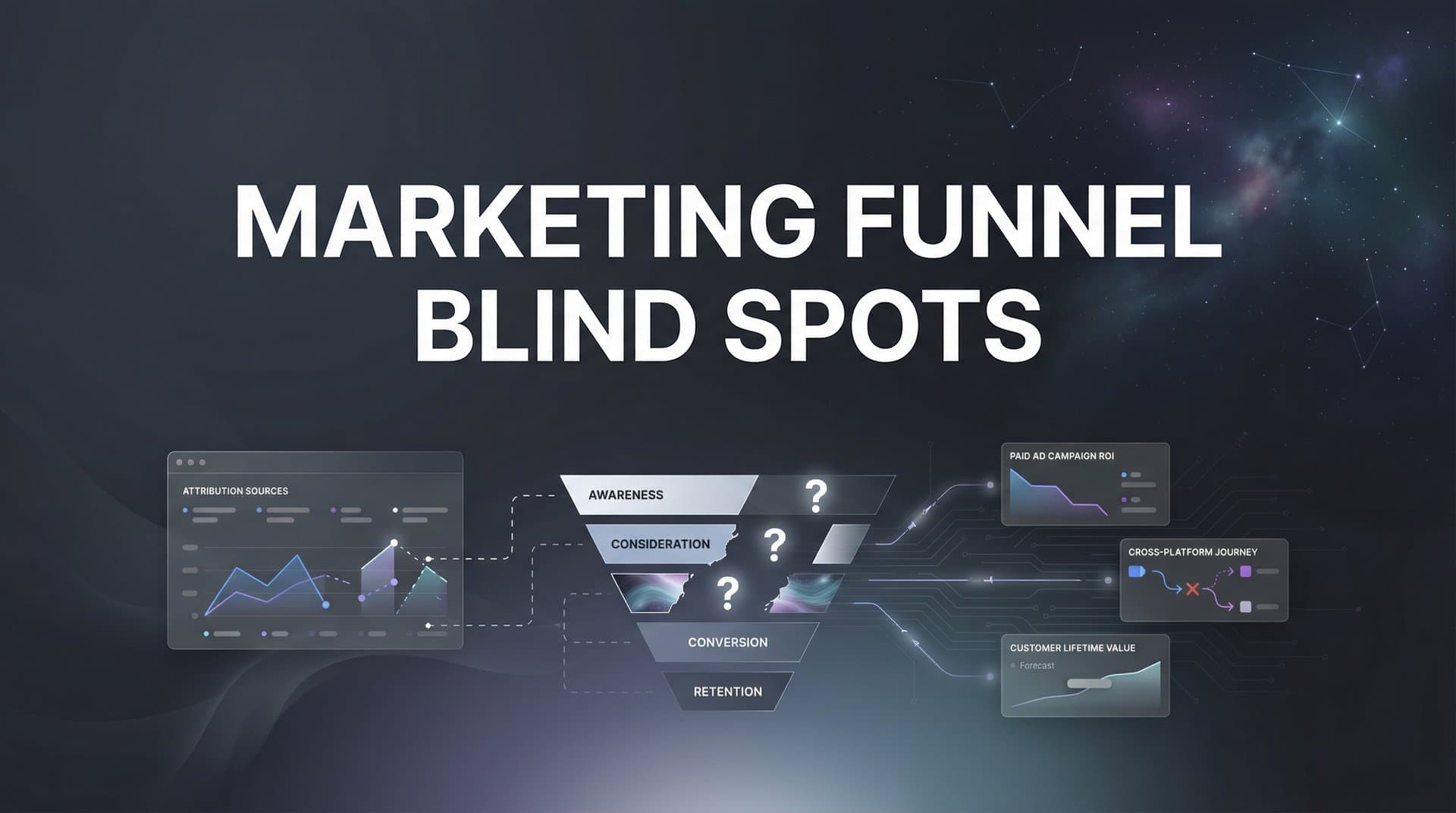
Every marketer knows the frustration: campaigns that should be winning are underperforming, budgets disappear into channels that seem promising but deliver murky results, and the customer journey feels more like a black box than a clear path. The culprit is often not your creative, your targeting, or even your offer. It is the blind spots hiding in your marketing funnel that prevent you from seeing what is actually happening.
These gaps in visibility lead to misallocated budgets, missed optimization opportunities, and flawed strategic decisions. You might be scaling the wrong campaigns, cutting winners too early, or feeding your ad platforms incomplete data that degrades their ability to optimize.
The good news? Once you know where to look, these blind spots become fixable problems rather than invisible profit drains. This guide reveals the seven most common funnel blind spots plaguing digital marketers today, along with practical strategies to eliminate each one and finally get the clarity you need to scale with confidence.
1. The Cross-Platform Attribution Gap
The Challenge It Solves
Open your Facebook Ads Manager and Google Ads dashboard simultaneously. Look at your conversion numbers. Now add them together. If that total exceeds your actual sales, you have discovered the cross-platform attribution gap in action.
Each ad platform uses last-click attribution by default, meaning they claim full credit for any conversion where their ad was the final touchpoint. When a customer clicks a Facebook ad, then later clicks a Google ad before purchasing, both platforms report that sale. Your data shows 150 conversions when you actually had 100. This inflated reporting creates a dangerous illusion of success that leads to budget misallocation and strategic mistakes.
The Strategy Explained
The solution requires moving beyond platform-reported metrics to independent, unified tracking that captures the entire customer journey across all channels. This means implementing a source-of-truth attribution system that sits outside your ad platforms and tracks every touchpoint from first click to final conversion.
Think of it like having a neutral referee instead of letting each team keep their own score. Your attribution platform should capture data from all sources, deduplicate conversions, and apply consistent attribution logic across every channel. This gives you an accurate view of how channels work together rather than competing attribution claims. Understanding marketing funnel attribution challenges is the first step toward solving this problem.
The key is connecting your website tracking, ad platform data, and conversion events into a single system that can identify the same user across multiple touchpoints and assign credit appropriately.
Implementation Steps
1. Implement unified tracking that captures user journeys across all marketing channels with a consistent user identifier that persists across sessions and devices.
2. Set up server-side tracking to ensure data accuracy independent of browser limitations, cookies, and ad blockers that can fragment your view of the customer journey.
3. Choose an attribution model that reflects your actual customer journey length and complexity, whether that is first-touch, linear, time-decay, or position-based attribution.
4. Compare platform-reported conversions against your unified tracking system to identify the magnitude of overlap and adjust budget allocation based on true incremental performance.
Pro Tips
Start by tracking the attribution discrepancy percentage for each platform. If Facebook reports 40% more conversions than your unified system attributes to it, you know exactly how much their reporting inflates reality. Use this insight to adjust your ROAS targets and budget decisions. Many marketers find that channels they thought were top performers are actually assisted touchpoints rather than primary drivers.
2. The iOS Privacy Tracking Void
The Challenge It Solves
When Apple introduced App Tracking Transparency, it fundamentally changed how the Facebook pixel and other browser-based tracking tools function on iOS devices. Users who opt out of tracking become invisible to traditional pixel-based measurement, creating a growing black hole in your data.
This is not a small gap. iOS represents a significant portion of high-value customers in many markets, and opt-in rates for tracking have remained low. The result is that a substantial percentage of your actual conversions go unreported, making profitable campaigns appear to underperform and degrading your ability to optimize targeting.
The Strategy Explained
The solution lies in server-side tracking architecture that bypasses browser-based limitations entirely. Instead of relying on cookies and pixels that users can block, server-side tracking sends conversion data directly from your server to ad platforms through their Conversion APIs.
When a user completes a purchase on your website, your server immediately sends that conversion event to Facebook, Google, and other platforms with all the relevant data they need to optimize. This happens regardless of whether the user has tracking enabled on their device, because the data transmission occurs server-to-server rather than through the browser.
The critical advantage is that server-side events are not subject to iOS privacy restrictions, ad blockers, or cookie deletion. You capture the full picture of conversions and feed complete data back to ad platform algorithms. This is one of the most effective marketing funnel visibility strategies available today.
Implementation Steps
1. Implement the Conversions API for Facebook and similar server-side tracking solutions for Google Ads and other platforms you use.
2. Ensure your server-side implementation captures key event parameters including event time, user data, custom parameters, and event source URL to maximize matching accuracy.
3. Set up event deduplication between browser pixel events and server events using event ID matching to prevent double-counting conversions that fire from both sources.
4. Monitor your event match quality scores in each platform to identify and fix data quality issues that reduce the effectiveness of your server-side tracking.
Pro Tips
Server-side tracking typically reveals 20-40% more conversions than pixel-only tracking in campaigns targeting iOS users. This additional visibility immediately improves campaign performance reporting and helps ad algorithms optimize more effectively. Prioritize implementing server-side tracking for your highest-value conversion events first, then expand to secondary events once the foundation is solid.
3. The Mid-Funnel Measurement Desert
The Challenge It Solves
Most attribution setups track the first click and the final conversion, but everything that happens in between remains invisible. A prospect might click your Facebook ad, read three blog posts, download a guide, watch a webinar, and receive five nurture emails before finally purchasing. Traditional tracking shows the Facebook click and the sale, but misses the five touchpoints that actually moved them toward conversion.
This mid-funnel blindness prevents you from understanding which content, nurture sequences, and engagement activities actually influence buying decisions. You cannot optimize what you cannot see, which means your mid-funnel strategy remains guesswork.
The Strategy Explained
Multi-touch attribution solves this by tracking and valuing every touchpoint in the customer journey, not just the first and last. This requires capturing engagement data across your website, email platform, CRM, and any other channels where prospects interact with your brand.
The goal is building a complete timeline for each customer that shows every ad click, page visit, content download, email open, and engagement event leading up to conversion. With this visibility, you can identify which mid-funnel activities correlate with higher conversion rates and which are dead ends. Implementing marketing funnel attribution analysis helps you understand these complex customer journeys.
For example, you might discover that prospects who watch a specific product demo video convert at three times the rate of those who do not, or that a particular nurture email sequence dramatically shortens the sales cycle. This intelligence allows you to optimize your entire funnel, not just the entry and exit points.
Implementation Steps
1. Implement event tracking for all meaningful mid-funnel interactions including content downloads, video views, pricing page visits, demo requests, and email engagement.
2. Connect your email platform, CRM, and website analytics into a unified customer journey tracking system that can stitch together touchpoints across platforms.
3. Set up cohort analysis to compare conversion rates and time-to-conversion for users who engage with specific mid-funnel content versus those who do not.
4. Build attribution reports that show the full path-to-conversion for your customers, highlighting which mid-funnel touchpoints appear most frequently in successful journeys.
Pro Tips
Focus on identifying your highest-leverage mid-funnel content by analyzing conversion paths. If 70% of customers who convert watched a specific video or read a particular case study, that content deserves more promotion and better distribution. Use this insight to build retargeting campaigns that push prospects toward your most effective mid-funnel assets rather than just retargeting them with the same top-of-funnel offer.
4. The CRM-to-Ad Platform Disconnect
The Challenge It Solves
Your ad platforms optimize for the conversion events you send them, but most marketers only send lead events, not actual sales. Facebook and Google celebrate when someone fills out a form, but they have no idea whether that lead closed for $500 or $50,000, or whether they churned after one month or stayed for three years.
This disconnect means your ad algorithms optimize for lead volume rather than revenue quality. You might be scaling campaigns that generate tons of low-value leads while starving campaigns that bring in fewer but higher-quality prospects who actually become profitable customers.
The Strategy Explained
The solution is closing the loop by sending downstream revenue data from your CRM back to your ad platforms. This is called offline conversion tracking or CRM integration, and it fundamentally changes how ad algorithms optimize your campaigns.
When you send actual sale amounts, customer lifetime values, and deal close dates back to Facebook and Google, their algorithms can optimize for revenue instead of just leads. The platforms learn which audience segments, ad creatives, and targeting parameters drive the most valuable customers, not just the most form fills. This approach to marketing revenue attribution transforms how you measure success.
This feedback loop allows ad platforms to shift budget toward genuinely profitable traffic sources and away from channels that generate vanity metrics without business impact.
Implementation Steps
1. Set up offline conversion tracking in Facebook Ads Manager and Google Ads by uploading conversion data from your CRM that matches back to the original ad click.
2. Include conversion value data in every upload so platforms can optimize for revenue rather than just conversion count, using actual deal amounts or customer lifetime value calculations.
3. Establish a regular upload cadence that sends updated conversion data as deals progress through your sales pipeline, typically weekly or bi-weekly depending on your sales cycle length.
4. Create value-based bidding strategies that tell ad platforms to prioritize high-value conversions over low-value ones, shifting budget toward audience segments with better revenue potential.
Pro Tips
The impact of CRM integration compounds over time as ad algorithms accumulate more data about what high-value customers look like. Many marketers see dramatic improvements in lead quality within 30-60 days of implementation as platforms learn to distinguish between tire-kickers and serious buyers. If your sales cycle is longer than 30 days, consider sending multiple conversion events at different pipeline stages so algorithms get faster feedback.
5. The Vanity Metrics Trap
The Challenge It Solves
Clicks, impressions, engagement rate, video views, page likes. These metrics feel good to report in meetings, but they often have zero correlation with actual business outcomes. A campaign with a 5% click-through rate might generate terrible ROI while a campaign with a 1% CTR drives profitable revenue.
The vanity metrics trap happens when marketers optimize for easily measurable engagement signals rather than the harder-to-track metrics that actually matter. You end up scaling campaigns that generate activity without value, while potentially cutting campaigns that drive real business results but show weaker engagement numbers.
The Strategy Explained
The fix requires ruthlessly connecting every metric you track back to revenue impact. This means building reporting that shows not just how many clicks or engagements you generated, but what those interactions actually produced in terms of pipeline, closed deals, and customer lifetime value.
Start by identifying your true north metric, the one number that best represents business success. For most businesses, this is revenue, qualified pipeline, or customer acquisition cost relative to lifetime value. Every other metric should be evaluated based on whether it correlates with and predicts this north star. Learning how to measure marketing campaign effectiveness properly eliminates this trap.
This does not mean engagement metrics are worthless. It means you need to understand which engagement signals actually predict conversion and which are just noise. A high email open rate matters if those opens lead to clicks, which lead to conversions. If they do not, the open rate is a vanity metric.
Implementation Steps
1. Audit your current reporting dashboards and identify which metrics you track that have never been proven to correlate with revenue or other business outcomes.
2. Build cohort analyses that compare engagement metrics against actual conversion and revenue data to identify which signals are predictive versus decorative.
3. Restructure your campaign reporting to lead with business outcome metrics like cost per acquisition, return on ad spend, and customer lifetime value, with engagement metrics as secondary context.
4. Set campaign goals and optimization targets based on business outcomes rather than engagement thresholds, even if this makes your metrics look less impressive in isolation.
Pro Tips
Create a simple test for any metric you track: if this number improved by 50% but revenue stayed flat, would you consider the campaign successful? If the answer is no, that metric should not drive your optimization decisions. Focus your attention on the metrics that pass this test, and relegate everything else to supporting context that helps explain performance but does not define it.
6. The Time-Lag Blindness Problem
The Challenge It Solves
You launch a new campaign on Monday. By Friday, it shows weak performance, so you pause it. Three weeks later, you discover that campaign generated several high-value sales that took time to materialize, but by then you have already killed it and moved budget elsewhere.
This scenario plays out constantly because most marketers judge campaign performance on a time horizon that is shorter than their actual customer decision cycle. B2B purchases might take 60-90 days from first touch to close. High-ticket consumer purchases might take weeks of research and consideration. Yet campaigns get evaluated and optimized based on 7-day or 14-day windows.
The Strategy Explained
The solution is aligning your measurement window with your actual customer journey timeline. This requires understanding how long it typically takes prospects to convert after their first interaction with your brand, then giving campaigns enough time to demonstrate true performance before making optimization decisions.
Start by analyzing your historical conversion data to identify the median time-to-conversion. If 50% of your customers convert within 30 days and 80% convert within 60 days, you need to evaluate campaigns over at least a 60-day window to capture the majority of their impact. This is especially critical when optimizing marketing funnel with analytics for longer sales cycles.
This also means implementing conversion lag reporting that shows when conversions are attributed back to earlier campaign activity. A campaign that looks weak in its first week might show strong performance when you account for conversions that happen in weeks two through eight.
Implementation Steps
1. Analyze your historical conversion data to calculate median and 80th percentile time-to-conversion from first touch, broken down by channel and campaign type.
2. Set attribution windows in your tracking platform that match your actual customer journey timeline rather than defaulting to platform standards like 7-day click or 1-day view.
3. Build lag-adjusted performance reports that show campaign results with conversions attributed back to the original touchpoint regardless of when they occurred.
4. Establish campaign evaluation policies that prevent optimization decisions on new campaigns until they have run for at least your median conversion timeline.
Pro Tips
Create a simple dashboard that shows campaign performance at multiple time horizons: 7 days, 14 days, 30 days, 60 days, and 90 days. This reveals how performance evolves over time and helps you identify campaigns that start slow but build momentum versus campaigns that show early promise but fail to deliver sustained results. Many of your best long-term performers will look mediocre in the first week.
7. The Algorithm Feedback Loop Failure
The Challenge It Solves
Facebook's Advantage+ campaigns and Google's Performance Max rely on machine learning to automatically optimize targeting, bidding, and creative delivery. These algorithms can dramatically improve performance, but only when they receive complete and accurate conversion data to learn from.
When your conversion tracking is incomplete due to iOS privacy issues, when you only send lead events instead of sale events, or when conversion data arrives delayed by days or weeks, you starve these algorithms of the feedback they need. The result is degraded performance as the AI optimizes based on partial or misleading signals.
For a deeper dive, see our guide to ad platform data accuracy issues.
The Strategy Explained
Maximizing algorithm performance requires feeding ad platforms the highest quality conversion data possible. This means implementing server-side tracking to capture conversions that browser pixels miss, sending conversion value data so algorithms can optimize for revenue, and ensuring conversion events fire as close to real-time as possible.
Think of ad platform algorithms as incredibly powerful engines that need high-quality fuel. Feed them premium data and they perform brilliantly. Feed them incomplete or delayed data and they sputter. Your job is ensuring the conversion data pipeline is as complete, accurate, and timely as possible. Leveraging AI powered marketing analytics tools can help automate this data optimization process.
This also means being strategic about which conversion events you optimize for. Optimizing for a micro-conversion that happens frequently but does not correlate with revenue will train the algorithm to find more of the wrong people. Optimizing for actual sales or high-intent actions trains the algorithm to find genuinely valuable prospects.
Implementation Steps
1. Implement server-side conversion tracking through Conversions API and similar tools to ensure ad platforms receive complete conversion data regardless of browser limitations.
2. Send conversion value data with every event so algorithms can optimize for high-value conversions rather than just conversion volume, using actual purchase amounts or estimated customer lifetime values.
3. Minimize conversion data latency by triggering conversion events in real-time or near-real-time rather than batch uploading data days later when the learning window has closed.
4. Audit your conversion event quality using platform-provided tools like Facebook's Event Match Quality score and Google's conversion tracking status to identify and fix data quality issues.
Pro Tips
Ad platform algorithms typically need 50 conversion events per week per campaign to optimize effectively. If you are running multiple campaigns that each generate fewer conversions than this threshold, consider consolidating into fewer campaigns with higher event volume so algorithms have enough data to learn from. This is why campaign consolidation often improves performance even though it seems counterintuitive.
Your Path to Complete Funnel Visibility
Eliminating marketing funnel blind spots is not about adding more tools or generating more reports. It is about connecting the data you already have into a unified view that reveals what is actually driving revenue.
Start by auditing your current tracking setup against these seven blind spots. Which ones are costing you the most right now? For most marketers, the cross-platform attribution gap and iOS tracking void create the foundation problems that cascade into other issues.
Prioritize fixing these tracking infrastructure blind spots first. Implement server-side tracking to capture iOS conversions your pixel misses. Set up unified attribution that deduplicates conversions across platforms. These changes immediately improve data accuracy and give you a clearer picture of true campaign performance.
Then layer in multi-touch attribution to illuminate your mid-funnel, and connect your CRM data back to ad platforms so algorithms can optimize for actual revenue. As each blind spot gets eliminated, your visibility improves and your optimization decisions become more confident.
The marketers who win are not the ones with the biggest budgets. They are the ones who can see clearly what their competitors cannot. When you can finally track every touchpoint that influences a sale, you stop guessing and start scaling with precision.
Ready to elevate your marketing game with precision and confidence? Discover how Cometly's AI-driven recommendations can transform your ad strategy. Get your free demo today and start capturing every touchpoint to maximize your conversions.


