

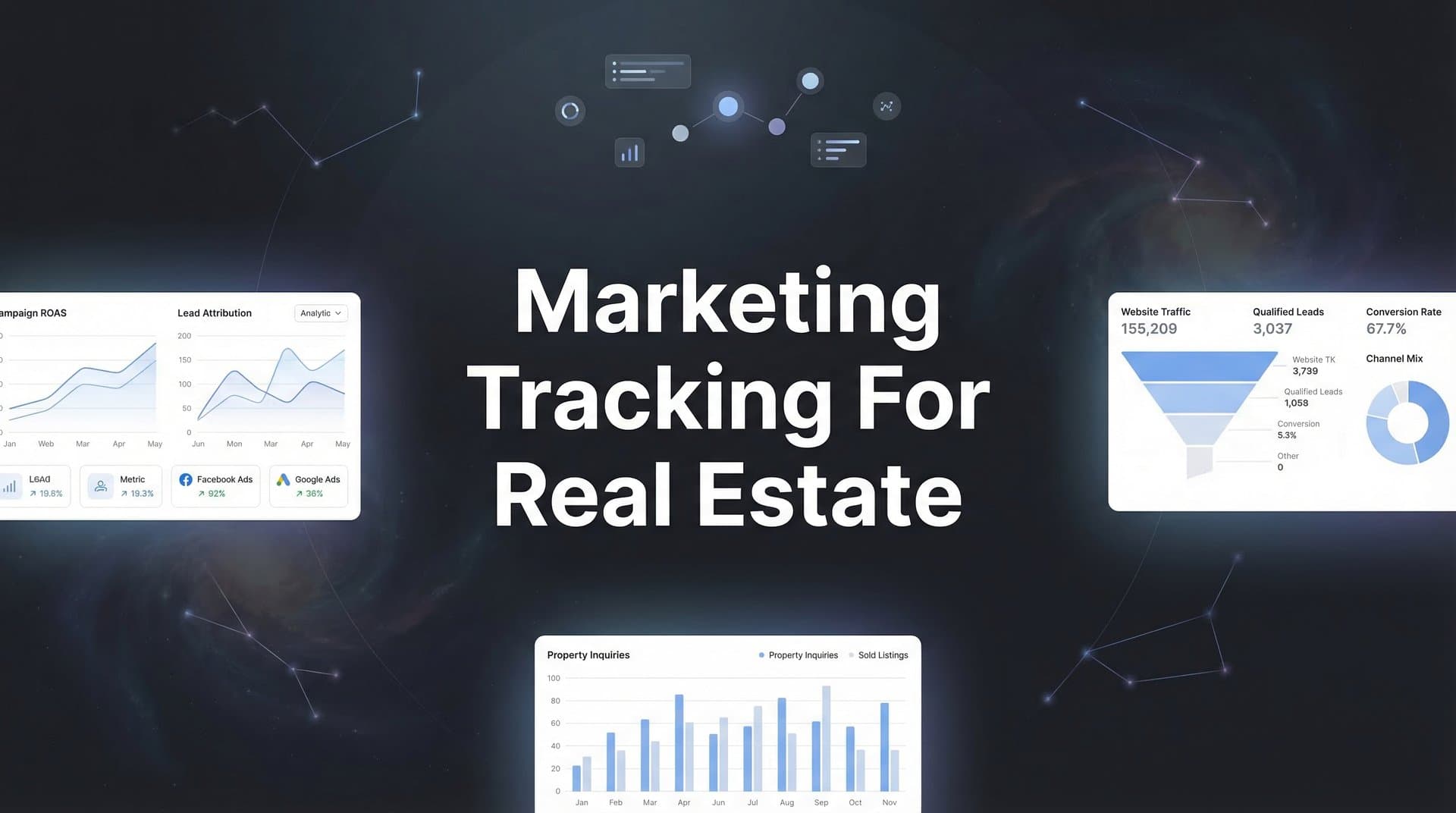
Real estate marketing presents a unique tracking challenge: the gap between a lead clicking an ad and actually closing on a property can span months. During that time, prospects visit open houses, browse listings, exchange emails with agents, and research neighborhoods—often across multiple devices. Without proper tracking, you're essentially flying blind, unable to connect your marketing spend to the deals that actually close.
Think about it. A buyer sees your Facebook ad for a new development in January, visits your website from their phone, comes back on their laptop two weeks later, attends an open house in February, emails with your agent through March, and finally closes in April. If you're only tracking that initial Facebook click, you're missing the entire story.
This guide delivers seven battle-tested strategies for implementing marketing tracking that follows the complete real estate buyer journey, from first ad impression to signed contract. Whether you're a solo agent, brokerage, or real estate marketing agency, these approaches will help you finally understand which channels deliver buyers who close—not just leads who ghost.
1. Implement Server-Side Tracking
The Challenge It Solves
Browser-based tracking breaks down fast in real estate. A prospect researches properties across multiple devices over months, browsers block cookies, and iOS privacy features prevent you from connecting the dots. When someone finally converts, you've lost track of where they originally came from.
This isn't just frustrating—it's expensive. You're making budget decisions based on incomplete data, potentially cutting channels that actually work while scaling ones that don't.
The Strategy Explained
Server-side tracking moves data collection from the browser to your server, capturing interactions directly before browser limitations can interfere. Instead of relying on cookies that expire or get blocked, you're creating a persistent record of each prospect's journey tied to identifiers that survive across sessions and devices. This approach aligns with modern cookieless tracking for marketing strategies that maintain accuracy despite privacy changes.
For real estate specifically, this means tracking property views, search filters, saved listings, and contact form submissions in a way that connects back to the original marketing source—even when months pass between first visit and closing.
The beauty here is accuracy. Server-side tracking captures what actually happened, not what browsers allow you to see.
Implementation Steps
1. Choose a platform that supports server-side tracking for real estate workflows, ensuring it can handle long conversion windows and multiple touchpoint attribution.
2. Install server-side tracking on your website and landing pages, configuring it to capture property-specific events like listing views, search parameters, neighborhood pages visited, and contact form submissions with property context.
3. Connect your ad platforms (Meta, Google Ads, etc.) to receive server-side conversion data, ensuring they see which campaigns drive property interest and eventual closings.
4. Test your implementation by tracking a few known conversions through the full journey, verifying that data flows correctly from initial ad click through website activity to final conversion.
Pro Tips
Focus on tracking property-specific context—not just page views. Knowing someone viewed "3-bedroom homes in Riverside under $500k" tells you far more than knowing they visited your listings page. This granular data becomes invaluable when analyzing which property types and price points your marketing actually drives.
2. Build Multi-Touch Attribution Models
The Challenge It Solves
Last-click attribution in real estate is wildly misleading. A buyer might discover your brokerage through a Facebook ad, research neighborhoods via your blog content, return through Google search, and finally convert after clicking an email. Last-click gives all credit to that email, ignoring the awareness and consideration touchpoints that made the conversion possible.
This creates a vicious cycle where you underinvest in top-of-funnel channels that actually introduce buyers to your brand, while overinvesting in bottom-funnel tactics that simply capture demand you've already created.
The Strategy Explained
Multi-touch attribution distributes credit across all meaningful touchpoints in the buyer journey. Instead of crediting only the last interaction, you're acknowledging that awareness channels, educational content, retargeting, and direct outreach all play roles in moving prospects toward closing. Understanding multi-touch marketing attribution platforms is essential for real estate professionals dealing with extended buying cycles.
For real estate, this is particularly powerful because buying cycles are long and involve multiple research phases. A prospect might interact with your marketing ten or fifteen times before scheduling a showing. Each touchpoint matters.
The right attribution model depends on your business. Some brokerages use linear attribution (equal credit to all touchpoints), while others use time-decay (more credit to recent interactions) or position-based (emphasizing first and last touch). The key is moving beyond last-click.
Implementation Steps
1. Audit your current buyer journeys by reviewing several recent closings and mapping every known marketing touchpoint from first awareness to signed contract.
2. Select an attribution model that reflects your marketing strategy—linear for balanced credit, time-decay if recency matters most, or position-based if you want to emphasize discovery and conversion moments.
3. Configure your analytics platform to apply your chosen model, ensuring it captures and credits all relevant touchpoints including paid ads, organic search, email, social media, and direct traffic.
For a deeper dive into this space, see our AI paid ads agent guide.
4. Review attribution reports monthly to identify which channels consistently appear in successful buyer journeys, even if they're not getting last-click credit.
Pro Tips
Start simple with a linear model to understand the full picture, then refine based on what you learn. You'll likely discover that channels you thought were underperforming actually play crucial awareness roles. Don't expect perfect data immediately—the goal is progressively better visibility into what's actually working.
3. Connect CRM Pipeline to Marketing Data
The Challenge It Solves
Most real estate marketing tracking stops at lead capture. You know which ad generated a contact form submission, but you have no idea if that lead actually closed six months later. This disconnect means you're optimizing for lead volume instead of closed deals—and those metrics tell very different stories.
A channel that generates tons of leads but few closings looks successful in your marketing dashboard while actually draining your budget. Meanwhile, a channel producing fewer but higher-quality leads gets cut because it doesn't hit volume targets.
The Strategy Explained
Connecting your CRM pipeline to marketing data creates a closed loop where you can track leads from initial touchpoint through every pipeline stage to final closing. You're not just seeing which campaigns generate leads—you're seeing which campaigns generate buyers who actually close. This integration is fundamental to marketing attribution platforms with revenue tracking capabilities.
This integration lets you calculate true marketing ROI based on commission revenue, not just cost-per-lead. You can identify which sources produce leads that move quickly through your pipeline versus ones that stall. You can spot patterns in which marketing channels attract serious buyers versus tire-kickers.
The insight shift is dramatic. Instead of "Facebook generated 50 leads this month," you're seeing "Facebook generated 12 leads that entered contract, with an average time-to-close of 87 days and total commission value of $84,000."
Implementation Steps
1. Identify all touchpoint data your CRM can accept—most modern real estate CRMs support custom fields for marketing source, campaign name, ad set, and specific ad creative.
2. Configure your lead capture forms and tracking system to pass complete marketing attribution data into your CRM when leads enter your database.
3. Map your CRM pipeline stages to meaningful conversion milestones—new lead, qualified, showing scheduled, offer submitted, under contract, closed—so you can analyze conversion rates at each stage by marketing source.
4. Build reports that connect marketing spend to pipeline progression and closed revenue, enabling you to calculate ROI based on actual closings rather than just lead volume.
Pro Tips
Don't wait for perfect integration before starting. Even manually tagging high-value closings with their marketing source provides valuable insight. As you build the full integration, you'll develop a growing dataset that reveals which channels consistently produce closable leads. This becomes your competitive advantage.
4. Track Offline Conversions
The Challenge It Solves
Real estate is inherently offline. Your best leads call instead of filling out forms. Prospects attend open houses after seeing yard signs. Buyers schedule showings through text messages. If you're only tracking digital conversions, you're missing the majority of meaningful interactions that lead to closings.
This creates a massive blind spot. You might be running successful billboard campaigns or yard sign strategies that drive phone calls and walk-ins, but without tracking those offline conversions back to their source, they appear to have zero ROI.
The Strategy Explained
Offline conversion tracking connects real-world interactions—phone calls, open house visits, in-person meetings—back to the digital marketing touchpoints that initiated them. You're building a complete picture of how online awareness drives offline action, which is where real estate deals actually happen. For phone-heavy businesses, implementing marketing attribution for phone calls is particularly critical.
The approach involves using unique phone numbers for different campaigns, QR codes on physical marketing materials, and intake processes that capture "How did you hear about us?" information in structured ways. Then you feed this offline conversion data back into your marketing analytics to understand true channel performance.
For real estate specifically, this often reveals that channels driving offline engagement—like local search, neighborhood content, or community-focused social media—dramatically outperform their digital-only metrics suggest.
Implementation Steps
1. Implement call tracking with unique phone numbers for major marketing channels—one for Google Ads, one for Facebook, one for your website, one for yard signs—so you can attribute inbound calls to their source.
2. Create intake questions for your team to ask during every initial contact, capturing how prospects found you in a structured format that maps to your marketing channels.
3. Add QR codes to physical marketing materials (brochures, yard signs, mailers) that link to unique landing pages, allowing you to track when offline materials drive online engagement.
4. Configure your analytics platform to accept offline conversion imports, then regularly upload call data, open house attendance, and other offline interactions with their attributed marketing sources.
Pro Tips
Train your team to consistently capture source information during every interaction. Make it part of your CRM workflow—no new contact gets saved without a marketing source attribution. This consistency turns offline tracking from a nice-to-have into a reliable data source that informs real budget decisions.
5. Feed Enriched Data to Ad Platforms
The Challenge It Solves
Ad platform algorithms optimize for the conversion data you send them. If you're only sending "lead submitted" events, Meta and Google optimize for generating leads—not for generating leads that actually close. This means their AI learns to find people who fill out forms, not people who buy houses.
The result is declining lead quality over time. Your cost-per-lead might look great, but your cost-per-closing keeps climbing because the algorithms are optimizing for the wrong outcome.
The Strategy Explained
Conversion sync sends enriched conversion data back to your ad platforms, teaching their algorithms to optimize for outcomes that matter. Instead of just telling Meta "this person became a lead," you're sending "this person became a lead, qualified as a serious buyer, scheduled a showing, submitted an offer, and closed for $450,000 in commission."
This creates a powerful feedback loop. Ad platforms use this richer data to identify patterns in who actually closes, then find more people who match those patterns. Over time, your campaigns automatically shift toward attracting serious buyers instead of just generating form fills. Effective ad performance tracking across platforms ensures your data flows correctly to each advertising channel.
We break down the leading options in our AI advertising agent guide.
The impact compounds. Better data leads to better targeting, which leads to higher-quality leads, which leads to more closings, which provides even better data to feed back to the platforms.
Implementation Steps
1. Configure conversion events that represent meaningful pipeline milestones—not just lead capture, but qualified lead, showing scheduled, offer submitted, and closed deal.
2. Set up server-side conversion tracking to send these enriched events back to Meta and Google, including conversion values based on estimated or actual commission amounts.
3. Create custom audiences based on high-value actions like "attended showing" or "submitted offer" to enable more sophisticated retargeting and lookalike audience creation.
4. Monitor how campaign performance evolves as algorithms receive better data, watching for improvements in lead quality metrics and cost-per-closing over 30-60 days.
Pro Tips
Don't wait until closing to send conversion data. Send progressive conversion events as leads move through your pipeline—qualified, showing scheduled, offer submitted. This gives algorithms faster feedback and helps them optimize more quickly. The platforms learn from every signal you provide, so provide signals that matter.
6. Segment by Property Type and Price
The Challenge It Solves
Treating all real estate marketing the same ignores a fundamental truth: luxury buyers and first-time homebuyers have completely different journeys. They use different channels, respond to different messaging, take different amounts of time to convert, and require different touchpoints before closing.
Blended tracking obscures these differences. You might see that Instagram performs poorly overall, missing that it's actually your best channel for luxury properties while underperforming for entry-level homes. Or you might cut a channel that's essential for one segment because it drags down your overall metrics.
The Strategy Explained
Segmented tracking creates separate data streams for different property types and price ranges, allowing you to understand channel performance within each segment. You're not asking "Does Facebook work for real estate?"—you're asking "Does Facebook work for condos under $300k?" and "Does Facebook work for luxury homes over $1M?" This approach mirrors strategies used in real estate marketing attribution to maximize campaign effectiveness.
This granularity reveals segment-specific insights. You might discover that Google Ads dominates for first-time buyers actively searching, while Instagram and high-end lifestyle content drive luxury buyer awareness. You might find that your email nurture sequences work brilliantly for mid-market buyers but luxury clients prefer direct agent outreach.
Armed with these insights, you can optimize channel mix and budget allocation by segment rather than applying one-size-fits-all strategies that work perfectly for nobody.
Implementation Steps
1. Define your property segments based on meaningful differences in your market—typically price ranges like entry-level, mid-market, luxury, plus property types like condos, single-family, multi-family, commercial.
2. Tag all marketing campaigns, landing pages, and tracking events with segment identifiers so you can filter analytics by property type and price range.
3. Create segment-specific conversion funnels and attribution reports to understand how buyer behavior differs across segments, including average time-to-close and touchpoint frequency.
4. Allocate budgets by segment based on performance data, potentially discovering that you should invest heavily in certain channels for specific property types while avoiding them for others.
Pro Tips
Start with just two or three broad segments rather than creating dozens of micro-segments. You need enough volume in each segment to draw meaningful conclusions. As you gather data, you'll identify which segments deserve their own dedicated tracking and which can be grouped together. Let the data guide your segmentation strategy.
7. Build Revenue-Focused Dashboards
The Challenge It Solves
Standard marketing dashboards show clicks, impressions, cost-per-lead, and conversion rates. These metrics matter, but they don't answer the only question that really matters in real estate: Which marketing investments actually drive commission revenue?
Without revenue-focused reporting, you're making budget decisions based on proxy metrics that may or may not correlate with actual business outcomes. You're optimizing for efficiency metrics while your competitors optimize for revenue growth.
The Strategy Explained
Revenue-focused dashboards connect marketing spend directly to commission revenue, creating clear ROI visibility. Instead of celebrating a low cost-per-lead, you're tracking cost-per-closing and return on ad spend based on actual commission checks. Building a cross-platform marketing analytics dashboard ensures you capture performance data from every channel in one unified view.
These dashboards typically show marketing spend by channel, leads generated, leads that progressed to qualified status, showings scheduled, offers submitted, closings completed, and total commission revenue—all in one view. You can instantly see which channels produce profitable returns and which ones drain resources.
The psychological shift is powerful. When you're looking at revenue numbers instead of vanity metrics, budget decisions become obvious. You confidently scale channels showing 5X ROI while cutting ones barely breaking even, regardless of how their cost-per-lead looks.
Implementation Steps
1. Define your key revenue metrics—total marketing spend, cost-per-closing, revenue per marketing dollar, and ROI by channel are essential starting points for real estate.
2. Build a dashboard that displays these metrics with clear visual hierarchy, making it immediately obvious which channels drive profitable outcomes versus which ones consume budget without returns.
3. Include time-lag analysis showing average days from first touchpoint to closing by channel, helping you set realistic expectations and properly attribute delayed conversions.
4. Schedule weekly or monthly dashboard reviews to identify trends, spot underperforming channels early, and make data-driven budget reallocation decisions before wasting significant spend.
Pro Tips
Build separate views for different time horizons—a 30-day view for tactical optimization, a 90-day view for trend analysis, and a 12-month view for strategic planning. Real estate's long sales cycles mean short-term data can be misleading. You need multiple perspectives to understand what's actually working.
Putting Your Real Estate Tracking Strategy Into Action
Here's the truth: you don't need to implement all seven strategies simultaneously. Start with the foundations that deliver the biggest immediate impact, then layer in sophistication as you mature.
Begin with CRM integration and server-side tracking. These two strategies create the infrastructure everything else builds upon. Once you're capturing complete journey data and connecting it to actual closings, you have the foundation for meaningful analysis.
Next, tackle multi-touch attribution and offline conversion tracking. These fill in the gaps—showing you which awareness touchpoints matter and connecting your offline interactions to digital sources. You'll start seeing the complete picture of how prospects actually become clients.
As your data quality improves, implement conversion sync to feed better signals back to ad platforms. This creates a virtuous cycle where better data drives better targeting, which produces better leads, which generates better data.
Finally, add segmentation and revenue-focused dashboards. These turn your tracking infrastructure into strategic advantage—revealing segment-specific insights and connecting every marketing dollar to commission revenue.
The goal isn't perfect data from day one. It's progressively better visibility into which marketing investments actually drive closings. Each strategy you implement compounds the value of the others, creating an increasingly clear picture of what works.
Start with one strategy this week. Within a quarter, you'll have the clarity to confidently scale what works and cut what doesn't. That clarity is worth far more than any individual campaign optimization.
Ready to elevate your marketing game with precision and confidence? Discover how Cometly's AI-driven recommendations can transform your ad strategy—Get your free demo today and start capturing every touchpoint to maximize your conversions.


