You're running campaigns on Google, Meta, TikTok, and LinkedIn. Your dashboards show thousands of clicks, impressive engagement rates, and decent conversion numbers. But when you look at your bank account, something doesn't add up. You're spending $50,000 a month on ads, yet you can't confidently answer which campaigns are actually driving revenue.
This disconnect between ad spend and business outcomes isn't just frustrating—it's expensive. Without proper measurement for advertising, you're essentially flying blind, making budget decisions based on incomplete data and hoping for the best.
The good news? There's a systematic way to track, analyze, and understand ad performance across your entire customer journey. This guide will walk you through the fundamentals of advertising measurement, from choosing the right metrics to building a framework that actually scales. By the end, you'll know exactly how to connect your ad spend to real business results.
The Hidden Problem With Platform Metrics
Here's a scenario that plays out in marketing teams every day: Your Facebook Ads Manager shows a 3.5x ROAS. Your Google Ads dashboard reports a 4.2x ROAS. You're celebrating these wins until your finance team asks a simple question: "Where's all this revenue in our actual sales data?"
The uncomfortable truth is that platform-reported metrics often paint a rosier picture than reality. Each ad platform uses its own attribution window, tracking methodology, and conversion counting system. Facebook might claim credit for a sale that happened within 28 days of someone clicking your ad—even if that person saw five other ads, got an email, and visited your site directly before purchasing.
This isn't necessarily deceptive. Ad platforms are designed to optimize their own performance metrics. But it creates a fundamental problem: you're making budget decisions based on data that doesn't reflect the complete customer journey.
The iOS 14.5 update in 2021 made this problem exponentially worse. When Apple introduced App Tracking Transparency, it gave users the power to opt out of cross-app tracking. The result? Pixel-based tracking lost visibility into a massive portion of mobile traffic. Suddenly, the conversion data that ad platforms relied on became fragmented and incomplete. Understanding how iOS 14 changed digital advertising is essential for modern marketers navigating these challenges.
Cookie deprecation is the next wave of this challenge. As browsers phase out third-party cookies, traditional tracking methods become even less reliable. Developing post-cookie advertising measurement strategies is no longer optional—it's a necessity for survival. The gap between what platforms can see and what's actually happening in your business continues to widen.
Then there's the vanity metrics trap. It's easy to get excited about high click-through rates, low cost-per-clicks, and growing impression numbers. These metrics feel good because they're improving. But here's the thing: none of them directly correlate to revenue.
A campaign with a 5% CTR might generate zero sales if it's attracting the wrong audience. Low CPCs mean nothing if those cheap clicks don't convert. Impressions are just eyeballs—they don't pay your bills.
This is why measurement for advertising needs to go deeper than platform dashboards. You need a system that tracks the complete journey from first ad impression to final purchase, connects all your data sources, and shows you which marketing touchpoints actually contribute to revenue.
The Metrics That Actually Move Your Business Forward
Let's cut through the noise and focus on what matters: metrics that directly connect to your bottom line.
Return on Ad Spend (ROAS) is your foundational metric. The formula is simple: revenue generated divided by ad spend. A 4x ROAS means you're generating $4 in revenue for every $1 spent on ads. But here's where it gets nuanced—you need to measure ROAS based on actual revenue data from your CRM or sales system, not just what ad platforms report.
Many businesses make the mistake of celebrating a high ROAS without considering profit margins. If your product has a 30% margin and you're running a 3x ROAS, you're barely breaking even after accounting for other business costs. Know your numbers.
Customer Acquisition Cost (CAC) tells you exactly how much you're paying to acquire a new customer. Calculate it by dividing your total marketing spend by the number of new customers acquired in that period. This metric becomes powerful when you segment it by channel—your Google Ads CAC might be $150 while your LinkedIn CAC is $400. That difference matters when allocating budget.
But CAC alone doesn't tell the full story. You need to compare it against Lifetime Value (LTV). If your CAC is $200 but your average customer generates $1,500 in revenue over their lifetime, you've got a healthy business model. If those numbers are reversed, you have a problem.
Lifetime Value (LTV) measures the total revenue you can expect from a customer over their entire relationship with your business. For subscription businesses, this might be average monthly revenue multiplied by average customer lifespan. For e-commerce, it includes repeat purchases and average order values over time.
The LTV to CAC ratio is your north star metric. A 3:1 ratio is generally considered healthy—you're generating three dollars in lifetime value for every dollar spent on acquisition. Below 2:1 and you're in dangerous territory. Above 4:1 and you might be underinvesting in growth.
Now, what about those engagement metrics like click-through rate and impressions? They're not useless—they're just contextual. CTR helps you understand if your ad creative is resonating with your target audience. If you're getting impressions but no clicks, your messaging or visuals need work.
Impressions matter for brand awareness campaigns where immediate conversions aren't the goal. But for performance marketing, impressions should be a leading indicator, not a success metric. High impressions with low conversions mean you're reaching the wrong audience or your offer isn't compelling.
Here's where measurement gets tricky: comparing performance across platforms fairly. Google Ads, Meta, TikTok, and LinkedIn all have different audience behaviors, ad formats, and conversion paths. A $50 CAC on LinkedIn might be excellent for B2B SaaS, while the same CAC on Facebook could be terrible for e-commerce.
The solution is to establish baseline metrics for each channel based on your business model and customer journey. Track how each platform performs against its own historical data, then compare contribution to overall revenue. A channel might have higher CPCs but drive customers with higher LTV—that's valuable insight you'd miss if you only looked at cost metrics.
Create a unified dashboard that shows revenue tracking across all channels. This gives you the complete picture: which platforms are driving the most revenue, which have the best efficiency, and where you should scale spend.
Understanding Attribution: Who Gets Credit for the Sale?
Imagine a customer's journey: they see your Facebook ad, click through to your website, leave without buying, see a Google search ad three days later, click that, browse your site again, receive an email the next week, and finally make a purchase after clicking through from that email. Which channel should get credit for the sale?
This is the attribution question, and how you answer it fundamentally changes how you evaluate ad performance.
Last-click attribution gives all the credit to the final touchpoint before conversion. In our example, the email would get 100% credit. This model is simple and clear, but it completely ignores the awareness and consideration stages. Those earlier ads did important work—they just didn't get the final click.
Last-click attribution tends to favor bottom-of-funnel channels like branded search and email, while undervaluing top-of-funnel awareness channels like display ads and social media. If you only use last-click, you might cut budget from channels that are actually driving new customer awareness.
First-click attribution does the opposite—it gives all credit to the first touchpoint. In our scenario, Facebook would get 100% credit because that's where the customer journey began. This model helps you understand which channels are best at generating initial awareness, but it ignores everything that happened afterward to actually close the sale.
First-click works well if you're primarily focused on top-of-funnel metrics and new audience acquisition. But for most businesses trying to optimize for revenue, it's too limited.
Linear attribution splits credit equally across all touchpoints. Facebook, Google, and email would each get 33.3% credit in our example. This is more fair than single-touch models, but it assumes every touchpoint has equal value—which usually isn't true. The ad that introduced your brand probably had a different impact than a retargeting ad seen later.
Time-decay attribution gives more credit to touchpoints closer to the conversion. It recognizes that interactions later in the journey often have more influence on the final purchase decision. In our example, the email might get 50% credit, Google 30%, and Facebook 20%. This model makes intuitive sense for many sales processes where momentum builds over time.
Position-based (U-shaped) attribution gives the most credit to the first and last touchpoints, with the remaining credit distributed to middle interactions. This acknowledges that both initial awareness and final conversion triggers are crucial, while still recognizing middle touchpoints played a role.
So which model should you use? It depends on your business model and sales cycle. Understanding what attribution model is best for optimizing ad campaigns requires careful consideration of your specific customer journey.
For e-commerce with short sales cycles, last-click or time-decay often works well because customers typically convert quickly after discovering your brand. For B2B with long sales cycles involving multiple stakeholders, multi-touch marketing attribution becomes essential—you need to understand how different channels work together over weeks or months.
If you're heavily investing in brand awareness and top-of-funnel content, first-click or position-based models help you see the value of those early touchpoints. If you're focused on conversion optimization and retargeting, time-decay gives you better insight into what's actually closing deals.
The most sophisticated approach is to compare multiple attribution models side by side. Look at how your channel performance changes under different models. If a channel looks great in last-click but terrible in first-click, it's primarily a conversion channel, not an awareness channel. Use those insights to set appropriate goals and budgets for each channel based on its role in your funnel.
Creating a Measurement System That Actually Works
You can't improve what you can't measure, and you can't measure what you don't track properly. Building a solid measurement framework is the foundation of smart advertising decisions.
The first step is connecting your data sources. Your ad platforms, website analytics, CRM, and sales systems all hold pieces of the customer journey puzzle. When these systems operate in silos, you're making decisions with incomplete information.
A unified measurement framework brings all this data together. When someone clicks your Facebook ad, that event should connect to their website behavior, form submissions, CRM records, and eventual purchase. This complete view lets you see which ads are driving not just clicks, but actual customers and revenue.
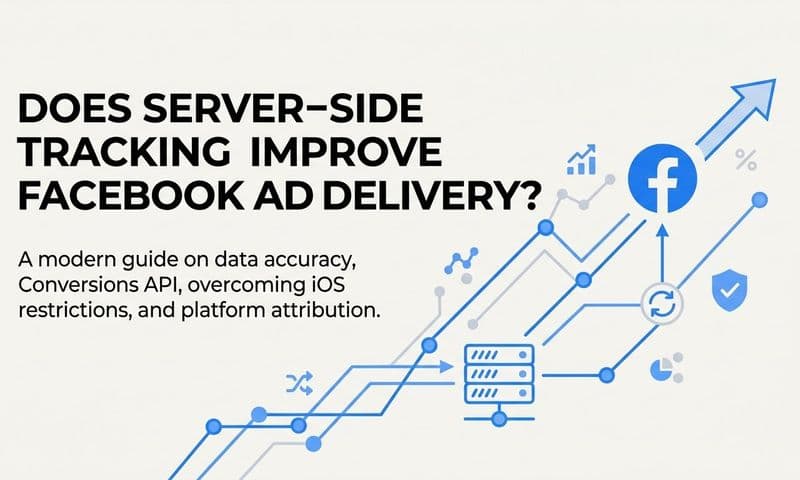
Here's where server-side tracking becomes critical. Traditional pixel-based tracking relies on browser cookies and JavaScript that can be blocked by privacy settings, ad blockers, or browser restrictions. Server-side tracking solves this by sending data directly from your servers to ad platforms and analytics tools.
Think of it like this: pixel tracking is like trying to follow someone through a crowded mall by watching them through store windows—you lose sight of them frequently. Server-side tracking is like having a direct communication line that reports their location continuously, regardless of what's blocking your view.
Platforms like Meta and Google now offer Conversion APIs that accept server-side data. By implementing these, you can send conversion events directly from your server, bypassing browser-based limitations. This gives ad platforms more accurate data to optimize against, which improves your campaign performance.
But technical infrastructure is only half the battle. You also need organizational structure—specifically, consistent naming conventions and UTM parameters across all campaigns.
UTM parameters are tags you add to your URLs that help you track where traffic comes from. A properly tagged URL might look like: yoursite.com/?utm_source=facebook&utm_medium=paid&utm_campaign=spring_sale&utm_content=video_ad_1
This tells you exactly which platform, campaign, and specific ad drove that visit. But UTM parameters only work if everyone on your team uses them consistently. Create a standardized naming structure and document it. Decide how you'll name campaigns, ad groups, and individual ads across all platforms.
For example, you might use this format: [channel]_[campaign-type]_[audience]_[date]. So a Facebook campaign targeting existing customers with a promotional offer launched in February might be: fb_promo_customers_0226. This makes it easy to filter and analyze performance across campaigns.
Document your conversion events clearly. What counts as a conversion in your business? Is it a form submission, a purchase, a demo request, or a specific page view? Define these events consistently across all platforms so you're comparing apples to apples.
Set up regular data audits. At least monthly, verify that your tracking is working correctly. Check that conversion numbers in your analytics match what's in your CRM. Look for discrepancies between platform-reported conversions and actual sales. When you find gaps, investigate and fix them immediately. Leveraging data analytics for digital marketing ensures your measurement foundation remains solid.
The goal is a measurement system where every ad impression, click, and conversion is tracked accurately and connected to business outcomes. This foundation lets you make confident decisions about where to invest your ad budget.
From Data to Decisions: Optimizing With Confidence
Measurement without action is just expensive reporting. The real value comes from turning your data into smarter advertising decisions.
Start by identifying your high-performing ads and channels. Look beyond surface metrics to find what's actually driving revenue. You might discover that a campaign with a lower CTR but higher-quality traffic outperforms a campaign with impressive engagement but poor conversion rates.
Segment your analysis by audience, creative, offer, and placement. Sometimes the channel isn't the issue—it's the specific combination of elements. You might find that video ads on Facebook work brilliantly for cold audiences but carousel ads perform better for retargeting. That granular insight lets you optimize at the creative level, not just the campaign level.
When you identify winning combinations, scale them confidently. But scale intelligently—doubling your budget overnight often decreases efficiency as you exhaust your best audiences. Increase spend gradually, typically 20-30% at a time, and monitor performance closely. If efficiency holds, scale again. If it drops, pull back and analyze why.
Use your conversion data to improve ad platform algorithms. This is where the feedback loop between measurement and optimization becomes powerful. When you send enriched conversion data back to platforms through Conversion APIs, their algorithms get smarter about who to target.
For example, if you can send data showing which conversions led to high-value customers versus low-value ones, the platform can optimize for quality, not just quantity. Someone who fills out a form but never becomes a customer isn't as valuable as someone who converts and spends thousands. Feed that distinction back to the platform, and its targeting improves.
Set up automated alerts for significant performance changes. If your cost per acquisition suddenly spikes 30%, you want to know immediately, not when you review reports next week. Create thresholds for your key metrics and get notified when something crosses them.
Build a regular optimization cadence. Weekly reviews let you catch and fix issues quickly. Monthly deep dives help you spot longer-term trends and make strategic adjustments. Quarterly planning sessions use accumulated data to inform bigger budget allocation decisions. Learning how to improve campaign performance with analytics transforms raw data into actionable growth strategies.
During these reviews, ask specific questions: Which campaigns are delivering the best LTV to CAC ratio? Where are we seeing diminishing returns? Which new audiences or creative approaches should we test? What's working in one channel that we could apply to others?
Test systematically, not randomly. Every test should have a clear hypothesis, a defined success metric, and a plan for what you'll do with the results. Don't just test different ad creatives because you're bored with the current ones—test because you have a specific theory about what might perform better and why.
Document your learnings. Create a knowledge base of what's worked and what hasn't. When you find that testimonial-focused ads outperform feature-focused ads for a specific audience, write that down. Six months later when you're planning a new campaign, you'll have proven insights to build from instead of starting from scratch. Following best practices for using data in marketing decisions ensures your team consistently makes evidence-based choices.
The most successful advertisers don't just react to data—they create systems that turn measurement insights into consistent optimization actions. This systematic approach is what separates businesses that waste ad spend from those that scale efficiently.
Bringing It All Together: Your Path to Measurement Mastery
Effective measurement for advertising isn't about tracking everything—it's about tracking what matters and connecting those insights directly to revenue. The difference between guessing and knowing where your ad budget should go is the difference between stagnant growth and confident scaling.
You've seen how traditional metrics can mislead, why revenue-focused indicators like ROAS, CAC, and LTV provide the real story, and how attribution models help you understand which touchpoints deserve credit in your customer journey. You understand that building a proper measurement framework requires connecting your data sources, implementing server-side tracking, and maintaining consistent naming conventions.
Most importantly, you know that measurement only creates value when it drives action. The insights you gather should directly inform which campaigns to scale, which audiences to target, and how to allocate your budget for maximum return.
The modern advertising landscape demands precision. Privacy changes and platform limitations have made guesswork expensive and ineffective. Marketers who thrive are those who invest in proper measurement infrastructure—tools that capture every touchpoint, connect ad spend to actual revenue, and translate complex data into clear recommendations.
Your measurement system should work for you, not create more confusion. It should answer the questions that matter: Which ads are driving real customers? Where should I invest more? What's actually working versus what just looks good in a dashboard?
Ready to elevate your marketing game with precision and confidence? Discover how Cometly's AI-driven recommendations can transform your ad strategy—Get your free demo today and start capturing every touchpoint to maximize your conversions.