
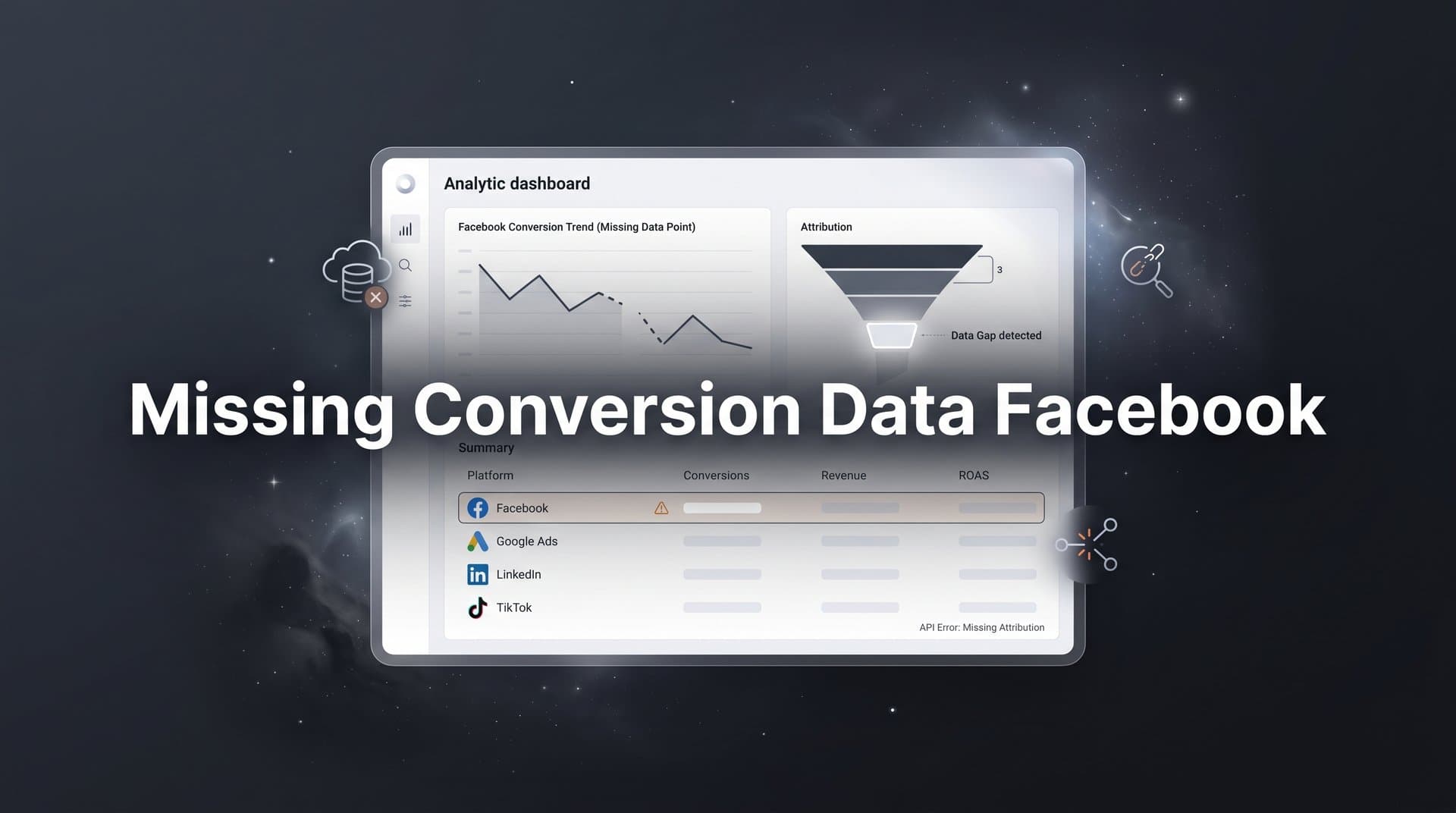
You check your Facebook Ads Manager and notice something alarming: your conversion numbers look way off. Sales are happening in your CRM, but Facebook is showing far fewer conversions than you know occurred. This gap between reality and reported data isn't just frustrating—it's actively hurting your ad performance.
When Facebook can't see your conversions, its algorithm can't optimize properly. You're essentially flying blind, letting the platform make decisions based on incomplete information. The result? Wasted ad spend on audiences that don't convert, missed opportunities to scale what's working, and campaigns that underperform their true potential.
The good news? Missing conversion data is a solvable problem. This isn't a permanent condition you have to accept. With a systematic approach, you can diagnose exactly why your conversion data is disappearing and implement fixes that restore accurate tracking.
Whether the issue stems from iOS privacy changes blocking your pixel, server-side tracking gaps, misconfigured events, or attribution window mismatches, you'll have a clear path to recovery. Each fix builds on the previous one, creating a comprehensive tracking infrastructure that captures conversions other advertisers miss.
Let's walk through the exact steps to diagnose your tracking issues and implement solutions that bring your Facebook conversion data back to reality.
Step 1: Audit Your Current Tracking Setup in Events Manager
Before you can fix missing conversion data, you need to understand exactly what's broken. Facebook's Events Manager is your diagnostic center—it shows you which events are firing, which ones are missing, and where the gaps exist in your tracking infrastructure.
Start by logging into Facebook Business Manager and navigating to Events Manager. Select your pixel from the data sources list and review the Overview tab. Look at the event activity chart for the past seven days. You should see a consistent pattern of events firing throughout each day. If you notice sudden drops, flat periods, or events that should be firing but aren't appearing at all, you've found your first clue.
Next, click into the Diagnostics tab. This is where Facebook flags active warnings and errors it has detected with your tracking setup. Common issues include duplicate events, missing parameters, incorrect currency formats, or events firing on the wrong pages. Each warning includes details about what Facebook detected and when the issue started occurring.
Pay special attention to the "Events Received" versus "Events Matched" comparison. Events Received shows how many conversion events Facebook's servers recorded. Events Matched shows how many of those events Facebook could successfully connect to a specific user profile. A large gap between these numbers indicates poor Event Match Quality, which we'll address in a later step.
Now verify that all your expected conversion events are actually firing. Click on each event type (Purchase, Lead, AddToCart, InitiateCheckout) and review the volume over time. If you know you had 50 purchases yesterday but Facebook only shows 20 Purchase events, you've quantified the tracking gap. Understanding inaccurate conversion data on Facebook is the first step toward fixing it.
Document your findings in a simple spreadsheet. List each conversion event type, the expected volume based on your backend data, the volume Facebook reports, and the percentage gap. This documentation becomes your roadmap for the remaining steps. If Purchase events show a 60% gap but Lead events are tracking accurately, you know where to focus your troubleshooting efforts.
Check the Test Events tab as well. This shows recent events Facebook received, including the parameters passed with each event. If you're not seeing test events appear when you complete a conversion on your site, your pixel isn't firing at all—that's a critical installation issue to address immediately.
Step 2: Verify Your Facebook Pixel Installation and Event Firing
Now that you know which events are missing, it's time to verify your pixel is installed correctly and firing on the right pages. Many tracking issues stem from simple installation problems that are easy to fix once identified.
Install the Facebook Pixel Helper browser extension for Chrome. This free tool shows you whether the Facebook pixel is present on any page you visit, which events fire, and whether there are any errors in the implementation. Navigate to your website's homepage and click the Pixel Helper icon. You should see your pixel ID listed with a green checkmark.
Walk through your entire conversion flow manually while monitoring pixel activity. Start from an ad click simulation, browse product pages, add items to cart, and complete a purchase. At each step, the Pixel Helper should show the appropriate event firing: ViewContent on product pages, AddToCart when adding items, InitiateCheckout at the beginning of checkout, and Purchase upon completion.
If events aren't firing at the expected moments, you have an implementation problem. Common causes include the pixel code being placed in the wrong location on the page, JavaScript errors preventing the pixel from loading, or the event code being triggered by the wrong user action. Learn more about why your Facebook pixel isn't tracking conversions to identify the root cause.
Check for duplicate pixels—a surprisingly common issue that skews your data. The Pixel Helper will flag if multiple pixels are firing on the same page. This often happens when you've installed the pixel through both a tag manager and directly in your site code, or when you've added the pixel multiple times during troubleshooting attempts. Remove duplicate installations to ensure clean data.
Verify that event parameters are passing correctly. Click on each event in Pixel Helper to see the parameters being sent. For Purchase events, you should see the correct value, currency, and content IDs. For Lead events, confirm the content_name or other custom parameters match your expectations. Missing or incorrect parameters reduce Event Match Quality and attribution accuracy.
Test across different browsers and devices. What works in Chrome on desktop might fail in Safari on iOS due to Intelligent Tracking Prevention. Complete test conversions in Safari, Chrome, Firefox, and mobile browsers. If certain browsers consistently fail to track conversions, you've identified an environment-specific problem that likely requires server-side tracking to solve.
Check your site's Content Security Policy headers if events aren't firing at all. Some security configurations block third-party scripts like the Facebook pixel. Work with your development team to whitelist Facebook's tracking domains if necessary.
Step 3: Configure Conversions API for Server-Side Tracking
Browser-based tracking alone is no longer sufficient. Ad blockers, browser privacy settings, and iOS App Tracking Transparency restrictions block a significant portion of pixel-based conversion tracking. This is why you're seeing fewer conversions in Facebook than actually occurred—your pixel simply can't see conversions from users with these privacy protections enabled.
The Conversions API solves this by sending conversion data directly from your server to Facebook's servers. No browser involvement means no browser-based blocking. When a conversion happens on your website or in your CRM, your server sends the event data to Facebook regardless of the user's privacy settings or ad blocking software. Follow our guide to Facebook Conversion API setup for detailed implementation steps.
Setting up Conversions API varies depending on your platform. If you use Shopify, WooCommerce, or another major e-commerce platform, look for official Facebook integration apps that handle the technical implementation for you. These integrations typically require just a few clicks to connect your store to Facebook's Conversions API.
For custom implementations, you'll need to work with your development team to send server-side events. Facebook provides detailed API documentation and SDKs for common programming languages. The basic process involves sending an HTTP POST request to Facebook's API endpoint whenever a conversion occurs, including the event name, timestamp, user data, and custom parameters.
Event deduplication is critical when running both pixel and Conversions API. Without it, Facebook will count the same conversion twice—once from the pixel and once from the server. Prevent this by assigning a unique event_id to each conversion and passing that same ID in both the pixel event and the server event. Facebook automatically deduplicates events with matching event_ids and timestamps.
After implementing Conversions API, verify that server events are being received in Events Manager. Navigate to your pixel in Events Manager and check the "Server" filter. You should see server-side events appearing alongside browser events. The Test Events tool shows whether each event came from the browser, server, or both.
Monitor your Event Match Quality score for server events. Higher match quality means better attribution. Include as much customer information as possible in your server events: email address, phone number, first name, last name, city, state, zip code, and country. Facebook uses this data to match conversions to user profiles, even when the pixel couldn't track the user's browser.
Platforms like Cometly handle server-side tracking automatically as part of their attribution infrastructure. Instead of building custom integrations, you connect your ad accounts and website once, and Cometly manages the technical complexity of sending enriched conversion data to Facebook through the Conversions API. This approach captures conversions that browser-only tracking misses while maintaining high event match quality scores.
Step 4: Optimize Event Match Quality for Better Attribution
Event Match Quality measures how well Facebook can connect your conversion events to specific user profiles. Higher scores mean Facebook can more accurately attribute conversions to the right ads and optimize toward your actual customers. Low scores result in missed attribution and poor campaign performance.
Check your current Event Match Quality score in Events Manager. Click on your pixel, select an event type, and look for the Event Match Quality section. Facebook rates match quality on a scale of 0 to 10, with scores above 6.0 considered good. If you're seeing scores below 4.0, you're leaving significant attribution accuracy on the table. Addressing poor Conversion API data quality should be a priority.
The score improves when you send more customer information parameters with each event. The most valuable parameters are email address, phone number, first name, last name, city, state, zip code, and country. Facebook hashes this information and matches it against user profiles to identify who completed the conversion.
Implement these parameters in both your pixel events and Conversions API events. For pixel events, you can collect customer information during checkout and pass it to the pixel before the Purchase event fires. For server-side events, you already have this information in your database—just include it in the API request.
Hash all personally identifiable information before sending it to Facebook. Facebook requires customer data to be hashed using SHA-256 encryption for privacy protection. Most Facebook SDKs handle hashing automatically, but if you're implementing custom code, ensure you're hashing email addresses, phone numbers, and names before transmission.
Enable Advanced Matching in your pixel configuration. This Facebook feature automatically detects customer information fields on your website (like email inputs in forms) and includes that data with pixel events. To enable it, go to Events Manager, select your pixel, click Settings, and toggle on Advanced Matching. Then specify which customer information parameters you want to include.
After implementing additional parameters, monitor your Event Match Quality score over the next few days. You should see the score increase as Facebook receives richer data with each event. Higher scores directly improve attribution accuracy, helping Facebook connect conversions to the ads that drove them.
Step 5: Review and Adjust Your Attribution Settings
Facebook's attribution window determines how long after someone interacts with your ad a conversion can be credited back to that ad. The default setting is a 7-day click and 1-day view window, meaning conversions that happen within 7 days of clicking an ad or 1 day of viewing an ad get attributed to that ad.
If your sales cycle is longer than 7 days, you're missing conversions that Facebook should be crediting to your ads. Someone might click your ad on Monday, research for a week, and purchase the following Tuesday. With the default 7-day window, that conversion falls outside the attribution period and doesn't get credited to your campaign. Understanding Facebook conversion attribution helps you make better decisions about these settings.
Access your attribution settings in Ads Manager by clicking the dropdown menu in the top right corner and selecting "Attribution Setting." Here you can see your current attribution windows and change them if needed. Facebook offers several options: 1-day click, 7-day click, and 28-day click windows, each with corresponding view windows.
Consider your actual customer journey timeline when selecting an attribution window. If you sell high-ticket items or B2B services where prospects take weeks to decide, a 28-day click window captures more of your true conversions. If you sell impulse-buy products where most purchases happen immediately, the default 7-day window might be sufficient.
Compare your attributed conversions across different window settings to identify gaps. In Ads Manager, you can view performance data using different attribution windows by selecting them from the attribution dropdown. If your 28-day click window shows significantly more conversions than your 7-day window, you're missing attribution with the shorter setting.
Be aware that longer attribution windows can make campaign performance appear better than it is for optimization purposes. Facebook's algorithm optimizes based on the attribution window you select, so changing windows affects how the algorithm learns and makes decisions. Most advertisers find the 7-day click window strikes the right balance between capturing conversions and maintaining optimization effectiveness.
Align your attribution model with how you analyze performance internally. If your analytics platform or CRM uses last-click attribution with a 30-day window, but Facebook uses 7-day click attribution, you'll always see discrepancies between the two systems. Consistency in attribution methodology helps you make better decisions about budget allocation.
Step 6: Set Up Aggregated Event Measurement for iOS Users
iOS 14.5 introduced App Tracking Transparency, requiring apps to ask permission before tracking users across other apps and websites. Most users opt out, which severely limits Facebook's ability to track conversions from iOS traffic using traditional pixel-based methods. Aggregated Event Measurement is Facebook's solution for this privacy-first environment.
Start by verifying your domain in Facebook Business Settings. Go to Business Settings, click Brand Safety, then Domains, and add your website domain. Facebook will provide a DNS TXT record or HTML file you need to add to your domain to prove ownership. Domain verification is required before you can configure Aggregated Event Measurement.
Once verified, configure your eight prioritized conversion events in Events Manager. Click on your pixel, select Aggregated Event Measurement, and choose which eight events matter most to your business. Facebook limits iOS opted-out users to reporting only the highest-priority event that fires, so this ranking is critical.
Rank your events strategically. Put your most valuable conversion event (typically Purchase or Lead) at the top, followed by events that indicate strong intent like InitiateCheckout or AddToCart. Lower-priority positions should go to top-of-funnel events like ViewContent or PageView.
Understand what this limitation means for your reporting. When an iOS user who opted out of tracking completes multiple events, Facebook only reports the highest-priority event that fired. If they view content, add to cart, and purchase, you'll only see the Purchase event—the others won't appear in your data for that user. This is a major cause of lost conversion data from iOS privacy changes.
Wait 72 hours after making configuration changes for full implementation. Facebook needs this time to propagate your settings across its systems. Don't make additional changes during this period, as it resets the 72-hour clock.
Monitor your iOS versus Android conversion rates to gauge the impact of privacy changes. In Ads Manager, break down your results by platform device. If you see significantly lower conversion rates from iOS compared to Android, you're experiencing the effects of App Tracking Transparency. This gap represents conversions happening on iOS that Facebook can't fully track or attribute.
Server-side tracking through Conversions API helps recover some of this lost iOS data by capturing conversions that happen on your website or in your CRM, regardless of the user's tracking preferences. While you can't completely eliminate the iOS tracking gap, combining Conversions API with properly configured Aggregated Event Measurement minimizes the impact.
Step 7: Validate Your Fixes and Establish Ongoing Monitoring
You've implemented multiple tracking improvements, but the work isn't done until you validate everything is working correctly. Testing and ongoing monitoring ensure your fixes stick and catch new issues before they compound into major data gaps.
Run test conversions immediately after implementing changes. Complete actual purchases or leads on your website and verify they appear in Events Manager within 20 minutes. Check both the browser events and server events to confirm both tracking methods are working. Use the Test Events tool to see the exact parameters being passed with each event.
Compare Facebook's reported conversions against your CRM or backend data. Pull a report of actual sales or leads from your database for the past week and compare it to what Facebook reports in Ads Manager. The numbers won't match perfectly due to attribution windows and view-through conversions, but they should be much closer now than before your fixes. This comparison helps you achieve accurate Facebook conversion tracking.
Calculate your tracking accuracy percentage by dividing Facebook's reported conversions by your actual backend conversions. If Facebook shows 80 conversions and you had 100 actual conversions, you're capturing 80% of your conversion data. Track this percentage weekly to monitor whether your tracking accuracy improves, stays stable, or degrades over time.
Set up regular weekly audits to catch tracking issues before they compound. Every Monday, spend 15 minutes reviewing Events Manager diagnostics, checking for new warnings, and comparing the past week's conversion volume to the previous week. Sudden drops in event volume often indicate tracking breakage that needs immediate attention.
Create alerts for significant drops in conversion event volume. While Facebook doesn't offer native alerting, you can set up simple monitoring by checking your daily conversion counts. If you normally see 50 Purchase events per day and suddenly see only 10, investigate immediately—your pixel may have broken, or a site update may have disrupted your tracking implementation.
Consider using a dedicated attribution platform like Cometly to maintain accurate cross-platform tracking without the constant manual monitoring. Cometly automatically tracks conversions across all your marketing channels, sends enriched data to Facebook through the Conversions API, and provides a unified view of which ads actually drive revenue. Instead of juggling multiple tracking systems and hoping Facebook sees all your conversions, you get accurate attribution data that helps you scale what works and cut what doesn't.
Moving Forward with Accurate Conversion Tracking
Fixing missing conversion data requires a systematic approach, but each step you complete brings your tracking closer to accuracy. You've audited your current setup in Events Manager, verified your pixel installation, implemented server-side tracking through Conversions API, optimized your event match quality, adjusted attribution settings, configured Aggregated Event Measurement for iOS users, and established ongoing monitoring to catch future issues.
The most impactful fix for most advertisers is implementing server-side tracking. This single change captures conversions that browser-based tracking misses entirely due to ad blockers, privacy settings, and iOS restrictions. When combined with high Event Match Quality scores and proper attribution windows, server-side tracking transforms your conversion data from incomplete to comprehensive.
With accurate conversion data flowing back to Facebook, the algorithm can finally optimize toward your actual customers. You'll see improved return on ad spend as Facebook learns which audiences, creatives, and placements drive real business results. Campaign scaling becomes more predictable when the platform can see and learn from all your conversions, not just the fraction that browser-based tracking captures.
Take action today. Start with Step 1 and work through each fix methodically. Don't skip steps or assume certain issues don't apply to your setup—systematic implementation ensures you address all potential tracking gaps. Your future campaigns will thank you as you gain the visibility needed to make confident optimization decisions.
Ready to elevate your marketing game with precision and confidence? Discover how Cometly's AI-driven recommendations can transform your ad strategy—Get your free demo today and start capturing every touchpoint to maximize your conversions.