

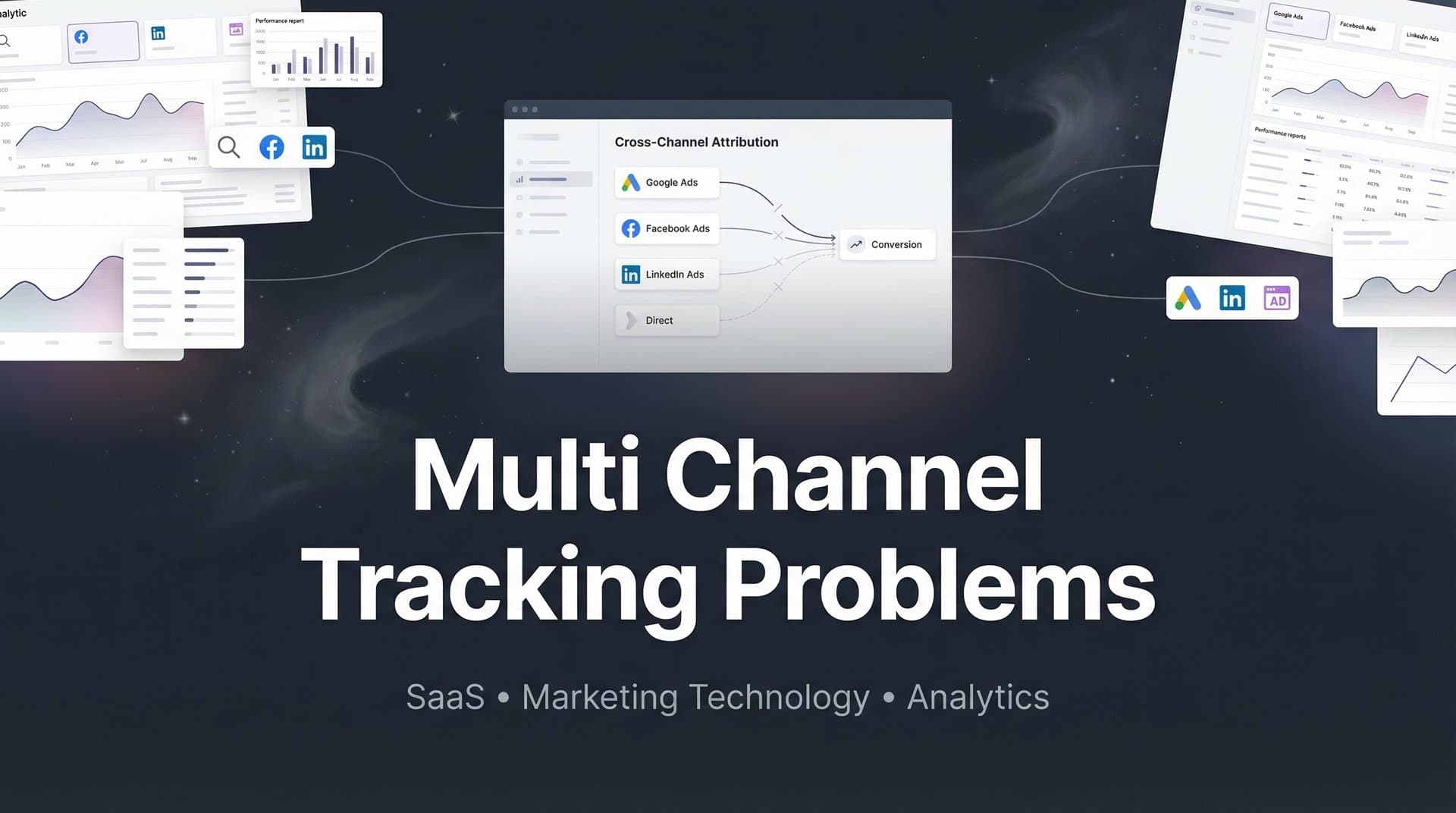
You're staring at three different dashboards on a Tuesday morning. Meta Ads Manager shows 47 conversions. Google Ads claims 52. Your CRM recorded 31. Same campaign, same time period, same conversion event—but the numbers tell completely different stories.
Which one is right? The honest answer: probably none of them.
This is the daily reality of multi-channel tracking problems. Every platform operates in its own universe, each one eager to claim credit for your conversions. Meanwhile, you're left trying to piece together a coherent picture of what's actually driving results, knowing that your budget decisions depend on data that fundamentally doesn't add up.
The frustration goes deeper than conflicting numbers. When your reports don't reconcile, you can't confidently scale what's working or cut what's not. You can't prove ROI to executives. You can't optimize campaigns based on real performance. You're flying blind with expensive fuel.
Here's what most marketers don't realize: these tracking problems aren't bugs—they're features of how modern digital advertising infrastructure was built. Understanding why your data fragments across channels is the first step toward fixing it. This guide breaks down the root causes of multi-channel tracking chaos and shows you exactly what infrastructure changes can restore accuracy and confidence to your marketing data.
The Data Fragmentation Dilemma: Why Every Platform Tells a Different Story
Every ad platform you use operates as a walled garden with its own tracking ecosystem. Meta uses the Pixel. Google uses gtag.js and conversion tracking tags. TikTok has its own pixel. LinkedIn, Twitter, Pinterest—each one deploys proprietary JavaScript that watches for conversions and reports back to its parent platform.
The problem starts here: these tracking systems don't talk to each other. They can't. Each platform only sees the slice of the customer journey that happens within its own tracking infrastructure. When someone clicks your Meta ad, browses your site, leaves, then returns three days later via a Google search and converts, both platforms see a conversion. Both claim credit. Neither knows about the other.
This isn't accidental. Ad platforms are fundamentally incentivized to demonstrate their value to you. Their business model depends on proving that advertising with them drives results. When attribution is ambiguous—and in multi-touch journeys, it almost always is—platforms default to claiming credit rather than sharing it. Understanding multiple ad platforms tracking issues helps you recognize why this happens systematically.
The result is systematic over-reporting across your entire channel mix. If you add up the conversions reported by each platform, the total often exceeds your actual conversion count by 30% to 50% or more. This isn't just a reporting annoyance. It fundamentally distorts your understanding of channel performance and ROI.
Then there's the cross-device and cross-browser reality. Your customer doesn't live in one browser on one device. They see your ad on their phone during their morning commute. They research on their laptop at work. They convert on their tablet at home three days later. Traditional cookie-based tracking shatters across these transitions, creating significant multi-device customer tracking challenges.
When platforms can't connect these touchpoints with certainty, they fill the gaps with modeled data—statistical estimates based on aggregated user behavior patterns. Some of this modeling is sophisticated. Some of it is educated guessing. None of it gives you the precise, deterministic tracking you need to make confident budget decisions.
The fragmentation compounds as you add channels. Two platforms create overlapping attribution. Five platforms create chaos. When you're running Meta, Google, TikTok, LinkedIn, and programmatic display simultaneously, you're dealing with five different tracking methodologies, five different attribution models, and five different versions of reality—none of which align with what your analytics platform or CRM actually recorded.
Privacy Changes That Shattered Traditional Tracking
If multi-channel tracking was already fragile, privacy changes over the past few years broke it completely. The earthquake started in 2021 when Apple rolled out iOS App Tracking Transparency. Suddenly, users had to opt in to cross-app tracking. Most didn't.
The impact on Meta, TikTok, and mobile-heavy platforms was immediate and severe. Conversion tracking that relied on the Identifier for Advertisers (IDFA) went dark for the majority of iOS users. Platforms lost visibility into whether ad clicks led to app installs, purchases, or any downstream actions. Reported conversion volumes dropped. Attribution windows shortened. Campaign optimization struggled with incomplete signals.
Meta publicly estimated that iOS changes would cost them roughly $10 billion in lost ad revenue in 2022 alone. That revenue didn't disappear because ads stopped working—it disappeared because platforms could no longer prove they were working. The conversions still happened. The tracking just couldn't see them. These cookie tracking problems in advertising continue to plague marketers today.
Browser-based restrictions hit from another angle. Safari's Intelligent Tracking Prevention (ITP) started limiting cookie lifespans years ago. First-party cookies now expire after seven days of inactivity. Third-party cookies—the backbone of retargeting and cross-site tracking—are blocked entirely. Firefox's Enhanced Tracking Protection follows similar rules.
Google's planned deprecation of third-party cookies in Chrome kept getting delayed, but the direction is clear. The cookie-based tracking infrastructure that powered digital advertising for two decades is being systematically dismantled. Privacy regulations like GDPR and CCPA add legal constraints on top of technical ones.
The combined effect: client-side tracking—JavaScript tags running in browsers—can no longer capture complete user journeys. Too many signals get blocked before they reach your analytics. Too many users opt out. Too many browsers restrict tracking by default.
Server-side tracking emerged as the critical solution. Instead of relying on browser-based pixels that users can block, server-side tracking sends conversion data directly from your server to ad platforms via APIs. The data flows through infrastructure you control, bypassing browser restrictions and ad blockers.
This matters enormously for attribution accuracy. Server-side tracking captures events that client-side methods miss. It provides more complete data to ad platform algorithms, improving their ability to optimize campaigns. It gives you a more reliable source of truth about what's actually happening in your funnel.
But here's the catch: implementing server-side tracking requires technical infrastructure that most marketing teams don't have in-house. You need server endpoints, API integrations, event matching, and ongoing maintenance. The complexity barrier keeps many marketers stuck with degraded client-side tracking, watching their data quality deteriorate as privacy restrictions tighten.
Attribution Model Chaos: When First-Click and Last-Click Both Lie
Even if you could perfectly track every touchpoint in every customer journey, you'd still face a fundamental question: which touchpoint gets credit for the conversion? This is where attribution models come in—and where things get philosophically messy.
First-click attribution gives all credit to the initial touchpoint. Last-click attribution gives it all to the final interaction before conversion. Both are simple. Both are wrong. Understanding multi-channel attribution models explained in depth reveals why single-touch approaches fail.
Think about your own buying behavior for anything significant. You don't see one ad and immediately purchase. You encounter multiple touchpoints: a social ad that introduces you to the brand, a Google search when you're actively researching, a retargeting ad that reminds you later, an email that finally pushes you to convert. Which one "caused" the purchase?
First-click attribution would credit only that initial social ad. Last-click would credit only the email. In reality, you needed all of them. Removing any single touchpoint might have prevented the conversion. Single-touch attribution fundamentally misrepresents how marketing actually works in a multi-touchpoint world.
Platform default attribution windows make this worse. Meta typically uses a 7-day click and 1-day view attribution window. Google Ads defaults to 30 days for search campaigns. LinkedIn uses different windows. TikTok has its own standards. When you're comparing channel performance, you're comparing metrics calculated with completely different rules.
A conversion that happens 10 days after someone clicked your Meta ad won't show up in Meta's reports (outside the 7-day window) but will appear in Google's reports if they also clicked a Google ad within 30 days. Same conversion, different attribution, incomparable metrics. This creates persistent multi-platform attribution problems that distort your data.
This isn't just academic. It directly impacts budget allocation decisions. If you're evaluating channels based on last-click attribution, you'll systematically undervalue upper-funnel awareness channels and overvalue bottom-funnel conversion channels. You'll cut brand building that actually drives demand and over-invest in retargeting that only captures demand you already created.
Multi-touch attribution models attempt to solve this by distributing credit across multiple touchpoints. Linear attribution splits credit equally. Time-decay gives more weight to recent interactions. Position-based (U-shaped) emphasizes first and last touch. Data-driven attribution uses machine learning to assign credit based on actual conversion patterns.
Each approach has merits. The key insight is that understanding the full customer journey changes how you allocate budgets. When you can see that most converters interact with 3-5 touchpoints before purchasing, you stop obsessing over last-click efficiency and start investing in the full-funnel mix that actually drives results.
The challenge: most marketers don't have access to true multi-touch attribution because it requires unified tracking across all channels. Platform-native attribution only sees that platform's touchpoints. Google Analytics can see cross-channel journeys, but only if your tracking is properly configured and privacy restrictions haven't fragmented the data. Building a complete view requires infrastructure that captures every touchpoint and connects them to actual conversions and revenue.
The CRM-to-Ad Platform Disconnect
Here's where tracking problems get expensive. Most conversion tracking stops at the lead form submission or initial purchase. The pixel fires, the platform records a conversion, and everyone moves on. But that's not where the story ends—it's where it begins.
What happens after someone converts? Do they become a qualified lead or junk? Do they actually close as a customer? What's their lifetime value? For B2B companies with sales cycles, this downstream data is everything. For e-commerce, repeat purchase behavior and customer value matter more than first-order metrics.
Your CRM knows all of this. It tracks lead quality, sales pipeline progression, closed deals, and revenue. Your ad platforms know almost none of it. They optimize for the initial conversion event without any visibility into whether those conversions actually generated business value. Learning how to measure ROI from multiple marketing channels requires bridging this gap.
The result: ad platforms optimize for the wrong outcomes. Meta's algorithm gets really good at finding people who fill out forms—but it has no idea if those leads are qualified or if they close. Google's smart bidding maximizes conversions without knowing which conversions are worth 10x more than others.
This disconnect compounds over time. As algorithms optimize for proxy metrics instead of actual business outcomes, campaign performance drifts away from what you actually care about. You hit your conversion targets while revenue stagnates. You scale campaigns that generate impressive lead volumes but terrible ROI.
Offline conversions and pipeline data rarely flow back to ad platforms because connecting them is technically complex. You need to match CRM records back to the original ad clicks, then send that data through conversion APIs with proper event matching. Most marketing teams lack the infrastructure to do this reliably.
The missed opportunity is enormous. When ad platforms receive enriched conversion data—lead quality scores, closed deals, revenue values—their algorithms can optimize for actual business outcomes. Meta's algorithm learns which audiences generate high-value customers, not just high volumes of leads. Google's smart bidding can target profitable conversions instead of just any conversion. This is why multi-channel attribution for ROI has become essential for performance marketers.
This feedback loop transforms campaign performance. Instead of guessing which campaigns drive revenue, you know. Instead of optimizing for vanity metrics, you optimize for profit. The platforms get smarter with every conversion they learn from, compounding improvements over time.
But it requires solving the CRM-to-ad-platform integration challenge. You need infrastructure that captures conversion data, enriches it with downstream outcomes, matches it back to ad interactions, and sends it to platforms via their conversion APIs. This is technically demanding work that sits at the intersection of marketing, sales operations, and engineering.
Building a Unified Tracking Infrastructure That Actually Works
Solving multi-channel tracking problems requires more than tweaking your current setup. It requires building infrastructure designed for the privacy-restricted, multi-touchpoint reality of modern digital marketing. Here's what that actually looks like.
Start with server-side tracking as your foundation. Instead of relying solely on browser-based pixels that privacy restrictions degrade, implement server-side tracking that captures events before they hit client-side limitations. This means setting up server endpoints that receive conversion data directly from your website or app, then forwarding it to ad platforms via their server-side APIs.
Server-side tracking captures more complete data because it bypasses browser restrictions, ad blockers, and cookie limitations. It provides deterministic event data rather than modeled estimates. It gives ad platform algorithms better signals to optimize against. The technical complexity is real, but the data quality improvement makes it foundational for accurate attribution. Proper cross-channel tracking implementation starts here.
Next, connect your CRM events and revenue data back to ad platforms. This closes the loop between marketing activity and business outcomes. When someone becomes a qualified lead, closes as a customer, or generates revenue, that data needs to flow back to Meta, Google, and other platforms through their conversion APIs.
This enriched conversion data transforms algorithm performance. Platforms learn which audiences, creatives, and targeting strategies generate actual business value—not just form fills or initial purchases. Over time, this feedback loop dramatically improves targeting efficiency and ROI. Your ad spend shifts toward what actually drives revenue.
Implement consistent UTM parameter structures across all campaigns and channels. This sounds basic, but inconsistent UTM tagging is one of the most common reasons attribution breaks down. When your Meta campaigns use one naming convention and your Google campaigns use another, connecting touchpoints becomes impossible. Avoiding UTM parameter tracking problems requires disciplined standardization.
Standardize how you structure campaign names, source tags, medium tags, and content parameters. Document the taxonomy. Enforce it across your team. Use UTM builders or automation to ensure consistency. This discipline pays dividends when you're analyzing multi-touch journeys and trying to understand which channel combinations drive conversions.
Build first-party data strategies that don't rely on third-party cookies. This means capturing user identifiers you control—email addresses, account IDs, customer numbers—and using them to connect touchpoints across devices and sessions. When someone logs in, you can deterministically link their mobile and desktop activity. When they convert, you can match that conversion back to all their previous interactions.
First-party data also powers better audience targeting. Instead of relying on platform audiences that degrade as privacy restrictions tighten, you can upload customer lists, build lookalike audiences from your best customers, and retarget based on actual behavior in your CRM. This shifts power back to you—you own the data and the relationships.
Finally, centralize your attribution analysis in a platform that sees across all channels. Whether that's a dedicated attribution platform, a properly configured analytics setup, or marketing intelligence software, you need a single source of truth that captures every touchpoint and connects them to conversions and revenue. Exploring the best multi-channel attribution tools can help you find the right solution for your needs.
This unified view is what lets you compare channels fairly, understand multi-touch journeys, and make confident budget allocation decisions. Without it, you're stuck reconciling incompatible reports from siloed platforms, never quite sure which numbers to trust.
Putting It All Together: From Fragmented Data to Confident Decisions
Multi-channel tracking problems aren't edge cases or temporary glitches. They're structural realities of how digital advertising infrastructure works—or doesn't work—across platforms. Data fragmentation, privacy restrictions, attribution model inconsistencies, and CRM disconnects combine to create a perfect storm of unreliable marketing data.
The business impact is significant. When your reports don't add up, you can't confidently scale winning campaigns. You waste budget on channels that appear to perform but don't actually drive revenue. You struggle to prove marketing ROI to executives who see conflicting numbers and lose confidence in your data.
The solution isn't trying to make platform-native reporting more accurate—those systems are fundamentally limited by their siloed design and conflicting incentives. The path forward is building unified tracking infrastructure that captures the full customer journey, connects to revenue outcomes, and feeds enriched data back to ad platforms.
This means adopting server-side tracking to bypass privacy restrictions. Connecting CRM data to close the loop between ad clicks and business outcomes. Implementing consistent tracking standards across all channels. Building first-party data strategies that don't depend on dying cookie infrastructure.
When you make these infrastructure investments, something shifts. Your data starts adding up. Your attribution becomes reliable. Your algorithm optimization improves because platforms learn from actual business outcomes. You can scale with confidence because you know what's really driving results.
The tracking problems aren't going away—they're intensifying as privacy regulations tighten and customer journeys span more touchpoints. But the marketers who build proper infrastructure now will have a decisive competitive advantage over those still struggling with fragmented, unreliable data.
Moving Forward with Clarity and Confidence
The days of trusting platform-reported metrics at face value are over. Multi-channel tracking problems will only get more complex as privacy restrictions evolve and customer journeys become more fragmented across devices, browsers, and platforms. Waiting for platforms to solve this for you means accepting degraded data quality and making budget decisions based on incomplete information.
The alternative is taking control of your tracking infrastructure. When you capture every touchpoint before privacy restrictions intervene, connect conversion data to actual revenue outcomes, and feed that enriched data back to ad platforms, you transform how your marketing performs. Algorithms optimize for what matters. Attribution reflects reality. Budget allocation becomes strategic rather than guesswork.
This infrastructure shift isn't optional for marketers who want to scale profitably. It's the foundation for confident decision-making in an increasingly complex digital landscape. The investment in proper tracking pays for itself many times over through improved campaign performance, reduced waste, and the ability to prove marketing's impact on revenue.
Ready to elevate your marketing game with precision and confidence? Discover how Cometly's AI-driven recommendations can transform your ad strategy—Get your free demo today and start capturing every touchpoint to maximize your conversions.



