Picture this: A potential customer sees your billboard on their morning commute, hears your radio spot during lunch, and then—three days later—types your company name into Google and converts. Your analytics dashboard credits Google Organic. Your billboard vendor can't prove impact. Your radio buy looks like a black hole for budget.
This is the offline attribution problem, and it's costing marketers millions in misallocated budget.
As marketing budgets face increasing scrutiny, the pressure to prove ROI on every dollar spent has never been higher. Yet while digital channels offer click-by-click tracking, traditional marketing channels—billboards, radio ads, TV spots, trade shows, direct mail—operate in a measurement blind spot. You know these channels build awareness and drive consideration. You just can't prove it with data.
The result? Marketers either keep investing in offline channels based on gut feeling, or they abandon effective campaigns simply because they can't measure them. Neither option is acceptable when every marketing dollar needs to justify its existence.
This guide breaks down offline marketing attribution: what it is, why it matters, and—most importantly—how to implement tracking methods that connect your traditional marketing investments to measurable business outcomes. You'll learn practical approaches for different campaign types, advanced techniques for larger budgets, and how to integrate offline data into your broader marketing analytics. By the end, you'll have a clear roadmap for proving the value of every marketing channel, not just the ones with built-in tracking.
The Tracking Gap Between Billboards and Browser Sessions
Offline marketing attribution is the process of connecting non-digital touchpoints—TV commercials, radio spots, print ads, billboards, trade show booths, direct mail pieces, and in-person events—to measurable conversions and revenue. It's the bridge between traditional marketing investments and the data-driven accountability that digital channels provide by default.
The fundamental challenge is simple: offline channels lack inherent tracking capabilities. When someone clicks a Facebook ad, the platform automatically logs the click, tracks the user to your website, and attributes any resulting conversion. When someone sees your billboard, hears your radio ad, or picks up your direct mail piece, there's no automatic tracking mechanism. No cookies, no click IDs, no pixel fires.
This creates a measurement vacuum. A customer might see your TV commercial, visit your trade show booth, receive your direct mail piece, and then—days or weeks later—search for your brand on Google and convert. Your analytics platform sees only the final touchpoint: a Google search. The offline interactions that built awareness and drove consideration remain invisible.
The business impact of this tracking gap is significant. Without proper attribution, marketers face an impossible choice: continue investing in offline channels based on intuition and anecdotal feedback, or cut campaigns that might be highly effective simply because their impact can't be measured. Neither approach optimizes marketing spend.
Consider a B2B software company running both Google Ads and sponsoring industry conferences. The Google Ads dashboard shows clear conversion data—clicks, form fills, demo requests. The conference sponsorship generates booth conversations, business card exchanges, and relationship building. Three months later, several of those conference contacts become customers. But the CRM attributes them to "Direct" or "Google Organic" because that's how they eventually reached the website.
The conference sponsorship looks ineffective in the data, even though it was the critical touchpoint that initiated the relationship. Without offline attribution, the marketing team might cut the conference budget and double down on Google Ads—optimizing for what they can measure rather than what actually drives results. This represents one of the most common attribution challenges in marketing analytics that teams face today.
This is why offline marketing attribution matters now more than ever. As marketing budgets tighten and stakeholders demand clear ROI justification, the ability to prove value across all channels—not just digital—becomes essential for protecting effective marketing investments and making truly data-driven decisions.
Common Methods for Connecting Offline Touchpoints to Conversions
The most straightforward approach to offline attribution involves creating unique identifiers that bridge the physical and digital worlds. These tracking mechanisms give you visibility into which offline campaigns drive action, even when the conversion happens online days or weeks later.
Unique Promo Codes: Assigning campaign-specific promotional codes to different offline channels creates a direct attribution link. A magazine ad might feature the code "MAG25," while a direct mail piece uses "MAIL25," and a radio spot promotes "RADIO25." When customers enter these codes at checkout or during signup, you know exactly which offline campaign drove the conversion.
This method works particularly well for campaigns with clear calls-to-action and limited timeframes. The key is making the codes memorable enough that customers actually use them, while distinct enough to separate campaign performance. Many companies also tie different discount values to different channels, testing whether a higher offer in expensive channels like print advertising generates enough lift to justify the cost.
Vanity URLs: Custom web addresses assigned to specific campaigns serve a similar purpose. A billboard might display "YourBrand.com/billboard" while a trade show booth promotes "YourBrand.com/event." These dedicated landing pages let you track traffic and conversions from each offline source.
The advantage over promo codes is that vanity URLs work even when customers don't complete an immediate transaction. You can track visits, time on site, pages viewed, and eventual conversions—building a fuller picture of how offline touchpoints influence customer behavior. The challenge is that many customers will simply search for your brand name instead of typing the full vanity URL, especially on mobile devices.
QR Codes: The resurgence of QR codes has created new opportunities for offline attribution. Placing scannable codes on print ads, direct mail, product packaging, billboards, or event materials creates a trackable bridge between physical and digital.
Modern QR code platforms provide detailed analytics: scan location, device type, time of day, and subsequent user behavior. You can create unique QR codes for different placements—one for the magazine ad, another for the trade show booth, a third for direct mail—and track performance separately. The data shows not just who scanned, but what they did afterward: visited your site, watched a product video, filled out a form, or made a purchase.
Dedicated Phone Numbers with Call Tracking: Assigning unique phone numbers to different offline campaigns transforms phone calls into trackable conversions. A TV commercial might display one number, while a billboard shows another, and a print ad features a third. Call tracking platforms route these numbers to your main line while logging which campaign generated each call. Understanding marketing attribution for phone calls is essential for businesses that rely heavily on inbound calls.
Advanced call tracking goes beyond simple call counting. Modern platforms record call duration, transcribe conversations, identify which calls resulted in appointments or sales, and even integrate with your CRM to connect calls to customer records. This transforms phone calls from an attribution black hole into a rich data source that shows which offline campaigns drive not just calls, but qualified conversations and revenue.
The limitation is that these methods require customers to take a specific action—use the code, visit the URL, scan the QR code, or call the number. Many customers exposed to your offline marketing will simply search for your brand or visit your main website directly. These attribution marketing tracking mechanisms capture some offline impact, but not all of it.
Advanced Attribution Techniques for Larger Campaigns
When offline campaigns reach significant scale—regional TV buys, national radio spots, major out-of-home advertising—direct tracking methods like promo codes become less effective. Customers exposed to these broad-reach campaigns rarely enter a code or call a specific number. Instead, they search for your brand, visit your website directly, or convert through other channels days or weeks later.
This is where statistical attribution methods become essential. Rather than tracking individual customer paths, these approaches use data analysis to identify patterns and correlations between offline media spend and business outcomes.
Media Mix Modeling: This statistical technique analyzes the relationship between marketing investments across all channels—TV, radio, print, digital, events—and business results over time. By examining historical data, media mix models identify how changes in offline spend correlate with changes in conversions, revenue, and other key metrics. Understanding the differences between multi-touch attribution vs marketing mix modeling helps teams choose the right approach for their needs.
For example, a media mix model might reveal that every additional thousand dollars spent on radio advertising in a given market correlates with a specific lift in website traffic and conversions during the following two weeks. This doesn't track individual customer journeys, but it quantifies the aggregate impact of offline spend on business outcomes.
The strength of media mix modeling is its ability to account for variables beyond marketing—seasonality, competitive activity, economic conditions, pricing changes—and isolate the specific contribution of each marketing channel. The limitation is that it requires substantial historical data (typically 18-24 months) and sophisticated statistical analysis. It's most valuable for companies with significant, consistent offline media spend across multiple channels.
Geographic and Temporal Lift Testing: This experimental approach measures the incremental impact of offline campaigns by comparing markets or time periods with and without the campaign running. The logic is straightforward: if conversions increase in markets where your billboard campaign runs compared to similar markets without billboards, that lift represents the campaign's impact.
A company might run a radio campaign in half of its target markets while keeping the other half as a control group. By comparing conversion rates between test and control markets—accounting for baseline differences—you can measure the specific lift generated by the radio spend. The same approach works temporally: measure conversion rates before, during, and after a TV campaign to identify the incremental impact.
This method provides clearer causation than simple correlation because you're controlling variables through experimental design. The challenge is that it requires the ability to segment campaigns geographically or temporally, and enough volume in each segment to detect statistically significant differences. It works best for larger campaigns where you can test in multiple markets or run controlled experiments over extended periods.
Survey-Based Attribution: Sometimes the most direct approach is simply asking customers how they heard about you. Post-purchase surveys, new customer questionnaires, or sales team intake forms that ask "How did you first hear about us?" can capture offline touchpoints that other tracking methods miss.
The key is asking the right question at the right time. Asking during the purchase process captures top-of-mind awareness, while follow-up surveys days or weeks later might reveal different touchpoints. Multiple-choice options should include your major offline channels—TV, radio, billboard, event, direct mail—alongside digital sources and referrals.
Survey data has obvious limitations: response bias, recall errors, and the tendency for customers to remember only the most recent touchpoint. But when combined with other attribution methods, surveys fill gaps and validate findings. If your media mix model suggests radio drives conversions, and survey data shows increasing customers citing radio as their discovery source, that convergence strengthens your confidence in the attribution. Leveraging data science for marketing attribution can help analyze these complex datasets more effectively.
Integrating Offline Data Into Your Marketing Analytics Stack
Tracking offline touchpoints is only half the solution. The real value comes from connecting offline interactions to your broader customer data—creating unified profiles that show the complete journey from first awareness to final conversion, regardless of channel.
This is where CRM integration becomes essential. Your CRM should capture not just digital interactions—website visits, email opens, ad clicks—but offline touchpoints as well: trade show attendance, phone call outcomes, direct mail sends, event registrations, in-person meetings, and store visits.
When a sales rep meets a prospect at a conference, that interaction should be logged in the CRM with the event name, date, and context. When a customer calls the dedicated phone number from your radio ad, the call tracking platform should push that data to the CRM, connecting the call to the customer record. When someone scans a QR code from your direct mail piece, that scan should be captured alongside their other touchpoints.
The goal is creating a single customer timeline that spans all channels. Instead of seeing "First Touch: Google Organic" and missing the billboard that drove the Google search, you see the complete sequence: Billboard exposure → Radio ad → Google search → Website visit → Conversion. This unified view reveals how offline and online channels work together throughout the customer journey.
Consider a B2B example: A potential customer attends your webinar (tracked), receives a follow-up direct mail piece (tracked via unique URL), visits your website two weeks later (tracked), has a phone conversation with sales (tracked via call logging), and eventually converts through a demo request form (tracked). Without integration, these appear as disconnected events across different systems. With proper CRM integration, they form a coherent journey that shows how multiple touchpoints—offline and online—contributed to the conversion. Companies focused on B2B marketing attribution find this integration particularly valuable for long sales cycles.
This is where server-side tracking and first-party data become increasingly critical. As browser-based tracking faces limitations from privacy regulations and cookie deprecation, the ability to track customer interactions through your own systems—CRM, call tracking, event management platforms—becomes more valuable. You own this data, it's not dependent on third-party cookies, and it can capture interactions that happen entirely offline.
The technical requirement is ensuring all your systems can communicate. Your call tracking platform needs to integrate with your CRM. Your event management system should sync attendee data to customer records. Your direct mail platform should log sends and responses to the same database that tracks digital interactions. When these systems connect, you can finally analyze customer journeys that span every channel.
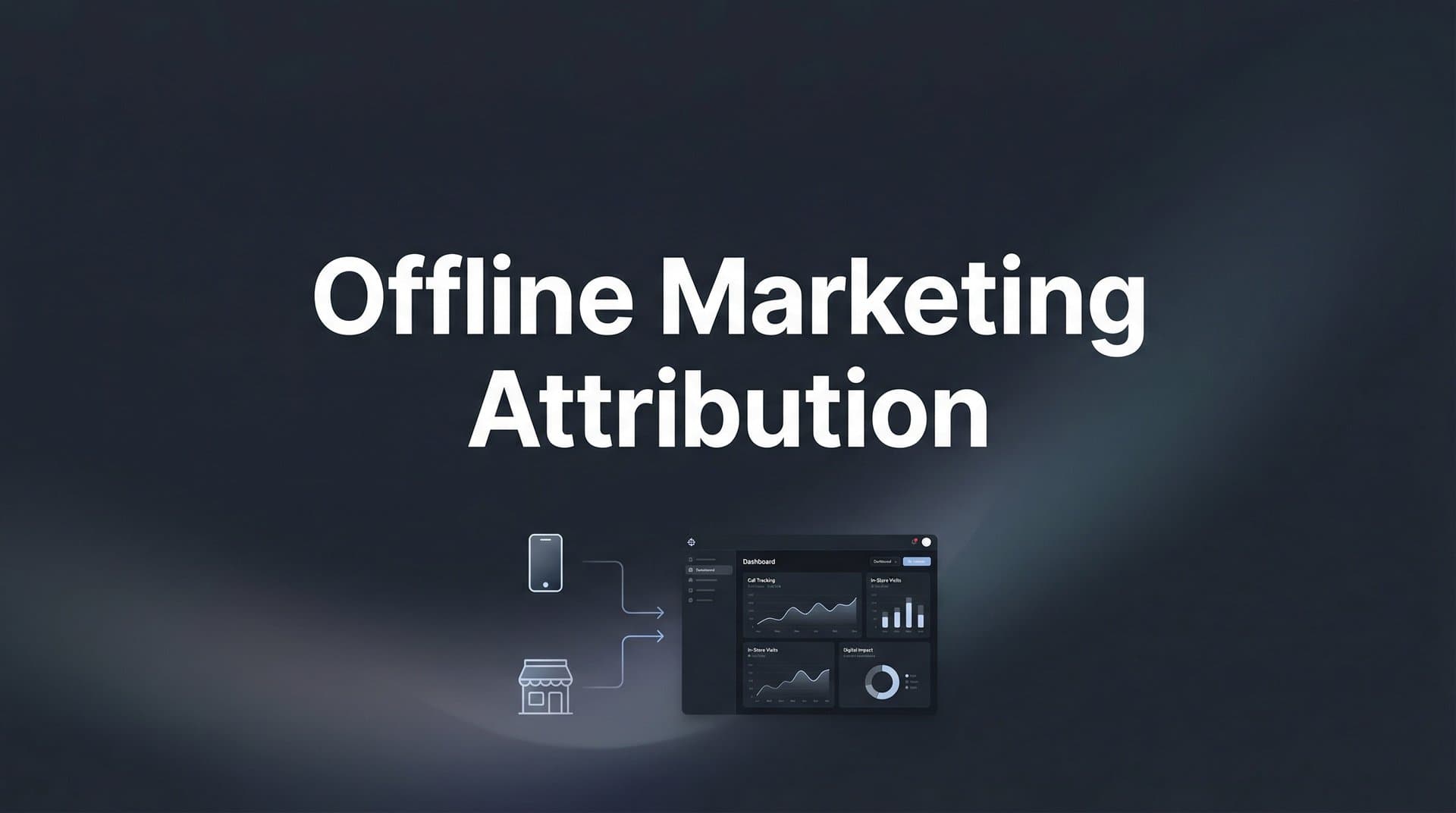
Modern marketing attribution platforms excel at this integration challenge. Rather than manually connecting disparate data sources, they provide centralized tracking that captures touchpoints from all channels—ad platforms, website analytics, CRM events, call tracking, and offline interactions—in a single view. This eliminates data silos and creates the complete visibility needed for accurate cross-channel attribution.
Building an Offline Attribution Strategy That Scales
Implementing offline attribution across every campaign simultaneously is overwhelming and unnecessary. The most effective approach is starting strategically, then expanding as you prove value and refine processes.
Prioritize High-Investment Channels First: Begin your offline attribution efforts with the channels consuming the largest portion of your budget. If you're spending significantly on trade show sponsorships, start there. If TV advertising represents your biggest offline investment, focus attribution efforts on measuring TV impact first.
This prioritization delivers the fastest ROI on your attribution work. Proving or disproving the effectiveness of your largest offline spend creates immediate opportunities for optimization. You either validate the investment and confidently maintain it, or identify underperformance and reallocate budget to more effective channels. Either way, you're making data-driven decisions about significant budget allocations.
Establish Consistent Naming Conventions: As you implement tracking across multiple offline campaigns, consistent naming becomes critical for clean data. Every campaign needs a clear identifier that follows the same format: channel, campaign name, and timing.
For example: "Radio_SpringPromo_Q1-2026" or "Billboard_Highway101_Feb2026" or "Event_TechConf_March2026." These naming conventions should extend to promo codes, vanity URLs, dedicated phone numbers, and QR codes. When every offline touchpoint follows the same naming structure, analyzing performance across campaigns becomes straightforward rather than requiring constant data cleanup.
The same discipline applies to campaign tracking in your CRM and analytics platforms. If your team logs trade show attendance as "conference," "trade show," "event," and "industry show" interchangeably, aggregating performance data becomes impossible. Standardized terminology and consistent tagging ensure your attribution data remains analyzable as it scales.
Set Realistic Attribution Windows: Offline touchpoints typically influence customers over longer timeframes than digital clicks. Someone who clicks a Facebook ad might convert within hours or days. Someone who sees your billboard or receives your direct mail piece might not convert for weeks or months.
Your attribution windows need to account for these different consideration periods. A seven-day attribution window that works for digital advertising will systematically undercount offline impact. For many offline channels, 30-day or even 60-day attribution windows better capture the true influence of the touchpoint. Understanding what a marketing attribution model is and how different models handle timing helps inform these decisions.
The specific window depends on your sales cycle and customer behavior. B2B companies with long sales cycles might need 90-day or 180-day windows to capture how trade show attendance influences eventual conversions. Consumer brands with shorter consideration periods might find 30-day windows sufficient for most offline channels.
The key is testing different windows and comparing results. If extending your attribution window from 14 days to 30 days significantly increases the attributed conversions from your direct mail campaign, that suggests the longer window better reflects customer behavior. Let your data inform the appropriate timeframe for each channel.
Putting It All Together: From Scattered Data to Clear ROI
Effective offline attribution isn't about implementing every tracking method simultaneously. It's about matching the right approach to each campaign type and budget level, then connecting all the data into a unified view of customer journeys.
For smaller campaigns with clear calls-to-action—direct mail, print ads, event booths—start with direct tracking methods: unique promo codes, vanity URLs, QR codes, and dedicated phone numbers. These provide immediate, actionable data about which specific campaigns drive conversions.
For larger, broad-reach campaigns—TV, radio, major out-of-home advertising—combine direct tracking with statistical methods. Use vanity URLs and promo codes to capture some direct attribution, while media mix modeling and geographic lift testing quantify the broader impact on brand awareness and conversion rates.
For all campaigns, integrate offline touchpoint data into your CRM and analytics stack. The goal is connecting every interaction—offline and online—to individual customer records, creating complete journey visibility that shows how channels work together rather than in isolation. The right software for tracking marketing attribution makes this integration significantly easier.
The ultimate measure of success isn't perfect tracking of every impression. It's gaining enough visibility to confidently allocate budget based on data rather than guesswork. When you can see that trade show attendance correlates with higher lifetime value, that radio advertising drives measurable lift in target markets, or that direct mail generates qualified leads at acceptable cost—you can make informed decisions about where to invest and where to cut.
This is where comprehensive attribution platforms transform offline marketing measurement. Instead of manually connecting call tracking data, CRM events, survey responses, and analytics across multiple systems, modern platforms capture every touchpoint automatically—from billboard exposure to website visit to final conversion—in a single, unified view.
For marketers running campaigns across multiple channels, this integrated approach eliminates the attribution gap between offline investments and measurable outcomes. You finally see which sources actually drive revenue, not just which channels get credit in limited analytics systems. Exploring channel attribution in digital marketing alongside offline methods creates a complete picture of your marketing performance.
Moving Forward: Turning Offline Investments Into Measurable Results
Offline marketing attribution transforms the most challenging aspect of marketing measurement—proving the value of traditional channels—into a data-driven discipline. The goal isn't achieving perfect tracking of every billboard impression or radio spot. It's gaining sufficient visibility to make confident, informed decisions about where to invest your marketing budget.
The approaches outlined here—from simple promo codes to sophisticated media mix modeling—provide a roadmap for measuring offline impact at any scale. Start with your highest-investment channels, implement appropriate tracking methods, integrate the data into your existing analytics stack, and expand as you prove value.
The marketers who succeed in this environment are those who can demonstrate clear ROI across all channels, not just the ones with built-in tracking. When you can show stakeholders exactly how your billboard campaign, trade show presence, or direct mail program contributes to revenue—with data, not assumptions—you protect effective marketing investments and optimize budget allocation based on actual performance.
Modern attribution platforms make this possible by capturing every touchpoint across all channels, connecting offline and online interactions into complete customer journeys, and showing which sources actually drive conversions. When your analytics system tracks not just ad clicks but also event attendance, phone calls, direct mail sends, and in-person interactions—all connected to individual customer records and eventual revenue—the offline attribution challenge becomes solvable.
Ready to elevate your marketing game with precision and confidence? Discover how Cometly's AI-driven recommendations can transform your ad strategy—Get your free demo today and start capturing every touchpoint to maximize your conversions.