You're spending thousands on Facebook ads, Google campaigns, and content marketing. Traffic is up. Engagement looks good. But here's the question that keeps you up at night: which of these efforts actually drives revenue?
Most marketers are flying blind. They see clicks in Google Ads, conversions in Facebook, and form fills in their CRM—but these numbers rarely match. One platform claims credit for 200 conversions while another says 150, yet your CRM shows only 100 actual sales. Something doesn't add up.
This is the attribution gap, and it's costing you more than you think. Without knowing which touchpoints actually influence purchases, you're making budget decisions based on incomplete data. You might be cutting campaigns that drive revenue while scaling ones that just look good on paper.
Online marketing attribution solves this problem. It's the system that connects every marketing touchpoint—from that first Instagram ad to the final email click—to actual revenue in your CRM. Think of it as the GPS for your marketing budget, showing you exactly which roads lead to conversions and which are dead ends.
This guide breaks down everything you need to know about online marketing attribution: how it works, why traditional analytics fall short, and how to build a system that shows you what's really driving results. No more guessing. No more conflicting reports. Just clear visibility into which marketing efforts deserve more budget and which ones don't.
The Revenue Visibility Problem Every Marketer Faces
Traditional analytics tools tell you half the story. Google Analytics shows you traffic sources and bounce rates. Facebook Ads Manager displays impressions and click-through rates. Your email platform tracks opens and clicks. But none of these tools answer the question that actually matters: which combination of these touchpoints led to a sale?
Here's why this matters more than ever. The average customer doesn't see one ad and buy. They might click a Facebook ad on Monday, visit your site from Google on Wednesday, open your email on Friday, and finally convert through a retargeting ad on Sunday. That's four touchpoints across three platforms over five days.
Without proper attribution, each platform claims credit for that conversion. Facebook says the retargeting ad drove the sale. Google Analytics credits the organic search. Your email platform counts it as an email conversion. You're now paying for the same customer three times in your reporting, and you have no idea which touchpoint actually influenced the decision.
This attribution blindness creates three expensive problems. First, you waste budget on channels that look good in isolation but don't actually drive conversions. That awareness campaign might generate thousands of clicks, but if none of those people ever buy, it's not working—yet traditional metrics make it look successful.
Second, you undervalue the channels that do the heavy lifting. Your email nurture sequence might be the reason people convert, but if they click through a retargeting ad at the last moment, that ad gets all the credit. You might cut the email budget while scaling the retargeting spend, making exactly the wrong decision.
Third, you can't scale with confidence. When you don't know what's working, every budget increase feels like a gamble. Should you double down on the channel showing the most conversions? Maybe—but if those conversions would have happened anyway through other touchpoints, you're just throwing money away.
The cost of this guesswork compounds over time. Companies often discover they've been overspending on last-click channels by 40-60% while underfunding the awareness and consideration touchpoints that actually start the customer journey. By the time they figure this out, they've burned through months of budget on the wrong strategy. Understanding the differences between marketing attribution software and traditional analytics is the first step toward solving this problem.
How Online Marketing Attribution Actually Works
Online marketing attribution is the process of assigning credit to the marketing touchpoints that influence a conversion. Instead of just seeing that someone bought, you see the entire sequence of interactions that led to that purchase—and you can measure which steps mattered most.
The technical foundation starts with tracking. Every marketing touchpoint leaves a digital footprint. When someone clicks your Facebook ad, a tracking pixel fires. When they land on your website from Google, UTM parameters in the URL identify the source. When they open your email and click through, your email platform records that interaction.
These tracking mechanisms create a timeline of interactions for each visitor. First-party cookies stored in the user's browser help connect multiple visits from the same person. Server-side tracking captures this data on your servers rather than relying solely on the browser, which makes it more reliable when users have ad blockers or strict privacy settings.
Here's where it gets powerful. Attribution platforms connect this marketing data to your actual business outcomes in your CRM or analytics system. When someone fills out a form, makes a purchase, or becomes a qualified lead, the attribution system looks backward through their entire journey and maps which touchpoints they encountered.
Let's walk through a real example. Sarah sees your Facebook ad about marketing analytics on Monday morning during her commute. She's interested but doesn't click—she's on her phone and wants to investigate later. That evening, she searches "marketing attribution tools" on Google and clicks your organic listing. She reads a blog post but doesn't convert yet.
On Wednesday, she receives your nurture email about common attribution mistakes. She clicks through and reads a case study, then leaves again. Friday afternoon, she sees your LinkedIn ad while scrolling during lunch. This time she clicks, visits your pricing page, and books a demo.
Traditional last-click attribution would credit only the LinkedIn ad. But that ignores the Facebook ad that created awareness, the organic search that built consideration, and the email that addressed her concerns. Online marketing attribution captures all four touchpoints and shows you how they worked together to create a conversion.
The system assigns each touchpoint a credit value based on the attribution model you choose. The Facebook ad might get 20% credit for awareness, the organic search 30% for consideration, the email 25% for nurturing, and the LinkedIn ad 25% for closing. Now you can see the true value of each channel instead of giving all the credit to whichever one happened to be last.
This complete view changes everything. You discover that your Facebook awareness campaigns are actually working—they just don't get last-click credit. Your email sequences are more valuable than you thought. And that expensive LinkedIn campaign you were about to scale? It's getting credit for conversions that other channels started.
The technical infrastructure connecting all this data requires integration between your ad platforms, website analytics, email tools, and CRM. Modern marketing attribution platforms automate these connections, pulling data from each source and building unified customer journey maps in real time.
Attribution Models Compared: Finding Your Best Fit
Attribution models are the rules that determine how much credit each touchpoint receives. Think of them as different lenses for viewing the same customer journey—each one reveals different insights about what's working.
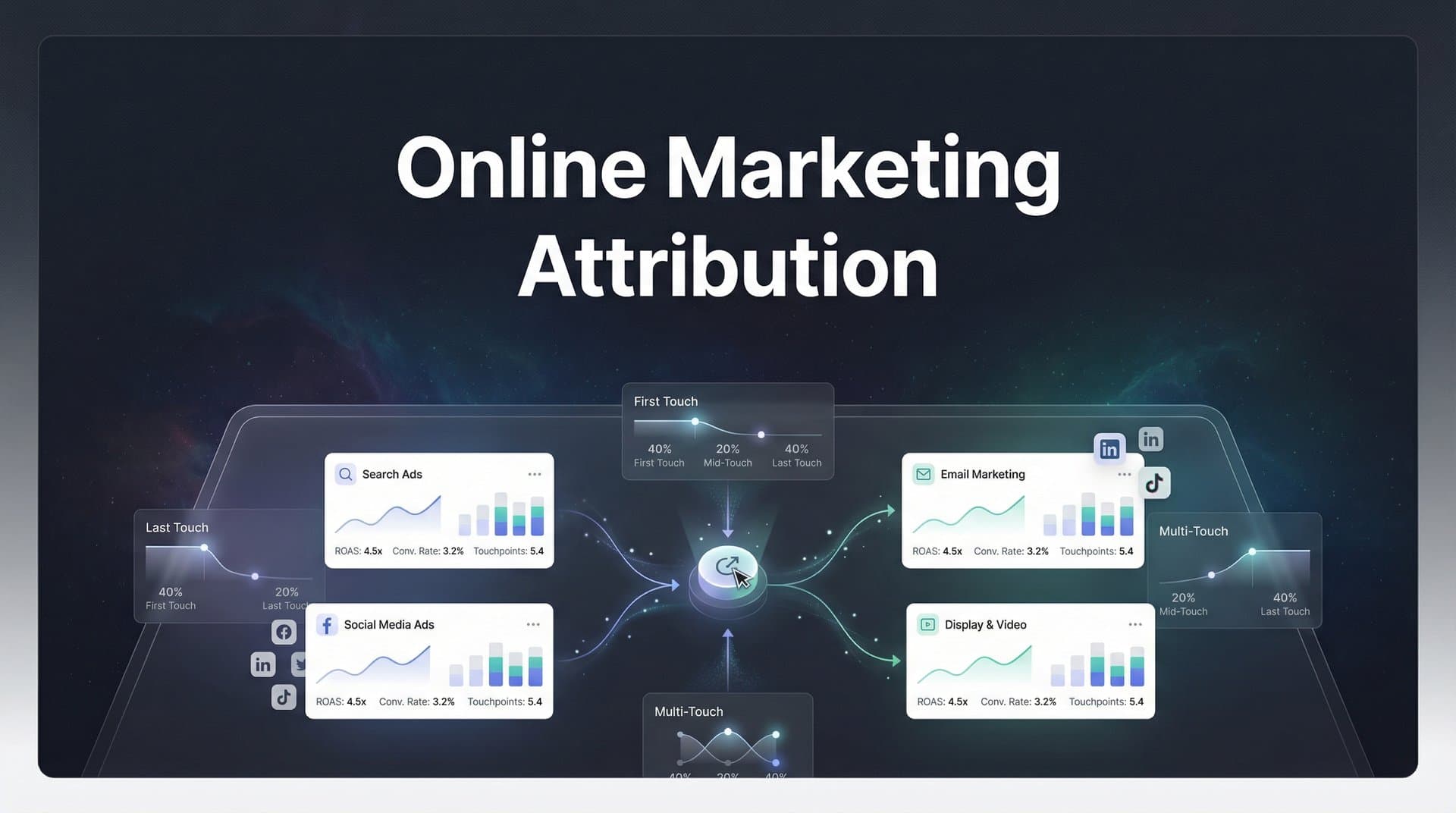
First-touch attribution gives all the credit to the initial touchpoint that brought someone into your ecosystem. If Sarah first discovered you through that Facebook ad, Facebook gets 100% credit for her eventual conversion—even if she interacted with five other channels before buying.
This model makes sense when you're primarily focused on awareness and acquisition. If you're running brand campaigns or trying to understand which channels bring in new prospects, first-touch shows you where people enter your funnel. It's particularly useful for businesses with short sales cycles where the first impression often drives immediate action.
Last-touch attribution does the opposite—it credits only the final touchpoint before conversion. If Sarah clicked your LinkedIn ad right before booking a demo, LinkedIn gets 100% credit. This is the default model in most advertising platforms because it makes their performance look better.
Last-touch works when you have a simple customer journey or when you're specifically optimizing for conversion campaigns. If most of your customers buy immediately after seeing a single ad, last-touch accurately reflects reality. But for complex B2B sales or considered purchases, it dramatically undervalues everything except the closing touchpoint.
Linear attribution splits credit equally among all touchpoints. Sarah's four interactions each get 25% credit. This model is fair in the sense that it acknowledges every touchpoint contributed something, but it assumes they all contributed equally—which is rarely true.
Linear attribution works well as a starting point when you're new to multi-touch attribution and want a balanced view. It prevents any single channel from dominating your reporting while you learn which touchpoints actually matter most for your specific customer journey.
Time-decay attribution gives more credit to touchpoints closer to the conversion. Sarah's LinkedIn ad might get 40% credit, her email 30%, her organic search 20%, and her Facebook ad only 10%. The logic is that recent interactions have more influence on the final decision.
This model fits businesses where the consideration phase is long but the decision phase is short. Once prospects are ready to buy, recent touchpoints matter more than what they saw weeks ago. It's particularly effective for retargeting campaigns and late-stage nurturing efforts.
Position-based attribution, also called U-shaped, gives the most credit to the first and last touchpoints—typically 40% each—with the remaining 20% split among middle interactions. This model recognizes that awareness and conversion moments are often most critical, while middle touchpoints play a supporting role.
U-shaped attribution works when both acquisition and closing matter significantly. If you're running awareness campaigns to fill your funnel and conversion campaigns to close deals, this model shows you the value of both ends of the journey without ignoring what happens in between.
Data-driven or algorithmic attribution uses machine learning to analyze your actual conversion patterns and assign credit based on statistical significance. Instead of following preset rules, it looks at thousands of customer journeys and determines which touchpoints actually correlate with conversions. You can explore how data science powers marketing attribution to understand the technical foundations behind these advanced models.
This is the most sophisticated approach, but it requires substantial data volume to work effectively. If you have hundreds or thousands of conversions per month, algorithmic attribution can reveal patterns you'd never spot manually. It might discover that your podcast ads don't directly convert but dramatically increase conversion rates for people who later see your search ads.
The right model depends on your business. Short sales cycles with simple journeys work fine with first-touch or last-touch. Complex B2B sales with long consideration periods need multi-touch models like time-decay or position-based. High-volume businesses with sophisticated marketing should explore data-driven attribution.
Many businesses start with linear attribution to get a balanced view, then experiment with other models to see which reveals the most actionable insights. The key is choosing a model that matches how your customers actually buy, not just the one that makes your favorite channel look best. For a deeper dive into model selection, check out our guide on what marketing attribution models are and how to choose one.
Overcoming Modern Attribution Challenges
Online marketing attribution used to be straightforward. Drop a cookie, track the clicks, connect the dots. Then Apple launched App Tracking Transparency, browsers started blocking third-party cookies, and privacy regulations reshaped the entire landscape. Now attribution requires more sophisticated approaches.
The iOS privacy changes hit first and hit hard. When Apple required apps to ask permission before tracking users across apps and websites, most people said no. Suddenly, Facebook and other platforms lost visibility into a huge portion of mobile traffic. Conversions that used to be tracked accurately now show up as "unknown" or don't get tracked at all.
This creates a reporting gap. Your actual sales haven't changed, but your attribution data shows fewer conversions because you can't track iOS users the same way. Some marketers saw their tracked conversions drop by 30-50% overnight, even though their real business results remained stable. The data got worse, not the marketing.
Cookie deprecation compounds the problem. Third-party cookies—the ones that track you across websites—are being phased out by major browsers. Safari and Firefox already block them by default. Chrome keeps delaying its phase-out, but it's coming. This breaks traditional cross-site tracking that many attribution systems relied on.
Server-side tracking offers a more reliable solution. Instead of tracking user behavior entirely in the browser where ad blockers and privacy settings can interfere, server-side tracking captures data on your own servers. When someone converts on your website, your server sends that conversion data directly to ad platforms.
This approach has several advantages. It's not affected by browser-based tracking blockers. It gives you more control over what data gets shared and how. And it often captures more complete conversion data because it's not dependent on cookies surviving across sessions or devices.
The catch is that server-side tracking requires more technical setup. You need to configure your server to receive conversion events, match them to the right users, and send that data to your ad platforms using their conversion APIs. But once it's running, you get more accurate attribution data than browser-based tracking alone.
Cross-device tracking remains one of the hardest attribution challenges. Sarah might see your ad on her phone during her commute, research on her work laptop during lunch, and finally convert on her tablet at home. Traditional cookie-based tracking sees these as three different people, not one customer journey. Understanding the common attribution challenges in marketing analytics helps you prepare for these obstacles.
Deterministic matching solves this when users log in. If Sarah logs into her account on all three devices, you can definitively connect her activity across devices. This is why encouraging account creation early in the customer journey helps attribution accuracy—not just for conversion optimization.
Probabilistic matching uses signals like IP address, device type, browser, and behavioral patterns to make educated guesses about which activities belong to the same person. It's less accurate than deterministic matching but better than treating every device as a separate user.
Cross-platform attribution creates similar challenges. Your customer journey might span Facebook, Google, LinkedIn, email, and organic search. Each platform tracks its own conversions, but they rarely communicate with each other. You need a central attribution system that pulls data from all platforms and connects the dots.
Modern attribution platforms address these challenges by combining multiple tracking methods. They use first-party cookies where possible, implement server-side tracking for critical conversions, leverage logged-in user data for deterministic matching, and apply probabilistic models to fill gaps. No single method is perfect, but together they provide reasonably accurate attribution even in today's privacy-focused environment.
The key is accepting that perfect attribution is impossible. Some journeys will remain invisible. Some conversions won't be tracked. The goal isn't perfection—it's having substantially better data than you'd get from last-click attribution or platform-reported metrics alone.
Turning Attribution Data Into Smarter Ad Spend
Attribution data is only valuable if it changes your decisions. The real power comes from using that visibility to shift budget from underperforming channels to ones that actually drive revenue.
Start by identifying which channels generate qualified conversions, not just clicks or form fills. Your attribution data might show that LinkedIn drives fewer total conversions than Facebook, but when you filter for conversions that actually closed into customers, LinkedIn's value jumps significantly. Those are the insights that traditional last-click attribution misses.
Look at the full customer journey to understand channel roles. You might discover that your podcast ads rarely get last-click credit but people who hear your podcast convert at twice the rate when they later see your search ads. The podcast isn't driving direct conversions—it's warming up your audience and making your other channels more effective.
This changes your optimization strategy. Instead of cutting the podcast budget because it shows few direct conversions, you recognize it as a force multiplier for your other channels. You might even increase podcast spend because it improves ROI across your entire marketing mix.
Channel interaction effects often reveal surprising insights. Attribution data might show that people who see both your Facebook ads and your email campaigns convert at three times the rate of people who only see one channel. This suggests these channels work better together than separately, so you should coordinate messaging across both rather than treating them as independent efforts. Mastering cross-channel attribution is essential for understanding these interaction effects.
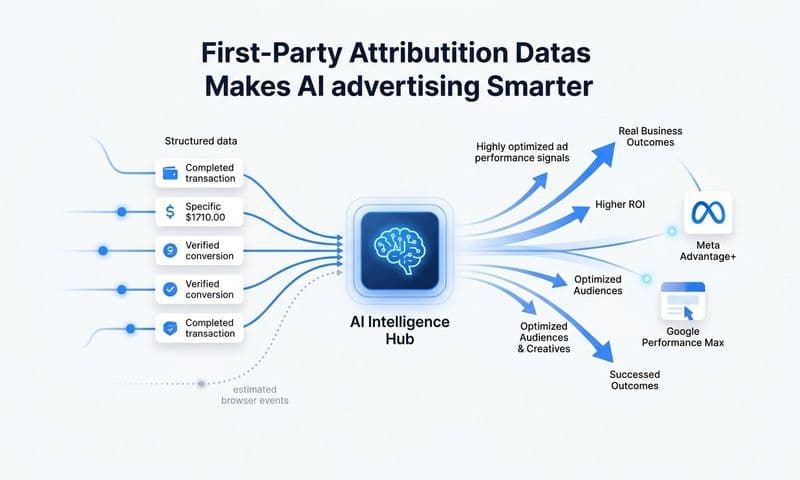
The feedback loop to ad platforms is equally important. Modern advertising platforms like Facebook and Google use machine learning to optimize ad delivery. They show your ads to people most likely to convert based on patterns they've observed. But they can only optimize based on the conversion data you send them.
When you feed ad platforms accurate, enriched conversion data from your attribution system, their algorithms get smarter. Instead of optimizing for form fills that never become customers, they can optimize for conversions that actually generate revenue. Instead of treating all conversions equally, they can prioritize high-value customers over low-value ones.
This creates a compounding advantage. Better conversion data leads to better targeting. Better targeting leads to higher conversion rates. Higher conversion rates generate more conversion data, which further improves the targeting. Companies that implement this feedback loop often see their cost per acquisition drop by 20-40% within a few months as the ad platforms learn to find better prospects.
Budget reallocation becomes data-driven rather than intuitive. Your attribution data might reveal that organic search drives 30% of revenue but only receives 15% of your marketing attention. Meanwhile, display ads get 25% of budget but contribute only 10% of revenue. The reallocation decision becomes obvious once you see the numbers.
Real-time attribution enables faster optimization. Instead of waiting until month-end to analyze what worked, you can see which campaigns are driving conversions today and adjust accordingly. If a particular ad set is generating qualified leads at half your target cost per acquisition, you can scale it immediately rather than waiting weeks to discover this in a monthly report.
The most sophisticated marketers use attribution data to inform creative decisions, not just budget allocation. If your data shows that video ads generate more first-touch conversions but image ads get more last-click credit, you might use video for awareness campaigns and images for retargeting. The attribution insights guide both strategy and execution.
Building Your Attribution Strategy From Scratch
Starting with attribution doesn't require a massive budget or months of preparation. You can build a working system in stages, improving accuracy as you grow.
Begin by connecting your data sources. At minimum, you need your website analytics, your primary ad platforms, and your CRM or sales system. These three connections let you see the journey from ad click to website visit to actual conversion. Start here before adding complexity.
Define your conversion events clearly. What counts as a conversion in your business? For e-commerce, it's straightforward—a purchase. For B2B, you might track multiple conversion types: demo requests, qualified leads, closed deals. Each event needs to be tracked consistently across all platforms.
The mistake many marketers make is tracking only the final conversion. They see who became a customer but miss the intermediate steps. Track the full funnel: ad clicks, website visits, content downloads, demo requests, qualified leads, and closed deals. This complete picture shows you where prospects drop off and which touchpoints move them forward. Our guide on attribution marketing tracking covers the technical details of setting this up properly.
Choose your attribution model based on your sales cycle and marketing strategy. If you're running simple, direct-response campaigns with short consideration periods, last-touch might suffice. If you have a complex B2B sale with multiple stakeholders and a three-month sales cycle, you need multi-touch attribution to understand the full journey.
Start with linear attribution if you're unsure. It's a balanced approach that acknowledges all touchpoints without making assumptions about which matter most. Run it for a month or two, then experiment with time-decay or position-based models to see if they reveal different insights.
Implement UTM parameters consistently across all campaigns. Every ad, email, and social post should have properly tagged URLs that identify the source, medium, campaign, and content. This discipline pays off when you're analyzing attribution data—you can't attribute conversions to specific campaigns if you can't identify which campaigns people came from.
Set up server-side tracking for critical conversions. You don't need to track everything server-side immediately, but your most important conversion events—purchases, demo bookings, qualified leads—should have server-side tracking to ensure accuracy even when browser-based tracking fails.
Connect your ad platforms to receive enriched conversion data. Facebook's Conversions API, Google's Enhanced Conversions, and similar features from other platforms let you send back detailed conversion information that improves their optimization algorithms. This closes the loop between attribution insights and ad performance.
When evaluating attribution platforms, prioritize these capabilities: integration with your existing tech stack, support for server-side tracking, flexible attribution models, and the ability to feed data back to ad platforms. The platform should make attribution easier, not add another disconnected data silo to your marketing stack. Review our comparison of marketing attribution software features to understand what capabilities matter most.
Look for platforms that offer AI-powered insights beyond basic attribution reports. The best systems don't just show you what happened—they identify patterns and recommend optimization opportunities. They might flag that your Google campaigns perform better on weekends, or that certain ad creatives drive higher-value customers than others.
Test your attribution setup before relying on it for major decisions. Run it in parallel with your existing reporting for a month. Compare the results. If your attribution data shows dramatically different results than your platform reports, investigate why. The discrepancy often reveals tracking gaps or data quality issues that need fixing.
Remember that attribution accuracy improves over time. Your first month of data will be messier than your third month as you refine tracking, fix integration issues, and learn which reports matter most. Don't expect perfect data immediately—expect progressively better visibility as your system matures.
Making Attribution Your Competitive Advantage
Online marketing attribution transforms marketing from a cost center into a measurable revenue driver. When you know exactly which touchpoints influence conversions, you stop guessing and start making confident decisions about where to invest.
The marketers winning today aren't necessarily spending more—they're spending smarter. They know which awareness campaigns prime their audience for conversion. They understand which nurture touchpoints move prospects forward. They can prove which channels deserve more budget and which ones are just burning cash.
This visibility compounds over time. Every optimization you make based on attribution data improves your results, which generates better data, which enables better optimizations. The gap between marketers with attribution and those without it widens every quarter.
The goal isn't just tracking—it's confidence. Confidence to scale what's working. Confidence to cut what isn't. Confidence to test new channels knowing you'll see their true impact. Confidence to prove marketing's value to the C-suite with revenue data, not vanity metrics.
Modern attribution isn't optional anymore. Your competitors are using it to outmaneuver you. Ad platforms are getting smarter, but only for advertisers who feed them quality conversion data. The privacy changes that broke traditional tracking aren't going away—they're accelerating. The marketers who adapt will thrive while others struggle with incomplete data and misallocated budgets.
Ready to elevate your marketing game with precision and confidence? Discover how Cometly's AI-driven recommendations can transform your ad strategy. We capture every touchpoint across your entire customer journey—from that first ad click to the final CRM conversion—and show you exactly which sources drive real revenue. Our platform connects your ad platforms, website, and CRM to give you complete visibility, then uses AI to identify high-performing campaigns and feed enriched conversion data back to your ad platforms for better optimization. Stop guessing which marketing efforts work. Get your free demo today and start making data-driven decisions that actually move revenue.