Every dollar you spend on paid advertising should work toward measurable business outcomes—but knowing exactly which ads drive revenue remains one of marketing's biggest challenges. With tracking limitations from iOS updates, cross-platform customer journeys, and fragmented data sources, many marketers struggle to connect ad spend to actual conversions.
The problem isn't just technical. It's strategic. When you can't accurately measure which campaigns generate real revenue, every budget decision becomes a guess. You might be scaling campaigns that look good in platform dashboards but deliver minimal actual ROI. Or worse, you could be cutting budget from channels that drive significant revenue through assisted conversions that never show up in last-click reports.
This guide walks you through a practical, step-by-step process for measuring paid advertising ROI accurately. You'll learn how to set up proper tracking infrastructure, define meaningful metrics, connect your data sources, and build a reporting system that reveals which campaigns truly deliver results.
By the end, you'll have a clear framework for making confident budget decisions based on real attribution data rather than platform-reported vanity metrics. Let's get started.
Step 1: Define Your Revenue Goals and Key Metrics
Before you can measure ROI accurately, you need to know exactly what success looks like for your business. This isn't about vanity metrics like impressions or clicks—it's about defining the conversion events that actually matter to your bottom line.
Start by identifying your primary conversion events. For ecommerce businesses, this might be completed purchases. For SaaS companies, it could be demo bookings or trial sign-ups that convert to paid subscriptions. For lead-generation businesses, it's qualified leads that your sales team can actually close.
The key is specificity. Don't just track "leads"—track leads that meet your qualification criteria and have realistic potential to become customers. A form submission from someone outside your target market or service area doesn't deserve the same attribution value as a qualified prospect.
Next, establish your baseline metrics across all current channels. Calculate your current customer acquisition cost by dividing total ad spend by the number of customers acquired. Determine your return on ad spend for each platform by dividing revenue generated by ad spend. Track conversion rates from click to conversion for every campaign.
These baselines become your benchmark. Without knowing where you are today, you can't measure improvement or identify which optimization efforts actually move the needle. Understanding how to calculate ROI for marketing provides the foundation for all your measurement efforts.
Now set specific ROI targets for each campaign type and platform. Your targets should reflect the role each channel plays in your marketing mix. Top-of-funnel awareness campaigns on platforms like Meta or TikTok might have lower immediate ROI but contribute significantly to conversions that other channels get credit for. Bottom-funnel search campaigns typically deliver higher direct ROI because they capture existing demand.
Think of it like a basketball team. Your point guard might not score the most points, but their assists make everyone else more effective. Similarly, your awareness campaigns might not get last-click credit, but they make your retargeting and search campaigns far more profitable.
Finally, determine your attribution window based on your typical sales cycle length. If most customers convert within seven days of their first interaction, a seven-day window makes sense. For B2B companies with longer sales cycles, you might need a 30-day or even 90-day window to capture the full customer journey.
Your attribution window directly impacts which campaigns get credit for conversions. Too short, and you undervalue top-of-funnel campaigns. Too long, and you might attribute conversions to touchpoints that had minimal actual influence.
Step 2: Set Up Server-Side Tracking Infrastructure
Browser-based tracking is dying. iOS privacy updates, cookie restrictions, and ad blockers have created massive blind spots in traditional pixel-based measurement. If you're still relying solely on browser pixels, you're probably missing 20-40% of your actual conversions.
Here's what's happening: When someone clicks your ad on their iPhone, browses your site, then converts later on their laptop, traditional pixel tracking often can't connect those dots. The cookie that stored their initial click data got blocked or deleted. From your tracking perspective, that conversion appears to come from direct traffic or organic search—not from the paid ad that actually started the journey. Understanding how iOS 14 changed digital advertising helps explain why these tracking gaps exist.
Server-side tracking solves this by capturing conversion data directly from your server rather than relying on browser cookies. When someone completes a purchase or fills out a form, your server sends that conversion event directly to your tracking platform. No cookies required. No browser restrictions to navigate around.
Setting up server-side tracking requires connecting your website or application backend to your attribution platform. This typically involves adding tracking code to your server that fires when specific conversion events occur. The implementation varies by platform, but the core principle remains the same: capture conversion data at the server level where privacy restrictions can't interfere.
The next critical step is connecting your tracking to your CRM. This is where measurement transforms from tracking clicks to tracking actual revenue. When someone fills out a lead form, that event gets logged in your CRM with a unique identifier. Your attribution platform can then track that lead through your sales pipeline—from marketing qualified lead to sales qualified lead to closed deal.
This connection reveals the true value of your marketing channels. That Meta campaign might generate fewer form fills than Google Ads, but if Meta leads close at twice the rate and generate higher deal values, Meta might actually be your most profitable channel. You'd never know that from looking at conversion data alone.
After implementing server-side tracking, verify accuracy by comparing your new data against platform-reported conversions. You'll likely see discrepancies—that's expected and actually reveals how much conversion data you were missing before. Platform dashboards show conversions they can track through their pixels. Your server-side tracking shows conversions that actually happened.
Document these discrepancies. Understanding the gap between platform-reported data and actual conversions helps you make better optimization decisions. When Facebook's dashboard shows a 3x ROAS but your attribution platform shows 4.5x ROAS, you know that campaign deserves more budget than the platform data suggests. Implementing post-cookie advertising measurement strategies ensures your tracking remains accurate despite privacy changes.
Step 3: Connect All Your Data Sources
Accurate ROI measurement requires bringing together data from every platform where you run ads and every system where conversions happen. Fragmented data creates fragmented insights. When your Meta data lives in one place, Google Ads in another, and CRM data in a third system, you're forced to make budget decisions based on incomplete information.
Start by integrating all your ad platforms into a unified dashboard. This means connecting Meta Ads, Google Ads, TikTok Ads, LinkedIn Ads, and any other platforms where you invest budget. Each platform should feed spend data, impression data, click data, and platform-reported conversions into your central attribution system.
The goal isn't just data aggregation—it's creating a single source of truth for your marketing performance. When everything flows into one system, you can compare channel performance apples-to-apples rather than trying to reconcile different reporting interfaces with different metrics and attribution methodologies. A robust paid advertising analytics tool makes this integration seamless.
Next, link your CRM data to attribute revenue back to original ad touchpoints. This connection closes the loop between marketing spend and actual revenue. When a lead converts to a customer three weeks after clicking your ad, your attribution platform needs to connect that revenue back to the original campaign, ad set, and even specific ad creative that started the journey.
This requires mapping unique identifiers across systems. When someone clicks your ad, they should receive a tracking ID that follows them through your website, into your CRM when they convert, and through your sales pipeline. That persistent identifier enables accurate attribution even when the customer journey spans multiple devices and sessions.
The most valuable insight comes from mapping the complete customer journey from first touch to final conversion. Most customers don't convert on their first interaction with your brand. They might see a social media ad, visit your website, leave, see a retargeting ad, click through to read a blog post, sign up for your email list, receive several nurture emails, then finally book a demo or make a purchase.
Each of those touchpoints contributed to the conversion. Understanding the full journey reveals which channels work together to drive results. Learning how to measure ROI from multiple marketing channels becomes essential when customers interact with your brand across different platforms.
Finally, ensure UTM parameters and tracking IDs flow consistently across all touchpoints. UTM parameters are the tags you add to your URLs to track campaign source, medium, and other details. These parameters need to persist as visitors move through your site and convert. If UTM data gets lost during the conversion process, you lose the ability to attribute that conversion back to its source.
Set up a standardized UTM naming convention and enforce it across all campaigns. When everyone on your team uses consistent naming, your attribution data stays clean and reliable. Inconsistent naming creates data chaos that makes accurate measurement impossible.
Step 4: Choose and Apply Your Attribution Model
Attribution models determine how credit for conversions gets distributed across the multiple touchpoints in a customer journey. The model you choose fundamentally shapes which channels appear successful and which appear to underperform—even though the actual customer behavior remains the same.
Let's start with the simplest models. First-touch attribution gives 100% of the credit to the first interaction a customer has with your brand. If someone clicks a Facebook ad, then later clicks a Google search ad before converting, Facebook gets all the credit. Last-touch attribution does the opposite—it gives 100% credit to the final touchpoint before conversion. In that same scenario, Google would get all the credit.
Both single-touch models create distorted views of reality. First-touch overvalues awareness channels while ignoring the nurturing and conversion-focused touchpoints that actually closed the deal. Last-touch overvalues bottom-funnel channels while ignoring the awareness campaigns that introduced prospects to your brand in the first place.
Linear attribution attempts to solve this by distributing credit evenly across all touchpoints. If a customer journey includes four interactions before converting, each touchpoint receives 25% of the credit. This model acknowledges that multiple channels contributed, but it assumes each contribution was equally valuable—which rarely reflects reality.
Time-decay attribution gives more credit to touchpoints closer to the conversion. The logic makes sense for some businesses: the interactions that happened right before someone converted probably had more influence than an ad they saw three weeks earlier. But this model still undervalues the awareness campaigns that started the entire journey.
Data-driven attribution uses machine learning to analyze thousands of customer journeys and determine which touchpoints actually correlate with conversions. Instead of applying a predetermined rule, the algorithm identifies patterns in your specific data. Choosing the right advertising attribution model depends on your business complexity and sales cycle length.
Choosing the right model depends on your sales cycle and customer journey complexity. For businesses with short sales cycles and simple journeys—like impulse ecommerce purchases—last-touch attribution might provide sufficient accuracy. The customer sees an ad, clicks through, and buys immediately. There aren't multiple touchpoints to consider.
For businesses with longer sales cycles and complex journeys—like B2B software or high-ticket services—multi-touch attribution becomes essential. Your customers might interact with your brand 10-15 times over several weeks before converting. Single-touch models completely misrepresent which channels drive results in these scenarios.
The real power comes from comparing multiple attribution models simultaneously. When you look at first-touch, last-touch, and data-driven attribution side by side, you spot where single-touch models create blind spots. If a channel shows strong performance in first-touch but weak performance in last-touch, it's primarily driving awareness rather than direct conversions. That's not bad—it's just a different role in your marketing mix.
Understanding these differences prevents costly mistakes. Without multi-touch attribution, you might cut budget from awareness channels because they don't generate many last-click conversions—not realizing those channels feed qualified traffic to your bottom-funnel campaigns. Navigating the attribution challenges in marketing analytics requires understanding how different models impact your insights.
Step 5: Calculate True ROI and ROAS by Channel
With proper tracking infrastructure and attribution in place, you can now calculate the metrics that actually matter: return on investment and return on ad spend. These numbers reveal which campaigns generate profit and which consume budget without delivering results.
The ROI formula is straightforward: subtract your ad spend from the revenue generated, divide by ad spend, then multiply by 100 to get a percentage. If you spent $10,000 on a campaign and generated $35,000 in attributed revenue, your ROI is 250%. For every dollar invested, you gained $2.50 in profit. Using an advertising ROI calculator simplifies these calculations across multiple campaigns.
ROAS simplifies this further by showing revenue multiple without the percentage calculation. Using the same example, your ROAS would be 3.5x—you generated $3.50 in revenue for every dollar spent. Both metrics tell the same story from slightly different angles. ROI emphasizes profit margin while ROAS emphasizes revenue efficiency.
The critical step is calculating these metrics at every level of granularity. Don't just measure ROI for "Facebook Ads" as a whole. Break it down by campaign, by ad set, and by individual ad creative. You might discover that your overall Facebook ROAS is 4x, but one specific campaign delivers 8x ROAS while another barely breaks even at 1.2x ROAS.
That granular insight transforms optimization. Instead of broad budget shifts between platforms, you can make surgical adjustments—cutting budget from underperforming ad sets while scaling the specific campaigns and creatives that drive disproportionate results.
For subscription businesses and companies with repeat purchases, factor customer lifetime value into your ROI calculations. A campaign that generates a 2x ROAS on initial purchase might actually deliver a 6x ROAS when you account for the average customer's repeat purchases over 12 months. Ignoring LTV causes you to underfund acquisition channels that bring in high-quality customers who generate revenue for years.
Calculate LTV-adjusted ROI by multiplying your average customer lifetime value by the number of customers acquired, then applying the standard ROI formula. This longer-term view often reveals that channels you considered marginal actually drive your most valuable customers.
Don't forget to account for assisted conversions that don't appear in last-click reports. Your attribution platform should show you how often each channel appears in converting customer journeys, even when it doesn't get last-click credit. A channel might only generate 100 last-click conversions but assist in 500 additional conversions where other channels got final credit.
Those assisted conversions represent real value that single-touch attribution completely misses. When you include assisted conversion value in your ROI calculations, channels that appeared mediocre suddenly show their true impact on your business. Understanding cross-channel attribution and marketing ROI reveals how channels work together to drive results.
Step 6: Build Your ROI Reporting Dashboard
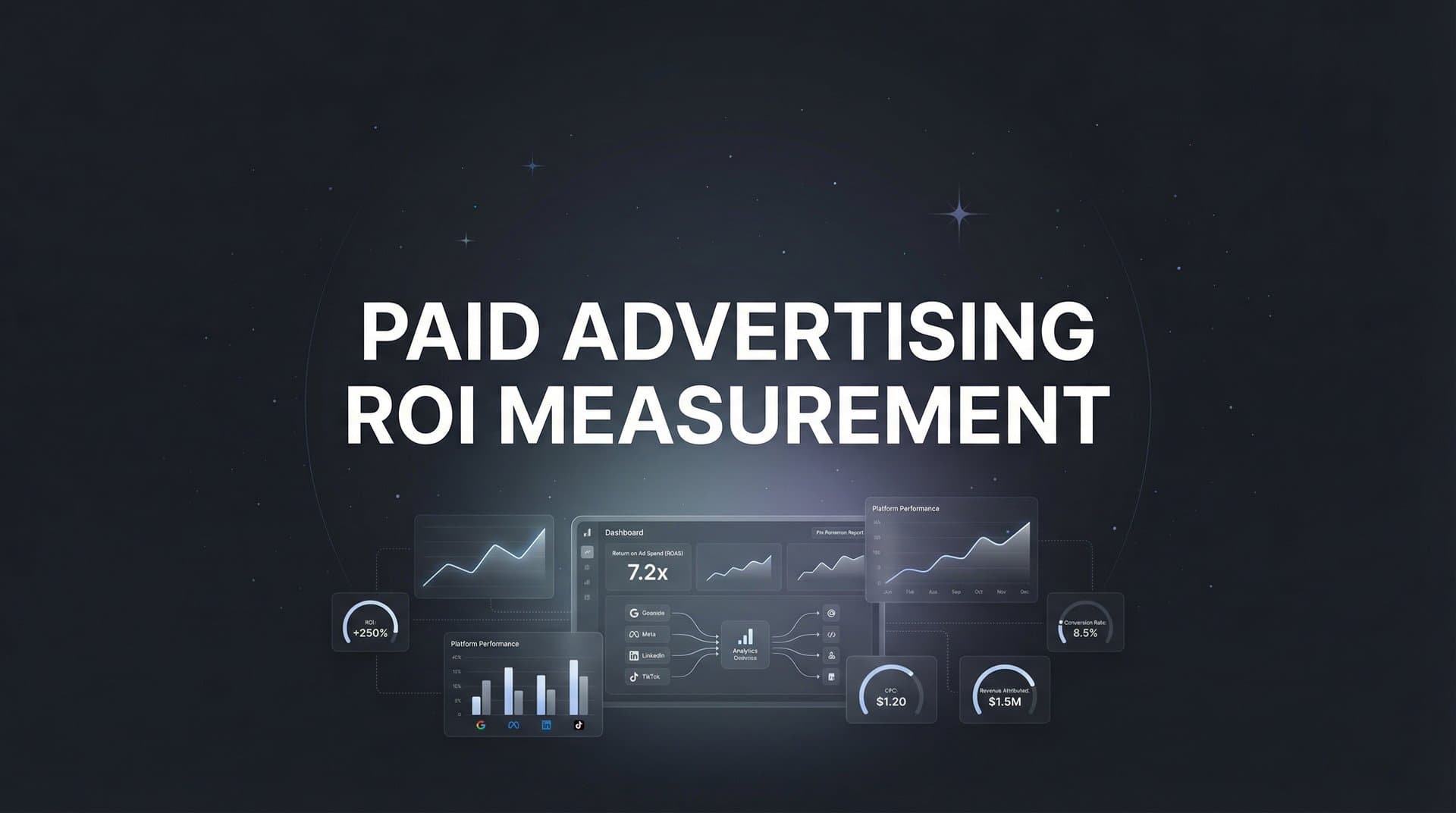
Raw data doesn't drive decisions—clear, actionable reporting does. Your ROI reporting dashboard transforms attribution data into insights you can act on immediately. The goal is real-time visibility into which campaigns generate profit and which burn budget.
Start by creating a dashboard that displays spend, conversions, and ROI by channel in real time. You should be able to glance at your dashboard and immediately see which platforms are hitting ROI targets and which are falling short. Color-coding helps—green for campaigns exceeding targets, yellow for campaigns near breakeven, red for campaigns losing money.
This real-time visibility enables fast response to performance changes. When a previously profitable campaign suddenly drops below your ROI threshold, you catch it within hours rather than discovering the problem a week later during your monthly review. That speed matters when you're spending hundreds or thousands of dollars per day.
Set up automated alerts for campaigns that fall below ROI thresholds. Your attribution platform should notify you immediately when a campaign's ROAS drops below your minimum acceptable level. These alerts prevent budget waste by flagging problems before they consume significant spend. Implementing paid advertising reporting automation tools saves hours of manual monitoring each week.
Configure alerts at multiple levels—campaign level, ad set level, and even individual ad level for your highest-spend campaigns. The more granular your alerting system, the faster you can identify and fix performance issues.
Include a comparison view that shows attributed revenue against platform-reported conversions. This side-by-side comparison reveals tracking gaps and attribution differences. When platform dashboards show 100 conversions but your attribution system shows 140, you know you're capturing conversions that pixel-based tracking missed. When the platforms show higher numbers than your attribution system, you might have tracking implementation issues to investigate.
These discrepancies also inform optimization decisions. If a platform consistently under-reports conversions in its own dashboard, you might be hesitant to scale campaigns that look marginal in platform reporting but actually deliver strong ROI according to your attribution data.
Finally, establish a regular reporting cadence that matches your business rhythm. Daily monitoring catches immediate issues. Weekly analysis identifies trends and optimization opportunities. Monthly reviews assess strategic performance and inform budget allocation decisions.
Your daily monitoring should focus on anomaly detection—are any campaigns performing dramatically differently than yesterday? Weekly analysis goes deeper into what's working and what's not, with time to test hypotheses and implement optimizations. Monthly reviews zoom out to assess whether your overall marketing mix is hitting business objectives and where strategic shifts might be needed.
Step 7: Optimize Budget Allocation Based on ROI Data
Accurate measurement only creates value when you act on the insights. The final step is using your ROI data to continuously optimize budget allocation toward campaigns and channels that deliver the strongest returns.
Start with the obvious moves: shift budget toward channels and campaigns with proven ROI above your targets. If your Meta campaigns consistently deliver 5x ROAS while your LinkedIn campaigns struggle to reach 2x ROAS, the math is clear. Allocate more budget to Meta and reduce LinkedIn spend until you can improve its performance or determine it's not viable for your business.
But don't make dramatic changes overnight. Gradual optimization prevents overcorrection and gives you time to observe how budget shifts impact performance. When you suddenly triple spend on a campaign, efficiency often decreases as you exhaust the most responsive audience segments and move into colder traffic. Following a proven advertising ROI action plan helps you make systematic improvements.
Use AI-powered recommendations to identify scaling opportunities you might miss manually. Modern attribution platforms analyze patterns across your entire account to spot campaigns that could profitably handle increased budget. The AI might notice that a specific ad set consistently maintains strong ROAS as you increase spend, suggesting significant headroom for scaling.
These recommendations go beyond simple "spend more here" advice. Advanced systems identify the optimal bid strategies, audience targeting adjustments, and budget pacing that maximize ROI as you scale. They might suggest increasing budget 30% while simultaneously adjusting your target CPA to maintain efficiency at higher volume.
Feed enriched conversion data back to ad platforms to improve their optimization algorithms. Platforms like Meta and Google use machine learning to optimize ad delivery toward users most likely to convert. But they can only optimize based on the conversion data they receive. When you send back enriched data from your attribution system—including conversion values, customer quality scores, and lifetime value predictions—platform algorithms can optimize toward your actual business objectives rather than just raw conversion volume.
This feedback loop compounds over time. Better data leads to better optimization, which leads to better results, which generates more data to further improve optimization. The platforms' AI becomes aligned with your actual ROI goals rather than optimizing for metrics that don't directly correlate with profit.
Finally, establish a testing framework for new channels using your measurement infrastructure. When you want to test TikTok Ads or explore Pinterest advertising, you already have the attribution system in place to accurately measure results from day one. Learning the strategies for scaling paid advertising profitably ensures you grow spend without sacrificing efficiency.
Your testing framework should include clear success criteria, defined testing budgets, and predetermined evaluation periods. Test for at least 30 days to gather sufficient data, but set a maximum test budget to prevent excessive spending on channels that clearly aren't working. Use the same attribution methodology you apply to existing channels so you're comparing apples to apples.
Your Path to Confident Budget Decisions
Measuring paid advertising ROI accurately requires the right infrastructure, connected data sources, and a clear attribution methodology. Start by defining your goals and metrics—know exactly what success looks like before you build your measurement system. Then implement server-side tracking that captures conversions browser-based pixels miss, especially in today's privacy-focused landscape.
Connect all your data sources into a unified view that maps complete customer journeys from first touch to final conversion. Choose an attribution model that fits your business complexity—multi-touch attribution for longer sales cycles, simpler models for straightforward customer journeys. Calculate true ROI at every level of granularity, from platform-level down to individual ad creative performance.
Build a real-time dashboard that surfaces actionable insights immediately, with automated alerts that catch problems before they consume significant budget. Then use that data to continuously optimize—shifting budget toward proven winners, leveraging AI recommendations to identify scaling opportunities, and feeding enriched conversion data back to platform algorithms.
The measurement framework you build today becomes the foundation for scaling profitably tomorrow. Every optimization cycle compounds. Every budget decision becomes more confident. Every dollar works harder because you know exactly which campaigns generate real business results.
Ready to elevate your marketing game with precision and confidence? Discover how Cometly's AI-driven recommendations can transform your ad strategy—Get your free demo today and start capturing every touchpoint to maximize your conversions.