You're running podcast ads. Your brand is being mentioned by trusted hosts. Thousands of listeners are hearing your message. But when you check your analytics dashboard, there's nothing. No clear signal. No definitive proof that those audio impressions are turning into customers.
This is the reality for most marketers investing in podcast advertising. Unlike search ads where you can track clicks, or social campaigns where you can monitor engagement, podcast ads exist in a measurement gray zone. You know people are listening. You just can't see the direct line from their earbuds to your checkout page.
The challenge isn't small. Podcast advertising has become a legitimate marketing channel, with brands allocating significant budgets to host-read sponsorships and programmatic audio. Yet the attribution question remains: which podcast placements are actually driving conversions, and which ones are just expensive brand awareness exercises?
This article breaks down the attribution methods available to track podcast ad performance—from traditional promo codes to sophisticated multi-touch models. You'll learn how each method works, where it falls short, and how to combine approaches to finally get clarity on your audio marketing spend.
Why Tracking Podcast Ads Feels Like Finding a Needle in a Haystack
The fundamental problem with podcast attribution is simple: podcasts are consumed in environments that don't naturally connect to digital behavior. Someone might hear your ad while commuting, exercising, or doing household chores—hours or even days before they're in front of a computer ready to make a purchase.
Unlike click-based digital advertising, there's no immediate action mechanism. A listener can't tap on an audio ad. They can't swipe up for more information. The conversion path requires them to remember your brand, actively seek you out later, and complete a purchase—all without any digital tracking in between.
This creates what marketers call the "delayed response problem." Someone might hear your podcast ad on Tuesday morning during their workout, think "that sounds interesting," and then completely forget about it until Friday when they're browsing products online. When they finally convert, how do you connect that sale back to the podcast episode they heard three days earlier?
The device fragmentation issue makes this worse. Podcasts are consumed across a fractured ecosystem: dedicated podcast apps, streaming platforms, smart speakers, car systems, and mobile browsers. Each platform has different tracking capabilities, and none of them naturally integrate with your website analytics or CRM.
Then there's the passive consumption factor. Podcast listening is often a secondary activity. People listen while doing something else, which means they're not primed to take immediate action. They're absorbing your message, but they're not in "shopping mode." This makes podcast ads powerful for brand building but notoriously difficult to measure for direct response.
Traditional web analytics tools weren't built for this. Google Analytics can tell you someone visited your site, but it can't tell you they heard your podcast ad during their morning jog. Without additional tracking mechanisms, podcast traffic typically shows up as direct visits or gets misattributed to the last-click channel—usually search or social. Understanding these attribution challenges in marketing analytics is the first step toward solving them.
This measurement gap forces marketers to choose between investing in a high-potential channel without clear ROI visibility, or avoiding podcast advertising altogether because they can't prove it works. Neither option is ideal. What's needed is a framework for connecting audio touchpoints to actual business outcomes.
Promo Codes and Vanity URLs: The Old Guard of Podcast Attribution
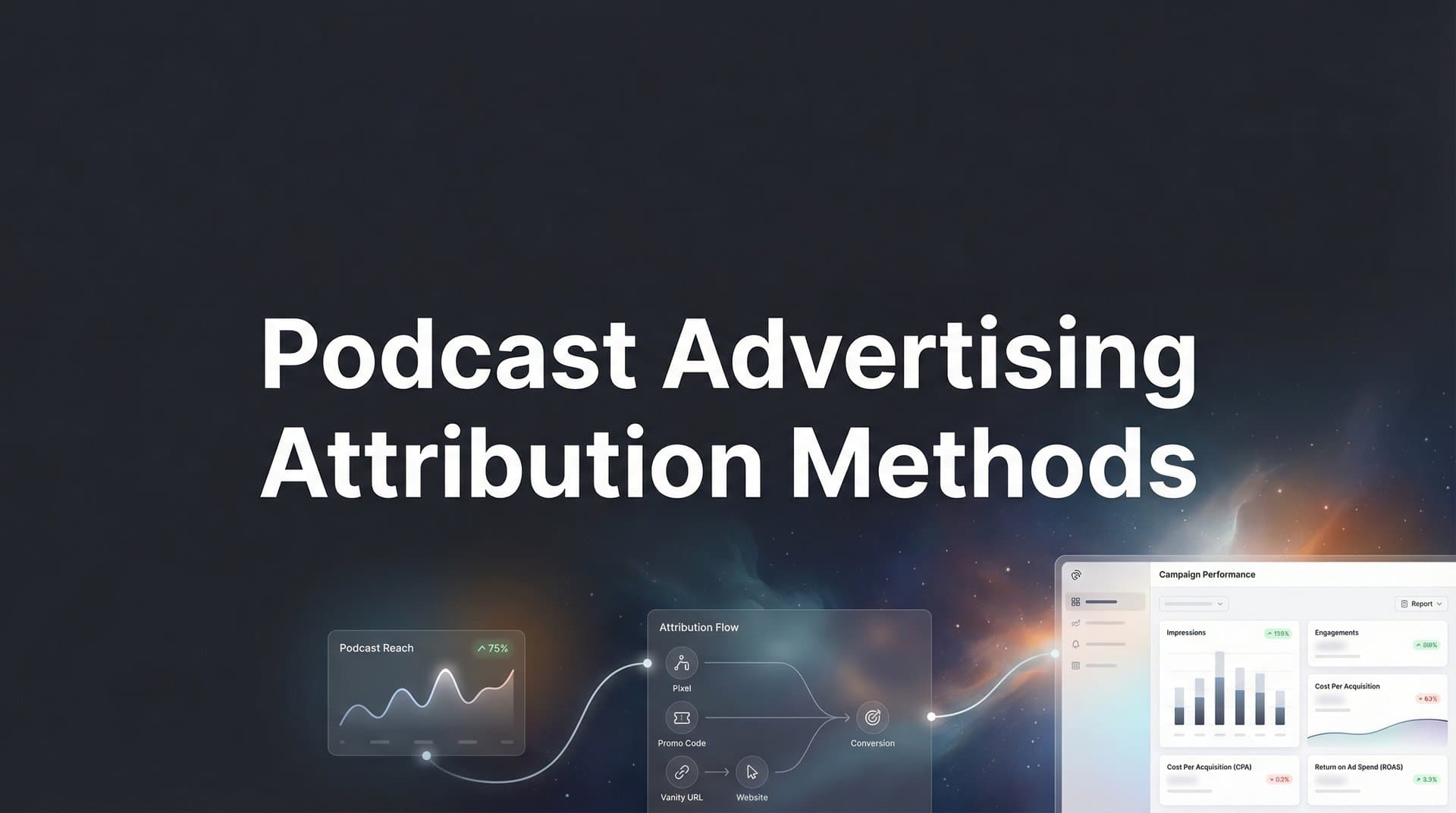
Promo codes are the most straightforward podcast attribution method. The host mentions a unique discount code during the ad read—"Use code PODCAST20 for 20% off"—and you track how many people redeem it. Simple, trackable, and directly tied to the podcast placement.
The appeal is obvious. Every time someone uses that code, you know exactly which podcast drove the conversion. You can calculate cost per acquisition, compare performance across different shows, and make budget decisions based on hard numbers. It's attribution you can see in your e-commerce dashboard.
But here's the limitation: promo codes only capture listeners who both remember the code and are motivated by the discount. Many listeners will hear your ad, visit your site, and purchase without using the code. Maybe they forgot it. Maybe they found a better discount elsewhere. Maybe they're not price-sensitive and didn't care about the offer.
This means promo codes systematically undercount podcast attribution. They're measuring a subset of conversions—the price-conscious listeners with good memory—not the full impact of your audio advertising. You're getting signal, but you're missing the bigger picture.
Vanity URLs work similarly. Instead of a promo code, you create a custom landing page: "Visit BrandName.com/PodcastName to learn more." When traffic hits that URL, you know it came from the podcast. It's clean, trackable, and doesn't require remembering a discount code.
The challenge with vanity URLs is that many listeners won't type them in exactly. They'll hear "BrandName.com/Podcast" and just Google your brand name instead. Or they'll go directly to your homepage. Or they'll search for your product category and find you through organic results. The vanity URL captures the most engaged listeners, but misses everyone who took a more indirect path.
There's also the direct traffic attribution problem. When someone types in a vanity URL, it shows up in analytics as direct traffic. But direct traffic is a messy category that includes people typing in your main domain, clicking bookmarks, or coming from sources that don't pass referrer data. Your podcast-specific URL gets lumped in with everything else, making it harder to isolate the true impact.
Despite these limitations, promo codes and vanity URLs still have their place. They work best for direct response campaigns where you're testing new shows and need quick feedback on whether listeners are converting. They're cost-effective—no special technology required—and easy to implement with any podcast host.
To maximize their effectiveness, make the codes memorable and the URLs simple. "PODCAST20" is better than "NEWLISTENER2026DISCOUNT." "BrandName.com/show" is better than "BrandName.com/podcast-attribution-tracking-campaign." The easier they are to remember and type, the more conversions you'll capture.
Think of these methods as your baseline measurement. They won't give you complete attribution, but they'll give you directional data. Use them to identify which shows are generating any trackable response, then layer in more sophisticated attribution tracking methods to capture the full picture.
Pixel-Based and Survey Attribution: Bridging the Audio-Digital Gap
Pixel-based attribution represents a significant leap forward in podcast measurement. Instead of relying on listeners to remember codes or type URLs, it uses technology to match podcast listeners to website visitors automatically. This happens through device fingerprinting and IP matching—connecting the device that streamed the podcast to the device that later visited your site.
Here's how it works in practice. A podcast listener streams an episode through their phone while commuting. The podcast hosting platform or attribution technology partner captures signals about that device: IP address, device ID, and other technical identifiers. Later, when that same person visits your website—whether on their phone or computer—the attribution platform matches those signals and connects the website visit back to the podcast exposure.
The advantage is clear: you're measuring actual exposure-to-conversion paths without requiring any action from the listener. Someone can hear your ad, never use a promo code, never visit a vanity URL, and you'll still capture their conversion if they visit your site within the attribution window.
This method reveals conversions that traditional tracking misses entirely. The listener who heard your ad, Googled your brand name two days later, and purchased? Captured. The person who heard the ad, discussed it with their partner, and bought a week later? If they visit your site within the tracking window, you'll see it.
The tradeoff is accuracy and privacy considerations. Device matching isn't perfect—people use multiple devices, clear cookies, use VPNs, and engage in behaviors that break the connection between podcast listener and website visitor. The match rates vary, typically capturing a portion of the true audience rather than everyone who heard the ad.
There are also implementation costs. Pixel-based attribution requires partnerships with podcast hosting platforms or third-party attribution providers. You'll need to integrate their tracking technology with your website and podcast placements. It's more complex than generating a promo code, and it comes with monthly platform fees. Evaluating digital marketing attribution software options can help you find the right solution for your needs.
Post-purchase surveys take a completely different approach: just ask customers how they found you. After someone completes a purchase, present a simple question: "How did you hear about us?" Include "Podcast" as an option, and let customers self-report their discovery source.
The beauty of surveys is their simplicity. No complex tracking technology required. No device matching algorithms. Just direct feedback from the people who actually converted. Surveys capture conversions that every other method misses—the listener who heard your ad weeks ago, the person who discussed it with friends, the customer who can't remember the specific podcast but knows it was audio content.
Surveys also provide qualitative context. You can ask which podcast they heard, what message resonated, and how long ago they first encountered your brand. This gives you insights beyond just attribution numbers—you're learning about the customer journey and message effectiveness. Implementing post purchase attribution analysis methods can significantly improve your understanding of what's driving conversions.
The limitation is response rates and accuracy. Not everyone completes post-purchase surveys. Those who do might not remember exactly where they heard about you, or they might attribute their discovery to the last touchpoint rather than the first. Survey data is directional rather than precise, useful for understanding trends but not for calculating exact ROI.
The most sophisticated approach combines both methods. Use pixel-based attribution to capture the technical signal and survey attribution to fill in the gaps. When the pixel data and survey responses align, you have high confidence. When they diverge, you learn something about the limitations of each method and can adjust your measurement framework accordingly.
Multi-Touch Attribution: Seeing Podcasts in Your Full Marketing Picture
Single-touch attribution models—whether first-click, last-click, or promo code redemption—fundamentally misrepresent how podcast advertising works. They force you to credit one touchpoint for the entire conversion, ignoring the reality that customers interact with your brand multiple times before purchasing.
Think about the typical customer journey. Someone hears your podcast ad during their morning routine. Later that day, they see your social media ad. That weekend, they Google your brand and read reviews. A week later, they search for your product category, click your search ad, and finally convert. Which channel "gets credit" for that sale?
In a last-click model, the search ad gets all the credit. The podcast ad that started the journey? Invisible. In a first-click model, the podcast gets all the credit, even though the customer needed multiple touchpoints to convert. Neither approach reflects reality. Both lead to poor budget decisions.
This is where multi-touch attribution models change the game. Instead of giving 100% credit to one touchpoint, they distribute credit across all the interactions that influenced the conversion. The podcast ad that created awareness gets credit. The social ad that reinforced the message gets credit. The search ad that captured intent gets credit. You see the full picture. Exploring multi-touch marketing attribution software can help you implement this approach effectively.
For podcast advertising specifically, multi-touch attribution solves the "invisible impact" problem. Podcasts often play an upper-funnel role—creating awareness and consideration rather than driving immediate conversions. In single-touch models, this contribution disappears. In multi-touch models, you can see how podcast exposure influences the entire customer journey, even if the final conversion happens through a different channel.
The implementation challenge is connecting podcast exposure data with all your other marketing touchpoints. This requires integrating podcast attribution signals—whether from pixel-based tracking, promo codes, or surveys—into a unified attribution platform that also tracks your paid social, search, display, email, and other channels.
You need to connect this data to actual conversion events. When someone purchases, subscribes, or completes whatever action you're measuring, the attribution system needs to look backward through their entire interaction history and identify all the touchpoints that contributed. This includes that podcast episode they listened to two weeks ago.
Different multi-touch models distribute credit differently. Linear attribution gives equal weight to every touchpoint. Time-decay models give more credit to recent interactions. Position-based models emphasize the first and last touchpoints. Understanding the comparison of attribution models for marketers helps you choose the right approach for your business.
What matters most is consistency. Choose an attribution model, apply it across all channels including podcasts, and use it to guide budget decisions. The goal isn't perfect precision—that's impossible—but rather a consistent framework for comparing channel performance and allocating spend.
This approach reveals insights you can't see any other way. You might discover that podcast ads don't drive many last-click conversions but significantly increase conversion rates for people who later see your social ads. Or that certain podcasts generate awareness that leads to branded search traffic weeks later. These patterns only emerge when you're tracking the full customer journey.
The technical requirements are real. You need an attribution platform that can ingest data from multiple sources, match users across touchpoints, and apply attribution models to conversion events. You need to connect your ad platforms, website analytics, CRM, and podcast attribution data into one system. This is where marketing attribution platforms become essential for revenue tracking.
Choosing the Right Attribution Method for Your Campaign Goals
Not every podcast campaign needs the same level of attribution sophistication. The right measurement approach depends on your campaign objectives, budget, and how much precision you need to make confident decisions.
For brand awareness campaigns, you might not need conversion-level attribution at all. If your goal is reaching new audiences and building brand recognition, you can measure success through brand lift studies, survey responses, and increases in branded search volume. Promo code redemption rates become less important when you're optimizing for reach rather than immediate sales.
Direct response campaigns demand tighter measurement. When you're running performance-focused podcast ads with clear conversion goals, you need attribution methods that connect audio exposure to actual purchases. This is where pixel-based tracking and multi-touch attribution become worth the investment—you're making budget decisions based on ROI, and you need accurate data.
Budget considerations matter significantly. Promo codes and vanity URLs cost almost nothing to implement. Pixel-based attribution platforms typically charge monthly fees based on traffic volume and tracking complexity. Multi-touch attribution solutions can represent substantial platform investments. Match your attribution spend to your advertising budget—spending thousands monthly on attribution for a five-thousand-dollar podcast budget doesn't make sense. Reviewing marketing attribution software features can help you find the right balance of capability and cost.
There's an accuracy spectrum to consider. Promo codes give you precise data about a small subset of conversions. Surveys give you directional data about a broader set of conversions. Pixel-based tracking captures more conversions but with some technical uncertainty. Multi-touch attribution provides the most complete picture but requires the most complex implementation.
The smartest approach for most marketers is building a measurement framework that combines multiple methods. Start with the basics—promo codes or vanity URLs—to establish baseline tracking. Add post-purchase surveys to capture what the basic methods miss. As your podcast advertising scales, invest in pixel-based attribution to automate measurement. Eventually, integrate everything into a multi-touch attribution model that shows podcasts alongside all your other channels.
This layered approach gives you confidence in your data. When multiple attribution methods point in the same direction—this podcast show drives conversions, that one doesn't—you can make decisions with certainty. When methods diverge, you learn about measurement gaps and can adjust your framework.
Consider your decision-making needs too. If you're testing podcast advertising for the first time and just need to know "does this work at all," simple promo code tracking might be sufficient. If you're optimizing a mature podcast strategy and making weekly budget allocation decisions, you need more sophisticated attribution that updates in near-real-time.
The goal isn't perfect attribution—that's impossible in a world of delayed responses, cross-device behavior, and passive audio consumption. The goal is having enough measurement confidence to make better decisions than you could with no attribution at all. Even directional data that shows "these three podcasts drive conversions while these two don't" enables smarter budget allocation. Understanding the right marketing attribution metrics to track is crucial for this process.
Putting It All Together
No single podcast attribution method will give you perfect visibility into how audio advertising influences your customer journey. Promo codes undercount conversions. Vanity URLs miss indirect traffic. Pixel-based tracking has match rate limitations. Surveys rely on customer memory. Each method has blind spots.
But here's what changes everything: you don't need perfect attribution to make better marketing decisions. You need enough signal to understand which podcast placements are working, which audiences are responding, and how audio touchpoints fit into your broader marketing mix. That's achievable when you combine attribution methods intelligently.
The marketers winning with podcast advertising aren't the ones with flawless measurement. They're the ones who've built attribution frameworks that connect audio touchpoints to their complete customer journey. They see podcast exposure alongside social ads, search campaigns, and email nurture sequences. They understand how each channel influences the others and allocate budget accordingly. Implementing cross channel attribution is key to understanding marketing ROI across all touchpoints.
This unified view is what transforms podcast advertising from a measurement black box into a trackable, optimizable channel. When you can see how podcast listeners move through your funnel, which shows drive the most valuable audiences, and how audio exposure affects conversion rates across other channels, you can confidently scale what's working.
The trend is clear: attribution is moving toward integration. The future isn't about measuring podcast ads in isolation—it's about bringing podcast data into platforms that track every marketing touchpoint and connect them all to revenue outcomes. This gives you the full picture, not just fragments.
Start where you are. If you're running podcast ads today with no attribution, implement promo codes tomorrow. If you're using promo codes, add post-purchase surveys next month. If you're doing both, explore pixel-based attribution solutions. Each step forward gives you more clarity and better decision-making capability.
The goal is building confidence in your podcast advertising investments. When you can demonstrate that specific shows drive conversions, justify budget increases, and optimize your creative based on what's working, podcast advertising stops feeling like a black box and starts feeling like a strategic advantage.
Ready to elevate your marketing game with precision and confidence? Discover how Cometly's AI-driven recommendations can transform your ad strategy—Get your free demo today and start capturing every touchpoint to maximize your conversions.